When Should You Start Preparing for IGCSEs?
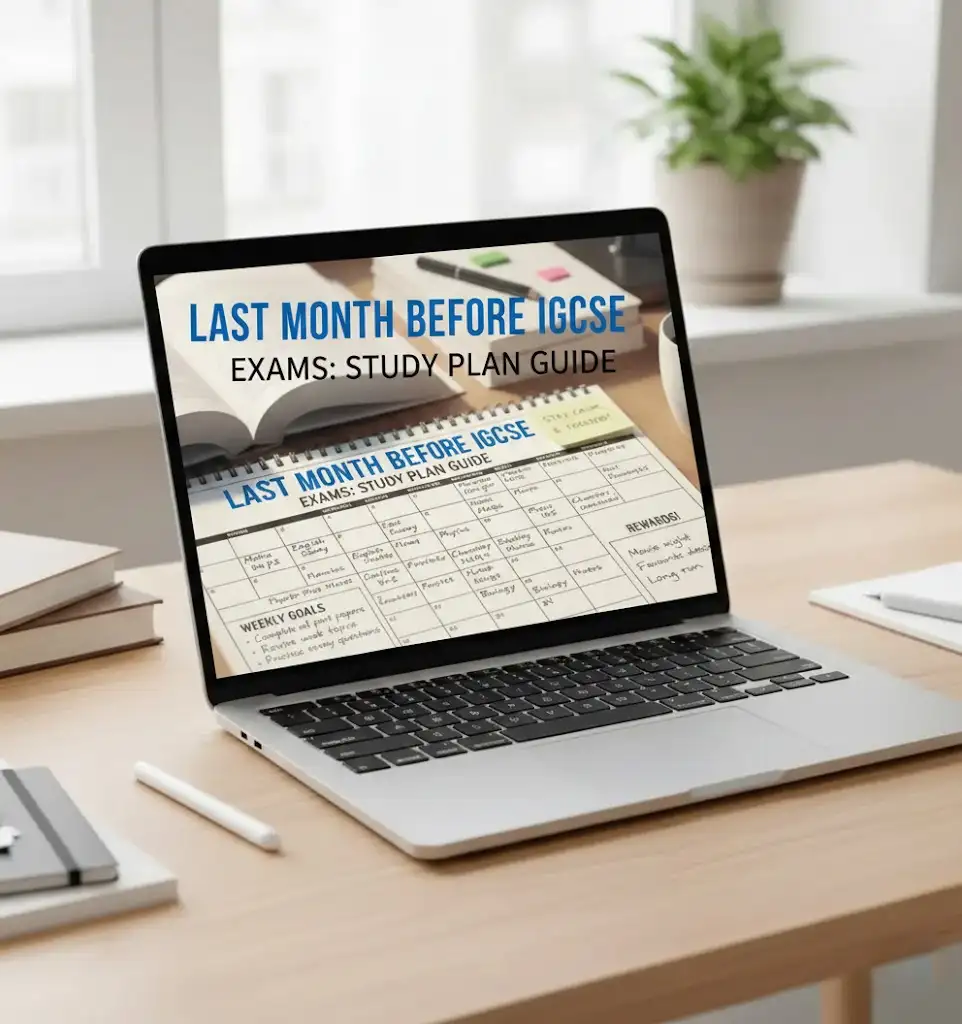
The earlier you begin your preparation process, the better. Ideally, you will start building understanding in Year 10, but focused revision should begin around six to four months before your exams.
Early preparation divides the load of work, reduces stress, and helps you memorise subject content more effectively. It also gives you time to specify and resolve any gaps in your learning before the day of the exam. Below is the step-by-step plan for preparing for your IGCSE exams.
Understand Your Syllabus
One of the biggest mistakes students make is revising without knowing exactly what is on the exam. Your IGCSE syllabus is your revision roadmap. Here are some steps you can take to get to know your syllabus in detail and start organising your revision:
- Download the specification for your subject. You can find these online. Make sure you have the correct exam board and paper. If you are not sure, check with your school teacher or online tutors at Mixt Academy.
- The specification sets out all the topics and content you could be tested on in your exams. If you know everything about your specification, you will be very well prepared for your exam.
- Using the specification and any lists from your teachers/school, create a checklist of all topics you need to know. If a topic is particularly long, break it down into smaller subtopics.
- As you revise, keep a record of each topic you have revised. You may need to revise more challenging topics more than once, so make sure to record this progress.
- Review past papers and mark schemes to get to know your assessment objects. These will tell you exactly what examiners are looking for and how you can achieve maximum marks for each type of question.
Click on the following link to access the recent a complete list of past papers for IGCSE or any curriculum.
Build a Realistic IGCSE Revision Timetable
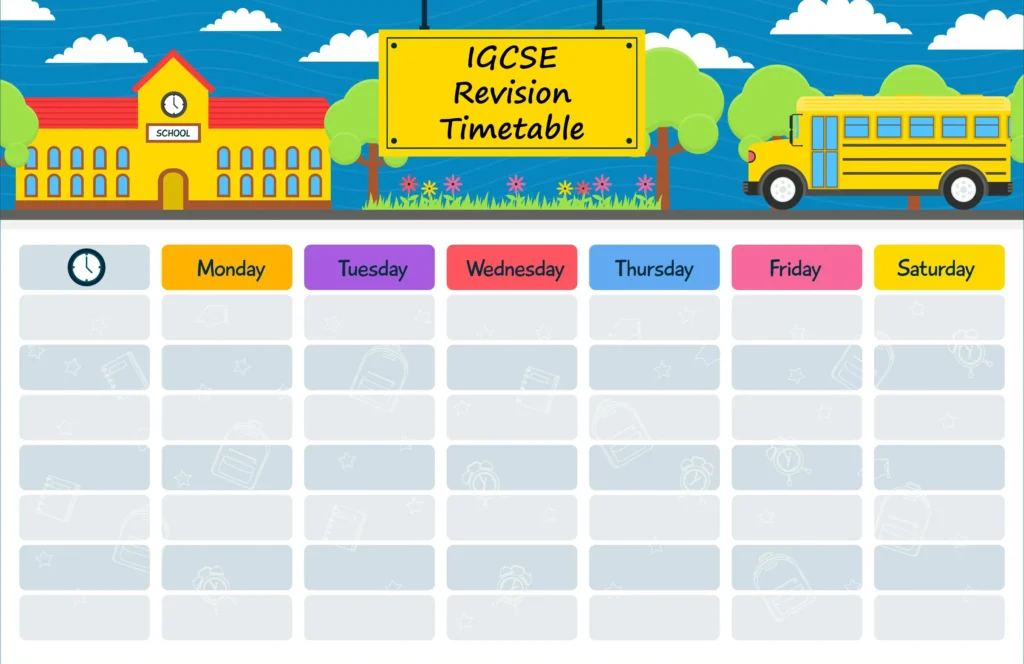
As you will likely be revising for multiple IGCSE subjects, it is essential to be realistic about how much time you have to spend revising each one and to organise your time.
- When creating your timetable, it can be helpful to break up your day into blocks, including breaks. For example, 45-minute study sessions with 15-minute breaks between or the Pomodoro Technique with 25 minutes of study and 5-minute breaks between.
- You could also colour-code your timetable to help you keep track of your subjects and revision blocks.
- Having a 1-day break per week can also give you time to relax and rest.
- When deciding what to revise when, it is best to be as specific as you can. For example, instead of just putting ‘Maths’ on your timetable, it is best to include the specific topic you are going to revise in that block, like ‘Maths: Quadratic Equations’.
- It is advisable to spend the most time revising the subjects you feel the least confident in and your core subjects English tutoring and Maths tutoring in Dubai. Make sure to schedule time to cover all your subjects.
Tools That Help
Looking for tools to help you create a revision timetable and track your progress? Here are some useful tools for helping you schedule your revision blocks:
- Calendar apps: Google Calendar, Apple Calendar, Microsoft Calendar
- Timetables and task tracking: Canva, Notion, My Revision Planner
- Revision resources and checklists: Mixt Academy, Exam specifications, etc
Use Active Study Techniques
Active revision techniques are more effective in helping you learn, memorise, and effectively recall important information and concepts. In contrast, passive revision, when you just read and highlight text or copy notes from a textbook, can feel productive but usually does not help much with memorising or consolidating information.
Active Recall
Active recall is when you revise information through testing your knowledge. This can be done through a range of methods, including:
- Flashcards
- Online, oral or written quizzes
- Redrawing mind maps or writing out bullet points from memory
- Blurting (when you revise a topic and then, without using your notes, write down everything you remember about it)
- Teaching the topic to someone else and having them ask you questions about it
These techniques are particularly useful for learning new vocabulary and definitions, short facts, statistics and equations and real-world examples.
Spaced Repetition
Reviewing information at increasing intervals over time (e.g., 1 day, 3 days, 7 days) can help you space out your revision sessions so content stays in your long-term memory.
Past Paper Practice
Past papers are another great way to revise. You can test your knowledge of topics by completing individual questions and using the mark scheme to check your answers are correct and meet the exam criteria. To improve your time-management skills and exam technique, it is best to complete questions under timed conditions.
Tailor Your Strategy by IGCSE Subject Type
Science and Maths
These subjects demand memorisation and regular practice. Focus on understanding key formulas, definitions, and processes using flashcards, mindmaps, graphs, or flowcharts. Upon covering the content, practice solving a wide range of problems. Use past papers to build confidence, and time yourself to improve speed and accuracy under exam conditions.
English and Humanities
In these subjects, start by closely reading and annotating your core texts, such as essays or historical evidence. Make a collection of key quotes or case studies, and ensure you know how to use them effectively. To develop strong essay-writing skills, practise planning and structuring arguments. Use past paper questions and their answers to guide your approach. Then write your own essays regularly to build clarity and confidence.
Track Your Progress
Review and track your progress after every week or two. Check if you are meeting your goals? Are there any revision methods more effective than others? If something is not working, don’t panic to switch techniques. Mock exams are a great way to check your progress and get used to the format and pressure of real exams. Use your results to fine-tune your study strategy.
Look After Yourself
Exams can be stressful, so it is essential to take care of your physical and mental health. Make sure you are getting enough sleep, eating well, and exercising regularly. Taking proper breaks and spending time with friends or family can help prevent burnout. Mindfulness techniques like breathing exercises, meditation, or journaling can also be great tools to manage stress during revision periods.
Does online tutoring improve grades?
Improving your child’s grades is a key reason why many families choose to start their tutoring journey. In fact, more than 95% of families chose Mixt Academy tutoring to achieve a grade or pass an exam. Luckily, tutoring has proven time and time again that it can significantly improve grades! The study, focused on online tutoring, found that:

- 3 in 4 students increase their exam performance by up to three grades with personalised tutoring.
- 92% of students who take at least 36 lessons report grade increases.
- 80% of maths students increase their grades by up to three levels after 12 months of consistent tutoring.
- The more lessons taken, the more likely students are to increase their grades by 2 and 3+ points.
Mixt Academy students are even more successful, with 90% of our students improving by at least one grade. In fact, a huge 98% of our students said their tutors positively impacted their exam results!
How does Mixt Academy help students improve grades?
Here are some of the key areas where expert online IGCSE tutors from Mixt Academy can help students to improve their exam grades.
Individual Attention
In school, your child will often be competing with 30 other students for their tutor’s attention. On the other hand, online tutoring will give your child one-on-one attention with an expert IGCSE tutor. In this way, tutoring is a fantastic way to accelerate your child’s learning and understanding, improving their performance both in the classroom and the exam room.
Customised Plans
An online IGCSE tutor will create lesson plans that are tailored to your child’s strengths, weaknesses and learning style. This means they can focus on the areas where your child needs it most, making the biggest impact in the smallest amount of time. It also means your child’s tutor can plan lessons that they know will hold your child’s attention.
Boost Confidence
Online tutoring for IGCSE is a fantastic way to improve your child’s confidence, as it gives them a safe space where they can make mistakes away from the eyes of their peers. Our IGCSE physics tutors are also experts in bringing your child out of their shell.
Each session is designed not just to further your child’s learning, but to give them courage in their own abilities, helping them to walk into the classroom and exam hall more confidently.
Increase Motivation
The right tutor for IGCSE can be the perfect cross between a teacher and a mentor. They are there to support your child through every step of the exam preparation process, which can look different for every student. An IGCSE tutor can hold them accountable and encourage them.
Offer Direction
Sometimes, your child might know that they need to improve their grades. But that does not mean that they know where to start. A tutor will be able to assess where your child is currently in their learning and identify areas where there is the most room for improvement, for instance, by going over your child’s mock exam results or setting practice tests.
Common Mistakes to Avoid
Here are some common mistakes that students must avoid when preparing for IGCSE exams.
- Start late: Begin your preparation process 3 to 4 months before IGCSE exams.
- Ignoring weak subjects: Avoiding difficult subjects instead of addressing them early.
- Irregular study plan: Avoid cramming without proper understanding. Be consistent instead of making irregular efforts.
- Neglecting past papers: Focusing only on the textbooks and avoiding exam practice using past papers.
- Poor time management: Not allocating enough time for lengthy subjects like History or Literature.
Bottom Line
Preparing for the IGCSE exam does not have to feel challenging. All you need is to start early preparation, use the latest revision techniques, and stay consistent. The key is progress, not perfection. With the right mindset and tools, you can walk into your exams feeling confident and in control. At Mixt Academy, our IGCSE tutors are all carefully chosen and have years of experience. So you can trust them with your child’s learning journey. In fact, we are so confident in the quality of our IGCSE biology tutors that we even offer a first lesson guarantee. What are you waiting for? Start your preparation journey toward excellent IGCSE grades with the right direction and expert support.