Hire the Best Online Tutors for Your Child
Definition of Mass and Weight
In simple words, Mass is the quantity of matter in an object. It is a scalar quantity, which means that it has magnitude only and has no direction like vector quantities.
Units: The SI unit of Mass is kilograms (kg)
On the other hand, Weight is the measure of the gravity acting on the object. Unlike mass, weight is a vector quantity as it has both magnitude and direction.
Units: The SI Unit of weight is Newton (N).
1 N = kilogram meter per second squared (kg⋅m/s²).
How to Calculate the Mass of the Object?
We can find out the mass of an object by using several equations. Which equation to use depends on the given information you have in each scenario.
1. From Density
Use the following formula when you have density and volume in the given data.
Mass = Density × Volume
Formula:
m = ρ × V
m = mass
ρ = density
V = volume
2. From Force and Acceleration
By using Newton’s second law
Mass = Force ÷ Acceleration
Formula:
m = F/a
(F) = force
(a) = acceleration
3. From Weight
Mass from weight can be found using the following formula.
Mass = Weight ÷ Gravitational acceleration
Formula:
m = W/g
(W) = weight
g ≈ 9.8 m/s² on Earth
4. From Momentum
Useful when you have momentum and velocity in the given data.
Mass = Momentum ÷ Velocity
Formula:
m = p/v
(p) = momentum
(v) = velocity
5. From Kinetic Energy
The mass can be found out by Kinetic Energy by using the kinetic energy formula.
Mass = (2 × Kinetic Energy) ÷ Velocity²
Formula:
m = 2KE / v²
(KE) = kinetic energy
(v) = velocity
How to Calculate the Weight of the Object?
Like Mass, there are many equations through which we can find the weight of an object depending on the information provided.
The Main Equation
Weight = Mass × Gravitational acceleration
W = m × g
W = weight (newtons, N)
m = mass (kilograms, kg)
g = gravitational acceleration
Earth: 9.8 m/s²
Moon: 1.6 m/s²
From Newton’s Second Law
Weight = Force due to gravity
W = F = m × a
Since gravity causes the acceleration,
W = m × g
From Density
Weight = Density × Volume × g
W = ρ × V × g
ρ = density
V = volume
From Gravitational Field Strength
Weight = Mass × Gravitational field strength
W = m × G
G = gravitational field strength (N/kg)
From Universal Gravitation
Weight = Gravitational force between Earth and object
W = GMm/r²
G = universal gravitational constant
M = mass of Earth
m = mass of object
r = distance from Earth’s centre
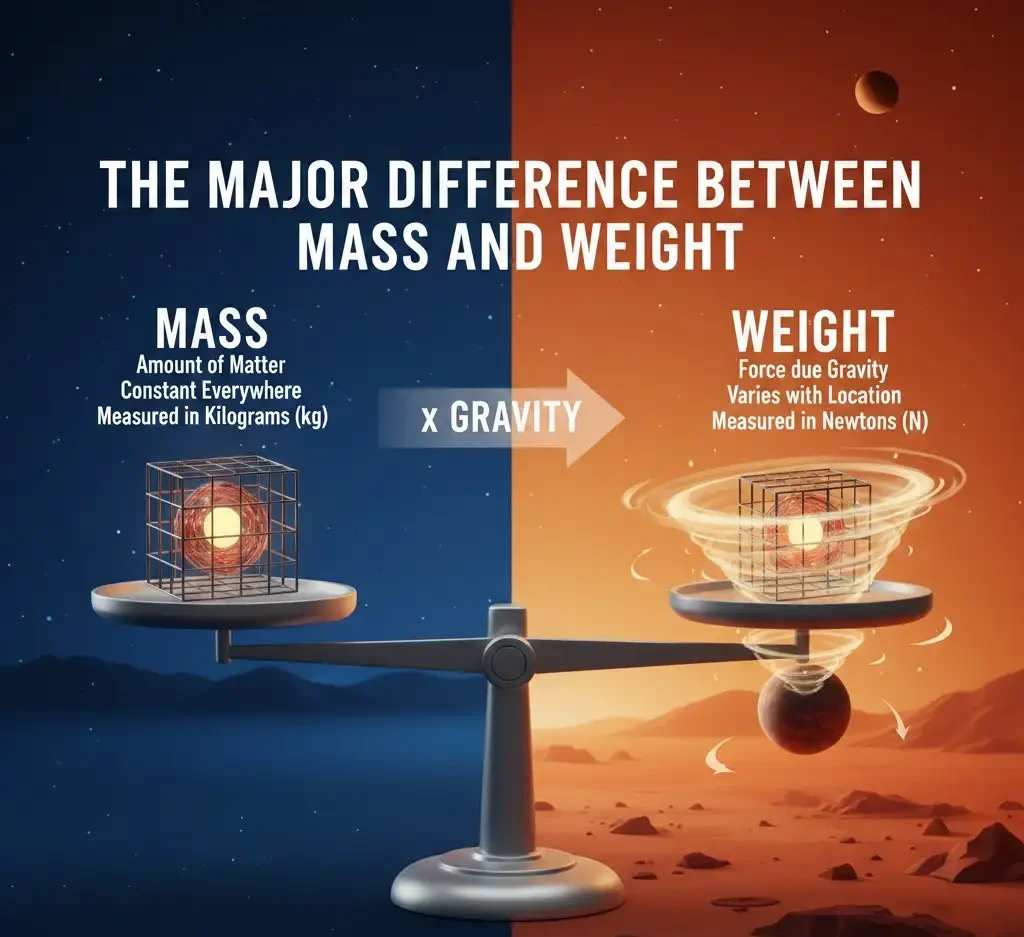
The Major Difference Between Mass and Weight in Physics
| Mass | Weight |
|---|---|
| Amount of matter in an object | Force of gravity acting on an object |
| Constant everywhere | Changes with location |
| Independent of gravity | Depends on gravity |
| Scalar quantity | Vector quantity |
| SI unit is the kilogram (kg) | SI unit is newton (N) |
| Measured using a beam balance | Measured using a spring balance |
| Same on Earth, Moon, and space | Different on Earth, Moon, and space |
| Never zero for a physical object | Can be zero in deep space |
| Used to measure inertia | Measures gravitational pull |
| Fundamental property of matter | Derived physical quantity |
| Symbol: m | Symbol: W |
| Related to density and volume | Related to mass and gravity |
| Does not cause motion by itself | Can cause objects to fall |
| Measured in everyday life for quantity | Felt as “heaviness” |
| Used in chemistry and atomic science | Used in mechanics and forces |
Mixt Academy helps students master physics concepts with clarity and confidence.
How to Measure Mass and Weight?
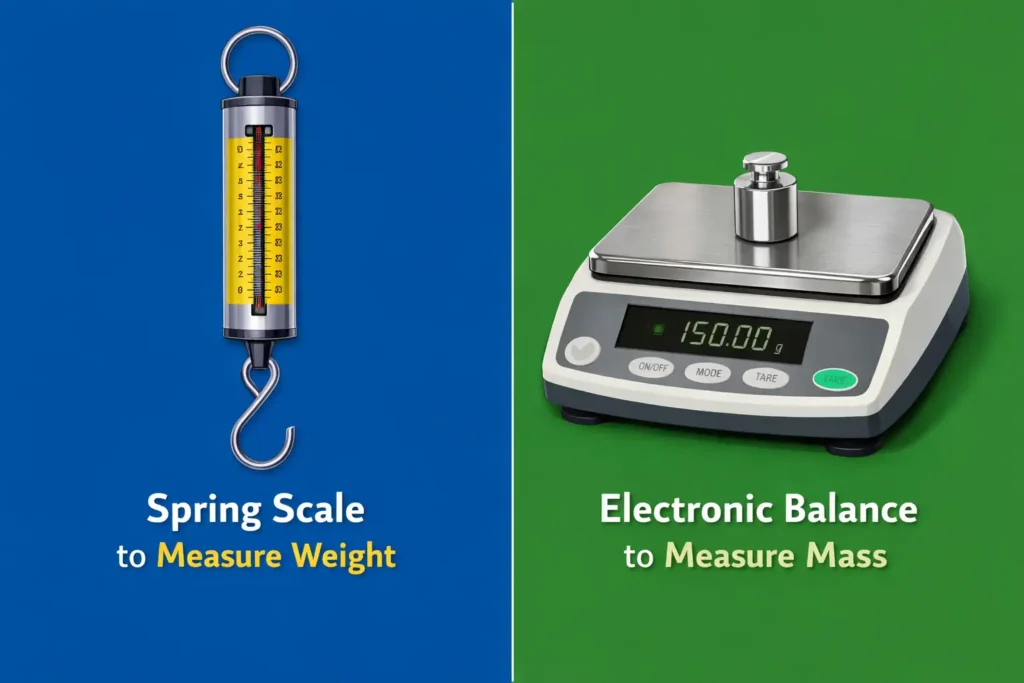
Weight can be measured by using a Force meter, also called a spring scale. Here’s how it works: A spring scale has a hook, and the object needs to hang on this hook to check the object’s weight. On the other hand, mass can be measured by using an electronic balance. You just need to reset towards zero and then place the object over to check the mass of an object.
Difference Between Mass and Weight With Example
The following is the difference between the mass and weight of a body on the Moon vs Sun:
Mass is the amount of matter in a body; therefore, whether you are on Earth or the moon, if an object’s mass is 50 kg, it will remain the same regardless of your location. However, the weight is the force of gravity on the object, so the weight of the same object will vary on two planets. Why? because gravity changes. Standard values of gravity for the Moon and Earth are given below:
Moon: g ≈ 1.62 m/s²
Earth: g ≈ 9.80665 m/s²
Suppose you have the mass of an object that is 50 kg.
On the Moon
Using W = m × g
W = 50 × 1.62
W = 81N
On the Earth
W = 50 × 9.80665
W = 490N
Solved Numericals
Let’s solve some questions to have a better understanding of how to find mass and weight in physics.
Question#1: An object has a mass of 10 kg. Find its weight on Earth. g = 9.8 m/s²
Solution:
W = m × g
W = 10 × 9.8 = 98N
Answer: Weight = 98 N
Question#2: An object has a weight of 196 N on Earth. Find its mass. g = 9.8 m/s²
Solution:
m = W/g
m = 196 / 9.8
m = 20kg
Answer: Mass = 20 kg
Question#3: An object has a mass of 30 kg. Find its weight on the Moon. Gravity on the Moon is 1.62 m/s²
Solution:
W = 30 × 1.62 = 48.6N
Answer: Weight on Moon = 48.6 N
Question#4: Jupiter has a gravitational acceleration of 24.8 m/s². What would a 2 kg laptop weigh on Jupiter?
Solution:
Given g = 24.8 m/s²
m = 2 kg
W = m × g
W = 2 × 24.8
W = 49.6 N
Hire the Best Online Tutors for Your Child
Mass & Weight Solved MCQs
1. Which of the following quantities remains the same on Earth, Moon, and Sun?
A. Weight
B. Force
C. Mass
D. Acceleration
Correct Answer: C. Mass
2. The SI unit of weight is:
A. kilogram (kg)
B. gram (g)
C. Newton (N)
D. meter (m)
Correct Answer: C. newton (N)
3. The SI unit of mass is:
A. newton
B. kilogram
C. meter
D. second
Correct Answer: B. kilogram
4. An object has a mass of 10 kg. What is its weight on Earth?
A. 9.8 N
B. 19.6 N
C. 98 N
D. 980 N
Correct Answer: C. 98 N
5. If the mass of a body is doubled, its weight will:
A. remain the same
B. become half
C. become double
D. become zero
Correct Answer: C. become double
Myths and Facts about Mass and Weight
The following are some common myths about mass and weight.
Myth#1: Mass and weight are the same thing.
Fact: Mass and weight are different physical quantities.
Explanation: Mass is the amount of matter in an object; however, weight is the force of gravity acting on that object. It means mass will remain the same anywhere, but weight will vary because of a change in gravity. If a boy is standing on the roof of his house, and if he stands at the top of the mountain, the mass will remain the same in both places, but the weight will vary as these two places have different gravitational forces.
Myth#2: If your weight changes, your mass also changes.
Fact: A change of weight does not mean a change of mass.
Explanation: The weight of a body depends on the force of gravity acting on it. If a person goes from Earth to the Moon, their weight decreases because gravity is smaller, but their mass will remain the same.
Myth#3: Objects with more mass always weigh more
Fact: Objects with more mass weigh more only if gravity is the same.
Explanation: Weight is calculated using the formula:
Weight = Mass × Gravity
An object with more mass will have more weight only if the gravitational field is constant. If gravity changes, a lighter object in strong gravity may weigh more than a heavier object in weak gravity.
Myth#4: Weight exists even without gravity.
Fact: Weight doesn’t exist without gravity.
Explanation: Weight is a force caused by gravity. In space, the gravitational effects are extremely low, which is why astronauts in space feel weightless, but they still have mass. Thats why weight depends on the force of gravity acting on an object, while mass does not depend on anything.
Myth#5: Heavier objects fall faster than lighter objects.
Fact: All objects fall at the same rate in the absence of air resistance, regardless of their mass.
Explanation: When an object falls freely under gravity, its acceleration depends only on the gravitational field, not on its mass. In a vacuum, where air resistance is absent, a heavy object and a light object reach the ground at the same time. The famous Moon experiment showed a hammer and a feather falling together. On Earth, lighter objects fall more slowly only because of air resistance, not because they have less mass.
Achieve Higher Grades with Mixt Academy
Physics concepts often look scary, and a lack of understanding can affect your grades. Learn from basics to complex topics with Mixt Academy, where you find
- Certified and Expert Tutors
- 1-on-1 Sessions
- Flexible Timings
- Personalized Tutoring
And the amazing part? You can start with our “Free Trial”. Mixt Academy is providing personalised tutors for all, whether you need help for IGCSE, GCSE, AS or A level. Mixt Academy can get all your academic queries resolved in no time.
Mass vs Weight Explained
Mass and weight may seem similar in everyday language, but in physics, they represent two very different concepts. Mass is the amount of matter in an object and remains constant everywhere, while weight is the force of gravity acting on that mass and changes with location.
Understanding these small differences helps students avoid common misconceptions, solve numerical problems correctly, and apply physics concepts confidently to real-world situations. By mastering the definitions, formulas, examples, myths, and FAQs covered in this guide, learners can build a strong foundation in science and clearly differentiate between mass and weight in both theory and practice.