
Understand the A Level Physics Assessment Structure
Wondering how many exam papers you’ll actually sit for? Here’s our quick breakdown: How many A Level Physics papers are there? For Edexcel A Level Physics, AQA, and OCR, students will have three written exams. CIE, on the other hand, has a different structure of exams. You will take three papers at AS level and two more to complete A Level.
In the exams, you will encounter various types of questions. Among them are multiple-choice questions (which may be more difficult than they look), short-answer questions like definitions, and longer questions where you need to express your thoughts clearly. Some long questions are more written ones, while others demand calculations or a mixture of both.
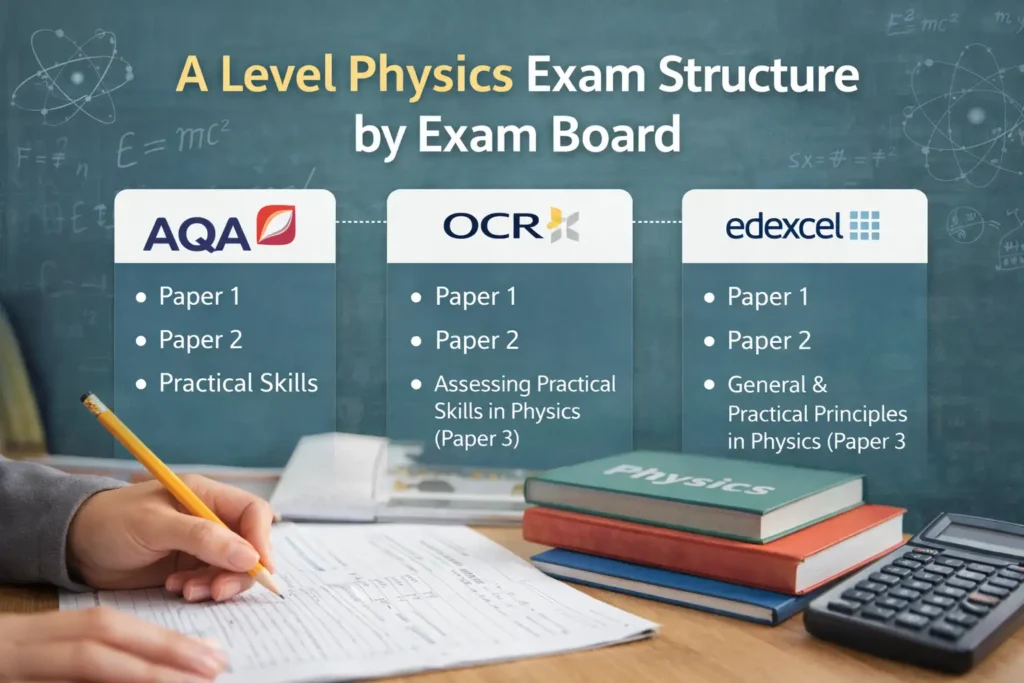
A Level Physics Exam Structure by Exam Board
AQA A Level Physics and Edexcel
- Papers 1 and 2 assess a wide range of topics using a combination of multiple-choice, short-answer, and longer explanation or calculation questions.
- Paper 3 focuses on the required practicals, testing your understanding of experimental methods, data analysis, and practical skills.
OCR
- Paper 1 includes multiple-choice, short-answer, and long-answer questions across different topics, including questions linked to the required practicals.
- Papers 2 and 3 follow a similar format but do not include multiple-choice questions, placing more emphasis on written responses and calculations.
CIE (Cambridge International)
- Paper 1 is multiple-choice only and covers the AS-level content.
- Paper 2 includes AS-level short and long answer questions on various topics.
- Paper 3 is the AS practical paper, assessing hands-on experimental skills.
- Paper 4 tests A Level content through short and long answer questions.
- Paper 5 focuses on planning, analysis, and evaluation, assessing how well you understand experimental design and data interpretation.
Let’s Guide the Physics A Level Specification Revision
Your physics A-Level specification should be the starting point for all your revision. It clearly outlines every topic and sub-topic you could be tested on, as well as which exam papers they appear in.
Use the specification to plan your revision and monitor how far you’ve progressed. Turning it into a checklist can be especially helpful—mark off each topic once you feel confident with it.
Try revising linked topics together, such as forces and motion or gravitational and electric fields, to build a stronger understanding. Finally, focus more time on areas that are worth higher marks or show up often in past exam questions.
How to Revise A Level Physics in 2026? Clear & Achievable Sections
A Level Physics includes a large amount of content, which can feel challenging if you try to revise it all at once. Splitting the A Level Physics syllabus into smaller, clearly defined topics makes revision easier to manage and helps you stay focused.
Begin with core areas such as mechanics, electricity, and waves. Each of these topics is made up of smaller sections that you can study one by one and mark off as you go. It’s best to concentrate on one topic at a time, even if it feels difficult, to build confidence and avoid confusion.
For each topic, use a simple three-step method:
- Develop a strong understanding of the key ideas and how they link together.
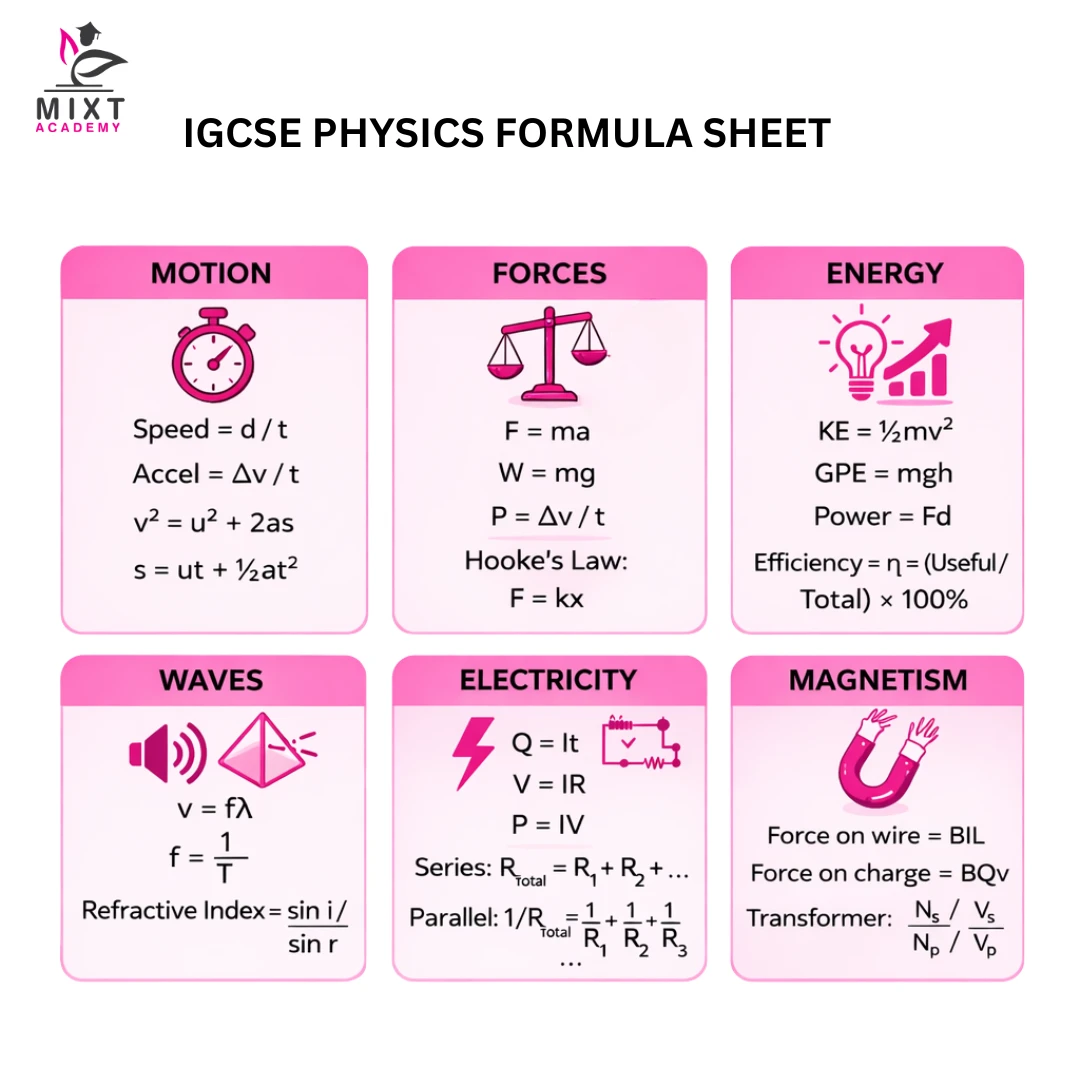
- Learn the essential formulas and know when and how to use them.
- Practise exam-style questions to apply your knowledge and improve your exam technique.
Focus on Understanding Before Memorising
At A Level, Physics still involves memorising formulas and definitions, but it’s much easier to remember them if you truly understand the concepts behind them. Memorising without understanding often leads to mistakes, especially when the same symbol can mean different things in different contexts.
For example, in the ideal gas law , p represents pressure, while in the momentum formula , p represents momentum. Understanding the meaning behind each formula helps you see how both relate to force, even though they describe different physical ideas.
When learning a new topic, start with the core concepts. Ask yourself questions: What is a gravitational field, and how does it work? Why does a bulb light up in a circuit? How do waves interfere? Try explaining the answers to someone else—if you can’t, there are gaps in your understanding that need revisiting.
Visual tools can make abstract ideas easier to grasp. Draw force diagrams, sketch electric field lines, or plot motion and energy graphs.
Practise Physics Calculations Often
Calculations make up a significant part of A Level Physics—roughly 40% of your marks—so being confident with maths is essential. You’ll need to rearrange A Level Physics equations/formulas. Work with powers, roots, and logarithms, and apply trigonometry in real physics problems.
But physics calculations are more than just maths. You might rearrange an equation perfectly, but if you choose the wrong formula, you won’t earn any marks. The key skill is understanding the question and identifying which formula to use. For example, if a question asks for the speed of a wave on a string, you need to know whether to use or some other formula—it’s not just about plugging numbers in.
The only way to get really good at this is to practise regularly. Work through lots of past-paper questions, try problems of different types, and review your mistakes. Over time, recognising the right formula and method will become second nature.
Why Is A Level Physics So Challenging?
To understand exactly what A Level Physics involves, including topics, exam structure, and difficulty, check out our detailed guide: “What is A Level Physics? Exam Structure, Topics, Difficulty & Revision Tips”.
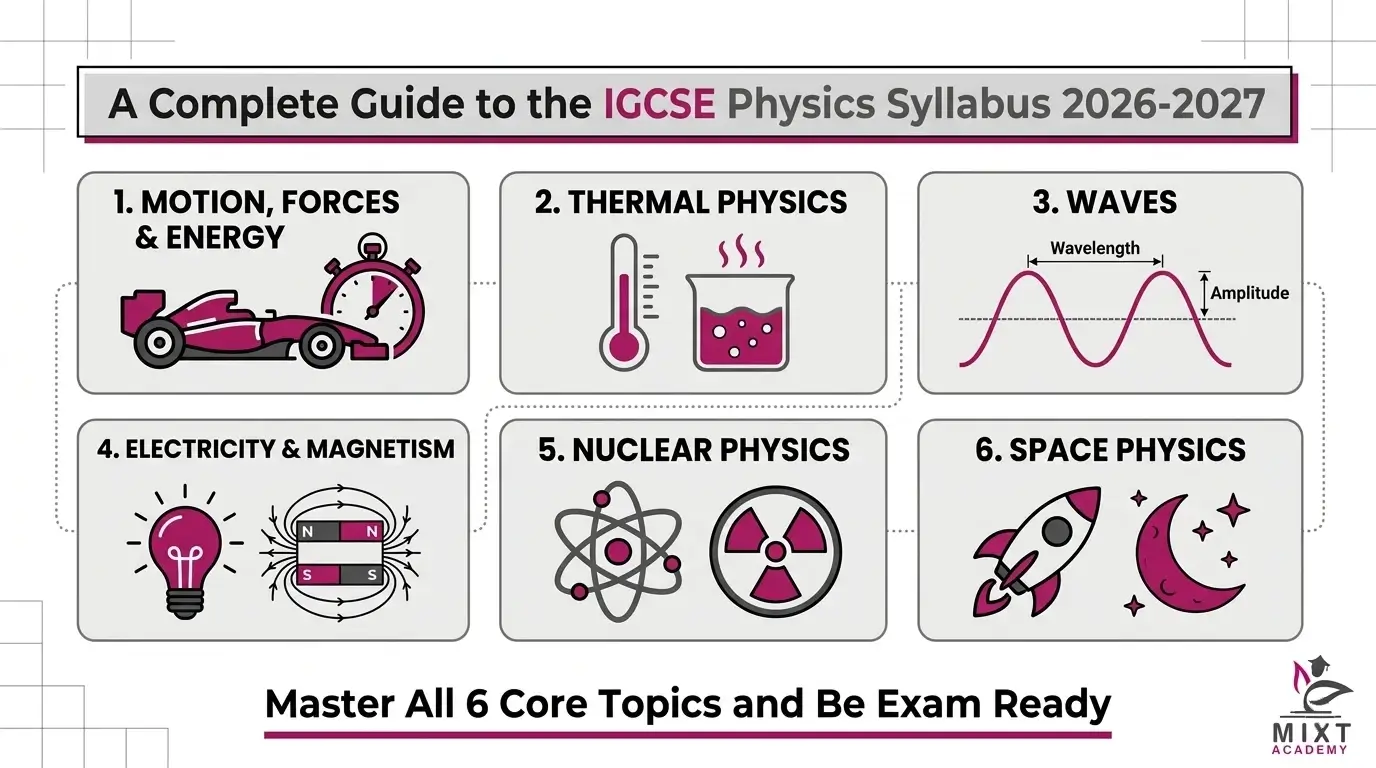
Firstly, the syllabus is broad. You study a wide range of topics such as mechanics, electricity, waves, thermal physics, and nuclear physics. Each area comes with its own formulas, theories, and problem-solving techniques.
Secondly, physics relies heavily on maths. You’re expected to rearrange equations, work with logarithms and trigonometry, and apply mathematical skills accurately within exam questions.
Lastly, many concepts are highly abstract. Ideas like quantum physics, electromagnetic induction, and particle physics are hard to visualise, making them more challenging to understand fully.
Confused About A Level Physics Papers?
Wondering, “Is A Level Physics hard?” Mixt Academy’s online professional tutors make complex topics easier to understand and guide you towards achieving top
Use Physics A Level Past Papers & Mark Schemes
Past papers are one of the best tools for revising A Level Physics because they give you a clear idea of the types of questions you’ll face in the exam. When you start, try older past papers without worrying about the time—focus on understanding the physics and solving the problems correctly. As the exams approach, switch to recent papers and time yourself. This helps you practice working under exam conditions and improves your time management.
Additionally, reviewing past papers can help you understand the A Level Physics grade boundaries, as it allows you to see what kinds of answers are needed to secure high marks. Always check your answers against the mark scheme. It helps you understand exactly what examiners are looking for in a top-scoring answer. By learning the marking style, you can shape your answers to earn the maximum marks.
Learn Smarter with Testing and Repetition
Simply reading your revision A Level Physics notes isn’t enough to remember everything for A Level Physics. To really lock in your knowledge, you need methods that actively challenge your memory, like self-testing and spaced revision.
Self-testing means quizzing yourself instead of just rereading notes. Use flashcards, try practice questions, or explain concepts out loud to check your understanding. Spaced revision is about revisiting topics regularly over time. Rather than cramming, go back to what you studied last week or last month—this makes your memory much stronger.
Another helpful trick is to mix different topics in a single revision session. This approach, called mixing topics, helps your brain link ideas and improves your ability to recall information during exams. Practising like this will make remembering formulas, definitions, and concepts much easier under pressure.
Get Confident with Practical Skills
Practical skills are a key part of your A Level Physics grade, so it’s essential to prepare for them carefully. Start by reviewing all the required practicals you’ve done during the course. Make sure you understand the methods, equipment, safety rules, and familiar sources of error for each experiment.
You should also be confident in handling experimental data—this includes recording results clearly, analysing data, drawing graphs, calculating errors, and evaluating your findings. It’s essential to understand concepts like accuracy vs precision and how they affect results.
Finally, think about how experiments could be improved. Common improvements include taking repeat readings, using more precise equipment, or changing the method to reduce errors. Practising these skills will help you tackle practical questions confidently in the exam.
Mixt Academy Smart Revision Plan
With a trusted online tutoring platform plan like this, your revision becomes organised, purposeful, and much more effective—helping you reach those A/A* grades in 2026.
Start Early & Pace Yourself
Physics takes time to understand fully, so begin serious revision at least 3–4 months before your exams. Spreading your study over several months helps concepts sink in and reduces stress.
Combine Learning with Practice
Spend part of your time revising key theories, formulas, and definitions, and the rest applying them through exam-style questions. A good split is roughly 40% learning, 60% practicing—this turns knowledge into skill.
Keep it Varied
Alternate between topics during a session and include short breaks or mini-sessions on other subjects to stay fresh. Mixing topics also helps your brain make connections between ideas.
Plan for Review
Don’t just study a topic once—come back to tricky areas multiple times. Revisiting topics strengthens your memory and builds confidence.
Set Realistic Daily Goals
Focus on completing small, achievable targets each day. It’s far better to make steady progress than to aim too high and get stressed.
Exam Day Strategy and Mindset
Revision is only part of the battle—performing well on exam day is just as important.
- Read Questions Carefully: Ensure you understand exactly what each question is asking. Many marks are lost simply because students answer the wrong part of the question.
- Show Your Working Clearly: Even if your final answer is incorrect, clear and logical working can earn you method marks.
- Manage Your Time Wisely: Don’t spend too long on small questions when bigger, higher-mark questions still need attention.
- Play to Your Strengths: If specific topics feel easier, tackle those questions first to build confidence and secure marks early.
- Stay Calm & Trust Yourself: Following a solid revision plan gives you the knowledge and skills you need—so focus, stay composed, and approach each question with confidence.