
Learning Arabic numerals from zero to ten is the easiest and most precious first step for anyone who wants to learn Arabic in the UAE. In day-to-day life, you will see two types of numbers.
This guide systematically clarifies both systems while providing pronunciation support and cultural examples from the UAE. It enables new learners in 2026 to be sure of their capability to understand and apply Arabic numerals in everyday situations.
Call +44 7577 325935 or book your session online by filling out the Mixt Academy form today.
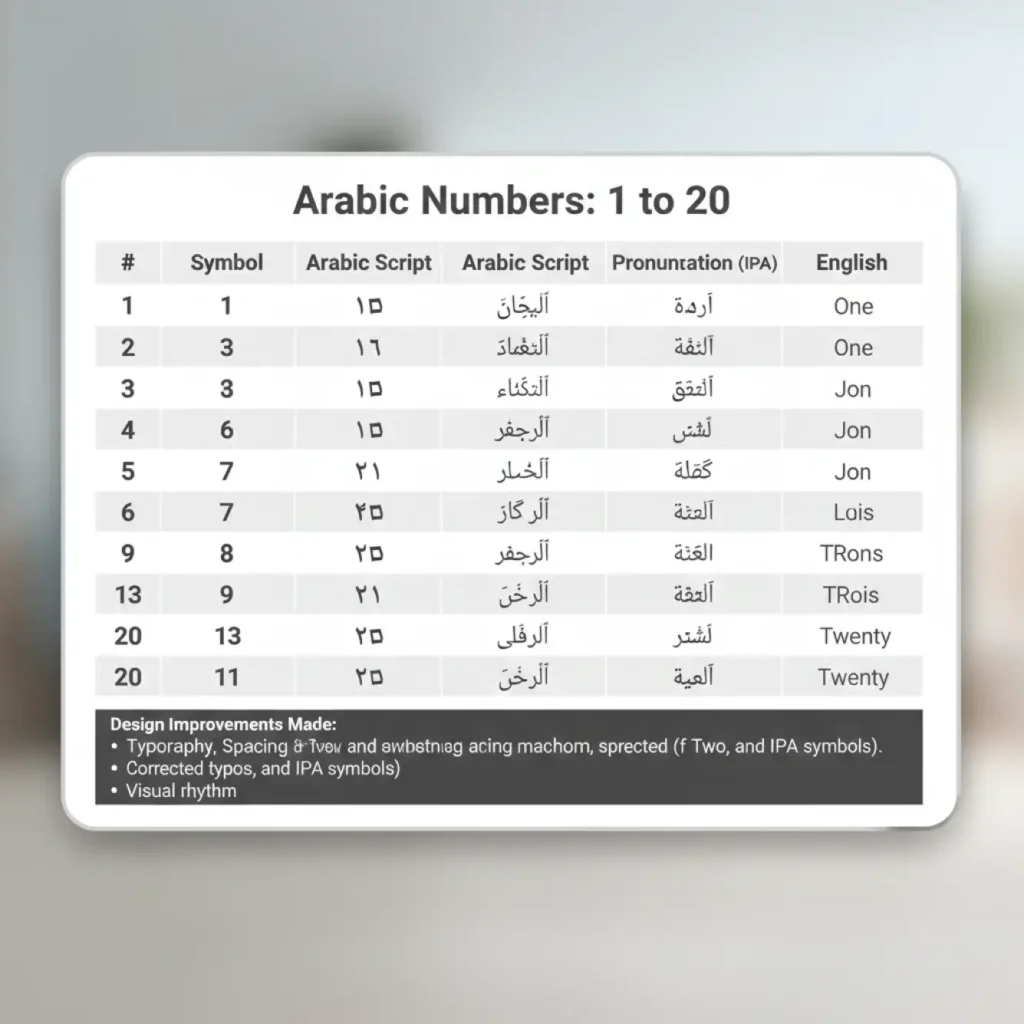
Examples: Only numbers 1 and 2 follow the noun
Numbers 3 to 9 come before the noun. The noun becomes plural. The number does NOT match the gender of the noun (it does the opposite).
Examples:
Ten (عشرة) can be used alone or combined with numbers 1–9. When used alone, it opposes the gender of the noun. The pronunciation changes slightly:
These rules may seem new at first, but with practice, counting in Arabic becomes much easier.
Arabic numbers 1 to 10 are the base system and digits: ٠١٢٣٤٥٦٧٨٩. These digits combine to form larger numbers, just like in English. For example, when digits are placed together, their value depends on position—numbers with higher value appear first on the left, followed by smaller values.
Although Arabic words are written from right to left, numbers are written from left to right. This can feel unusual at first, but it becomes easy with practice. When numbers above 10 are written in words, Arabic often uses the connector و (wa), meaning “and”, and the word order can change.
Example: 1967 is written as
ألف وتسعمئة وسبعة وستون
How far is the airport?
كم يبعد المطار؟
خمسة كيلومترات – ٥ كيلومترات (km 5)
How much will you charge?
تسعة ريالات – ٩ ريالات (riyals 9)
I want to deposit money into my account.
مَرْحَبًا، أُرِيدُ إِيدَاعَ أَمْوَالٍ فِي حِسَابِي
How much would you like to deposit?
خَمْسَةَ آلَاف – 5000
How many apples do you want to buy?
كَمْ تُفَّاحًا تُرِيدُ شِرَاءَه؟
١ كيلوجرام – كِيلُوجِرَامًا وَاحِدًا (kg 1)
What is the price?
٢٠ ريالا – عِشْرُونَ رِيَالًا (riyals 20)
These examples show how Arabic numbers are commonly used in daily conversations, making them essential for real-life communication.
The best way to learn Arabic numbers is through regular practice. Write them by hand and say them aloud to improve recognition and pronunciation. Practicing numbers in order helps you remember their shapes. You can also try simple math—addition, subtraction, multiplication, and division—to understand how Arabic numbers work with place value.
Using tracing worksheets can also be a helpful extra tool to build confidence and improve number-writing accuracy.
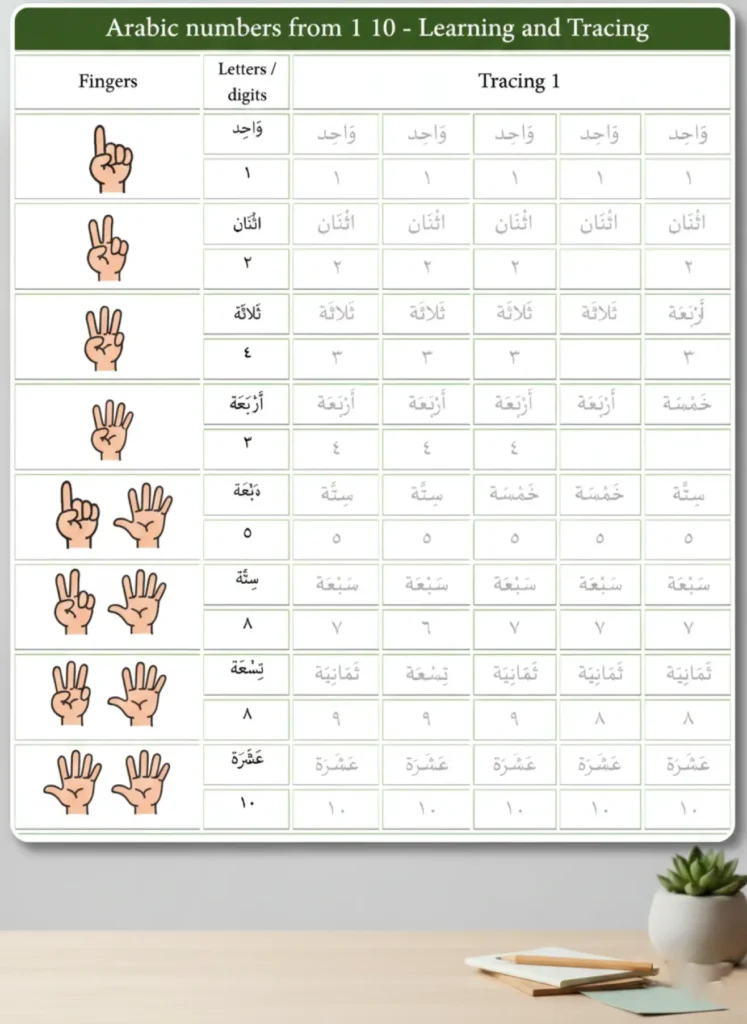
Arabic numbers are the digits we use today, with origins over 2,000 years ago. Indian mathematicians first developed them during the Gupta Empire. Through trade and cultural exchange, Arab scholars refined and spread them across the Middle East, North Africa, and parts of Europe.
Over time, 3 styles of Arabic numerals developed, including Arabic numbers 1 to 10 in English, Arabic, and numbering:
Arabic Numbers 1–10 with Pronunciation | |||
|---|---|---|---|
1 | One | ١ | waahid |
2 | Two | ٢ | ithnan |
3 | Three | ٣ | thalatha |
4 | Four | ٤ | arba’a |
5 | Five | ٥ | khamsa |
6 | Six | ٦ | sitta |
7 | Seven | ٧ | sab’a |
8 | Eight | ٨ | thamaniya |
9 | Nine | ٩ | tis’a |
10 | Ten | ١٠ | ‘ashara |
The Western style later travelled to Europe and, by the 15th century, replaced Roman numerals such as I, V, and X because it was easier to use for calculation.
Join Mixt Academy today. Our tutors help you speak Arabic numbers correctly from day one.
Arabic numerals evolved over centuries, originating in India around the 6th–7th century. Arab scholars like Al-Khwarizmi and Al-Kindi refined them, spreading the decimal system to Europe and laying the foundation for modern mathematics.
The Arabic number system uses the Place Value System (PVS), where digits like 0 change meaning based on position. For learners, understanding symbols, place values, and basic calculations is crucial. This system also underpins technology, coding, and digital tools, forming the foundation of modern computing.
Arabic numbers showcase their versatility in two distinct styles:
Learning Arabic numbers takes patience and practice. Keep reading, writing, and using them daily. Follow Mixt Academy to continue improving your skills, and don’t miss our free 30-minute demo lessons on your preferred topic!
Arabic numerals (0, 1, 2, 3, etc.) are widely used worldwide. To easily learn them, follow these steps:
Learning Arabic quickly requires focus and consistency. Here are some tips:
If you want personal assistance in studies, contact Mixt Academy, who offer certified tutors at affordable fees to give maximum support in studies.
The logic of Arabic numbers is based on the decimal (base-10) system, which is structured around the idea of place value. For example:
The digits 1, 3, 5, 7, and 9 are referred to as Arabic numerals because they originated from the Indian numeral system and were later adopted by Arab mathematicians during the 8th century. These numerals were introduced to Europe through translations of Arabic texts, and the system became widely used in the West as “Arabic numerals” despite their Indian origins.
To learn Arabic numerals from 1 to 100, start by memorizing the basic numbers and then build on that. Here’s 1 to 100 Arabic numerals:
1: واحد (wahid)
2: اثنان (ithnayn)
3: ثلاثة (thalatha)
4: أربعة (arba’a)
5: خمسة (khamsa)
6: ستة (sitta)
7: سبعة (sab’a)
8: ثمانية (thamaniya)
9: تسعة (tis’a)
10: عشرة (ashara)
11: أحد عشر (ahada ‘ashar)
12: اثنا عشر (ithna ‘ashar)
13: ثلاثة عشر (thalatha ‘ashar)
14: أربعة عشر (arba’a ‘ashar)
15: خمسة عشر (khamsa ‘ashar)
16: ستة عشر (sitta ‘ashar)
17: سبعة عشر (sab’a ‘ashar)
18: ثمانية عشر (thamaniya ‘ashar)
19: تسعة عشر (tis’a ‘ashar)
20: عشرون (ishroon)
21: واحد وعشرون (wahid wa ishroon)
22: اثنان وعشرون (ithnayn wa ishroon)
23: ثلاثة وعشرون (thalatha wa ishroon)
24: أربعة وعشرون (arba’a wa ishroon)
25: خمسة وعشرون (khamsa wa ishroon)
26: ستة وعشرون (sitta wa ishroon)
27: سبعة وعشرون (sab’a wa ishroon)
28: ثمانية وعشرون (thamaniya wa ishroon)
29: تسعة وعشرون (tis’a wa ishroon)
30: ثلاثون (thalaathoon)
31: واحد وثلاثون (wahid wa thalaathoon)
32: اثنان وثلاثون (ithnayn wa thalaathoon)
33: ثلاثة وثلاثون (thalatha wa thalaathoon)
34: أربعة وثلاثون (arba’a wa thalaathoon)
35: خمسة وثلاثون (khamsa wa thalaathoon)
36: ستة وثلاثون (sitta wa thalaathoon)
37: سبعة وثلاثون (sab’a wa thalaathoon)
38: ثمانية وثلاثون (thamaniya wa thalaathoon)
39: تسعة وثلاثون (tis’a wa thalaathoon)
40: أربعون (arba’oon)
41: واحد وأربعون (wahid wa arba’oon)
42: اثنان وأربعون (ithnayn wa arba’oon)
43: ثلاثة وأربعون (thalatha wa arba’oon)
44: أربعة وأربعون (arba’a wa arba’oon)
45: خمسة وأربعون (khamsa wa arba’oon)
46: ستة وأربعون (sitta wa arba’oon)
47: سبعة وأربعون (sab’a wa arba’oon)
48: ثمانية وأربعون (thamaniya wa arba’oon)
49: تسعة وأربعون (tis’a wa arba’oon)
50: خمسون (khamsoon)
51: واحد وخمسون (wahid wa khamsoon)
52: اثنان وخمسون (ithnayn wa khamsoon)
53: ثلاثة وخمسون (thalatha wa khamsoon)
54: أربعة وخمسون (arba’a wa khamsoon)
55: خمسة وخمسون (khamsa wa khamsoon)
56: ستة وخمسون (sitta wa khamsoon)
57: سبعة وخمسون (sab’a wa khamsoon)
58: ثمانية وخمسون (thamaniya wa khamsoon)
59: تسعة وخمسون (tis’a wa khamsoon)
60: ستون (sittoon)
61: واحد وستون (wahid wa sittoon)
62: اثنان وستون (ithnayn wa sittoon)
63: ثلاثة وستون (thalatha wa sittoon)
64: أربعة وستون (arba’a wa sittoon)
65: خمسة وستون (khamsa wa sittoon)
66: ستة وستون (sitta wa sittoon)
67: سبعة وستون (sab’a wa sittoon)
68: ثمانية وستون (thamaniya wa sittoon)
69: تسعة وستون (tis’a wa sittoon)
70: سبعون (sab’oon)
71: واحد وسبعون (wahid wa sab’oon)
72: اثنان وسبعون (ithnayn wa sab’oon)
73: ثلاثة وسبعون (thalatha wa sab’oon)
74: أربعة وسبعون (arba’a wa sab’oon)
75: خمسة وسبعون (khamsa wa sab’oon)
76: ستة وسبعون (sitta wa sab’oon)
77: سبعة وسبعون (sab’a wa sab’oon)
78: ثمانية وسبعون (thamaniya wa sab’oon)
79: تسعة وسبعون (tis’a wa sab’oon)
80: ثمانون (thamaanoon)
81: واحد وثمانون (wahid wa thamaanoon)
82: اثنان وثمانون (ithnayn wa thamaanoon)
83: ثلاثة وثمانون (thalatha wa thamaanoon)
84: أربعة وثمانون (arba’a wa thamaanoon)
85: خمسة وثمانون (khamsa wa thamaanoon)
86: ستة وثمانون (sitta wa thamaanoon)
87: سبعة وثمانون (sab’a wa thamaanoon)
88: ثمانية وثمانون (thamaniya wa thamaanoon)
89: تسعة وثمانون (tis’a wa thamaanoon)
90: تسعون (tise’oon)
91: واحد وتسعون (wahid wa tise’oon)
92: اثنان وتسعون (ithnayn wa tise’oon)
93: ثلاثة وتسعون (thalatha wa tise’oon)
94: أربعة وتسعون (arba’a wa tise’oon)
95: خمسة وتسعون (khamsa wa tise’oon)
96: ستة وتسعون (sitta wa tise’oon)
97: سبعة وتسعون (sab’a wa tise’oon)
98: ثمانية وتسعون (thamaniya wa tise’oon)
99: تسعة وتسعون (tis’a wa tise’oon)
100: مئة (mi’a)

Mixt Academy is a global online tutoring platform that connects students with expert IGCSE, GCSE, and A-Level tutors for one-to-one learning. With flexible scheduling, personalized lesson plans, and experienced teachers from top curricula, Mixt Academy helps students strengthen concepts, improve exam skills, and achieve higher grades with confidence.


IGCSE Physics Formula Sheet: Key Formulas for 0625 & Edexcel…
IGCSE Chemistry Papers: Common Mistakes & Exam Tips This IGCSE…
IGCSE Extended vs Core Tiers: How to Pick the Right…
Understanding GCSE Grade Boundaries and How to Prepare? Grade boundaries…
Differences GCSE English Language vs English Literature GCSE English is…
What is GCSE? A Guide for International Students & Parents…
A Level vs AP: Complete Guide to Choosing the Right…
Top Benefits of Completing AS and A Levels Privately Explore…
Cambridge vs IB Guide to Choosing the Best Curriculum Choosing…
IB vs A Levels: Which Qualification Is Right for You?…
How to Use OCR Past Papers for Effective Revision? Past…
AQA Physics Equation Sheet: Complete GCSE Guide for Combined Science…
AQA vs Edexcel Complete GCSE Comparison and Guide Choosing between…
Complete Guide to the AQA GCSE Chemistry Specification Understanding the…
Hire an Expert Tutor from Just 15$/hr