
Most of us grow up learning numbers as fixed and predictable; 2 + 2 will always equal 4. However, one of the better ways to learn about mathematics is to shift our focus from constants to changes. This is where delta comes into play.
In math, delta is a powerful symbol (∆) used to describe how much something shifts, grows, or decreases. Delta is the concept that assists in bringing motion to mathematics. Whether it is the measurement of the difference between values, the tracking of a function’s behaviour or the analysis of a graph’s movement.
From algebra to calculus, understanding delta allows students to see patterns, make comparisons, and solve complex problems with clarity. In this Mixt Academy blog post, we shall look at how to deal with delta-based problems numerically and convert the otherwise abstract into something concrete, simple and tiny.
Basics of Delta are illustrated through simple steps supported by an example. Read this blog: What is Delta in Math? Explain in Easy Wording!
It is essential to comprehend what the delta symbol stands for before embarking on delta-related problem-solving. “In mathematics, delta (∆) simply means change”. It is a comparison between an original value and a new one that makes it possible to reveal how much something has gone up or down.
For example, in the case of a value that changes from 5 to 9, the delta is the difference between those two. The entire idea can be summed up in one word, and that is the foundation of advanced mathematics like slopes, rates of change, and derivatives. Understanding what delta measures in a mathematical problem helps students pick the right strategy to solve it.
Mixt Academy helps students understand delta step by step using simple examples and clear teaching.
The symbol ∆ (delta) indicates change or difference, and its interpretation can vary a bit from one branch of mathematics to another. Grasping these nuances can considerably enhance one’s problem-solving skills. Delta-based problems can be grouped into several categories, some of the most common ones being:
While each type of problem applies delta in a slightly different way, the underlying concept is always the same: quantifying change. Mastering this idea helps students across all areas of mathematics, from algebra to calculus.
Contact Mixt Academy’s professional maths tutors via the contact number or email provided on their official website.
Tackling DeltaMath problems effectively isn’t just about plugging in numbers; it’s about thinking strategically, understanding the math, and using the platform wisely. Here’s how to approach it like a pro.
No matter what type of problem you face, certain habits make problem-solving much easier:
DeltaMath isn’t just a homework platform; it’s a powerful learning tool. Here’s how to use it effectively:
The real key to success is blending solid problem-solving habits with smart platform use. By understanding the maths and using Delta Math’s features wisely, you can:

Delta is a fundamental mathematical symbol used to represent change or difference. Its applications extend far beyond mathematics, playing an essential role in many real-world fields such as finance, science, engineering, and technology.
At its core, delta represents a measurable difference between two values. This idea of “change” is widely used in both everyday and professional settings:
Video Game Development: Smooth motion in games depends on continuous calculations of small changes in position (Δx, Δy) to update character movement from one frame to the next.
Beyond its general meaning of “change”, delta also appears in specialised mathematical concepts with important practical uses:
In algebra, the discriminant (Δ=b^2-4ac) determines whether a quadratic equation has two real solutions, one real solution, or no real solutions. This concept is useful in engineering and physics when analysing systems with different possible outcomes.
In calculus, the formal definitions of limits and continuity rely on epsilon and delta to describe arbitrarily small tolerances. This rigorous framework is crucial for precise engineering applications, such as ensuring accurate targeting or maintaining acceptable error margins in system design.
The Dirac delta is a generalised function used to model instantaneous events or point sources:
In linear algebra, the Kronecker delta equals 1 when i=j and 0 otherwise. It is essential for working with matrices, tensors, and identity matrices in physics and computer science.
The curved or lowercase delta-like symbol ∂ represents partial derivatives, which measure how a function changes with respect to one variable while keeping others constant. This concept is fundamental in fields such as thermodynamics, economics, and fluid dynamics, where multiple variables interact simultaneously.
When working on Delta (Δ) problems, students often make errors due to haste, misreading the question, or weak foundational understanding. Common issues include ignoring the order of operations (PEMDAS/BODMAS), mishandling signs or units, skipping steps, and failing to check final answers. These mistakes can usually be avoided by reading carefully, working methodically, organising calculations clearly, and reviewing results thoroughly.
Mixt Academy tutors guide students through delta problems so learning feels easy and organised.
Learning delta becomes much easier when you see it in action. Below are simple examples with clear, step-by-step solutions.
Delta Math can feel confusing because it focuses on change, not fixed numbers. Many students know the formulas but struggle to understand when and how to use them. Mixt Academy helps students learn Delta step by step in a clear and simple way.
Experienced maths tutors explain what delta means using easy examples and real questions from school lessons. Students learn how to find changes in numbers, graphs, and functions without feeling stressed. Tutors also help students avoid common mistakes and build strong problem-solving habits. Each lesson is planned around the student’s level, so learning feels comfortable and organised.
Understanding Delta Math is more than learning a symbol; it’s about developing the ability to recognise, measure, and interpret change across mathematics and real-life applications. From simple differences in numbers to advanced concepts in calculus, physics, and finance, delta builds the foundation for strong mathematical thinking and problem solving confidence.
By applying the right mathematics problem-solving techniques, avoiding common mistakes, and using platforms like Delta in math strategically, students can turn challenging problems into manageable steps and steady progress into real success.
Join Mixt Academy and learn with the guidance of experienced, qualified tutors who make complex topics easier. Take the next step today and transform the way you approach Delta Mathematics and advanced math learning with confidence.
Delta means “change” or “difference”. It shows how much a value increases or decreases.
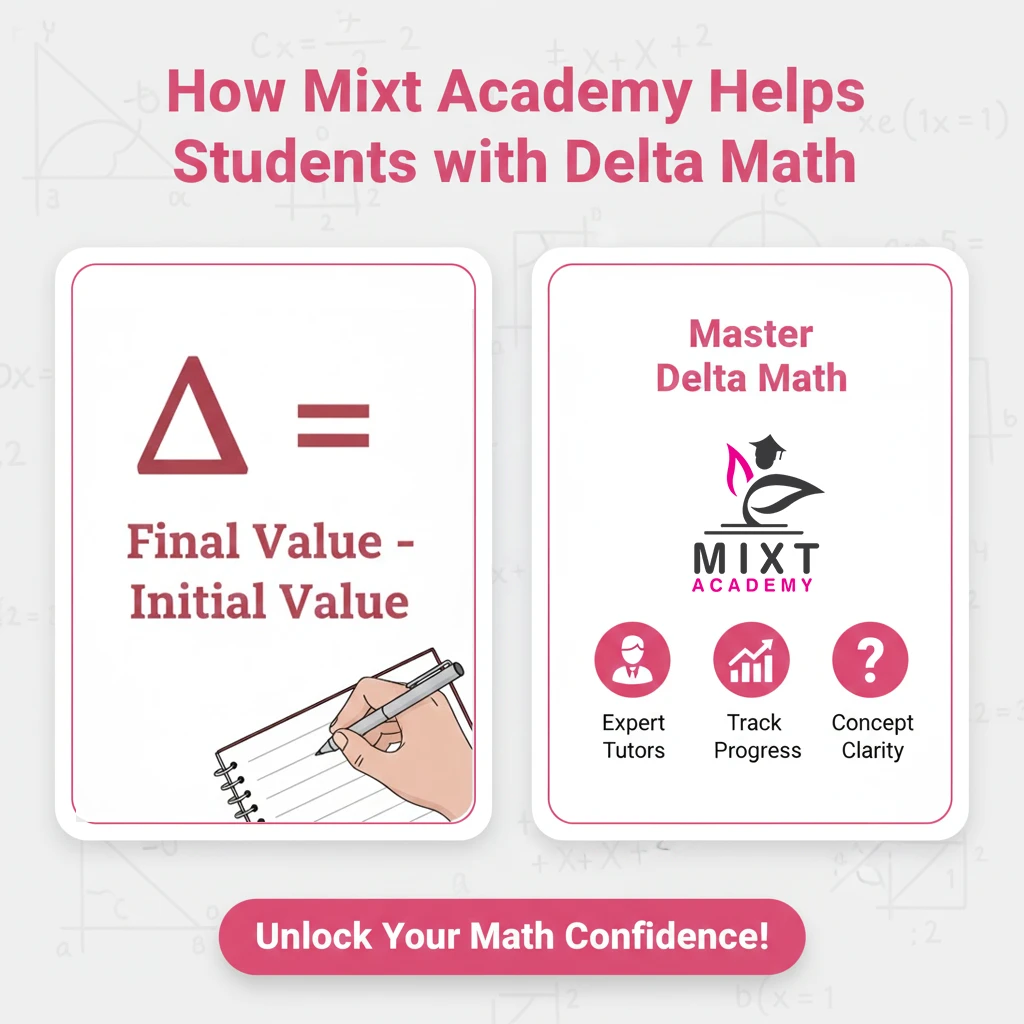
Delta is calculated by subtracting the initial value from the final value: ∆ = final value − initial value
No! Delta is used in algebra, geometry, calculus, physics, and many real-life calculations involving change.
Delta helps students understand how values change over time or between points. It is essential for learning slopes, rates of change, and derivatives.
“Delta” and “derivative” both describe change, but in different ways.

Mixt Academy is a global online tutoring platform that connects students with expert IGCSE, GCSE, and A-Level tutors for one-to-one learning. With flexible scheduling, personalized lesson plans, and experienced teachers from top curricula, Mixt Academy helps students strengthen concepts, improve exam skills, and achieve higher grades with confidence.



IGCSE Physics Formula Sheet: Key Formulas for 0625 & Edexcel…
IGCSE Chemistry Papers: Common Mistakes & Exam Tips This IGCSE…
IGCSE Extended vs Core Tiers: How to Pick the Right…
Understanding GCSE Grade Boundaries and How to Prepare? Grade boundaries…
Differences GCSE English Language vs English Literature GCSE English is…
What is GCSE? A Guide for International Students & Parents…
A Level vs AP: Complete Guide to Choosing the Right…
Top Benefits of Completing AS and A Levels Privately Explore…
Cambridge vs IB Guide to Choosing the Best Curriculum Choosing…
IB vs A Levels: Which Qualification Is Right for You?…
How to Use OCR Past Papers for Effective Revision? Past…
AQA Physics Equation Sheet: Complete GCSE Guide for Combined Science…
AQA vs Edexcel Complete GCSE Comparison and Guide Choosing between…
Complete Guide to the AQA GCSE Chemistry Specification Understanding the…
Hire an Expert Tutor from Just 15$/hr