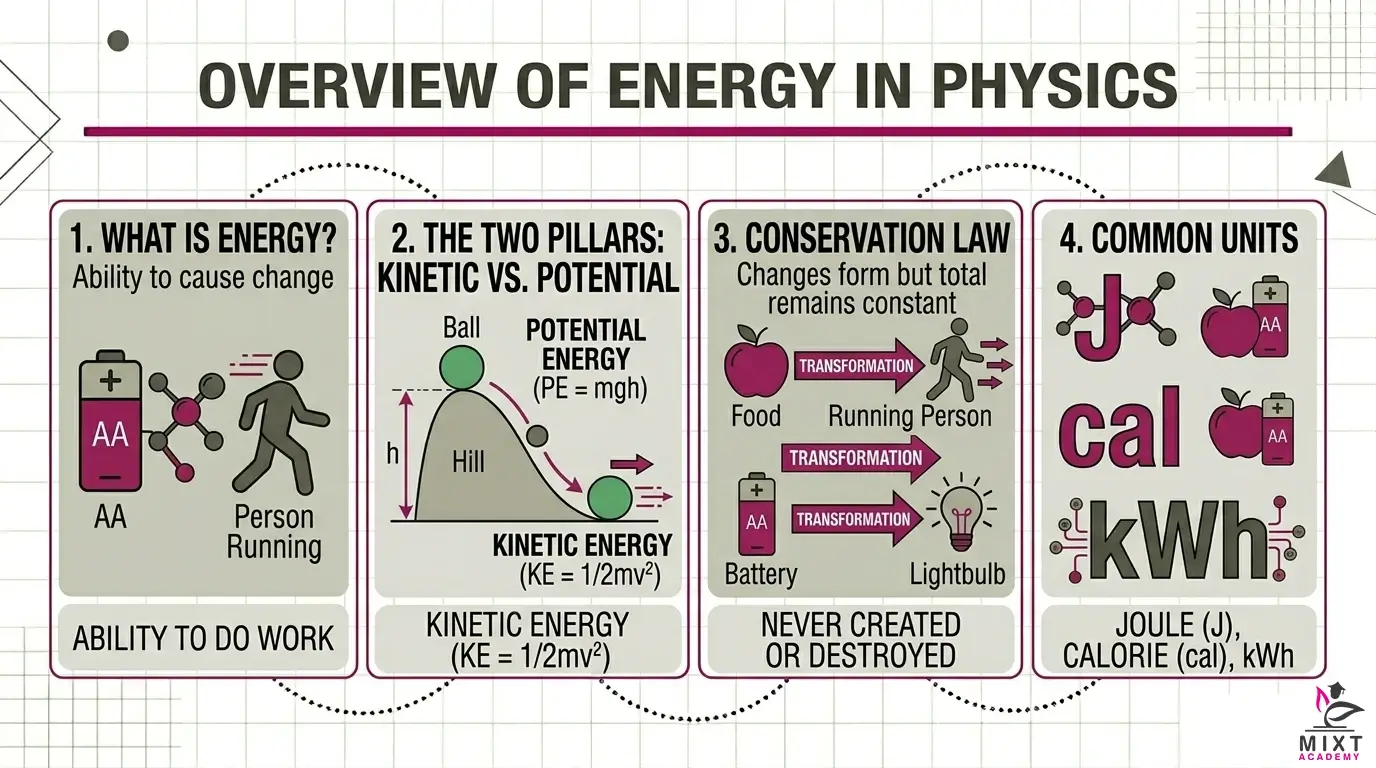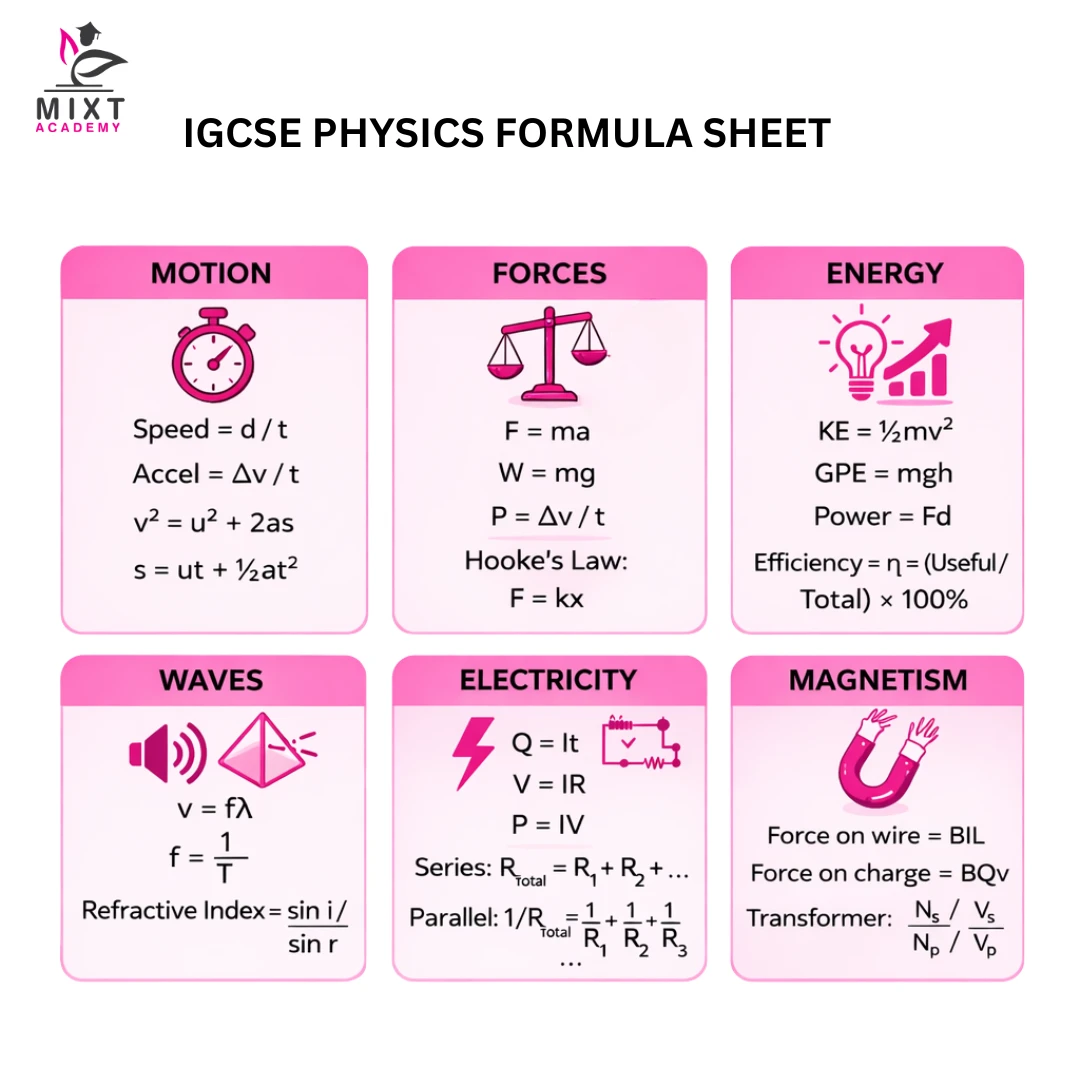


From algebra to calculus, understanding delta allows students to see patterns, make comparisons, and solve complex problems with clarity. In this Mixt Academy blog post, we shall look at how to deal with delta-based problems numerically and convert the otherwise abstract into something concrete, simple and tiny.
Basics of Delta are illustrated through simple steps supported by an example. Read this blog: What is Delta in Math? Explain in Easy Wording!
Understanding the Delta Mathematical Symbol
It is essential to comprehend what the delta symbol stands for before embarking on delta-related problem-solving. “In mathematics, delta (∆) simply means change”. It is a comparison between an original value and a new one that makes it possible to reveal how much something has gone up or down.
For example, in the case of a value that changes from 5 to 9, the delta is the difference between those two. The entire idea can be summed up in one word, and that is the foundation of advanced mathematics like slopes, rates of change, and derivatives. Understanding what delta measures in a mathematical problem helps students pick the right strategy to solve it.
Struggling with Delta Math?
Mixt Academy helps students understand delta step by step using simple examples and clear teaching.
Common Types of Delta Problems Students Encounter
The symbol ∆ (delta) indicates change or difference, and its interpretation can vary a bit from one branch of mathematics to another. Grasping these nuances can considerably enhance one’s problem-solving skills. Delta-based problems can be grouped into several categories, some of the most common ones being:
- Calculating Differences Between Numbers: For example, calculating Δx or Δy to find out how one quantity changes with respect to another.
- Measuring Change in a Function’s Output: Assessing how the value of a function alters with its input.
- Finding Slope in Coordinate Geometry: Determining how steep a line is by using Δy/Δx. When slopes are linked to angles, learning how to find trigonometric ratios helps students understand how changes relate to sine, cosine, and tangent in a clear and simple way.
- Solving Calculus Problems: The Concept of delta is applied in limits and derivatives to determine instantaneous rates of change.
While each type of problem applies delta in a slightly different way, the underlying concept is always the same: quantifying change. Mastering this idea helps students across all areas of mathematics, from algebra to calculus.
How to Succeed with Delta Math? Combining Strategy & Platform Tools
Tackling DeltaMath problems effectively isn’t just about plugging in numbers; it’s about thinking strategically, understanding the math, and using the platform wisely. Here’s how to approach it like a pro.
General Math Strategies That Always Work
No matter what type of problem you face, certain habits make problem-solving much easier:
- Understand the Problem First: Take a moment to read carefully. Highlight keywords, note what’s given, and identify what you’re asked to find. Sometimes reading it out loud helps!
- Visualize the Situation: Diagrams, graphs, or sketches can turn abstract numbers into a clearer picture.
- Break it Down: Big problems become manageable when you split them into smaller, sequential steps.
- Use formulas correctly: Use formulas correctly: Whether it’s the discriminant or the change in values, make sure you understand what each symbol means. For questions with angles or slopes, using a trigonometric ratios table can help you find answers faster and avoid small mistakes.
- Practice regularly: Like any skill, math improves with repetition. Familiarity with different problem types boosts speed and confidence.
- Check your work: Always verify your solution makes sense and satisfies the original question. A quick second look can prevent careless mistakes.
Getting the Most Out of Delta Math
DeltaMath isn’t just a homework platform; it’s a powerful learning tool. Here’s how to use it effectively:
- Engage with hints and examples: Don’t just peek at answers; use hints and worked examples to understand the logic behind each step.
- Watch tutorials when needed: Many problems include links to videos or step-by-step guides. These are great for clarifying tricky concepts.
- Understand each step: When reviewing solutions, pause to make sure you know why each step works. If something’s confusing, look for extra explanations online or ask a teacher.
- Try before you check: Attempt problems on your own first. This strengthens critical thinking and helps you learn from mistakes.
- Ask for help when stuck: Teachers, classmates, or online forums can provide valuable insights. Collaborating doesn’t mean you’re not learning; it often deepens understanding.
- Focus on mastery: DeltaMath requires a certain level of accuracy to move forward. Embrace this; it ensures you truly understand the material before advancing.
Combining Strategy with the Platform
The real key to success is blending solid problem-solving habits with smart platform use. By understanding the maths and using Delta Math’s features wisely, you can:
- Solve problems more efficiently
- Strengthen your conceptual understanding
- Build confidence with challenging topics
- Retain knowledge for long-term success
Real-World Applications of Delta in Mathematics

Delta is a fundamental mathematical symbol used to represent change or difference. Its applications extend far beyond mathematics, playing an essential role in many real-world fields such as finance, science, engineering, and technology.
General Applications of Change (Δ or δ)
- Financial Markets: In trading, “delta” is a key risk metric that indicates how much an option’s price is expected to change in response to a change in the price of the underlying asset. Traders use this information for strategies such as delta hedging to manage risk.
- Physics and Engineering: Delta is commonly used to describe changes in physical quantities, including displacement (Δx), velocity (Δv), time (Δt), and energy (ΔE).
- Meteorology: Weather forecasting relies on tracking changes in temperature, air pressure, and humidity to predict weather patterns and storms.
- Medical Research: In healthcare, delta is used to evaluate treatment effectiveness by comparing patient measurements, such as blood pressure or heart rate, before and after medical interventions.
- Video Game Development: Smooth motion in games depends on continuous calculations of small changes in position (Δx, Δy) to update character movement from one frame to the next.
Specific Mathematical Applications
Beyond its general meaning of “change”, delta also appears in specialised mathematical concepts with important practical uses:
Discriminant of a Quadratic Equation (Δ)
In algebra, the discriminant (Δ=b^2-4ac) determines whether a quadratic equation has two real solutions, one real solution, or no real solutions. This concept is useful in engineering and physics when analysing systems with different possible outcomes.
Epsilon Delta Definitions (ϵ,δ)
In calculus, the formal definitions of limits and continuity rely on epsilon and delta to describe arbitrarily small tolerances. This rigorous framework is crucial for precise engineering applications, such as ensuring accurate targeting or maintaining acceptable error margins in system design.
Dirac Delta Function (δ(x))
- Physics: Represents point masses, point charges, or impulsive forces, such as the impact of a bat striking a ball.
- Engineering: Helps analyze systems with sudden shocks or voltage spikes, often using Laplace transforms.
- Signal Processing: Used for ideal signal sampling and image reconstruction, including applications like MRI technology.
Kronecker Delta (δ_ij)
In linear algebra, the Kronecker delta equals 1 when i=j and 0 otherwise. It is essential for working with matrices, tensors, and identity matrices in physics and computer science.
Partial Derivatives (∂)
The curved or lowercase delta-like symbol ∂ represents partial derivatives, which measure how a function changes with respect to one variable while keeping others constant. This concept is fundamental in fields such as thermodynamics, economics, and fluid dynamics, where multiple variables interact simultaneously.
Common Mistakes When Solving Delta (Δ) Problems
When working on Delta (Δ) problems, students often make errors due to haste, misreading the question, or weak foundational understanding. Common issues include ignoring the order of operations (PEMDAS/BODMAS), mishandling signs or units, skipping steps, and failing to check final answers. These mistakes can usually be avoided by reading carefully, working methodically, organising calculations clearly, and reviewing results thoroughly.
Conceptual and Understanding Errors
- Misinterpreting the Question: Skimming the problem or making assumptions instead of carefully analysing what is being asked.
- Weak Foundational Knowledge: An incomplete understanding of core concepts, formulas, or properties leads to incorrect problem-solving approaches.
- Incorrect Use of Formulas: Applying the wrong formula or using the correct formula improperly.
Execution and Calculation Errors
- Rushing and Careless Mistakes: Errors such as incorrect signs, misplaced decimals, or copying numbers incorrectly (for example, confusing 6 and 9).
- Ignoring the Order of Operations (PEMDAS/BODMAS): Performing calculations in the wrong sequence, especially when parentheses or mixed operations are involved.
- Sign Errors: Incorrectly distributing negative signs or confusing addition and subtraction.
- Skipping Steps: Jumping to the final answer without showing intermediate steps increases the likelihood of hidden mistakes.
- Ignoring Units and Significant Figures: Forgetting to include units or rounding improperly, resulting in inaccurate or misleading answers.
Process and Review Errors
- Poor Organisation: Disorganised or cluttered work makes it difficult to follow reasoning and identify mistakes.
- Failure to Verify Answers: Not checking solutions by substituting them back into the original equation or using an alternative method.
- Overreliance on Technology: Depending too heavily on calculators without understanding the underlying concepts or carefully entering values.
6 Mathematics Problem-solving Techniques to Avoid Delta Mistakes
- Work Slowly and Thoughtfully: Take time to process each step and avoid rushing.
- Read the Problem Carefully: Ensure you fully understand what is being asked before beginning.
- Show All Steps: Clearly write out each step to track your logic and catch errors early.
- Stay Organised: Keep calculations neat and logically arranged.
- Practice Regularly: Consistent practice strengthens understanding and builds confidence.
- Review Your Work: Check signs, units, calculations, and final answers for accuracy.
Master Delta Math with Confidence
Mixt Academy tutors guide students through delta problems so learning feels easy and organised.
Examples of Delta Mathematics Problems with Solutions
Learning delta becomes much easier when you see it in action. Below are simple examples with clear, step-by-step solutions.
Example 1: Finding the Change Between Two Values
Problem: A number changes from 8 to 13. Find the delta.
Solution: Delta means final value − initial value
∆ = 13 − 8
∆ = 5
Answer: The change (delta) is 5.
Example 2: Delta in Coordinates
Problem: The x-value changes from 2 to 7. Find ∆x.
Solution:
∆x = 7 − 2
∆x = 5
Answer: The change in x is 5.
Example 3: Delta in a Function
Problem: A function has a value of 4 at x = 1 and 10 at x = 3. Find the change in the function’s value.
Solution:
∆f = 10 − 4
∆f = 6
Answer: The function increased by 6.
How Mixt Academy Helps Students with Delta Math
Delta Math can feel confusing because it focuses on change, not fixed numbers. Many students know the formulas but struggle to understand when and how to use them. Mixt Academy helps students learn Delta step by step in a clear and simple way.
Experienced maths tutors explain what delta means using easy examples and real questions from school lessons. Students learn how to find changes in numbers, graphs, and functions without feeling stressed. Tutors also help students avoid common mistakes and build strong problem-solving habits. Each lesson is planned around the student’s level, so learning feels comfortable and organised.
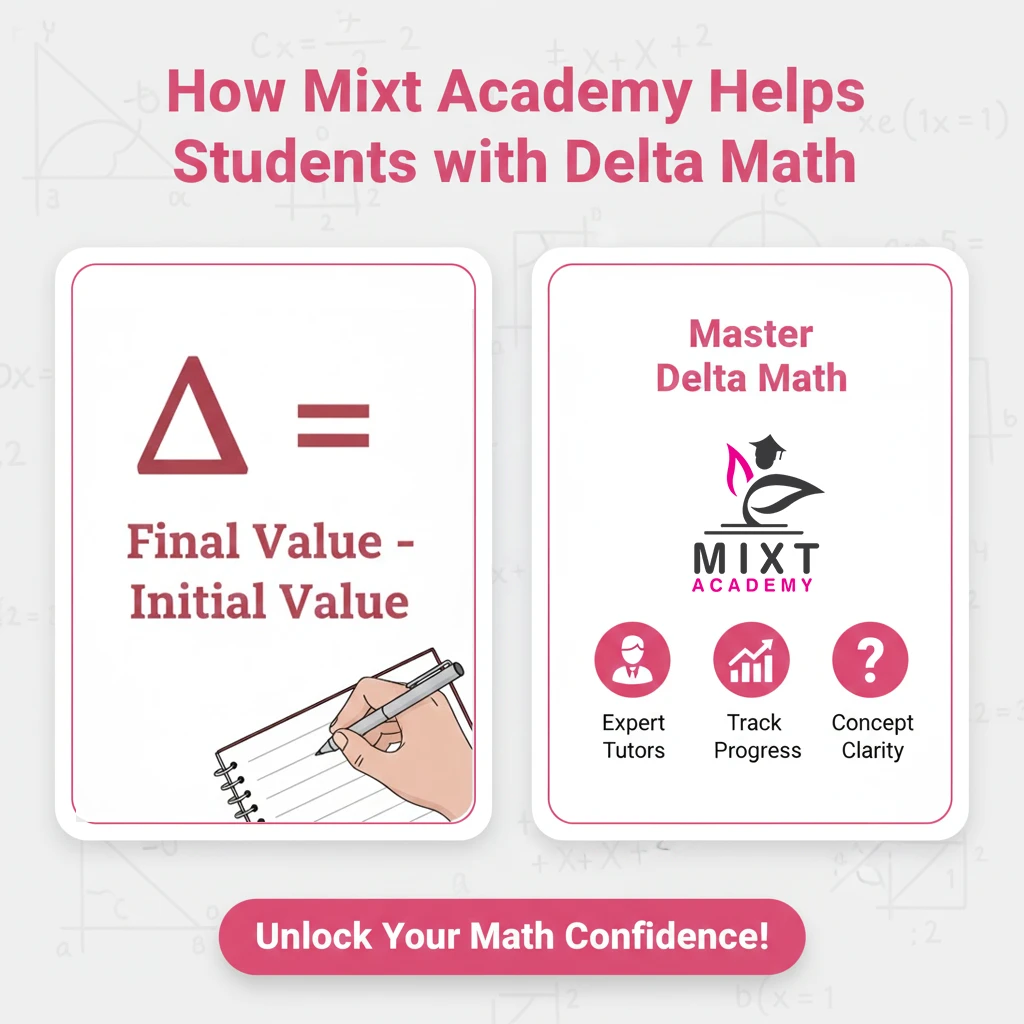
Master Delta Math with Confidence | Take the Next Step Today
Understanding Delta Math is more than learning a symbol; it’s about developing the ability to recognise, measure, and interpret change across mathematics and real-life applications. From simple differences in numbers to advanced concepts in calculus, physics, and finance, delta builds the foundation for strong mathematical thinking and problem solving confidence.
By applying the right mathematics problem-solving techniques, avoiding common mistakes, and using platforms like Delta in math strategically, students can turn challenging problems into manageable steps and steady progress into real success.
Join Mixt Academy and learn with the guidance of experienced, qualified tutors who make complex topics easier. Take the next step today and transform the way you approach Delta Mathematics and advanced math learning with confidence.