Which is the Hottest Planet in the Solar System, and Why is it Venus?

The hottest planet within our solar system is not Mercury, although it is the closest to the Sun; still, many people would think of Mercury. However, the title of the warmest planet goes to Venus. Venus, being the second planet in the solar system after the Sun, has a thick atmosphere that is entirely made up of carbon dioxide and sulphuric acid clouds. This situation results in a drastic greenhouse effect, thus trapping the heat and raising the surface temperature to about 464°C (867°F), which is so hot that lead can melt.

In contrast, Mercury, which is closer to the Sun, has very little atmosphere, and consequently, it cannot retain the heat; hence, it undergoes drastic temperature changes. “In the late 1950s, it was observed that Venus’s thick atmosphere is the reason for the planet’s extreme heat.” This discovery not only provided an explanation for the intense heat on Venus but also settled the long-standing debate on which is the hottest planet in the solar system, even though Venus is not the closest planet to the Sun. 

Struggling to Understand Science Concepts Clearly?

Mixt Academy provides specialised 1-on-1 science tutoring, starting to establish solid foundational knowledge. 

Table of Contents
    Add a header to begin generating the table of contents

    Why Is Venus So Hot? The Science Behind Its Intense Heat?

    The extreme temperature of Venus is mainly caused by the planetary atmosphere, which is very thick. Venus’s atmosphere is more than 90 times denser than Earth’s. Carbon dioxide (CO₂), a greenhouse gas that contributes significantly to the heating effect, is the main constituent of the atmosphere. The mechanism of the greenhouse effect on Venus is explained as follows: 

    Solar Radiation

    Venus takes in sunlight, but rather than allowing it to go back to space, the thick atmosphere absorbs a great deal of the heat and prevents it from escaping. 

    Greenhouse Effect

    The CO₂ present in the atmosphere captures the infrared radiation, thus keeping the heat inside. This translates into a continual rise in temperature as the heat gets more and more concentrated. 

    Sulfuric Acid Clouds

    Venus is also completely enveloped in very dense clouds of sulfuric acid. These clouds reflect sunlight, but at the same time, they help to hold the heat in the atmosphere, further increasing the already very high temperature at the surface of the planet. 

    Why Venus’s Temperatures Keep Rising

    The heat is so intense that it causes the planet to be under a “runaway greenhouse effect”, which implies that the temperatures on Venus can go higher and higher. Consequently, water can never be present in its liquid state. The heat is so severe on Venus that even the surface pressure is comparable to that of being 900 meters (3,000 feet) underwater on Earth! 

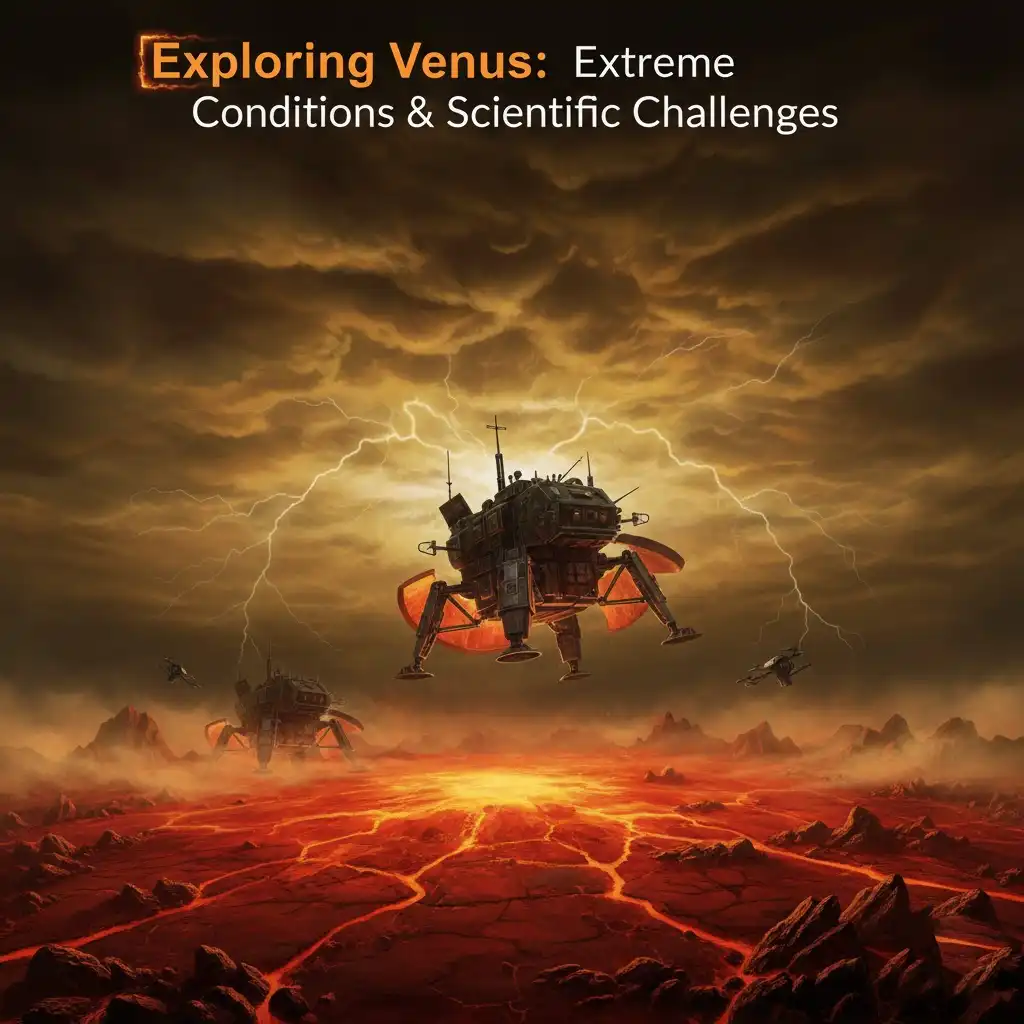
    Exploring Venus: Extreme Conditions & Scientific Challenges

    Illustration of Venus showing extreme heat, dense clouds, and robotic spacecraft exploring its surface.

    Venus is among the planets in the solar system that exhibit the most extreme conditions. Its intense heat, crushing pressure, and toxic atmosphere make exploration very difficult. Despite these challenges, Venus remains a key target for planetary research.

    • Extremely High Surface Temperature: Venus has an average surface temperature of about 464°C, making it the hottest planet in the solar system.
    • Crushing Atmospheric Pressure: The surface pressure on Venus is about 92 times higher than Earth’s, similar to deep-ocean conditions.
    • Toxic Atmosphere: Venus’s atmosphere is mostly carbon dioxide and contains sulfuric acid clouds that are harmful to life and machines.
    • Limited Spacecraft Survival: Most landers sent to Venus survived only a short time due to extreme heat and pressure.
    • Unusual Day Length: A single day on Venus is longer than its year because the planet rotates very slowly.
    • Scientific Importance: Studying Venus helps scientists understand greenhouse effects and climate evolution on planets.

    The Hottest Planet in Our Solar System is Venus

    In conclusion, when people ask which planet is the hottest in the solar system, the correct answer is Venus. Although Mercury is closer to the Sun, it lacks a thick atmosphere to trap heat. Venus, on the other hand, has a dense carbon dioxide atmosphere that creates a strong greenhouse effect, causing extremely high surface temperatures.


    This trapped heat keeps Venus consistently hot both day and night. Studying Venus helps scientists better understand planetary atmospheres and climate processes. It also highlights how atmospheric composition plays a more important role than distance from the Sun in determining planetary temperatures. Enjoyed learning which is the hottest planet in the solar system? Read more space, science, and education blogs on Mixt Academy to keep your curiosity growing. Read More 

    FAQs

    Which is hotter, Mercury or Venus?

    Venus is hotter than Mercury, even though Mercury is closer to the Sun. The key reason is Venus’s extremely dense atmosphere, which traps heat through a powerful greenhouse effect. Mercury lacks a thick atmosphere, so it cannot retain heat and cools rapidly at night, making Venus consistently hotter.

    Uranus is the coldest planet in the solar system, with temperatures dropping as low as −224°C. Although Neptune is farther from the Sun, Uranus releases very little internal heat, which causes it to be colder overall than any other planet.

    Mercury is much hotter than Mars. Mercury experiences extremely high daytime temperatures due to its closeness to the Sun. Mars, on the other hand, has a thin atmosphere and lower solar exposure, keeping its average temperature far colder.

    Mercury is the second-hottest planet in the solar system. While it can reach very high temperatures during the day, its lack of atmosphere prevents it from holding heat, causing extreme temperature drops at night.

    Venus is the hottest planet because its thick carbon dioxide atmosphere traps heat efficiently. This runaway greenhouse effect prevents heat from escaping, causing surface temperatures to remain extremely high at all times.

    Venus is hotter than Mercury because it has a dense atmosphere that stores heat continuously. Mercury’s thin atmosphere allows heat to escape quickly, leading to dramatic temperature changes rather than constant extreme heat. 

    round logo

    Mixt Academy

    Mixt Academy is a global online tutoring platform that connects students with expert IGCSE, GCSE, and A-Level tutors for one-to-one learning. With flexible scheduling, personalized lesson plans, and experienced teachers from top curricula, Mixt Academy helps students strengthen concepts, improve exam skills, and achieve higher grades with confidence.


    Recently posts

  • Top 4 Schools…

    Top-rated ★★★★★ Top 4 Schools in Dubai Land Find Top…

  • Join the Immerse…

    Enter the Immerse Education Essay Competition Today! Do you possess…

  • 5 American Curriculum…

    Top-rated ★★★★★ Top 5 American Curriculum Schools in Ajman Find…

  • Categories

    IGCSE Popular Blogs

  • IGCSE Chemistry Papers: Common Mistakes That Cost You Marks

    IGCSE Chemistry Papers: Common Mistakes & Exam Tips This IGCSE…

  • IGCSE Extended vs Core Tiers: How to Pick the Right One?

    IGCSE Extended vs Core Tiers: How to Pick the Right…

  • Last Month Before IGCSE Exams: Study Plan Guide

    Last Month Before IGCSE Exams: A Complete Study Plan Are…

  • GCSE Popular Blogs

  • GCSE Grade Boundaries Guide

    Understanding GCSE Grade Boundaries and How to Prepare? Grade boundaries…

  • Differences GCSE English Language vs English Literature

    Differences GCSE English Language vs English Literature GCSE English is…

  • What is GCSE? A Guide for International Students & Parents

    What is GCSE? A Guide for International Students & Parents…

  • AS & A Level Popular Blogs

  • Top Benefits of Completing AS and A Levels Privately

    Top Benefits of Completing AS and A Levels Privately Explore…

  • IB Popular Blogs

  • IB Curriculum Subjects

    IB Curriculum Subjects – All Programmes Complete Guide When people…

  • IB Math: Strategies for Achieving a Level 7

    IB Math: Strategies for Achieving a Level 7 Learn expert…

  • OCR Popular Blogs

  • How to Use OCR Past Papers for Effective Revision

    How to Use OCR Past Papers for Effective Revision? Past…

  • AQA Popular Blogs

  • AQA GCSE Chemistry Specification Guide for Exam Success

    Complete Guide to the AQA GCSE Chemistry Specification Understanding the…

  • Everything Students and Parents Must Know About AQA Exams

    Everything Students and Parents Must Know About AQA Exams Choosing…

  • AQA vs Cambridge: Comparing UK and International Exam Boards

    AQA vs Cambridge: Comparing UK and International Exam Boards When…

  • Contact Mixt Academy to Hire a Tutor
    Who i am
    Name
    Offers End in
    • 00
    • 00
    • 00

    Hire an Expert Tutor from Just 15$/hr