
A Level Physics combines detailed theory, challenging concepts of maths, and practical experiments. Many students think about whether they will be able to deal with the demands of the A Level Physics syllabus, whether their maths skills are good enough, or how big a step it is from GCSE Physics. These are all genuine concerns.
A Level Physics is a complex subject, and it tests your problem-solving skills and pushes you to think about the world in new, abstract ways. Success comes from building strong foundations, applying knowledge to new problems, and understanding how the exam papers are structured. This is why organised A Level Physics notes and regular exam practice are essential.
In this article, we will walk you through exactly what A Level Physics is, what skills it requires, how it is assessed, and why study it. You will also find proven guidance on how to revise A-level Physics effectively and see how an A-level Physics tutor can help boost your performance.
Get clear guidance from an expert and book a free trial with Mixt Academy.
A Level Physics is a two-year science qualification that students study in Years 12 and 13. It is built on the knowledge of GCSE, but in a more comprehensive way. You will explore why things happen, not just what happens. Think of GCSE Physics as learning the rules of the game. A Level Physics is mastering the strategy using advanced A Level Physics equations/formulas.
But here is the reality: it is both conceptually comprehensive and mathematically challenging. You will need to understand complex ideas and back them up with calculations. But don’t let that put you off, because universities love this subject. It shows you can think critically, solve problems, and handle tough material. This is why AQA A Level Physics, Pearson Edexcel A Level Physics, and OCR Physics are all highly regarded by STEM universities.
The course content follows a clearly defined A Level Physics topics list syllabus, covering both theoretical principles and practical applications.
A Level Physics covers a wide range of core topics. The exact topics depend on whether you are studying AQA, OCR, or Pearson Edexcel. Here are the core content areas you will explore:
Read our complete guide on Quantum Physics to learn more about this fascinating topic.
Across many of these core areas, students revisit foundational scientific ideas such as Physical and chemical changes, particularly when studying thermal physics, nuclear processes, and material behaviour. Understanding how energy transfers can cause physical changes without altering substances, versus chemical changes that form new substances, helps students build stronger links between GCSE science concepts and advanced A Level Physics applications.
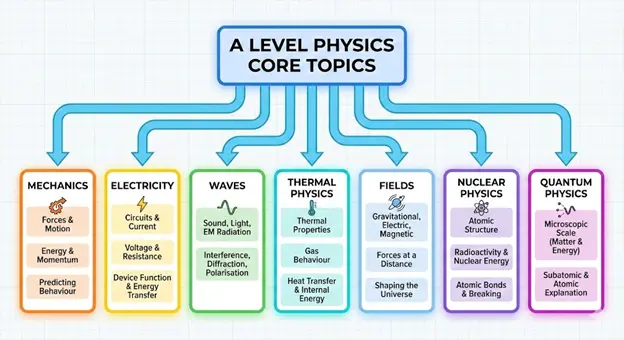
As you progress to A Level content, the topics become more advanced and complex. These topics require confidence in algebra and regular use of A Level Physics equations/formulas under exam conditions.
Exam boards allow students to study one optional module in greater detail.
Mastering these core, advanced, and optional topics ensures you have the knowledge and skills needed to succeed in both the exams and future studies in physics.
Get Expert help at Mixt Academy and get your queries answered instantly.
A Level Physics is not just about memorising facts. You need a specific set of skills, including:
Strong revision habits and structured A Level Physics revision plans make a huge difference here.
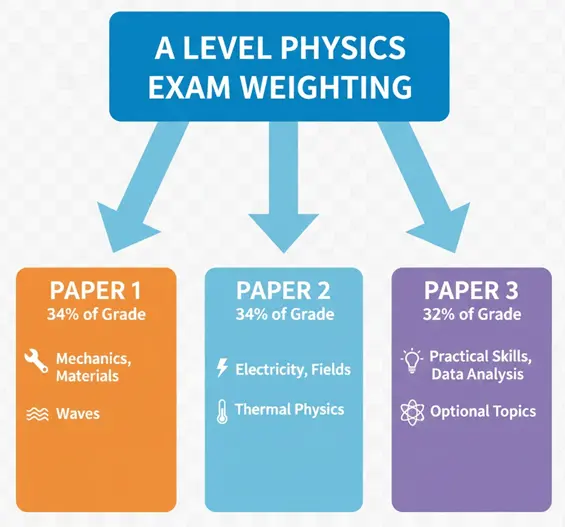
The A Level Physics syllabus is assessed through several papers that combine theory questions with practical skills evaluation. Follow this guide, Everything About A Level Physics Papers and Exam Preparation, to learn about each A Level Physics paper in detail.
A great benefit of privately completing your AS or A Level qualification is getting the freedom to balance your learning time with your hobbies in a schedule that is designed to your needs.
There are some issues faced by students and parents. These include the school learning environment itself, which is not always advantageous to the development of slow learners or students with learning disabilities. Students may not be 100% satisfied with their class’s learning outcomes. Moreover, parents may feel that they need to take further steps. For example, spending money on additional tutoring.
Paper 1
Covers fundamental concepts like motion, forces, energy, materials, and wave behaviour. Questions require both short, direct answers and multi-step problem-solving.
Paper 2
Focuses on electricity and circuits, electric and gravitational fields, and the principles of thermal physics. This paper tests your ability to link theory with mathematical applications.
Paper 3
Examines your practical knowledge, ability to analyse data, and understanding of an optional topic such as Astrophysics, Medical Physics, or Engineering Physics.
The weight of each paper varies slightly between exam boards, but generally:
Paper 3 contributes the remaining 32% and includes practical skills, data analysis, and optional topics.
With nearly a third of your marks tied to practical and analytical work, it is essential to prepare for these assessments as carefully as you do for theory papers.
Through self-study, you should develop your learning skills instead of just memorizing the textbooks. Self-confidence will help you in networking and expand your circle of contacts. It takes a lot of hard work, but your confidence can put you in the best possible position to achieve your educational goals.
Most boards assess practical skills through a mix of formal lab-based practical exams and practical endorsements or coursework, which confirm your competence in carrying out core experiments.
Even if practical work is not directly graded, it still plays a key role in written papers where you may be asked to analyse experimental data, evaluate methods, or suggest improvements. Understanding how each paper is structured and weighted helps you plan your revision effectively and prepare for every part of the assessment.
Master it with 1-to-1 A Level Physics tutoring from Mixt Academy.
While all exam boards assess the same core physics principles, each has its own approach to content, question style, and practical assessment.
While the core physics principles are the same, each board has its own style:
Some topics in A Level Physics consistently challenge students. Breaking them into smaller parts can make them manageable.
Breaking challenging topics into smaller, logical steps makes them easier to understand and more manageable to revise.
Successful students tend to follow structured, varied study plans. For a detailed understanding, read our complete guide on How to Revise for A Level Physics, where we break down proven methods step by step.
Revise your GCSE content
Make sure you have a solid understanding of the basic GCSE concepts like forces, energy, electricity, and waves. These are the foundations that everything else builds on.
Boost your key maths skills
Practice algebra, rearranging equations, working with standard form, and basic trigonometry. Because you will use these constantly.
Practice with Past Papers and Mark Schemes
Use A Level past papers early to learn question styles and pacing. Check mark schemes to see what examiners want, and revise difficult questions until you are confident.
Use Visual Learning
Create concept maps, concise A Level Physics notes, flashcards for key equations, and annotated diagrams to help remember complex ideas.
Master Physics Formulas
A Level Physics numerical problems demand the application of formulas, units, and logical steps. Read our guide “How to Solve Physics Numericals Step-by-step” to learn these demanding topics easily.
Focus on Time Management
Practise mixed-topic questions, time yourself to improve speed, and review mistakes to avoid repeating them.
Combine Your Study with Expert Tutoring
Self-study builds core knowledge, while an online A Level Physics tutor can help with advanced problems, practical skills, and spotting knowledge gaps.
An A Level Physics tutor can show you exactly what to fix.
A Level Physics opens doors, and it is as simple as that. Real-world applications are everywhere. Physics explains how your phone works, why planes fly, and how doctors diagnose diseases with MRI scanners. University courses require it, and Physics is essential or highly desirable for degrees in:
Many medicine courses also value Physics alongside Chemistry and Biology. Transferable skills last a lifetime. You will develop:

An A Level Physics tutor can give you personalised explanations, guide you through complex problems, provide feedback on Physics A Level past papers, and help build your practical and data analysis skills while keeping your revision on track.
With Mixt Academy, you learn from experienced examiners who know how marks are awarded, can highlight common mistakes, and design lessons to your needs. Hence, you approach the exam with confidence.
“Online physics tutors from Mixt Academy helped my daughter finish coursework. She explained clearly what examiners want now. Her grades improved, and she feels proud to show her work.”
Just like this happy student, we can provide you with the best online academic support you are looking for.
A Level Physics is a challenging course, but it rewards curiosity, persistence, and imagination. The subject gives you not just a qualification, but a detailed understanding of how the universe works. You will develop an analytical mindset and problem-solving skills that last a lifetime. Plus, you will open doors to exciting careers in science, engineering, technology, and beyond. Success does not come from being naturally brilliant. It comes from curiosity, expert support, and good study habits. And those are things you can absolutely develop.
At Mixt Academy, we have all the tools you need to support your learning, including past exam papers organised by course for easy access.
It is challenging due to its mix of theory, maths, and practical work. However, with consistent study and practice, it becomes manageable.
Yes, A Level Physics is hard and can be a big jump up from GCSE. But don't forget, it is supposed to be! After all, 'A Level' stands for 'Advanced Level. However, professional support from A Level Physics tuition makes this subject easily manageable.
AQA, Pearson Edexcel, OCR, and CIE are the main exam boards that offer A Level Physics.
Many students find mechanical and electromagnetic fields, quantum physics, and some force-related problems most challenging.
The exact number depends on the board. For example, AQA requires 12 core practicals, while Pearson Edexcel specifies 16.
Grades in A Level Physics start from A* to E and are awarded based on your total percentage across all exam papers. These percentages are then compared against A Level Physics grade boundaries, which are set each year by exam boards such as AQA, Pearson Edexcel, and OCR.
Master the syllabus, practise regularly, review mark schemes, and ensure strong performance in both theory and practical assessments.
Yes, but it requires discipline, good resources, and regular practice with past papers.
Engineering, astrophysics, technology, healthcare, renewable energy, data science, and more.
Begin consistent revision at least six months before your exams, and increase the intensity of revision in the final three months and prepare yourself using past papers and A-level physics equation sheet.
Yes, personalised guidance from an online A Level Physics tutor can address weaknesses, improve exam technique, and build confidence.

Mixt Academy is a global online tutoring platform that connects students with expert IGCSE, GCSE, and A-Level tutors for one-to-one learning. With flexible scheduling, personalized lesson plans, and experienced teachers from top curricula, Mixt Academy helps students strengthen concepts, improve exam skills, and achieve higher grades with confidence.


IGCSE Physics Formula Sheet: Key Formulas for 0625 & Edexcel…
IGCSE Chemistry Papers: Common Mistakes & Exam Tips This IGCSE…
IGCSE Extended vs Core Tiers: How to Pick the Right…
Understanding GCSE Grade Boundaries and How to Prepare? Grade boundaries…
Differences GCSE English Language vs English Literature GCSE English is…
What is GCSE? A Guide for International Students & Parents…
A Level vs AP: Complete Guide to Choosing the Right…
Top Benefits of Completing AS and A Levels Privately Explore…
Cambridge vs IB Guide to Choosing the Best Curriculum Choosing…
IB vs A Levels: Which Qualification Is Right for You?…
How to Use OCR Past Papers for Effective Revision? Past…
AQA Physics Equation Sheet: Complete GCSE Guide for Combined Science…
AQA vs Edexcel Complete GCSE Comparison and Guide Choosing between…
Complete Guide to the AQA GCSE Chemistry Specification Understanding the…
Hire an Expert Tutor from Just 15$/hr