
In this article, we will walk you through exactly what A Level Physics is, what skills it requires, how it is assessed, and why study it. You will also find proven guidance on how to revise A-level Physics effectively and see how an A-level Physics tutor can help boost your performance.
Not Sure if a Level Physics Is Right for You?
Get clear guidance from an expert and book a free trial with Mixt Academy.
What is A Level Physics?
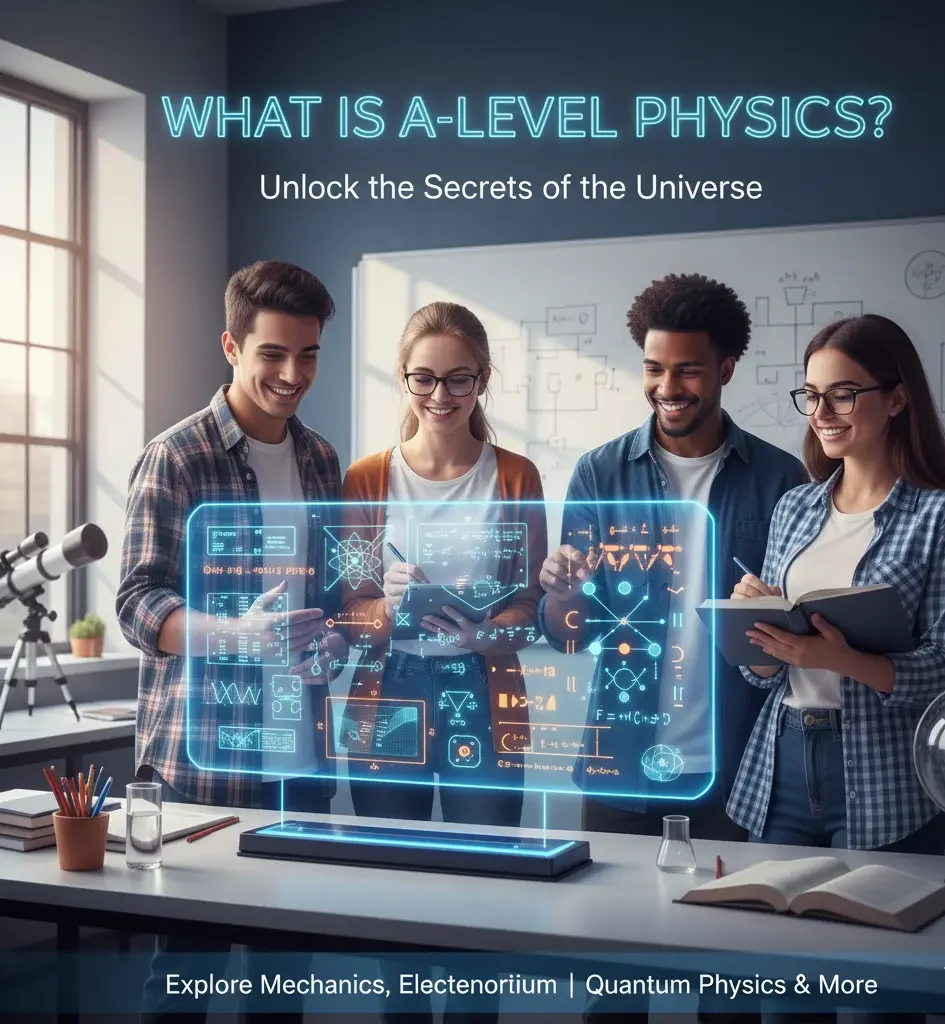
A Level Physics is a two-year advanced science qualification studied in Years 12 and 13. It builds on the foundational principles of physics learned earlier, but in a much more detailed and analytical way. Instead of simply understanding what happens in physical systems, students explore why it happens by applying advanced concepts and equations. In essence, if basic physics teaches you the rules of the game, A Level Physics is about mastering the strategy, using mathematical formulas and deeper reasoning to explain and predict how the universe works.
But here is the reality: it is both conceptually comprehensive and mathematically challenging. You will need to understand complex ideas and back them up with calculations. But don’t let that put you off, because universities love this subject. It shows you can think critically, solve problems, and handle tough material. This is why AQA A Level Physics, Pearson Edexcel A Level Physics, and OCR Physics are all highly regarded by STEM universities.
What Topics Do You Study in A-level Physics?
The course content follows a clearly defined A Level Physics topics list syllabus, covering both theoretical principles and practical applications.
Core Topics
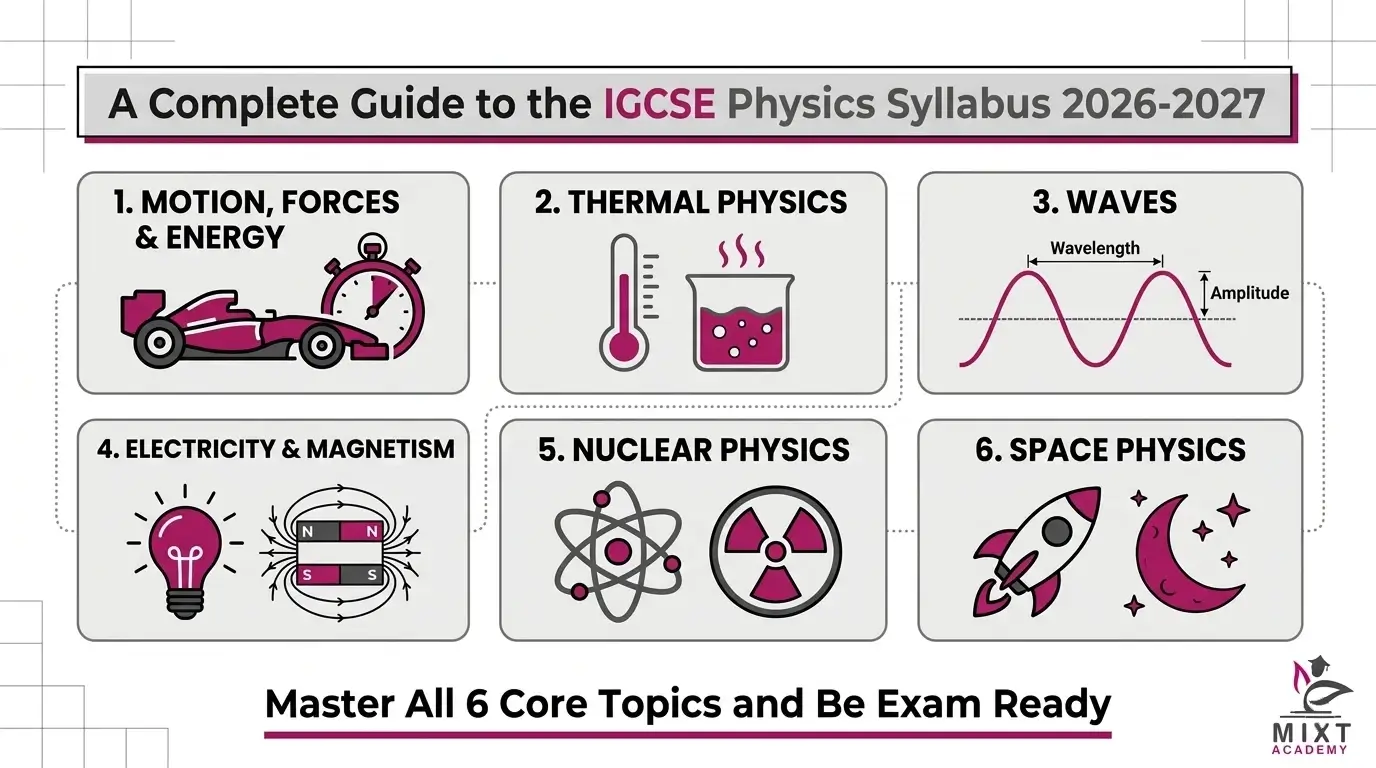
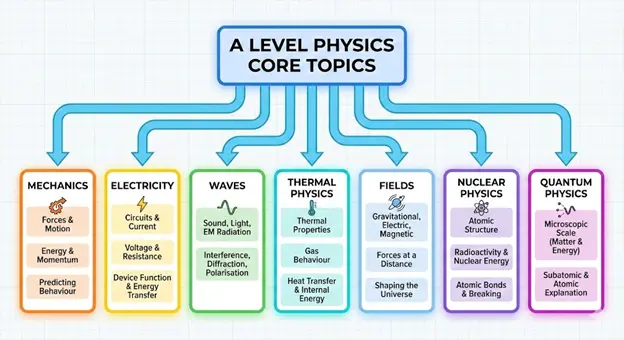
A Level Physics covers a wide range of core topics. The exact topics depend on whether you are studying AQA, OCR, or Pearson Edexcel. Here are the core content areas you will explore:
- Mechanics: It deals with forces, motion, energy, and momentum, and you will learn why objects move and how to predict their behaviour.
- Electricity: This topic covers circuits, current, voltage, and resistance, and you will understand how electrical devices work and how energy is transferred.
- Waves: The concept explores properties of waves, including sound, light, and electromagnetic radiation. You will also learn about phenomena such as interference, diffraction, and polarisation.
- Thermal Physics: It examines the thermal properties of matter and the behaviour of gases. You will also learn about heat transfer and the concept of internal energy.
- Fields: Students will study gravitational, electric, and magnetic fields in this topic. They will also discover the forces that act at a distance and how they shape our universe.
- Nuclear Physics: It looks at atomic structure, radioactivity, and nuclear energy. You will understand what holds atoms together and what happens when they break apart.
- Quantum Physics: It is the study of matter and energy at microscopic scales and explains everything at the subatomic and atomic scales.
Read our complete guide on Quantum Physics to learn more about this fascinating topic.
Across many of these core areas, students revisit foundational scientific ideas such as Physical and chemical changes, particularly when studying thermal physics, nuclear processes, and material behaviour. Understanding how energy transfers can cause physical changes without altering substances, versus chemical changes that form new substances, helps students build stronger links between science concepts and advanced A Level Physics applications.
Advanced Topics
As you progress to A Level content, the topics become more advanced and complex. These topics require confidence in algebra and regular use of A Level Physics equations/formulas under exam conditions.
- Thermal Physics: This topic deals with temperature, heat transfer, and the kinetic theory of gases.
- Gravitational and Electric Fields: It covers field lines, potential, and the laws concerning interactions between masses and charges.
- Nuclear Physics: You will study radioactive decay, nuclear models, binding energy, and applications in power generation or medicine under this topic.
Optional Topics
Exam boards allow students to study one optional module in greater detail.
- Astrophysics: You can learn stellar properties, cosmology, and observational techniques in this topic.
- Medical Physics: It deals with imaging methods, radiation therapy, and diagnostic tools.
- Engineering Physics: This topic covers rotational mechanics, materials technology, and thermodynamic systems in engineering contexts.
Mastering these core, advanced, and optional topics ensures you have the knowledge and skills needed to succeed in both the exams and future studies in physics.
Struggling With Mechanics, Electricity, or Quantum Physics?
Get Expert help at Mixt Academy and get your queries answered instantly.
What Skills Do You Need to Succeed in A-Level Physics?
A Level Physics is not just about memorising facts. You need a specific set of skills, including:
- Problem-solving: You will face questions that require you to apply multiple concepts in new situations. Students need to break down complex problems into manageable steps.
- Logical thinking: Physics is all about following chains of reasoning from first principles to conclusions.
- Maths fluency: You will use algebra, trigonometry, and logarithms regularly. If you are comfortable with maths, physics becomes much easier.
- Curiosity: The best physics students are the ones who ask questions and have curiosity about learning in detail.
- Perseverance: Some ideas in physics take time to learn. You need patience and determination to keep going when concepts seem impossible to understand.
- Practical skills: You will conduct experiments, collect data, and analyse results. Being careful, systematic, and good at interpreting is crucial.
Strong revision habits and structured A Level Physics revision plans make a huge difference here.
How is the A-Level Physics Syllabus structured Across Exam Papers?
The A Level Physics syllabus is assessed through several papers that combine theory questions with practical skills evaluation. Follow this guide, Everything About A Level Physics Papers and Exam Preparation, to learn about each A Level Physics paper in detail.
Breakdown of Exam Papers
Here is what each A Level Physics exam paper covers and how it tests your knowledge and skills.
Paper 1:
Covers fundamental concepts like motion, forces, energy, materials, and wave behaviour. Questions require both short, direct answers and multi-step problem-solving.
Paper 2:
Focuses on electricity and circuits, electric and gravitational fields, and the principles of thermal physics. This paper tests your ability to link theory with mathematical applications.
Paper 3:
Examines your practical knowledge, ability to analyse data, and understanding of an optional topic such as Astrophysics, Medical Physics, or Engineering Physics.
Weighting and Mark Distribution
The weight of each paper varies slightly between exam boards, but generally:
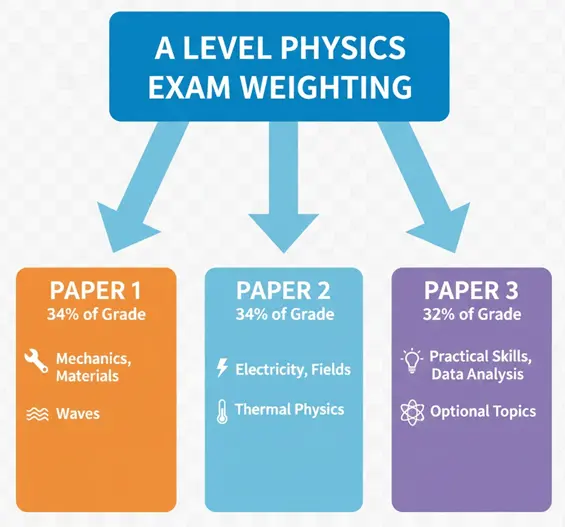
- Paper 1 makes up about 34% of your grade, focusing on mechanics, materials, and waves.
- Paper 2 also accounts for roughly 34%, covering electricity, fields, and thermal physics.
- Paper 3 contributes the remaining 32% and includes practical skills, data analysis, and optional topics.
Internal Assessments and Practical Exams
Most boards assess practical skills through a mix of formal lab-based practical exams and practical endorsements or coursework, which confirm your competence in carrying out core experiments.
Even if practical work is not directly graded, it still plays a key role in written papers where you may be asked to analyse experimental data, evaluate methods, or suggest improvements. Understanding how each paper is structured and weighted helps you plan your revision effectively and prepare for every part of the assessment.
Understanding the Exam Structure Is the Key to Top Grades.
Master it with 1-to-1 A Level Physics tutoring from Mixt Academy.
Comparing Exam Boards: AQA, Pearson Edexcel, OCR
While all exam boards assess the same core physics principles, each has its own approach to content, question style, and practical assessment.
Key Differences Between Exam Boards
While the core physics principles are the same, each board has its own style:
- AQA: Straightforward questions, focus on applying knowledge to real-life scenarios, clear practical requirements.
- Pearson Edexcel: Strong focus on mathematical problem-solving and a variety of question formats.
- OCR: Offers two routes, OCR A (traditional) and OCR B (context-led), with engaging links to real-world applications.
How to Deal with Difficult Topics in A-Level Physics?
Breaking Down Mechanics Problems
- Start with clear diagrams.
- Identify all known and unknown quantities.
- Apply Newton’s laws or kinematic equations step-by-step.
- Check units at every stage.
Electricity and Circuits Made Simple
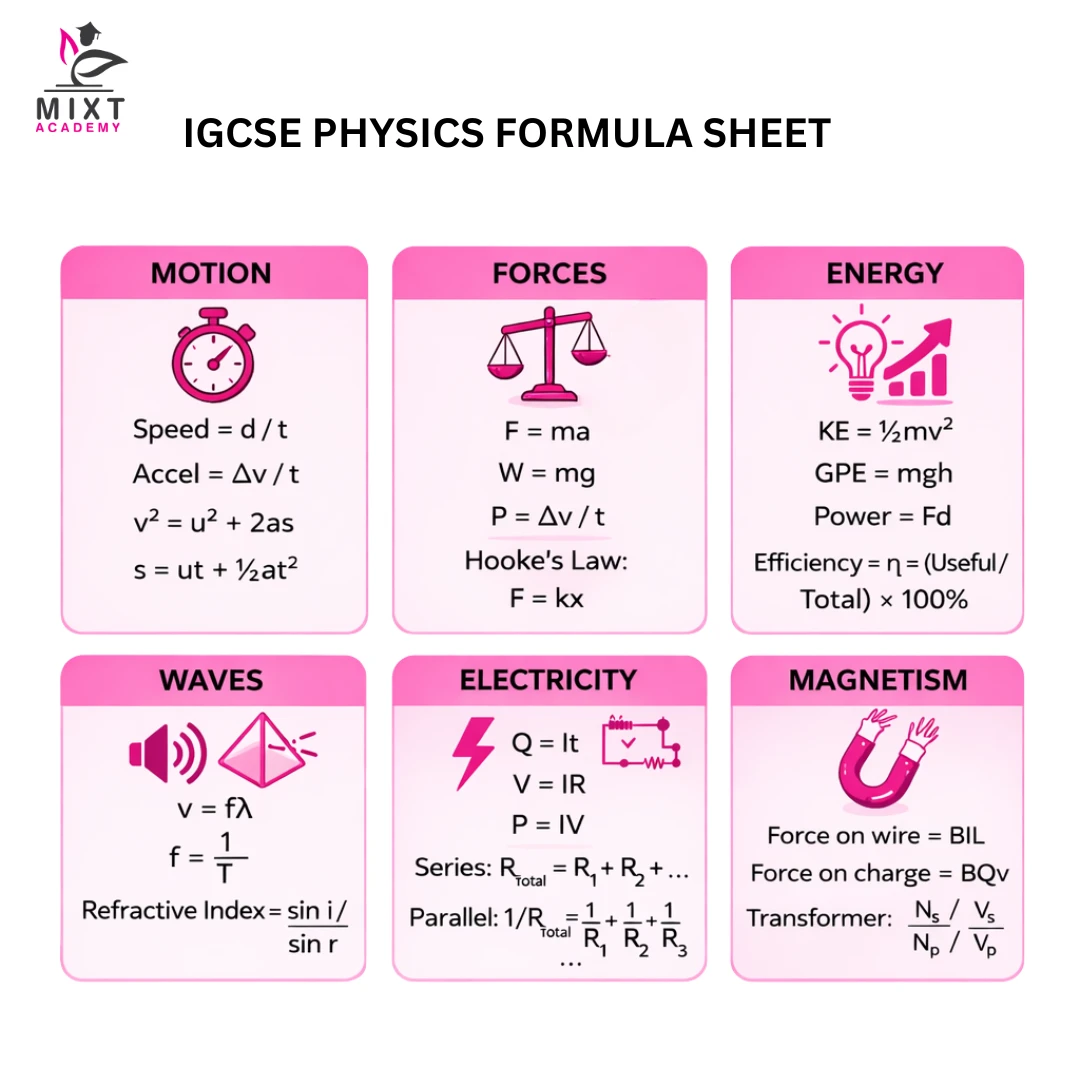
- Memorise key equations such as V = IR and P = VI.
- Practice using Kirchhoff’s laws to solve multi-loop circuits.
- Use past paper circuit diagrams to become comfortable interpreting complex layouts.
Understanding Waves and Optics
- Review definitions of frequency, wavelength, and wave speed.
- Use double-slit and diffraction grating equations in practice problems.
- Watch animations or use simulations to visualise interference and diffraction patterns.
- Breaking challenging topics into smaller, logical steps makes them easier to understand and more manageable to revise.
Proven Study Strategies for A Level Physics
Successful students tend to follow structured, varied study plans. For a detailed understanding, read our complete guide on How to Revise for A Level Physics, where we break down proven methods step by step.
Boost your key maths skills
Practice algebra, rearranging equations, working with standard form, and basic trigonometry. Because you will use these constantly.
Practice with Past Papers and Mark Schemes
Use A Level past papers early to learn question styles and pacing. Check mark schemes to see what examiners want, and revise difficult questions until you are confident.
Use Visual Learning
Create concept maps, concise A Level Physics notes, flashcards for key equations, and annotated diagrams to help remember complex ideas.
Master Physics Formulas
A Level Physics numerical problems demand the application of formulas, units, and logical steps. Read our guide “How to Solve Physics Numericals Step-by-step” to learn these demanding topics easily.
Focus on Time Management
Practise mixed-topic questions, time yourself to improve speed, and review mistakes to avoid repeating them.
Combine Your Study with Expert Tutoring
Self-study builds core knowledge, while an online A Level Physics tutor can help with advanced problems, practical skills, and spotting knowledge gaps.
Why Study A Level Physics?
A Level Physics opens doors, and it is as simple as that. Real-world applications are everywhere. Physics explains how your phone works, why planes fly, and how doctors diagnose diseases with MRI scanners. University courses require it, and Physics is essential or highly desirable for degrees in:
- Engineering of all types
- Physics and Theoretical Physics
- Computer Science
- Architecture
- Materials Science
- Natural Sciences
- Aerospace Engineering
- Geophysics
Many medicine courses also value Physics alongside Chemistry and Biology. Transferable skills last a lifetime. You will develop:
- Analytical thinking that helps you break down complex problems.
- Data handling skills are used in multiple careers.
- Problem-solving abilities that employers want.
- Numerical literacy is valuable in finance, technology, and research.
- Critical thinking helps you evaluate evidence.
How Mixt Academy Can Help You Ace A Level Physics?

An A Level Physics tutor can give you personalised explanations, guide you through complex problems, provide feedback on Physics A Level past papers, and help build your practical and data analysis skills while keeping your revision on track.
With Mixt Academy, you learn from experienced examiners who know how marks are awarded, can highlight common mistakes, and design lessons to your needs. Hence, you approach the exam with confidence.
“Online physics tutors from Mixt Academy helped my daughter finish coursework. She explained clearly what examiners want now. Her grades improved, and she feels proud to show her work.”
Just like this happy student, we can provide you with the best online academic support you are looking for.
Achieve More in A Level Physics…
A Level Physics is a challenging course, but it rewards curiosity, persistence, and imagination. The subject gives you not just a qualification, but a detailed understanding of how the universe works. You will develop an analytical mindset and problem-solving skills that last a lifetime. Plus, you will open doors to exciting careers in science, engineering, technology, and beyond. Success does not come from being naturally brilliant. It comes from curiosity, expert support, and good study habits. And those are things you can absolutely develop.
At Mixt Academy, we have all the tools you need to support your learning, including past exam papers organised by course for easy access.
- Revision notes covering the entire course, including examiner tips and tricks to help you ace your exams.
- Exam questions arranged by topic with student-friendly model answers, mark scheme guidance and question-based examiner tips and tricks to help you understand exactly what examiners are looking for.
- Target tests that pinpoint your weak areas and turn them into strengths, with exam-style tests built just for you.
- Mock exams that allow you to replicate the complete exam experience. Innovative, focused exam practice, making sure you’re ready for anything.