
Different sciences affect our daily activities, from the gadgets we use to the food we eat, the cures we take to the surroundings we live in. But what is science? It is the study of the activities of the natural world and the laws controlling these activities, through observation and experimentation. Science has helped humanity understand complicated events in our everyday lives and has also helped improve life on Earth. Studying science is not only about learning things. It is about developing the ability to think and analyze, ask questions, and find solutions.
Science is the process of learning. It is organized and based on the use of evidence and the ability to adapt and change. One of the key characteristics of Science is the use of the Scientific Method. The Scientific Method is a process that helps scientists discover and understand new things and test and refine their ideas.
Book a one-on-one session with Mixt Academy today and get step-by-step guidance to master even the toughest topics!
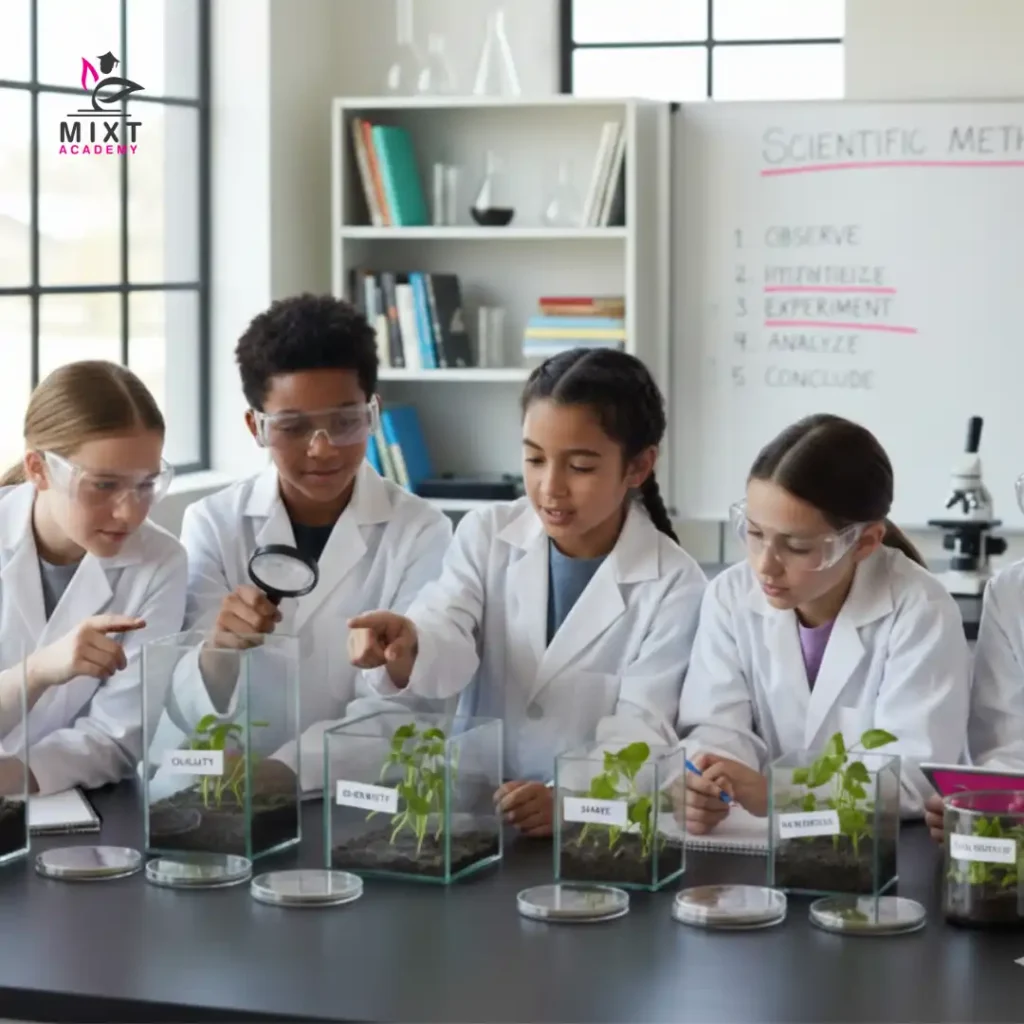
The word “science” is rooted in the Latin word “scientia,” which means “knowledge”. The core of science is the search for knowledge about the world through evidence-based answers. It is about structured knowledge. For example, a student may look around and notice that some plants grow faster than others.
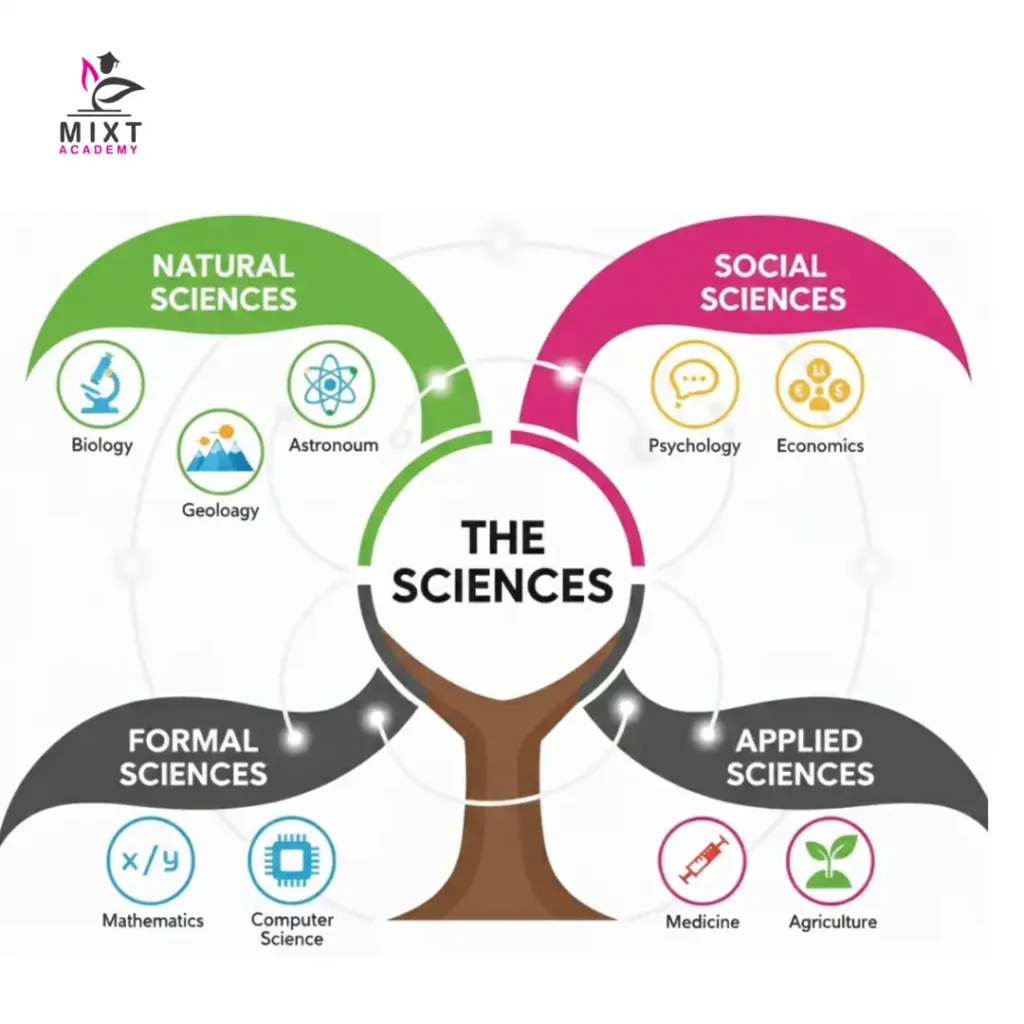
Science is broad and comprehensive; however, to maximize efficiency in the study of science, it is separated into various branches. Each of the branches covers different parts of the natural or man-made world. Understanding these branches would make it easier for students and parents to approach the subject.
The natural sciences focus on the study of the universe and all of its features. The branches that fall into this category include:
The branch of science that analyzes human societies and behaviors falls into this category. The major areas of social sciences include psychology, sociology, anthropology, and economics. There is a focus on the study of human actions to answer the question “What is social science?” In addition, it is the mass observation and the surveying of the human population.
The study of systems and logic, and not the study of natural occurrence, is called formal science. What is computer science? That is formal sciences. Other fields would be math, statistics, and logic. These fields and others help tech, engineering, and research by giving the ability to break down and solve complex problems.
Solving problems in the real world requires knowledge of the natural sciences, social sciences, and formal sciences. These comprise engineering, medicine, and environmental science. For example, developing solutions for clean energy requires knowledge of physics, chemistry, and environmental science.
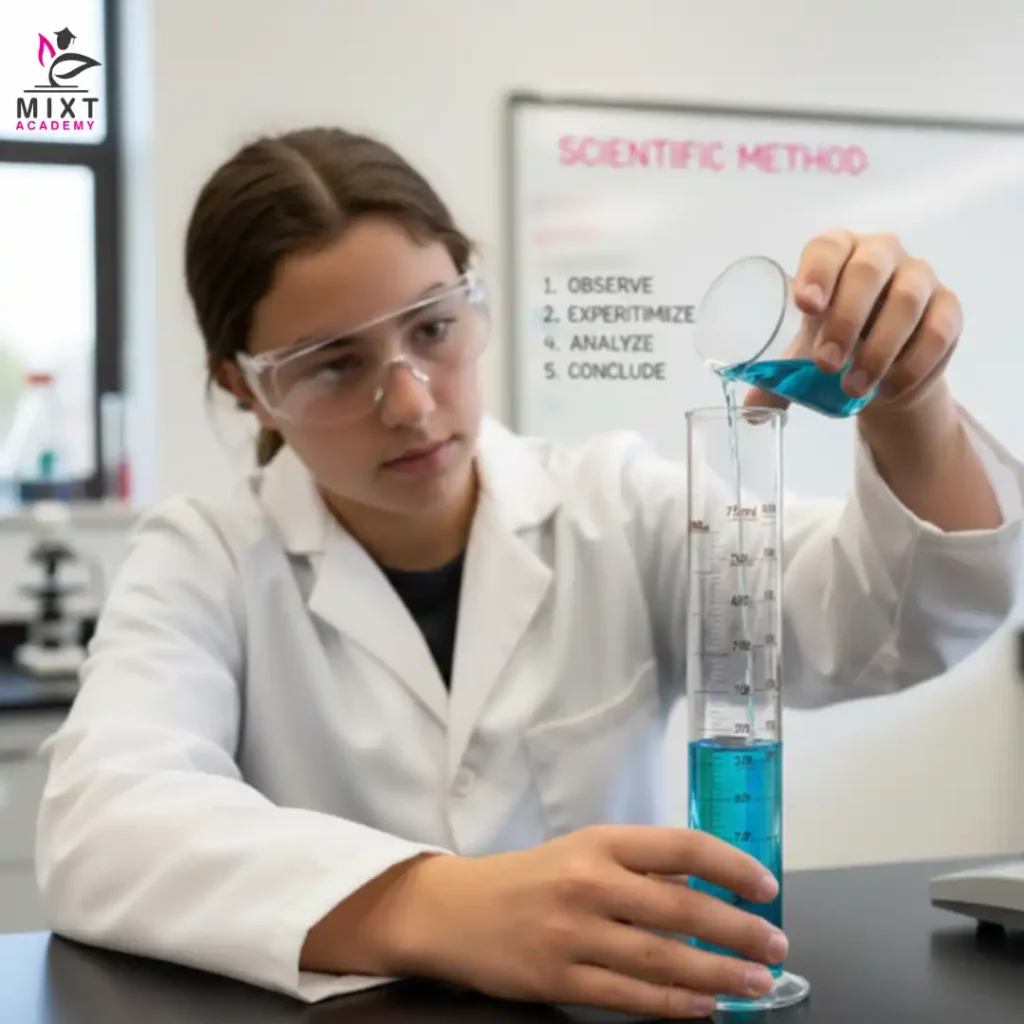
While branches of science are essential, students must understand the fundamental concepts that are the cause of all scientific disciplines. These include matter, energy, and systems. Fundamental concepts support higher-level learning, and a knowledge of core scientific concepts focuses on students’ ability to excel in STEM fields.
Matter is everything that has mass and takes up space. It is critical to understand how to study efficiently and shine in physics, chemistry, and biology. Students learn about different states of matter, like gas, liquid, and solid and how matter changes state under different conditions.
Energy makes it possible for work to happen. Energy can come in many different forms. Kinetic and potential, as well as thermal, chemical, and electrical energy, are just some of them. Energy changes can often be observed in our lives, like how food energy changes into motion for us to move.
An object can be moved or made to change its direction because of forces. The changes are described in Newton’s laws of motion. These laws help students learn about the physical world and how it works. Such concepts are useful for engineering, sports, and transportation systems.
Students often ask, “What is volume in science?” It measures the accurate space of an object. Volume is very important in all kinds of fields, like in cooking, in experiments, in the medical field, and in engineering. This space can be measured using different-sized units like liters and milliliters.
In understanding biology, students have to learn about how different systems interact with one another, in this case, the living and the non-living. This is how the world works, and how humans interact with the world and why the world needs to be cared for. This understanding also helps the students learn how to manage the resources and be sure to use them in a sustainable way.
Understanding the history of science helps students appreciate knowledge. Science is systematic. Great ancient civilizations such as Mesopotamia, Egypt, and Greece made breakthroughs in fields like astronomy, medicine, and mathematics. Greek philosopher Aristotle studied, advanced, and documented most of the fields of science, including biology and physics. The Egyptians studied the stars and created calendars.
Knowing the history of science is very important. It teaches students and the world that science is a cumulative process. Science encourages people to be curious, and it also teaches people that mistakes, debates, and experiments transform the world. As defining and systematic as the scientific method is, it also gives people the flexibility to explore questions that need answers and their frequent, varied discoveries.
The scientific method is the backbone of science. It allows researchers to explore questions systematically and ensures that findings are accurate and reproducible. The steps of the scientific method include:
Science is everywhere, and it has shaped technology, healthcare, environmental solutions, education, and transportation. Some examples include:
Explore how Mixt Academy can help you understand concepts like volume in science, ecosystems, and the scientific method with practical examples.
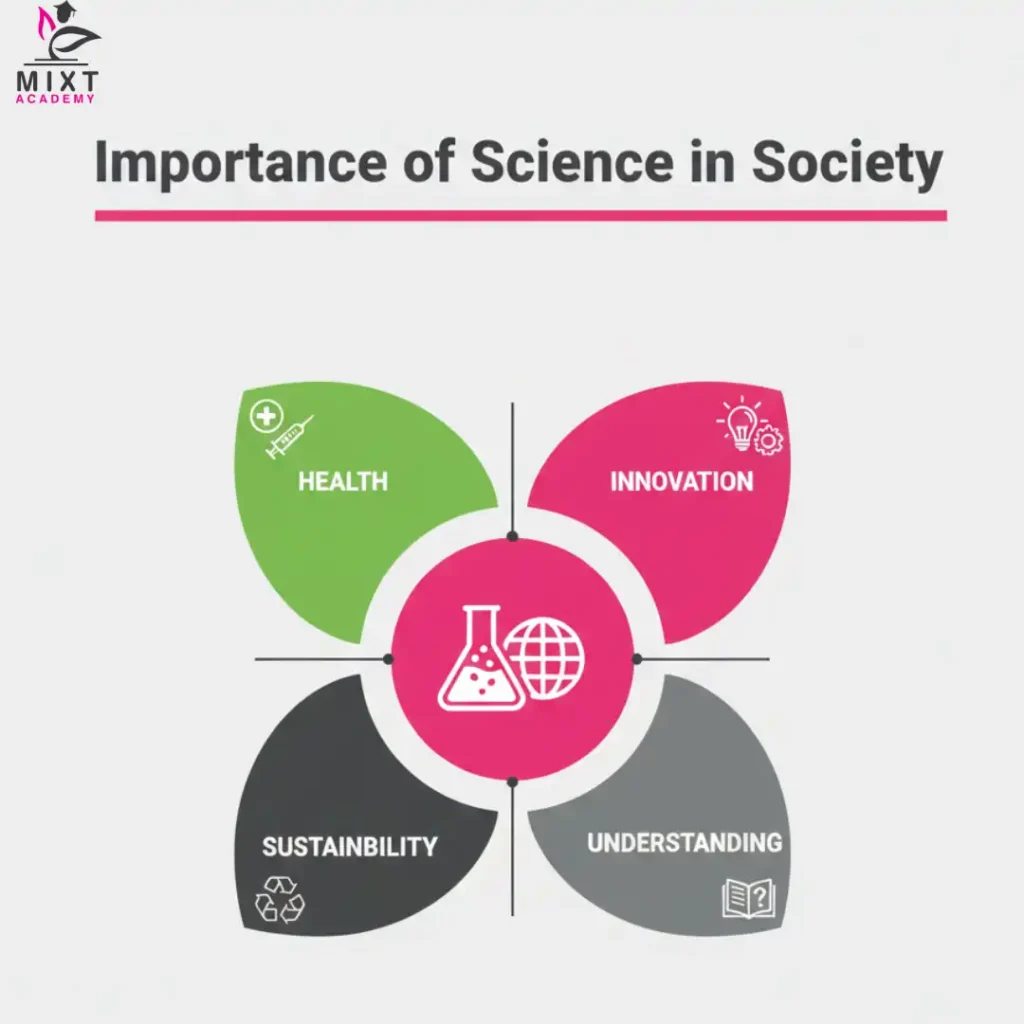
Science surrounds us every day, and it continuously improves our daily activities. Whether it is the games we play, the food we eat, the exercises we do, the lessons we learn, or the activities we choose to engage in, science is present. We don’t only study science in the classroom. Every single day, we realize the importance of science.
Inventions and new ideas are the byproducts of science. Smartphones, new medicines, and even video games started as ideas. By learning science, many students will learn how to ask the right questions that can lead to discoveries to make life easier and more exciting. Science is a tool that makes it possible to turn curiosity into a way to help communities and improve the world in many ways.
Science helps keep people safe and healthy. Clean food and water, vaccines, and even washing hands are how science keeps us safe. Scientists study pollution, the environment, and many factors related to the weather to help keep communities safe. Science teaches students the importance of things mentioned above, and how following simple rules can keep everyone healthy.
Science assists people in making positive decisions on a daily basis. It teaches us about good nutrition, how to care for wildlife and the planet, and how to navigate new technologies. Students gain the ability to question, verify, and deliberate before making decisions. As a result, they make good choices for themselves, their families, and their communities.
Join Mixt Academy to explore fun experiments and activities that show how science works every day!
If you take it step by step, learning science can be interesting and even fun. Science is all about observing, experimenting, using technology, and even collaborating with friends. Here are some enjoyable activities that can help you learn science.
To start with, the best way to learn science is to do some science observation. Students can observe the growth process of plants, the behavior of different types of weather, and even the movements and activities of insects. Students can make and keep a notebook of their observations. This will help you to see and recognise different patterns and make them ask questions.
Conducting experiments is one of the most enjoyable ways of learning. Science is fun. Students will perform activities such as growing plants in the shade and growing plants in the sun. Students learn how to formulate a working hypothesis and test it. Students learn to measure and think about what the outcome will be.
Collaborating with friends adds to the enjoyment of learning science. Students can exchange thoughts, inquire, and resolve issues. Collaborative assignments and activities teach students skills like collaboration, articulating their reasoning and exploring alternative solutions to obstacles. Science is mostly about collective learning and understanding how various concepts integrate to form solutions.
Many careers open with an understanding of the various branches of science.
Science teaching helps make informed career choices, and the necessary skills for success are developed.

At Mixt Academy, we understand that science is challenging; therefore, we offer personalized tutoring services that help students learn all of the branches of science. This includes, but is not limited to, physics, chemistry, social sciences, and computer science. Mixt Academy offers:
With Mixt Academy, students not only learn facts, but they also develop critical thinking, analytical skills, and the confidence to tackle any scientific problem.
Science is an extremely broad subject; however, it is also much more than just a subject. It is a way for people to think, reason, explore, and understand the world around us. There are numerous different branches of science that give students the ability to understand the world around them.
With the help of Mixt Academy, students are able to master science and begin to love learning. Learning is a lot more enjoyable when guided learning and interaction are paired with expert help, and every student should have the opportunity to grow into someone curious about the world and the people around them.
Science is the study of the natural world through observation, experimentation, and evidence-based reasoning.
Science can be summarized simply as the search for knowledge about how the world works.
It is the systematic study of nature and phenomena using evidence.
Science for kids introduces basic concepts like matter, energy, plants, animals, and simple experiments to spark curiosity.
Science for students includes structured learning of natural, social, and formal sciences to develop critical thinking and problem-solving skills.
Begin with observation, ask questions, perform small experiments, and gradually explore advanced topics with guidance.
Yes, understanding cause and effect, measurement, and experimentation strengthens critical thinking and practical decision-making.
From computer science to social science, Mixt Academy tutors make learning easy, interactive, and fun.

Mixt Academy is a global online tutoring platform that connects students with expert IGCSE, GCSE, and A-Level tutors for one-to-one learning. With flexible scheduling, personalized lesson plans, and experienced teachers from top curricula, Mixt Academy helps students strengthen concepts, improve exam skills, and achieve higher grades with confidence.




IGCSE Physics Formula Sheet: Key Formulas for 0625 & Edexcel…
IGCSE Chemistry Papers: Common Mistakes & Exam Tips This IGCSE…
IGCSE Extended vs Core Tiers: How to Pick the Right…
Understanding GCSE Grade Boundaries and How to Prepare? Grade boundaries…
Differences GCSE English Language vs English Literature GCSE English is…
What is GCSE? A Guide for International Students & Parents…
A Level vs AP: Complete Guide to Choosing the Right…
Top Benefits of Completing AS and A Levels Privately Explore…
Cambridge vs IB Guide to Choosing the Best Curriculum Choosing…
IB vs A Levels: Which Qualification Is Right for You?…
How to Use OCR Past Papers for Effective Revision? Past…
AQA Physics Equation Sheet: Complete GCSE Guide for Combined Science…
AQA vs Edexcel Complete GCSE Comparison and Guide Choosing between…
Complete Guide to the AQA GCSE Chemistry Specification Understanding the…
Hire an Expert Tutor from Just 15$/hr