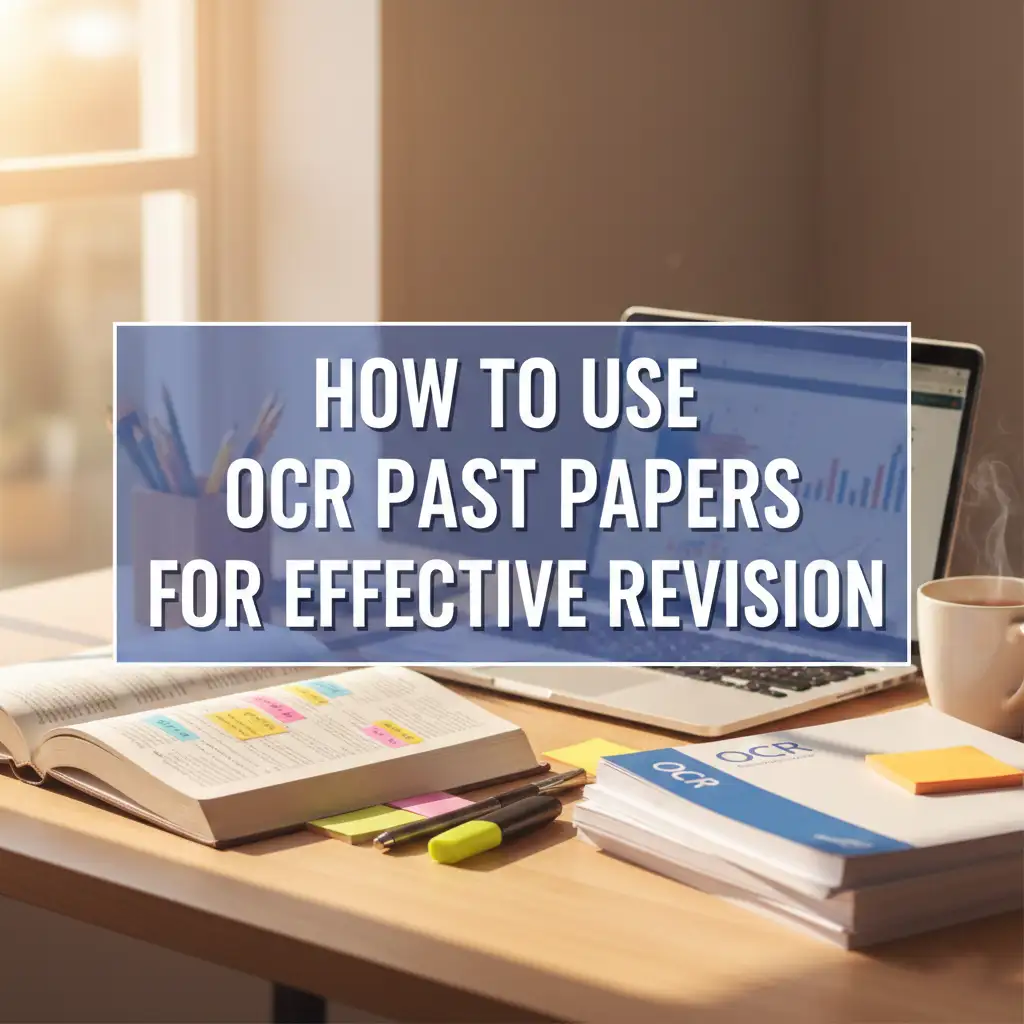
A past paper gives you an opportunity to practise the type of questions used in an actual assessment. More importantly, when you use the paper alongside its mark scheme and, where available, examiner feedback, you can identify exactly where your answers need improvement. The key is not simply to complete as many papers as possible.
The real benefit comes from attempting questions, analysing your mistakes, revising the relevant material, and then applying what you have learned to another question. Here is a practical way to make OCR past papers a meaningful part of your revision.
Why Should You Use OCR Past Papers for Revision?
Past papers help you move from passive revision to active exam practice. Reading a textbook or reviewing class notes can help you understand a topic, but it does not always prepare you for the way that knowledge will be tested. Past papers allow you to practise recalling information and using it in the format expected in an OCR assessment. They can help you:
- Become familiar with the structure and style of your exam.
- Understand how command words affect your answer.
- Identify topics or concepts you have not fully understood.
- Practise applying knowledge rather than simply recalling it.
- Improve the speed and organisation of your answers.
- Learn how marks are awarded.
- Recognise patterns in your mistakes.
- Build confidence before the real examination.
However, a past paper should not be treated as a prediction of what will appear in your next exam. Past questions can help you understand the exam style, but they cannot tell you exactly what the next paper will contain. This is why it is important to find a tutor that guides you at home or online after school.
When Should You Start Using OCR Past Papers?
You do not have to wait until the final weeks before your exam to use past papers. They can be useful at different stages of revision, provided you use them differently.
Early Revision: Use Questions to Check Understanding
At the beginning of your revision, you may not be ready to sit an entire paper under timed conditions. Instead, choose questions related to topics you have already studied. Attempt them with your notes available when necessary. At this stage, focus on questions such as:
- What is this question really asking?
- Which topic does it test?
- Which command word has been used?
- What information should I include?
- Where did my understanding break down?
The goal is not to achieve a high score. It is to discover what you know and where you need further work.
Hire the Best Online Tutors for Your Child
Midway Through Revision: Practise Without Notes
Once you have covered most of the syllabus, start attempting questions without referring to your notes. You can work through individual sections or topic-based questions and introduce time limits gradually.
For example, if a section normally takes around 20 minutes, give yourself a similar amount of time and assess whether you can complete it accurately without rushing. This stage helps connect subject knowledge with exam technique.
Final Revision: Complete Full Papers
Closer to the exam, start completing full OCR papers under realistic conditions. Find a quiet space, put your notes away, set the appropriate time limit and avoid interruptions. Once you finish, take a proper break before marking the paper.
Full papers are particularly useful at this stage because they test more than your subject knowledge. They also test concentration, time management, question selection and your ability to maintain the quality of your answers throughout an entire exam.
How to Use OCR Past Papers Step by Step
Completing a past paper is only the first part of the process. Follow a structured review method to get more from every paper.
- Check Your Exact Specification
Before choosing a paper, make sure it relates to the OCR subject, qualification and specification you are currently studying. This matters because specifications can change. An older paper may include content or assessment features that are not part of your current course. Check the paper details carefully rather than assuming that every OCR paper is interchangeable.
- Attempt the Paper Honestly
Choose whether you need an untimed, partially timed or fully timed attempt based on your stage of revision. Do not look at the mark scheme while answering. Avoid checking notes unless the purpose of the exercise is specifically to practise learning rather than testing. The more accurately you recreate the conditions you are preparing for, the more useful your results will be.
- Mark Your Answers Carefully
Once you finish, use the relevant mark scheme to assess your work. Do not simply count your score and move on. For each missed mark, ask why you lost it. The following turns a score into useful information.
- Was your knowledge incorrect?
- Did you misunderstand the question?
- Did you fail to develop your explanation?
- Did you overlook a key instruction?
- Did you run out of time?
- Create an Error Log
An error log is one of the simplest ways to make past papers more effective. Record the questions you struggled with and classify the reason for the mistake. For example:
| Problem | What Happened | What to Do Next |
| Knowledge gap | I could not recall the relevant concept. | Relearn the topic. |
| Misread question | I answered a different point. | Underline keywords. |
| Weak Explanation | I gave a point without developing it. | Practise extended responses. |
| Calculation Error | The method was correct, but arithmetic was wrong. | Check each step. |
| Timing Issue | I left a question unfinished. | Practise timed sections. |
After several papers, your error log can reveal patterns. You may discover that your main problem is not lack of knowledge but interpreting questions, managing time or developing your answers. That insight can make your revision much more targeted.
- Revisit the Weak Topic
Do not immediately move to the next paper after marking. Go back to the topic behind the mistake. Review your notes, textbook or other trusted revision resources and make sure you understand the concept. Then answer a similar question without looking at the solution. This second attempt is important because it shows whether you have actually corrected the weakness.
- Try Again Later
Keep difficult questions or topics in a separate revision list. Return to them after a few days rather than repeating the same question immediately. Reattempting it later gives you a better indication of whether the knowledge and technique have stuck.
How to Get More From OCR Mark Schemes
Many students use mark schemes only to find out whether an answer is right or wrong. You can get much more value from them. Pay attention to how marks are allocated.
Some questions may reward a correct fact or calculation, while others may require a developed explanation, comparison, evaluation or a clear chain of reasoning. Look at what separates a partially correct response from one that earns full marks.
You should also pay attention to the language used in the mark scheme. This does not mean memorising model answers word for word. Instead, it helps you understand the level of precision and detail expected.
A useful habit is to ask, “What did the mark scheme reward that my answer did not include?” That question can help you improve the structure and depth of future answers.
Use Examiner Feedback to Spot Common Mistakes
Where OCR provides examiner feedback or reports for your qualification, these can add another layer to your revision. Examiner feedback can highlight common problems students experienced with particular questions. This may include vague explanations, misunderstandings of terminology, incomplete responses or failure to address a particular part of the question.
You can use these observations as a checklist when reviewing your own answers. The objective is not to copy an examiner’s wording. It is to understand why certain responses were less effective and avoid making similar mistakes yourself.
How to Approach OCR Command Words
Understanding the command word is an important part of exam technique. Words such as describe, explain, compare, analyse, evaluate and discuss can require different types of responses. For example:
- Describe usually requires relevant characteristics, features or information.
- Explanation generally requires you to show how or why something happens and develop the relevant point.
- Compare requires you to identify similarities, differences or both, depending on the question.
- Analysing requires you to examine information carefully and develop relationships, effects or implications.
- Evaluation usually requires a balanced judgement supported by appropriate evidence or reasoning.
Always check how the command word is being used within your specific subject and qualification. The question itself and the assessment guidance should determine how you structure your response.
Subject-Specific Ways to Use OCR Past Papers
Past papers can be used across different subjects, but the most effective approach depends on the type of assessment.
Maths and Science
For maths and science subjects, focus on both the final answer and the method used to reach it. Show your calculations clearly where appropriate and practise applying equations, interpreting data, analysing graphs and explaining scientific concepts. When marking, identify whether an error occurred because you:
- Chose the wrong formula or method.
- Substituted values incorrectly.
- Made an arithmetic mistake.
- Used incorrect units.
- Misinterpreted a graph, table or diagram.
- Did not provide enough scientific reasoning.
Practising maths patterns in Dubai, you can learn something for the final exam with the support of Dubai maths tutors at flexible timings.
Essay-Based Subjects
For subjects that involve extended writing, do not always write full answers to every question. Sometimes it is more efficient to practise planning. Read a question and spend a few minutes identifying your argument, supporting evidence and the structure of your response. Then compare your plan with the requirements of the question and relevant marking guidance. For longer answers, focus on staying directly relevant to the question rather than including everything you know about the topic.
Languages
Use past papers to practise the different skills assessed in your qualification, including reading, writing, listening and speaking where applicable. For writing tasks, review your responses for accuracy as well as range. Look for repeated grammatical errors, limited vocabulary, weak sentence structures and failure to address all parts of the task.
For reading and listening, review incorrect answers carefully. Knowing the correct answer is useful, but understanding why you selected the wrong one is even more valuable.
How Many OCR Past Papers Should You Complete?
There is no universal number that guarantees better results. Completing three papers carefully can be more useful than rushing through ten without analysing your mistakes. A sensible approach is to increase the number of full papers as your exam approaches, while continuing to use individual questions for targeted practice throughout your revision. Quality matters more than quantity. After each paper, you should know:
- Which topics need more revision.
- Which question types cause difficulty.
- Which mistakes you keep repeating.
- Whether your timing is improving.
- What you need to change before your next attempt.
If you cannot answer these questions, you may be completing papers without fully using the feedback they provide.
Where Can You Find OCR Past Papers?
The safest starting point is the official OCR website, where students can access past assessment materials and related resources for their qualifications. You can also find past papers for other UK examination boards through their official websites:
- OCR: Past Paper Finder
- AQA: Past Papers and Mark Schemes
- Pearson Edexcel: Past Papers
- Eduqas: Past Papers
- CCEA: Past Papers and Mark Schemes
- SQA: Past Papers
Always check that the paper, mark scheme and specification match the qualification you are currently studying.
Common Mistakes Students Make With Past Papers
Past papers are powerful revision tools, but they can become less effective when used incorrectly.
Doing Papers Too Early
If you have not learned the underlying content, repeatedly completing full papers may mainly show you what you do not know. Use individual questions alongside topic revision until your knowledge becomes more secure.
Focusing Only on Your Score
A score is useful, but it does not explain why you lost marks. Spend time reviewing your errors and identifying the underlying problem.
Memorising Model Answers
Model answers can show you how a response may be structured, but memorising them is not a substitute for understanding. Exams can use unfamiliar contexts, so you need to be able to apply knowledge rather than reproduce prepared sentences.
Ignoring Timing
Knowing the content is only part of exam preparation. Once your knowledge is reasonably secure, practise completing sections within the available time so you can identify where you are spending too long.
Repeating the Same Paper Too Quickly
If you look at the answers and immediately attempt the paper again, your score may reflect memory rather than genuine improvement. Use different questions and revisit the original paper later.
How to Build OCR Past Papers Into Your Revision Plan
Instead of making past papers your entire revision strategy, combine them with other active techniques. A balanced revision session could look like this:
- Review: Revisit a difficult topic or concept.
- Practise: Complete several relevant OCR questions without notes.
- Mark: Use the mark scheme to identify missed marks.
- Reflect: Record the reason for each mistake.
- Fix: Relearn the weak area and attempt a similar question.
- Review later: Return to the topic after a few days to check that the improvement has lasted.
This approach makes past papers part of a wider revision cycle rather than a collection of tests.
What Should You Do When Your Past Paper Score Is Low?
Do not treat a low score as a final judgement on your ability. A practice paper is there to show you what needs work. Start by dividing your mistakes into three categories:
- Knowledge: You did not know or remember the content.
- Technique: You knew the content but did not answer in the way the question required.
- Timing: You knew what to do but could not complete it within the available time.
Each problem requires a different solution. Knowledge gaps require focused revision. Technique problems require more question practice and mark-scheme analysis. Timing problems require timed sections and full-paper practice. This is much more useful than simply deciding that you “need to revise more”.
Final Thoughts
OCR past papers are most valuable when you treat them as a learning tool rather than a test of your current ability. A paper can show you what you know, but the review afterwards can show you how to improve.
Start with topic-based questions when your knowledge is still developing, move towards timed sections as your confidence grows, and use full papers under exam-style conditions closer to the assessment. Most importantly, analyse your mistakes and revisit weak areas instead of moving from one paper to another without reflection.
With a structured approach, OCR past papers can help you become more familiar with question styles, improve your answer technique, manage your time more effectively and approach your exams with greater confidence.
For students who need additional support, working with an experienced tutor can also make it easier to identify recurring weaknesses and practise difficult question types. Mixt Academy provides online academic support designed to help students strengthen their subject knowledge and exam preparation across the UAE.