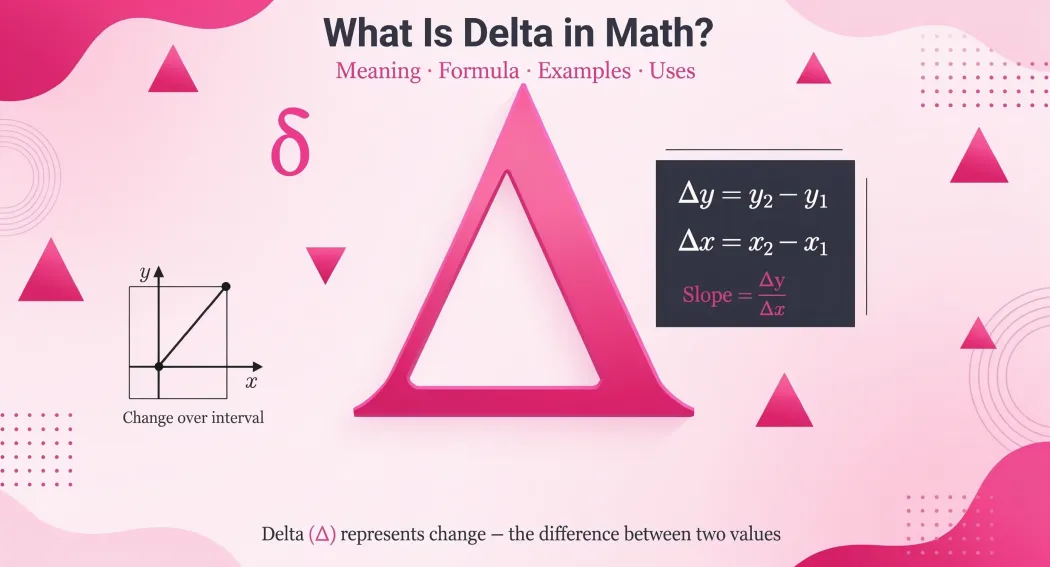
Delta in math usually represents a change or difference between two values. The symbol for delta is the Greek letter Δ when written as a capital delta. For example, Δx means the change in x, while Δy means the change in y.
The meaning of delta can vary depending on the area of mathematics. You may see it used to compare measurements, calculate slope, describe changes in quantities, or find the discriminant of a quadratic equation.
For students studying these topics, online igcse maths tutoring can provide clear explanations and step-by-step examples that make mathematical notation easier to understand.
What Does Delta Mean in Math?
The word “delta” generally refers to a change, difference, or variation in a quantity. A simple delta formula is:
Δ = New Value − Original Value
For example, if a student’s test score increases from 70 to 82, Δ = 82 − 70 = 12
The positive result means the value increased by 12. If the score falls from 82 to 70, Δ = 70 − 82 = −12.
The negative result shows a decrease of 12. So, when you see a delta symbol in a mathematical problem, the first question to ask is:
What quantity is changing, and what are its starting and ending values?
What Does the Delta Symbol (Δ) Mean?
The Greek letter delta has two commonly seen forms:
- Capital delta: Δ
- Lowercase delta: δ
Capital Δ is widely used to represent a change or difference between two values. The lowercase δ can have different meanings depending on the mathematical field and context. For example: Δx = x₂ − x₁
- This tells you how much x has changed between two points. Similarly: Δy = y₂ − y₁
- This tells you how much “y” has changed. The exact meaning of delta always depends on the notation around it.
Delta Formula in Math
When delta represents a change, you can calculate it by subtracting the original value from the new value:
Δ = Final Value − Initial Value
This is one of the simplest ways to understand delta.
Example
A water tank contains 120 litres at the beginning and 165 litres later.
- ΔV = 165 − 120
- ΔV = 45 litres
The volume increased by 45 litres. The formula works in the same way for many quantities:
- Δx = x₂ − x₁
- Δy = y₂ − y₁
- Δt = t₂ − t₁
- Δd = d₂ − d₁
The letter after delta tells you which quantity has changed.
Delta x and Delta y
You will often see Δx and Δy in coordinate geometry and algebra.
- Δx represents the change in the horizontal direction.
- Δy represents the change in the vertical direction.
- Suppose two points are:
- A(2, 3)
- B(8, 11)
- To find the change in x: Δx = 8 − 2 = 6
- To find the change in y: Δy = 11 − 3 = 8
These values are useful for finding the slope of a line.
Using Delta to Find Slope
The slope formula can be written as: m = Δy / Δx
For the points above:
- m = 8 / 6
- m = 4 / 3
So, the slope of the line is 4/3. This is one of the most common ways delta notation appears in coordinate geometry.
Delta in Algebra: The Discriminant
In algebra, capital delta has another important use. It can represent the discriminant of a quadratic equation.
- A quadratic equation has the general form: ax² + bx + c = 0
- The discriminant is Δ = b² − 4ac
The value of Δ tells you how many real solutions the quadratic equation has.
When Δ > 0
If Δ > 0, the quadratic equation has two distinct real solutions.
When Δ = 0
If Δ = 0, the equation has one real repeated solution.
When Δ < 0
If Δ < 0, the equation has no real solutions. Let’s look at some examples.
Example 1: Δ > 0
Consider: x² − 2x − 15 = 0
Here:
- a = 1
- b = −2
- c = −15
Using the discriminant formula:
- Δ = b² − 4ac
- Δ = (−2)² − 4(1)(−15)
- Δ = 4 + 60
- Δ = 64
Because Δ > 0, the equation has two distinct real solutions.
In fact: x² − 2x − 15 = (x − 5)(x + 3)
So: x = 5 or x = −3
Example 2: Δ = 0
Consider: x² − 6x + 9 = 0
Here:
- a = 1
- b = −6
- c = 9
Therefore:
- Δ = (−6)² − 4(1)(9)
- Δ = 36 − 36
- Δ = 0
So, the equation has one repeated real solution.
Factoring gives: (x − 3)² = 0
Therefore: x = 3
Example 3: Δ < 0
Consider: x² + 2x + 5 = 0
Here:
- a = 1
- b = 2
- c = 5
So:
- Δ = 2² − 4(1)(5)
- Δ = 4 − 20
- Δ = −16
Because Δ < 0, the equation has no real solutions.
Delta in Geometry
In geometry, delta can be used to describe the change in a measurement between two situations. For example, ΔL = L₂ − L₁ can represent a change in length.
Similarly, ΔA = A₂ − A₁ can represent a change in area.
Example: Change in Area
Suppose the area of a rectangular garden increases from 24 m² to 31 m². The change in area is:
- ΔA = 31 − 24
- ΔA = 7 m²
So, the garden’s area increased by 7 m².
Delta in Triangles
There is another use of the symbol Δ in geometry. ΔABC means triangle ABC. In this notation, delta is not describing a change. Instead, it is being used as a symbol for a triangle.
For example, ΔABC ≅ ΔDEF means that triangle ABC is congruent to triangle DEF. This is an important reminder that the meaning of a symbol depends on the mathematical context.
Delta Distance
Delta can also describe the change in distance or position. For example: Δd = d₂ − d₁
Suppose an object moves from a position of 15 metres to 42 metres.
- Δd = 42 − 15
- Δd = 27 metres
The object’s position changed by 27 metres. In coordinate geometry, the horizontal and vertical changes can also be used to calculate the distance between two points.
For points:
- A(x₁, y₁)
- B(x₂, y₂)
First calculate:
- Δx = x₂ − x₁
- Δy = y₂ − y₁
Then:
- d = √[ (Δx)² + (Δy) ²]
Using points A(2, 3) and B(8, 11):
- Δx = 6
- Δy = 8
Therefore:
- d = √(6² + 8²)
- d = √(36 + 64)
- d = √100
- d = 10
So, the distance between the two points is 10 units.
Delta in Calculus
Delta notation is also useful in calculus because calculus studies how quantities change. For example, Δx can represent a finite change in x. The idea of change is central to derivatives. A derivative looks at how one quantity changes in relation to another, especially as the change in the input becomes extremely small. For students who find these ideas difficult, private tutors online can make concepts such as delta, derivatives, and rates of change easier to understand through step-by-step examples.
For example, if a function is f(x) = x² and x changes from 2 to 3, Δx = 3 − 2 = 1
The corresponding change in the function is:
- Δf = f(3) − f(2)
- Δf = 9 − 4
- Δf = 5
The average rate of change is therefore: Δf / Δx = 5 / 1 = 5
Calculus takes the idea further by examining instantaneous rates of change through derivatives.
Delta and Partial Derivatives
Students may also encounter the symbol ∂ in calculus. It is important not to confuse ∂ with Δ.
- Δ generally describes a finite change or difference.
- ∂ is used for partial derivatives when a function has more than one variable.
For example: f(x, y) = 4x³ + xy − 7y
The partial derivative with respect to x is ∂f/∂x = 12x² + y.
Here, y is treated as constant while the change with respect to x is examined.
Delta in Statistics and Data
In statistics and data analysis, delta can be used to describe the difference between two values. For example, a company’s monthly sales increase from $45,000 to $52,000.
- ΔSales = 52,000 − 45,000
- ΔSales = $7,000
This tells us that sales increased by $7,000. Delta can therefore be useful when comparing measurements over time, although the exact notation and interpretation depend on the statistical method being used.
Delta in Science
The idea of change represented by delta is also common in scientific subjects. For example:
- Δt can represent a change in time.
- ΔT can represent a change in temperature.
- Δv can represent a change in velocity.
Suppose a temperature rises from 18°C to 26°C.
- ΔT = 26 − 18
- ΔT = 8°C
In chemistry, you may also see expressions such as ΔH, where delta is used as part of the notation for a change in enthalpy.
The basic idea remains the same: delta indicates that some quantity is being compared between two states.
Positive and Negative Delta
Delta can be positive, negative, or zero.
Positive Delta
A positive delta means the final value is greater than the initial value.
Example: Δx = 15 − 10 = 5
The quantity increased by 5.
Negative Delta
A negative delta means the final value is smaller than the initial value.
Example: Δx = 10 − 15 = −5
The quantity decreased by 5.
Zero Delta
A zero delta means there was no change.
Example: Δx = 12 − 12 = 0
The starting and ending values are the same. Understanding the sign of delta can help you interpret what happened to a quantity.
Must Read: How to Get a Grade 9 in GCSE Maths: A Practical Guide for Students
Common Mistakes When Using Delta in Math
Students often make a few simple mistakes when working with delta.
Confusing Final and Initial Values
When using:
Δ = Final − Initial
Keep the order consistent. Reversing the values changes the sign.
Assuming Delta Always Means Change
Delta does not always mean the same thing. In geometry, ΔABC represents a triangle, while in algebra, Δ can represent the discriminant. Always check the context.
Confusing Δ With ∂
These symbols have different purposes.
- Δ is commonly used for a finite change or difference.
- ∂ is used for partial derivatives.
Forgetting Units
A delta value may still need units.
For example: ΔT = 8°C
not simply 8, when the quantity being measured is temperature.
Why Is Delta Important in Math
Delta is useful because it gives a simple way to describe how a quantity changes. Instead of writing a long explanation such as “the difference between the final value and the original value”, mathematical notation allows us to write:
Δx or Δy
This makes equations easier to read and helps mathematicians communicate relationships clearly. You will encounter delta in different forms across algebra, geometry, calculus, statistics, physics, and chemistry. Learning what it means in each context helps build a stronger understanding of mathematical notation.
Learn Delta in Math with Expert Online Tutoring
Mathematical notation can feel confusing when several symbols have different meanings in different topics. Students can strengthen their understanding by working through examples with experienced Dubai online maths tutors who can explain each step clearly and adapt lessons to their level.
With personalised guidance from Mixt Academy maths tutors, students can practise difficult concepts and ask questions with greater clarity. This support helps them build stronger problem-solving skills across algebra, geometry, calculus, and other areas of mathematics.
Final Thoughts on Delta in Math
Delta in math most commonly represents change or difference, but its exact meaning depends on the problem. You may use Δx to describe a change in x, Δy to describe a change in y, or Δ = b² − 4ac to find the discriminant of a quadratic equation.
The easiest way to understand delta is to look at the quantity beside the symbol and identify what is being compared. Once you become comfortable with this notation, many mathematical formulas become easier to understand and apply.