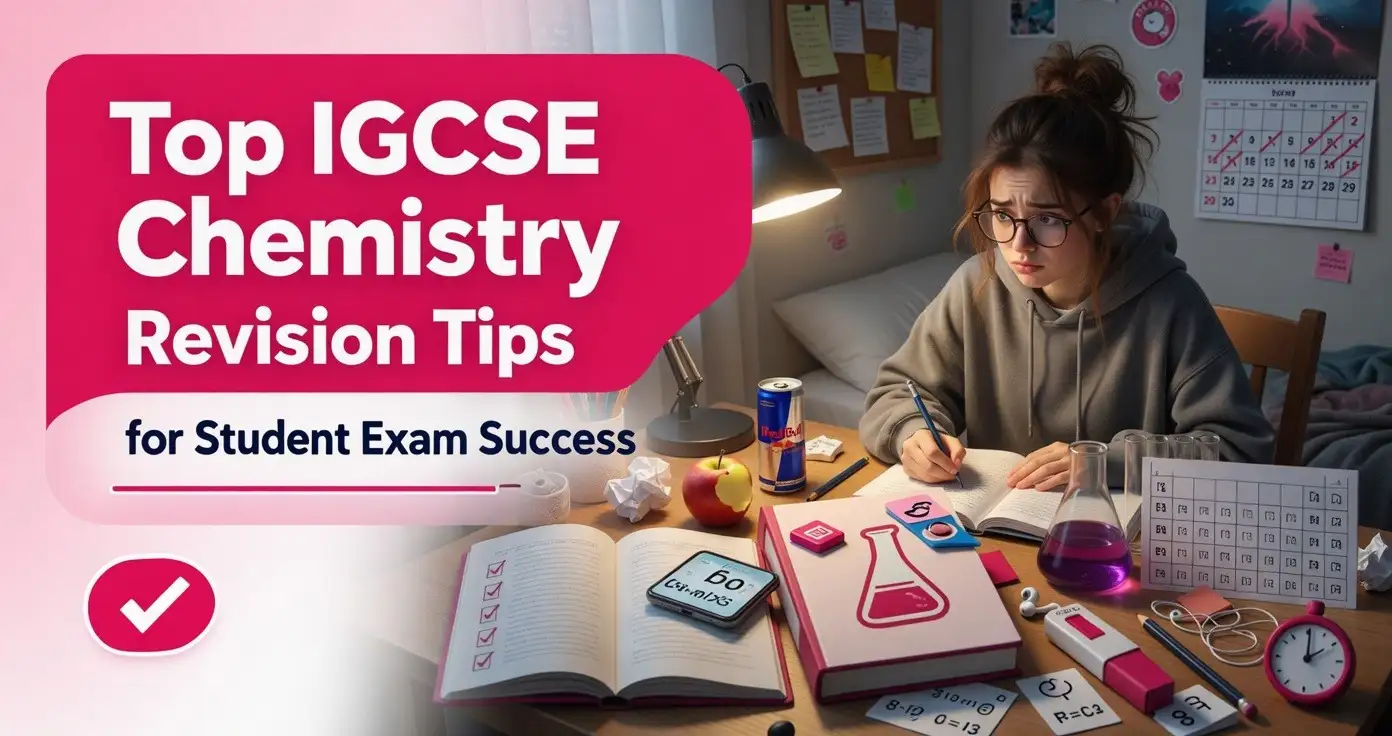
Both ways go into the mind of the student in IGCSE chemistry. It’s one day learning to remember abstract atomic structures and the next learning to calculate titration yield or balance complex redox reactions. It’s the contrast of theory and practice that makes it so hard for a lot of students to organise study time. If there is no strategy, revision soon becomes merely a process of highlighting notes and reading, which have been shown to produce low retention.
This guide explains 10 high-impact revision strategies of the IGCSE chemistry learning that will help you organise your revision time, learn key areas and get ready for exam day.
Top 10 Chemistry Revision Tips Every IGCSE Student Should Know
IGCSE chemistry is drawing students in two directions simultaneously. One day you are learning about atomic structure, and the next, you have to calculate titration data in the lab. The combination of theory and practice is precisely what makes it so difficult for many students to plan revision. The following are the top 10 revision tips for every IGCSE student to remember.
1. Read the Syllabus Before You Open a Textbook
The most important document you will have throughout revision will be your exam board’s syllabus (whether CIE, Pearson or Oxford AQA). It presents all the important ideas, equations and experiments that examiners may use to test.
Action Step! Read the specification of your code (e.g., CIE 0620 or 4CH1 Edexcel). Review each bullet point with a traffic light system:
- Red: I don’t understand this concept yet.
- Amber: I understand the theory, but I make errors on exam questions.
- Green: I can explain this clearly and score full marks on past paper questions.
2. Chunk Complex Topics into Micro-Units
Attempting to rewrite an entire chapter, such as organic chemistry or quantitative chemistry, can result in a cognitive overload. Divide big, heavy topics into micro-topics:
Organic Chemistry ➔ Alkanes vs. Alkenes ➔ Addition Reactions ➔ Test for Unsaturation
A dedicated 25–30 minutes of work on one mechanism or calculation type results in much greater long-term retention than skimming through an entire unit of textbook material.
3. Replace Text Notes with Visual Diagrams
Chemistry has a visual aspect. Diagrams are a better way to encode concepts such as lattice structures, covalent bonding and electrolysis setups than dense paragraphs of text.
High-Yield Diagrams to Practice Drawing
- Dot and cross diagrams of ionic compounds and covalent compounds.
- Gas collection, gas filtration and gas titration apparatus setups.
- Reaction pathways and energy profile diagrams (exothermic vs. endothermic).
Revision Tip: Draw diagrams from memory. Check your sketch with your textbook, add in any labels that are missing in another colour and test yourself again 2 days later. Most students take help from IGCSE chemistry tutors to learn how to draw a diagram.
4. Leverage Active Recall with Digital Flashcards
Spaced retrieval helps to consolidate definitions, state symbols, colour changes, and chemical formulas into long-term memory. Use digital flashcard sites (Anki, Quizlet, or paper cards) to quiz yourself.
| Front of Card | Back of Card |
|---|---|
| What is the test and positive result for chlorine gas (Cl₂)? | Damp blue litmus paper turns red, then bleaches white. |
| State the flame test colour for Calcium (Ca²⁺). | Brick red / Orange-red |
| What is the formula for a nitrate ion? | NO₃⁻ |
5. Execute a 3-Step Past Paper Protocol
Solving past papers is crucial, but open note working will not be as effective. The best way to benefit from past paper practice is to complete this three-step process:
Simulate Real Conditions: Complete the paper under strict exam timing without using books, notes, or internet searches.
Mark Rigorously with Official Mark Schemes: Pay close attention to underlined keywords in the mark scheme; examiners require specific terminology to award marks.
Log Your Mistakes: Record every lost mark in an error log categorised by issue type:
- Knowledge Gap (didn’t know the fact)
- Calculation Error (misread the units or math)
- Exam Technique (didn’t answer the specific command word)
Hire the Best Online Tutors for Your Child
6. Prioritise Practical & Alternative to Practical (ATP) Skills
The experimental knowledge is a substantial part of your total IGCSE grade for either Paper 5 (Practical Test) or Paper 6 (Alternative to Practical).
Essential Practical Skills to Master
- Qualitative Analysis: Understand the tests and colours of some important cations, anions and gases.
- Use of Titration Techniques: Read a burette to an accuracy of ±0.05 cm³, calculate concordant results and identify sources of error.
- Experimental Design: Practice in writing clear, step-by-step procedures for experiments, including apparatus, controlled variables, safety, and how to measure.
7. Focus on High-Weightage, Weak Topics
It’s nice to have topics you already know well to spend hours going over again, such as States of Matter. But the highest grade will be obtained if you concentrate on your weaker points.
[Identify Weakness in Error Log] ➔ [Re-learn Core Theory] ➔ [Solve 10 Topical Questions] ➔ [Re-Test]
If you struggle with quantitative chemistry and/or mole calculations, spend the next 70% of your study time on specifically those problems and eventually do them without thinking about it.
8. Use Mnemonics for the Hard-to-Remember Stuff
Chemistry facts that are not conceptual in nature and need to be memorised instead (e.g., reactivity series, results of flame tests, definition of redox). Make your own colourful and memorable mnemonic devices to memorise these facts:
- Redox Reactions (OIL RIG): Oxidation is loss, reduction is gain (of electrons).
- Reactivity Series: Please put Charlie’s monkey and zebra in cages that are heavy with silver, gold (potassium, sodium, calcium, magnesium, aluminium, carbon, zinc, iron, lead, hydrogen, copper, mercury, silver, and gold).
9. Explain Concepts to Others or Study with an IGCSE Chemistry Tutor
When you try to explain something out loud, you find yourself having to structure your thoughts, and you will discover immediately what you don’t know.
- Peer Study: Study together as a class with one another and take turns teaching each other a hard topic (such as the electrolysis of aqueous solutions) without notes.
- Private Tutoring: When key concepts still don’t make sense after an independent study, the use of a professional tutor.
10. Implement a Spaced Repetition Study Schedule (Plan for 21 Days)
Last-minute cramming is only going to activate short-term memory and produce a stressful environment with a low performance score on a multi-step question. Rather, create a sustainable study schedule that is based on spaced repetition:
- Day 1: Learn Topic (e.g., Acids & Bases)
- Day 3: Self-Test via Flashcards
- Day 7: Complete 5 Past Paper Questions
- Day 21: Final Review via Error Log
At Mixt Academy, our sessions of chemistry tutoring in Dubai with other subjects keep your brain engaged and prevent study fatigue.
Success in IGCSE chemistry isn’t simply about natural ability; it comes from using the right strategies consistently. By following the official syllabus, actively testing your knowledge with flashcards and past papers, and focusing deliberately on weaker areas, you can build stronger subject knowledge and improve your exam performance over time.
For students who benefit from private tutors in Dubai, Mixt Academy is one of the leading one-to-one IGCSE chemistry tutoring platforms that are designed around individual learning needs. Students can build confidence, practise exam-style questions, develop good revision strategies and reinforce concepts that students struggle with using DBS-checked experienced tutors.