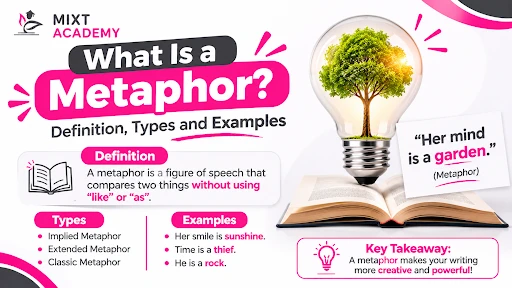
A metaphor is a figure of speech that describes one thing as another to show a meaningful connection. It is not meant literally. Instead, it helps you picture an idea, understand an emotion or recognise a writer’s point of view. You may encounter metaphors in poems, novels, classroom discussions, speeches and everyday expressions. Recognising them helps you understand not only what a text says, but also how its language shapes tone, mood and meaning.
For GCSE and IGCSE English, this skill can strengthen close reading and creative writing. This guide from Mixt Academy explains how metaphors work, how to identify different types and how to discuss their effects with clear evidence.
What Is a Metaphor in English
A metaphor is a figure of speech that compares two different things by presenting one as the other. The comparison highlights a shared quality, feeling or idea rather than a literal connection.
For example: “The classroom was a zoo.”
A classroom is not actually a zoo. The sentence compares the classroom to a place filled with noisy, uncontrolled activity. It suggests that pupils were behaving wildly or making a great deal of noise.
Compare this sentence with a literal description: “The classroom was noisy and difficult to manage.”
Both sentences communicate a similar idea. The metaphor, though, creates a more vivid picture and conveys a stronger impression of the situation. Metaphors are a form of figurative language, which uses words beyond their straightforward, literal meanings. Writers use figurative language to express abstract ideas, describe characters, communicate emotions and help readers interpret events.
What Are the Two Main Parts of a Metaphor
A useful way to understand a metaphor is to identify what it describes and what it compares that subject to.
Consider this example: “Her mind is a library.”
- Subject: Her mind. This is the thing being described.
- Comparison: A library. This provides the image used to describe her mind.
- Shared Meaning: She has extensive knowledge and remembers many things.
These labels are useful when studying literary terminology. You do not need to memorise specialist terminology to understand a metaphor, but identifying the two parts can make your analysis more precise.
How Does a Metaphor Work
A metaphor works by connecting two things that share a recognisable quality. The reader uses that connection to understand a person, object, experience or abstract idea in a different way.
Consider this example: “Fear was a locked door.”
Fear is an emotion, while a locked door is a physical object. The metaphor connects them through the idea of restriction. Fear can prevent someone from taking action, just as a locked door can prevent someone from entering a room. The comparison creates meaning in three steps:
- Identify the Subject: The writer is describing fear.
- Examine the Comparison: A locked door represents something that blocks progress.
- Explain the Effect: The metaphor presents fear as an obstacle that restricts a person’s choices.
Notice that the metaphor does more than tell you that someone feels frightened. It suggests how that emotion affects their behaviour. A strong metaphor often works through familiar experiences. Readers understand what a locked door does, so they can connect that experience to an abstract feeling.
The exact meaning also depends on context. A locked door might suggest protection in one passage and confinement in another. Read the surrounding sentences before deciding what a metaphor means.
Examples of Metaphors and Their Meanings
The following examples show how metaphors communicate different ideas. Each example includes an explanation so you can understand the comparison rather than simply memorising the phrase.
| Metaphor Example | Meaning | Effect on the Reader |
|---|---|---|
| Time is a thief. | Time takes moments that cannot be recovered. | Creates a sense of loss and urgency. |
| Her voice was music. | Her voice sounded pleasing or comforting. | Suggests beauty and emotional warmth. |
| The city was a sleeping giant. | The city appeared large, quiet and full of potential power. | Creates a sense of scale and hidden strength. |
| His words were knives. | His words caused emotional pain. | Presents his speech as sharp and hurtful. |
| Hope was a small candle. | Hope offered a little comfort during a difficult time. | Suggests fragile but meaningful optimism. |
| My bedroom is an oven. | The bedroom is extremely hot. | Makes the heat easy to imagine. |
| Her memory is a steel trap. | She remembers details with great accuracy. | Emphasises the strength of her memory. |
| The politician’s promise was a smoke. | The promise lacked substance or reliability. | Suggests deception or something that disappears. |
Examples in Everyday Language
Metaphors are not limited to novels or poetry. People use them in ordinary conversations to communicate ideas quickly.
- “I am buried in homework.” This means you have too much homework to manage comfortably.
- “He has a heart of stone.” This suggests that he appears unkind or emotionally insensitive.
- “That idea is a seed.” This means an idea could develop into something larger.
- “She is the backbone of the team.” This means she provides essential support and helps the team function.
- “The news was a wake-up call.” This means the news prompted someone to recognise a problem and take action.
Some familiar expressions have become so common that speakers may not picture their original imagery. They still carry a figurative meaning, even when their metaphorical origins receive little attention. When interpreting an example, always ask what quality connects the two things and why that connection suits the situation.
What Are the Different Types of Metaphors
Metaphors can be classified according to how directly they express a comparison and how long that comparison continues.
Direct or Explicit Metaphor
A direct metaphor openly connects one thing to another. The comparison is usually easy to identify because the sentence states that one thing is another.
Examples:
- “The exam was a mountain.”
- “My brother is a walking dictionary.”
- “The playground became a battlefield.”
In the first example, the exam is compared to a mountain to suggest difficulty. The second describes someone who knows many words or facts. The third suggests competition, conflict or disorder on the playground. Direct metaphors work well when a writer wants readers to recognise a comparison immediately.
Implied Metaphor
An implied metaphor suggests a comparison without directly naming both things. A particular verb or description gives the reader a clue.
Examples:
- “The angry manager barked instructions.”
- “She sailed through the interview.”
- “His criticism wounded her.”
In the first example, the verb “barked” suggests the manager behaved like a dog, making a harsh sound. In the second, “sailed” compares the interview experience to smooth movement across water. In the third, “wounded” presents criticism as an injury.
Implied metaphors often make writing sound natural because the comparison sits within an ordinary sentence. Readers must use context to understand the intended meaning.
Extended Metaphor
An extended metaphor develops a single comparison across several sentences, lines or paragraphs. The writer returns to the same central image and adds related details.
For example: “Learning to play the piano was a long climb. Every new piece presented another hill. Mistakes became steep paths that forced me to slow down. After months of practice, the final performance felt like reaching the summit.”
The passage presents learning as climbing a mountain. Hills, paths and a summit continue the same comparison. Extended metaphors can give a paragraph or complete poem a clear direction. They allow writers to explore a central idea in more depth rather than relying on one descriptive sentence.
Dead Metaphor
A dead metaphor is an expression whose original imagery has become familiar through frequent use. People generally understand its figurative meaning without thinking about the literal comparison. Examples include:
- The foot of the mountain.
- The head of the table.
- A branch of knowledge.
- The legs of a journey.
These expressions remain useful in everyday communication. Their meanings are widely understood, even when readers no longer imagine the original physical comparison. In creative writing, familiar metaphors can be appropriate. The problem arises when a writer relies on predictable expressions instead of choosing language that suits the scene.
Mixed Metaphor
A mixed metaphor combines images that do not fit together logically. This can make the meaning difficult to follow.
For example: “We must get our ideas on the same page before the ship sails.”
This sentence combines the image of sharing a page with the idea of a ship departing. Each comparison could work independently, but placing them together creates an awkward shift.
A clearer version would be “We must agree on our plans before it is too late.”
Mixed metaphors are not always deliberate mistakes. Writers may use them for humour or to show that a character speaks in a confused way. Outside such situations, maintaining one consistent image usually makes the message clearer.
Metaphor vs Simile: What Is the Difference
Metaphors and similes are figures of speech that compare different things. The main difference is how they express that comparison.
| Feature | Metaphor | Simile |
|---|---|---|
| Meaning | Presents one thing as another. | States that two things are similar. |
| Common Wording | Often uses a form of “be”, such as is or was. | Often uses “like” or “as”. |
| Example | Her eyes were stars. | Her eyes shone like stars. |
| Main Effect | Creates a direct figurative connection. | Makes the resemblance explicit. |
Consider these two sentences:
- Metaphor: “The child was a whirlwind.”
- Simile: “The child moved like a whirlwind.”
The metaphor presents the child as a whirlwind, suggesting energy, speed and constant movement. The simile describes how the child moves by comparing the action to a whirlwind. A metaphor does not have to use the verb “to be”.
For example, “His words stabbed me” is a metaphor because the verb suggests emotional pain through the image of a physical injury. Likewise, a comparison does not automatically become a metaphor just because it sounds descriptive. You must consider how the sentence connects its ideas.
Can a Sentence Contain Both a Metaphor and a Simile?
Yes! A writer can use both devices in one passage, provided each comparison serves a clear purpose.
For example: “Her confidence was a flame. She stood like a lighthouse, guiding the nervous team.”
The first sentence uses a metaphor to compare confidence with a flame. The second uses a simile to describe how she guides others. When analysing either device, explain what the comparison suggests and how it contributes to the overall meaning.
Metaphor vs Analogy and Symbolism
Metaphors, analogies and symbols can all help communicate meaning beyond literal descriptions. Their purposes differ, though, and recognising those differences makes literary analysis more accurate.
Metaphor vs Analogy
An analogy explains a connection between two things, often to help someone understand an unfamiliar subject. A metaphor usually expresses a comparison more briefly.
- Metaphor: “The brain is a control centre.”
- Analogy: “The brain is like a control centre in a busy building because it processes information and coordinates different activities.”
The metaphor makes a compact comparison. The analogy develops the relationship to explain how the brain performs certain functions. An analogy can include a metaphor or simile, so the categories are not always completely separate.
Metaphor vs Symbolism
A metaphor directly connects one thing with another to create a particular meaning. Symbolism involves an object, character, colour or action representing a broader idea.
For example, “Her heart was an open door” is a metaphor suggesting that she is welcoming or willing to trust others.
A door appearing repeatedly in a story might symbolise opportunity, change or exclusion. Its meaning develops through the events and themes surrounding it. The key distinction is that a metaphor makes a figurative comparison, while a symbol can carry a wider meaning throughout a text.
Why Do Writers Use Metaphors
Writers use metaphors to communicate ideas more vividly and encourage readers to look beyond literal descriptions. The exact effect depends on the comparison and the context.
To Express Emotions
Emotions can be difficult to describe precisely. A metaphor can give an abstract feeling a recognisable form.
Example: “Grief was an empty room.”
The image suggests loneliness, absence and a sense that something important is missing. It gives readers a way to imagine the emotional experience without explaining every detail.
To Create Imagery
A metaphor helps readers picture a scene or experience.
Example: “The clouds were grey blankets.”
The comparison suggests that the clouds covered the sky. It may also create a feeling of heaviness or confinement, depending on the surrounding description.
To Develop Characters
Metaphors can reveal a character’s personality, behaviour or relationships.
Example: “Amir was the glue holding the family together.”
The metaphor presents Amir as someone who maintains unity and supports other family members. It tells readers something about his role without listing every action he takes.
To Strengthen an Argument
Speakers and writers also use metaphors to make complex ideas easier to understand.
Example: “A rumour is a spark in a dry forest.”
This comparison suggests that a small piece of information can spread quickly and cause serious consequences. It encourages readers to consider how gossip can affect a wider group. For GCSE English, understanding a metaphor’s purpose is only one part of literary analysis. You should also explain how the writer’s word choices create an effect and support your interpretation with evidence from the text.
How to Identify and Analyse a Metaphor
Identifying a metaphor is the first step. Strong analysis requires you to explain what it means and why the writer might have chosen it. Follow these steps when reading a poem, novel or unseen passage. Understanding metaphors can help students develop their literary techniques and language analysis skills for GCSE English exams.
Step 1: Look Beyond the Literal Meaning
Ask whether the sentence makes sense if you interpret every word literally. For example, “The news spread like wildfire” uses a simile, while “The news was wildfire” uses a metaphor. Neither describes actual fire. Both suggest rapid spread.
Step 2: Identify the Comparison
Determine what the writer describes and which image helps communicate that description. In “Her voice was velvet”, the writer compares a voice with velvet. The connection may suggest softness, smoothness or a pleasant quality.
Step 3: Examine the Specific Words
Individual words can shape the meaning of a metaphor. Consider whether the comparison suggests comfort, danger, excitement, frustration or another feeling. Do not assume every metaphor creates a positive or negative effect. Its meaning depends on the passage.
Step 4: Explain the Effect in Context
Connect the metaphor to the character, setting, situation or central idea. For example, if a character describes school as “a prison”, the comparison may suggest that the character feels trapped or restricted. If the surrounding passage describes unfair rules, the metaphor may also criticise the school’s lack of freedom.
Step 5: Support Your Interpretation With Evidence
Refer to the relevant word or phrase and explain how it supports your interpretation. Avoid simply stating that the metaphor creates a picture in the reader’s mind.
A stronger response explains the particular picture and its significance.
Example of a Strong Metaphor Analysis
Sentence: “The city swallowed him whole.”
Basic explanation: The city made him feel lost.
Stronger analysis: The verb “swallowed” compares the city to a creature consuming someone. This suggests that its size and activity overwhelm the character, making him feel small or unnoticed. The image presents the city as a powerful force rather than a neutral setting.
The stronger explanation identifies the comparison, examines a specific word and links it to the character’s experience. Students who need further help can practise these skills with GCSE English tutors, focusing on language analysis, textual evidence and exam-style responses.
How to Write Your Own Metaphors
Creating a metaphor starts with an idea you want to communicate. Choose an image that expresses the idea clearly and gives the reader a useful way to understand it.
Start With a Feeling or Idea
Choose something abstract, such as fear, ambition, loneliness, knowledge or hope. For example, suppose you want to describe determination. A basic sentence might be “She never gave up.” Now consider a physical image that suggests persistence.
“Her determination was an anchor.” The anchor suggests stability and the ability to hold firm under pressure. You could use this metaphor to describe someone who remains focused during difficult circumstances.
Find a Meaningful Connection
Think about what the subject and image share. Ask yourself:
- What quality connects these two things?
- Does the image suit the situation?
- What feeling might the reader associate with it?
- Does the comparison add meaning beyond a literal description?
A useful metaphor should have a clear connection. An unusual comparison may attract attention, but it needs to make sense within the passage.
Develop the Image Carefully
If you want to extend the metaphor, keep the details connected to the original comparison.
For example: “Her ambition was a compass. It kept her focused on her destination when setbacks made the route difficult.”
Both sentences use the idea of a compass to communicate direction and purpose. The second sentence develops the image without introducing an unrelated comparison.
Revise for Clarity
Read the sentence aloud and ask whether it communicates your intended meaning. Remove any words that distract from the comparison. You can also replace a familiar metaphor with a more specific image.
Instead of writing “He was a bright star”, consider what kind of achievement or quality you want to highlight. Originality matters, but clarity matters more. Your reader should be able to understand the connection without guessing what you intended.
Common Metaphor Mistakes in Writing and Literary Analysis
Even a simple metaphor can become confusing when a writer does not consider meaning and context. Avoid these common mistakes.
- Taking the Comparison Literally: If a writer says, “Her heart is ice,” they probably mean she seems emotionally cold, not that her heart has frozen.
- Confusing Metaphors with Similes: Check whether the writer presents one thing as another or explicitly compares them using words such as “like” or “as”.
- Ignoring the Context: The same image can suggest different ideas in different passages. Use surrounding details to support your interpretation.
- Writing Vague Analysis: Instead of saying a metaphor makes writing interesting, explain the particular emotion, image or idea it conveys.
- Overusing Metaphors: Too many comparisons can make a paragraph difficult to follow. Keep the focus on the ideas that matter.
- Mixing Incompatible Images: Avoid combining unrelated comparisons unless you intend to create humour or confusion.
The best approach is to choose a clear comparison, understand its meaning and explain its role in the text. Students who want to improve their writing and text analysis can explore our IGCSE English tutors for personalised exam support.
Practise Identifying Metaphors
Test your understanding with these five sentences. Decide whether each one contains a metaphor or a simile, then explain the intended meaning.
- The library was a treasure chest.
- Her hands were as cold as ice.
- The coach planted confidence in the team.
- His thoughts moved like racing cars.
- The final minutes of the match were an eternity.
Answers and Explanations
- Metaphor: The library is compared to a treasure chest, suggesting that it contains valuable knowledge or discoveries.
- Simile: The hands are explicitly compared with ice using the word “as”.
- Implied Metaphor: The verb “planted” compares the coach’s actions to planting a seed, suggesting that the coach helped confidence develop.
- Simile: The word “like” compares the speed of his thoughts with racing cars.
- Metaphor: The final minutes are presented as an eternity to emphasise how slowly time seemed to pass.
When you practise, do not stop after naming the figure of speech. Explain the comparison and identify the words that support your interpretation. This habit is useful for creative writing and literature analysis.
Improve Your Understanding of Figurative Language
Understanding metaphors helps you read more carefully, express ideas creatively and explain how language shapes meaning. Practise identifying comparisons in poems, stories and everyday conversation. Then challenge yourself to explain why the writer chose a particular image.
Mixt Academy can support your GCSE English preparation through personalised tuition and guided practice. With regular feedback, you can develop clearer literary analysis and learn to support your interpretations with relevant evidence. Apply these skills to your next reading or writing task and review your progress as you practise.