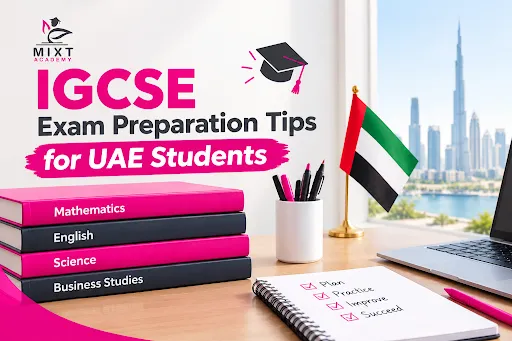
To do well in IGCSE exams in the UAE, check your exam board and exam series, begin organised revision four to six months before your exams, practise timed past papers each week, and plan for Term 2 mock exams and Ramadan 2027. Use an error log to correct mistakes instead of simply studying for longer.
Many revision guides offer general advice but overlook the details of the UAE school year. This guide is for students and parents in Dubai, Abu Dhabi, Sharjah, and other Emirates. It includes a revision countdown, a Ramadan study plan, and a tutor checklist to help students prepare for IGCSE exams.
Know Your IGCSE Syllabus Before You Start Revising
Schools in the UAE use exam boards such as Cambridge International and Pearson Edexcel. Each board has different timetables, exam papers, and syllabus codes. Check with your school’s exams officer to confirm your exam board and series for each subject. For example, Cambridge English syllabus codes include First Language English (0500), Literature in English (0475), and English as a Second Language (0510). UK GCSE resources may not always match your IGCSE syllabus.
IGCSE exams in the UAE usually take place in the May/June or October/November series, depending on your school and exam board. The October/November 2026 series is taking place around this time. Exam start times follow Gulf Standard Time (UTC+4) and are confirmed by your exam centre. Check with your school to find out whether your exams are scheduled for the morning or afternoon. Check your exam board’s official website for the latest May/June 2027 timetable.
Work Backwards: A Four-Stage Revision Plan
For May/June exams, begin structured revision four to six months in advance. Follow these four stages to organise your preparation.
- Four to six months before your exams, review each subject topic by topic and label topics as red, amber, or green according to your confidence. Start an error log that records the topic, the marks you lost, and the reason for each mistake.
- Two to four months before your exams, focus on red and amber topics and test yourself with exam questions. Many UAE schools hold mock exams in Term 2, so use your results to update your revision priorities.
- During the final six to eight weeks, complete at least one timed paper for each subject every week. Mark each paper carefully using the relevant mark scheme.
- During the final two weeks, review summary sheets, practise exam command words, and get enough sleep. Focus on strengthening your existing knowledge rather than trying to learn large amounts of new material.
Start with around six to eight hours of revision each week in addition to homework, then increase to ten to twelve hours during the final eight weeks if your schedule allows. Adjust these targets to your subjects, workload, and individual needs.
A Sample Week for a Busy IGCSE Student
Adjust this schedule to suit your subjects and school commitments. On Monday and Tuesday, review one topic each day and answer ten exam questions. On Wednesday, practise recalling information from memory and briefly review previously studied topics. On Thursday, use your error log to correct earlier mistakes. On Friday, do a light review or take a break. On Saturday, complete one timed paper and mark it on the same day. On Sunday, plan the following week’s revision.
Move sessions around your after-school activities and rotate subjects to ensure that you cover everything. Keep one evening free each week because rest helps support memory, motivation, and concentration.
Plan Around Ramadan 2027
Ramadan is expected to begin around 8 February 2027 and end around 8 or 9 March. Eid Al Fitr is expected around 9 or 10 March, depending on the moon sighting and official announcements. As these dates fall within the main revision period for May/June exams, plan your study schedule in advance.
Study your hardest subject when you feel most alert. Use shorter study sessions of 25 to 30 minutes, with breaks between sessions. Complete one timed paper each week to maintain your exam skills. Also, check whether your school has adjusted its timetable for Ramadan.
Study Techniques That Can Improve Your Marks
Choose effective study methods and use them consistently.
- Retrieval practice: Close your notes, write down what you remember, and then check your answers against your notes.
- Spaced revision: Review each topic after three or four days and revisit it again after a week.
- Timed past papers: Use official exam papers and mark schemes from your exam board. Record exactly where and why you lost marks.
- Command words: Learn what words such as “state”, “explain”, “calculate”, and “evaluate” require you to do. Answer each question according to its instructions.
Subject-Specific Tips
- Maths: Show every step of your working, include the correct units where required, and estimate answers when appropriate to identify possible calculator errors.
- Sciences: Learn key definitions accurately, link causes and effects in explanation questions, and practise unit conversions.
- English: Write one timed piece each week and ask a teacher or tutor to mark it. Make sure your practice matches your syllabus code rather than relying only on general UK GCSE resources.
Four Common Mistakes IGCSE Students Make
Students often make four common mistakes: rereading notes instead of testing themselves, using UK GCSE papers that do not match their Cambridge or Edexcel syllabus, ignoring mock exam results, and cramming new topics during the final week.
You can avoid these mistakes by practising active recall, using past papers that match your exam board and syllabus, turning mock exam results into a revision priority list, and using the final week to review key concepts and correct mistakes.
How Parents in the UAE Can Help
Keep routines consistent and ask your child about the most difficult question they faced that week, rather than focusing only on how many hours they studied. Encourage them to redo corrected exam papers, protect their sleep, and plan breaks around family commitments.
Provide a quiet place to study and set a clear stopping time each evening so revision does not interfere with sleep. Support your child’s study schedule without monitoring every minute.
When Online Tutoring Can Help
Many students make good progress through self-study, but extra support can help when mock exam results reveal gaps in knowledge, confidence is low, or a subject requires expert feedback. Qualified IGCSE tutors in the UAE can mark timed papers, explain mark schemes, and create revision plans suited to each student’s exam board.
Families looking for online tutors in Dubai may benefit from flexible evening sessions without the need to travel. This can be particularly helpful during busy school weeks. Choose UAE online tuition that provides exam-board-specific practice, detailed feedback, and clear progress updates.
Mixt Academy offers live, one-to-one online lessons for major exam boards. Check its official website for current availability and first-session offers.
Before booking a tutor, ask these questions:
- Which exam board and syllabus code do you teach?
- How do you mark students’ work and provide progress updates?
- Can you adjust lesson times to fit school hours and Ramadan schedules?