
When people hear the term IB curriculum subjects, it can sound complicated at first. The International Baccalaureate (IB) is a globally recognised education framework designed to help students think independently, ask better questions, and connect what they learn in class to the real world. Explore this blog to understand what the IB curriculum is, its four programmes, and how to excel in IB exams.
International Baccalaureate (IB) is a global educational framework that develops skills like critical thinking, international mindedness, creativity, and resilience. The IB curriculum isn’t a single subject list; it is a continuum of four programs offered for students from 3 to 19 years of age. Each programme has its own curriculum, goals and subject structures. All these programmes together form the IB curriculum, and when we talk about IB subjects, they vary in each programme. Official IB programmes are given below:
The Primary Years Programme is one of the official IB educational programmes designed for students of 3 to 12 years of age. PYP focuses on the holistic development of learners and emphasises inquiry-based learning rather than traditional methods.
PYP includes the following 6 subject areas.
Mostly IB PYP schools also offer a second language as part of the language programme.
The Middle Years Programme is a part of the IB continuum and is designed for students aged approximately 11 to 16. The main goal is to make connections between studies and the real world by developing academic, social, and personal skills like critical thinking, research, communication, and self-management. MYP offers a holistic and balanced curriculum and focuses on inquiry & conceptual learning.
Below are the eight core subject areas included in the MYP.

The IB Diploma Programme is widely regarded by universities worldwide and is a two-year educational curriculum for students aged 16 to 19. Grade 11 is known as DP1, and Grade 12 is known as DP2 in the IB Diploma Programme. This two-year programme develops skills like inquiry, critical thinking, research skills, and global awareness to prepare learners for top universities and life beyond school. The IB Diploma Programme includes six subject groups with 3 core elements.
Students have to choose one subject from each group. The IB Diploma Programme has the following Subject groups.
Includes subjects such as:
Examples include:
Two main courses:
Or an additional subject from Groups 1–4:
Theory of Knowledge (TOK): TOK is compulsory for students; it is a reflective interdisciplinary course that focuses on how knowledge is formed. It develops critical thinking and open-mindedness among learners.
Extended Essay (EE): This component helps students develop research skills. It includes a 4000-word individual research project on the topic of the student’s choice.
Creativity, Activity, Service (CAS): CAS is a non-academic component compulsory for students to complete in order to have the Diploma Programme.
The DP (Diploma Programme) includes two Levels.
Students must choose three HL subjects that provide in-depth knowledge and three SL subjects that cover foundational concepts.
CP is an international educational framework that combines academic study with career-related learning. The programme is designed for students aged 16 to 19. It’s designed to prepare learners for higher education, apprenticeships, or direct entry into the workforce, while still keeping the rigour and values of the IB. The following are the four main areas included in the CP:
IB Programme | Age Range | Main Focus | Subjects / Learning Areas Included |
Primary Years Programme (PYP) | 3–12 years | Holistic development through inquiry-based learning | Language, Mathematics, Science, Social Studies, Arts, Personal, Social & Physical Education (PSPE), Second Language (in many schools) |
Middle Years Programme (MYP) | 11–16 years | Connecting learning to real life through conceptual and inquiry-based education | Language & Literature, Language Acquisition, Individuals & Societies, Sciences, Mathematics, Arts, Physical & Health Education, Design |
Diploma Programme (DP) | 16–19 years | Academic depth, critical thinking, and university preparation | Studies in Language & Literature, Language Acquisition, Individuals & Societies, Sciences, Mathematics, The Arts + Core (TOK, EE, CAS) |
Career-related Programme (CP) | 16–19 years | Career-focused learning combined with academic rigour | Career-related studies, Personal & Professional Skills (PPS), Service Learning, Language Development, Reflective Project |

The IB curriculum, structure, learning approach and assessment system help students to have essential skills that support their education, career and life.
IB subjects are not limited to memorising facts. Across all programmes, students learn to think critically, analyse information from multiple perspectives, and solve complex problems.
The curriculum emphasises research, analysis, and independent inquiry. For example, elements such as the Extended Essay (EE) and Theory of Knowledge (TOK) in the Diploma Programme help students learn how to construct arguments, conduct research, and write academic texts.
IB subjects focus on inquiry-based learning. Students make connections across subjects, link theory with practice, and apply knowledge to authentic problems. This approach makes learning more relevant and meaningful.
The IB curriculum is structured to encourage curiosity, adaptability, reflection, and self-motivation. This approach helps students become creative and independent learners.
One of the prominent features of the IB curriculum is its emphasis on international mindedness and cultural understanding. These skills help graduates work effectively across cultures.
IB graduates often perform well in university admissions processes because the programme is globally recognised for its comprehensive curriculum.
The IB curriculum goes beyond traditional academic achievement and encourages emotional intelligence, ethical reasoning, and community engagement. Programmes like Creativity, Activity, Service (CAS) encourage learners to apply their knowledge and skills in real-world contexts and contribute to their communities.
IB offers a comprehensive continuum of programmes. Each programme offers powerful learning but has its own core subjects and its own academic goals. Some students find it challenging to practice with certain subjects, and it may lower their grades. This is where personalised online tutoring at Mixt Academy helps students break down complex IB topics and stay consistent with demanding syllabi.
Sometimes you need extra focus on some subjects because of their rigorous syllabus. Personalised academic support can help you understand each topic that you struggle with in detail and have a good grip on it, so that you can score higher in the exam confidently.
Sometimes you have the knowledge but find it difficult to put your ideas into words within a fixed time frame. Tailored support from Tutoring platforms can help you achieve higher grades in your exam with the right and personalised help.
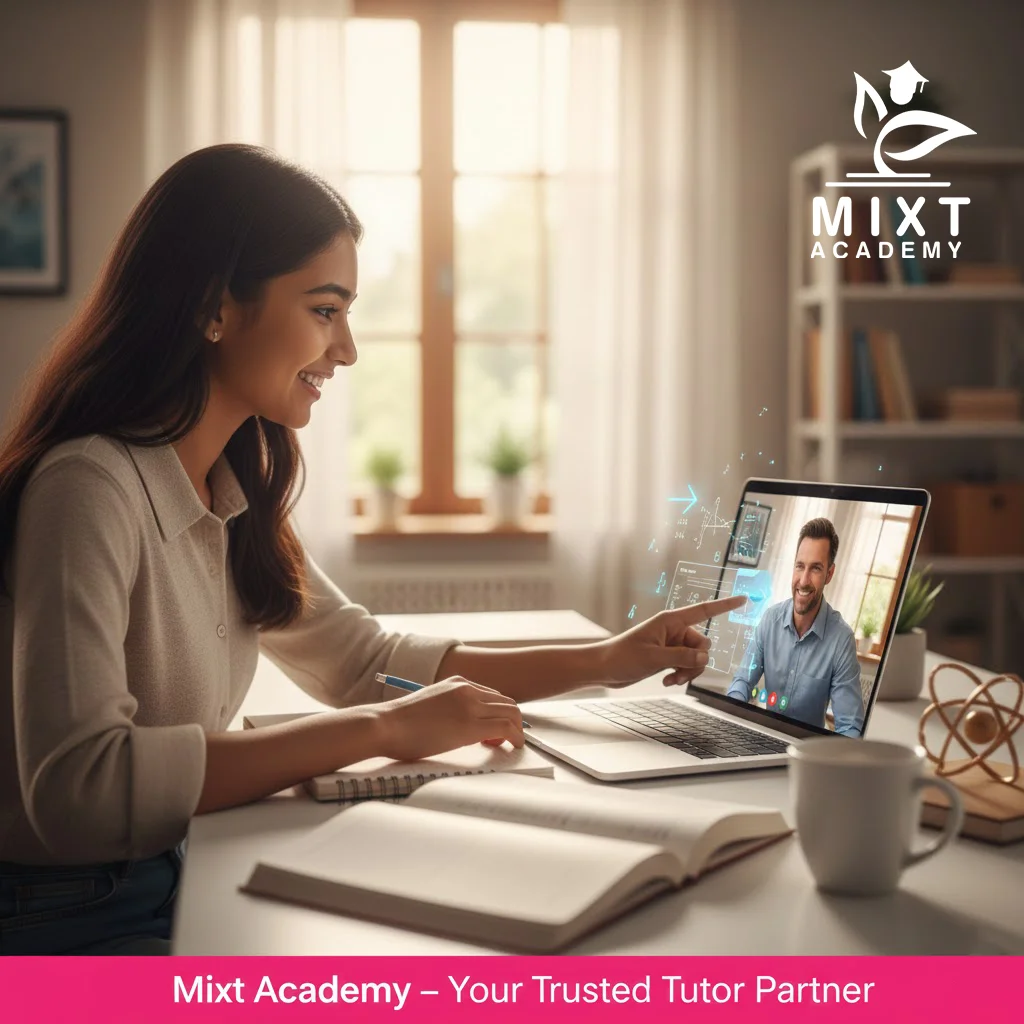
Mixt Academy provides personalised IB tutoring through expert tutors across Mathematics, Sciences, Economics, Computer Science, and Languages, supporting students at different academic levels. We provide online tutors for all subjects, including Accounting, Business Studies & Economics, Combined Science / General Science support, Mathematics, Physics, Chemistry, Biology, Computer Science, English (English Literature / Language/exam prep), and other common subjects.
Learners can choose tutors depending on the subject, level, curriculum, teaching mode, hourly rate, and tutor reviews/ratings. Mixt Academy holds a rating of 4.5 on Trustpilot. They cater to all learners from young students up to exam level (IGCSE / GCSE / A-Level / AS-Level).
The IB curriculum is a globally recognised education framework that develops critical thinking, international mindedness, and creativity. It is not a single subject list but a continuum of four programmes for learners aged 3 to 19, each with its own goals and subject structures.
These include the Primary Years Programme (PYP) for ages 3–12, the Middle Years Programme (MYP) for ages 11–16, the Diploma Programme (DP) for ages 16–19, and the Career-related Programme (CP) for ages 16–19.
Together, they provide a balanced, inquiry-based education that encourages students to connect learning with real life, develop essential academic and life skills, and prepare confidently for higher education, global careers, and lifelong success.
One-to-one online tutoring to master IB subjects, improve exam confidence, and stay ahead

Mixt Academy is a global online tutoring platform that connects students with expert IGCSE, GCSE, and A-Level tutors for one-to-one learning. With flexible scheduling, personalized lesson plans, and experienced teachers from top curricula, Mixt Academy helps students strengthen concepts, improve exam skills, and achieve higher grades with confidence.