
For many families, the term GCSEs can initially feel confusing, especially for international students and their parents. These exams mark a major milestone in UK secondary education and play an important role in shaping future academic and career opportunities.
This guide breaks down what GCSE are, how they work, and how parents can best support their children through them. Let’s explore the essentials with Mixt Academy.
GCSE is an abbreviation for the General Certificate of Secondary Education. It is a series of exams administered to students in England, Wales, and Northern Ireland, normally at the age of 16 after completing Key Stage 4 (Year 11).
The GCSEs are important qualifications that show a student’s level of knowledge in various subjects. They are recognized by employers, colleges, and universities as a requirement for further education, such as A-levels or vocational training.
The GCSEs are normally taken in the months of mid-May and late June. As an example, the exams will be conducted between Monday, May 4, and Friday, June 26, in 2026. Each exam has some specific dates, depending on the subject and exam board. The school will provide a schedule to students that shows the exact time each exam will be conducted.
Each of the subjects could have specific dates, depending on the exam board (AQA, Pearson Edexcel, OCR, CCEA, WJEC). The exam boards collaborate to avoid clashes between subjects.
In the GCSE curriculum, students learn a combination of mandatory (core) subjects (English, Maths, and Science) and optional (History, languages, Art, and Physical Education) ones. This mix allows them to build the necessary skills to continue their education and enables them to discover their personal interests and career goals.
In England, the following core subjects are compulsory for all students, and they are usually the basis of most university and entry-level career requirements:
The subjects are fundamental to the acquisition of important literacy, numeracy, and critical thinking skills, which are recognized by universities and the business community.
Besides the core subjects, students normally have three or four elective subjects chosen from a wide selection of options. Such options might vary depending on the school, but they usually involve subjects related to the following categories:
The students are encouraged to select a balanced mix of subjects that best suit their interests and future career goals. Such choices may affect their A-level choices, higher education applications, and even apprenticeship applications a lot. The specific subject offerings are commonly listed in the GCSE options booklet of the school.
The main method of assessing GCSEs is a final written examination at the end of the course, which lasts two years. Each GCSE in England is graded on a numerical scale from 9 to 1, where 9 is the highest and 1 the lowest.
All three grading systems are applied in Wales and Northern Ireland. There are also some subjects that include non-exam assessments (NEAs) or coursework as part of the final grade.
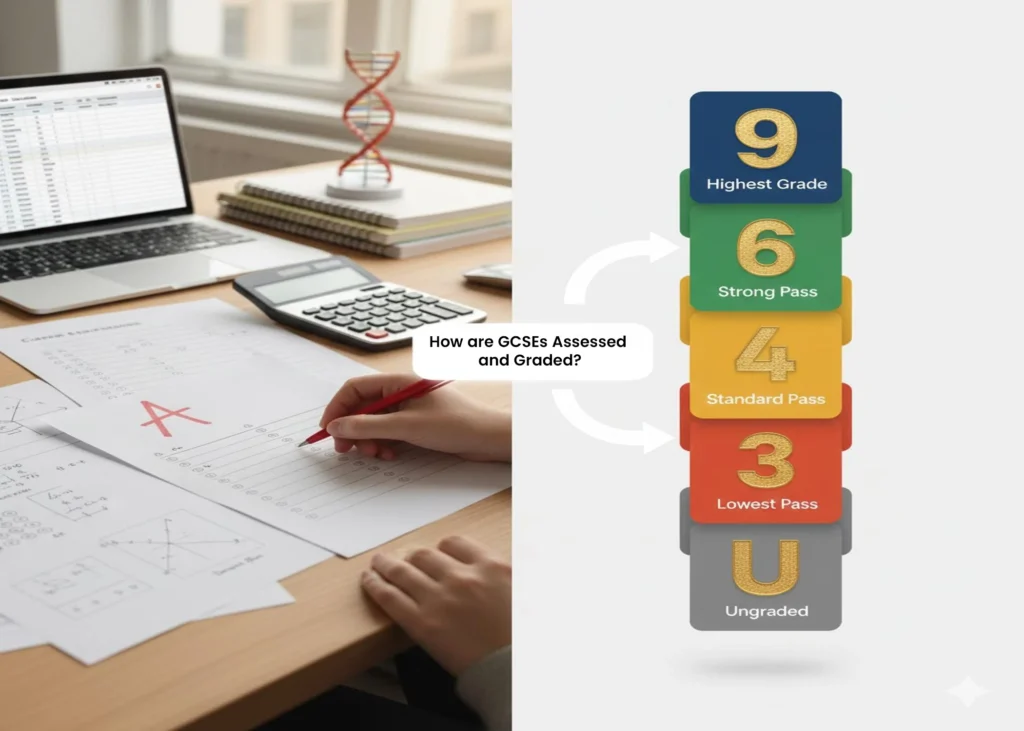
A GCSE qualification gets most of its marks through final exams during the May or June exams in Year 11. This system has been implemented as a change in the curriculum in England and has led to a decline in the use of coursework and modular assessments during the year, with a greater focus on examinations at the end of the course.
Non-exam tests in science (at least 15% of the marks), languages, fieldwork in Geography, and practical projects in arts and design are included. These tests are added to the final GCSE mark alongside the written examination.
The grading system also depends on the place of study, and England has used the 9 to 1 scale in all GCSE subjects. In England, Grade 9 is the top grade and is given when one has done exceptionally well, whereas Grade 1 is the lowest, and “U” means the person has not achieved any grade (Ungraded).
The majority of colleges and employers have minimum requirements of Grade 4 in such core subjects as English and Maths. Many sixth forms require Grade 5 or 6 in A-levels.
The traditional A to G grading system is still used in Wales and Northern Ireland, but in some schools in Northern Ireland, both systems may be used, depending on the board.
It has grade boundaries, which are the lowest marks needed to gain a specific grade. The grades are decided according to these grade boundaries. Senior examiners decide these limits annually and may change slightly to achieve fairness based on the difficulty of the exam and the performance of the group of students.
No! The key differences between the GCSE (General Certificate of Secondary Education) and the IGCSE (International General Certificate of Secondary Education) are their availability, content of the course, the methods of assessment, and the systems of grading. They are both well-respected and regarded as having the same qualifications by the universities and employers worldwide.
Feature | GCSE | IGCSE |
Target Audience | Primarily, students in the UK state school system follow the national curriculum. | Students around the world, including those in international and UK private schools. |
Course Content | Often focused on the UK; for example, Shakespeare is a compulsory part of English Literature, and history focuses heavily on British history. | More international focus, with global case studies. Examples: Shakespeare is optional, and history topics are diverse. |
Assessment Style | Assessed primarily by final exams, though some creative/practical subjects still include coursework (e.g., Art, Music, D&T). | Historically, more exam-based, designed to be easier for students whose first language may not be English, and for distance learners. |
Grading System | Uses the numerical 9-1 grading scale (9 is the highest). | Traditionally uses the A*-G letter scale, but some exam boards (like Pearson Pearson Edexcel) also offer the 9-1 scale for consistency. |
Exam Dates | Exams are held annually in the May-June series, with resits for core subjects in November. | Offers more flexibility with multiple exam sessions per year (May/June, November, and for some subjects, January). |
The planned audience is the most important difference. In the UK, the national qualification is the GCSEs, and in international schools and students, the IGCSEs were created.
The two qualifications are regarded as equal in standard and are accepted by universities, including top ones like Oxford and Cambridge, and employers worldwide.
Although IGCSEs used to be considered harder since they rely only on final exams, recent changes in the UK educational system have made GCSEs just as exam-based, which more or less levels the playing field when it comes to the challenges.
No! The GCSE is not limited to British schools alone. Although the GCSE is the standard and most widely accepted national qualification for students in England, Wales, and Northern Ireland, it can also be taken in several international schools in countries such as the UAE, Australia, Canada, and India.
The International GCSE (IGCSE), a version of the qualification with a more global focus and flexible assessment, is widely available and studied in international schools in over 160 countries around the world.
Both GCSE and IGCSE qualifications are recognized and respected worldwide. They are considered equivalent by universities and employers, providing a pathway to further education such as A-levels or the International Baccalaureate (IB) Diploma.
The GCSE curriculum can be expensive, depending on the type of school the student attends, and may cost very little or nothing for children in state schools in the UK. For private school or homeschooling students, the cost can run into several thousand pounds.
In state schools in the UK, the school pays for the curriculum itself and the main examination fees (covered by the government). Parents do not pay so that their child is entered to take their first set of GCSE exams in Year 11.
The expenses are considerably higher in the case of students in independent (private) schools or online home-based students.
In summary, although the basic GCSE curriculum is publicly funded in the UK state system. The overall financial cost to the families can vary greatly based on their personal preferences and the kind of school in which a child studies.
Official GCSE past papers are best and most reliable found on the websites of the relevant exam boards. Question papers, mark schemes, and examiner reports on most subjects and previous series of examinations are freely available on these sites.
You should identify which exam board and specification your child is studying in each subject before choosing the right past papers (ask your teacher if you are unsure). The main UK exam boards are:
Mixt Academy is an online tutoring company that provides professional, affordable support in preparing students to take GCSE and IGCSE exams. They have a team of longtime tutors and offer one-on-one lessons that suit the needs of different students to make sure they revise and master the subject. They have a wide range of subjects taught by their tutors, such as English, Maths, and Science, and are aimed at developing academic skills and confidence.
The team will assist you in finding your way around certain subjects, whether you are in need of some advice on how to approach the exam. They are committed to helping students produce the best outcomes. The learning environment is flexible and designed to ensure that the students get the support that they require. Use professional tutoring to ensure you make your GCSE more effective and successful.
With the help of these resources and by focusing on these qualities, you will be able to find a professional tutor who provides support tailored to your child’s needs. So, work closely with them to make the process of succeeding in GCSE exams easier.
Supporting GCSE students requires a mix of practical help, emotional support, and encouragement for independence. Reducing stress and encouraging healthy study habits should also be a focus to help them stay motivated and in control.
GCSEs serve as a major milestone in the academic path of a student, providing a pathway for higher education and career paths. The exams largely influence the future of a student by testing the key skills in the areas of English, Maths, and Science. It is very important for students and their parents to understand the GCSE system, including the subjects offered and the grading methods.
Mixt Academy provides professional online tutoring services in the UK, UAE, and worldwide to assist students in their GCSE examinations. They ensure that the students will be given the right support for the successful completion of the exam through knowledgeable tutors and customized lessons. By developing effective study habits and maintaining emotional well-being, students can approach their exams confidently.
Ultimately, a good understanding of the GCSE process and proper preparation can lead students to the world of academics and career opportunities, making this a critical period in their education.
GCSEs are the first set of exams that students normally take at 16, while A-levels are the next exams that students take, usually when they are 18. A-levels allow students to study a few subjects in detail, and these are the subjects that are usually required for university entrance.
GCSE scores carry weight in the entrance of students to the universities, especially those in the main subjects such as Maths and English. Most universities have a minimum GCSE grade requirement, and the results can also have an effect on the student's eligibility for the courses offered, particularly in competitive programs.
A wide range of resources is available to students for their GCSE exam preparation, such as past papers, revision guides, and online learning. Private tutoring, like the one offered by Mixt Academy, can also be a means of providing individualised attention needed to support classroom learning and address specific weaknesses.
Absolutely! Numerous online revision resource platforms offer materials like past papers, video tutorials, and interactive quizzes. Mixt Academy, Exams, and other websites provide organised resources to help students anywhere prepare for their GCSEs.
Parents can support their children's education by creating a conducive study environment, encouraging a balanced study schedule, and actively participating in the revision process. Additionally, they can seek online tutoring assistance from platforms like Mixt Academy, which offers qualified tutors to help students improve their understanding and academic performance.

Mixt Academy is a global online tutoring platform that connects students with expert IGCSE, GCSE, and A-Level tutors for one-to-one learning. With flexible scheduling, personalized lesson plans, and experienced teachers from top curricula, Mixt Academy helps students strengthen concepts, improve exam skills, and achieve higher grades with confidence.



IGCSE Physics Formula Sheet: Key Formulas for 0625 & Edexcel…
IGCSE Chemistry Papers: Common Mistakes & Exam Tips This IGCSE…
IGCSE Extended vs Core Tiers: How to Pick the Right…
Understanding GCSE Grade Boundaries and How to Prepare? Grade boundaries…
Differences GCSE English Language vs English Literature GCSE English is…
What is GCSE? A Guide for International Students & Parents…
A Level vs AP: Complete Guide to Choosing the Right…
Top Benefits of Completing AS and A Levels Privately Explore…
Cambridge vs IB Guide to Choosing the Best Curriculum Choosing…
IB vs A Levels: Which Qualification Is Right for You?…
How to Use OCR Past Papers for Effective Revision? Past…
AQA Physics Equation Sheet: Complete GCSE Guide for Combined Science…
AQA vs Edexcel Complete GCSE Comparison and Guide Choosing between…
Complete Guide to the AQA GCSE Chemistry Specification Understanding the…
Hire an Expert Tutor from Just 15$/hr