
One of the ways to ensure a strong academic progress leading to a university is to choose the right school qualification. At the end of middle school, you have to choose how to continue your school journey. The International General Certificate of Secondary Education (IGCSE) is one of the options. It is typically offered to students during their high school years, with the examinations for these taking place at the age of 16. In this guide, you will discover what an IGCSE is and why it is a great alternative for students worldwide. You will also learn about IGCSE exam boards, the structure of the qualification, its benefits, and how students can prepare for it.
IGCSE stands for International General Certificate of Secondary Education. It is a qualification designed for students aged 14–16. The curriculum offers a broad and balanced curriculum. The IGCSE was introduced by Cambridge Assessment International Education (CAIE) in 1988. It was designed as an alternative to the UK’s GCSE, offering a curriculum that could be used in schools across different countries.
Over the years, IGCSEs have achieved recognition worldwide. Many international schools, private institutions, and homeschooling programs offer this qualification. This makes it one of the most widely accepted secondary education certifications. Today, several IGCSE exam boards, including Cambridge (CAIE), Pearson Pearson Edexcel, and Oxford AQA, provide slightly different versions of the qualification.
IGCSE is usually taken by 14-16-year-old students; however, there is no age restriction. This means that any student can gain this qualification at any point during their academic journey. Many students choose to take one or more subjects early.
Students typically take between 5 and 14 subjects from these groups. At the same time, most schools require three compulsory subjects. These include Mathematics, English, and at least one Science subject. Beyond these requirements, you have the freedom to choose from approximately 70 options to achieve your educational interests or career plans.
Many subjects offer a two-tier examination system, Higher (Extended) and Lower (Core) tiers. While the Core provides fundamental content, the Extended tier delivers more advanced knowledge. This approach makes the qualification accessible to students with different academic abilities.
The International GCSE (IGCSE) offers a comprehensive and flexible curriculum that allows students to choose subjects based on their future goals. The grading system and exam structure vary slightly depending on the IGCSE exam boards. However, all of these follow a standard approach to assessment.
One of the key benefits of the IGCSE is the wide range of subjects available. Compared to other national curriculums, IGCSE subjects allow students to customize their studies to their interests and future career paths. All these options can be broken down into five subject groups:
Beyond the core subjects, students can choose from a variety of optional subjects, including:
There are several IGCSE exam boards you can choose from, and these are given as follows. Each exam board follows the same core IGCSE structure, but their syllabuses and assessment styles differ slightly. For example, Cambridge and Oxford AQA offer more coursework-based options, while Pearson Pearson Edexcel has a strong focus on final exams.
Assessment methods vary by subject and exam board, but generally include a mix of:
The IGCSE grading system depends on the exam board. While some boards use the traditional A-G grading. In comparison, others have adopted the newer 9-1 grading system used in UK GCSEs.
Final exams assess most subjects; however, some offer coursework options. This means students can either follow an exam-only model or submit coursework as part of their final grade, depending on their school’s chosen syllabus.
Exam boards have designed both IGCSEs and GCSEs similarly. In fact, UK universities treat both equally. At the same time, although there are no fundamental differences, the IGCSE is not an exact copy of its English-focused counterpart. Here are the key ways the qualifications differ:
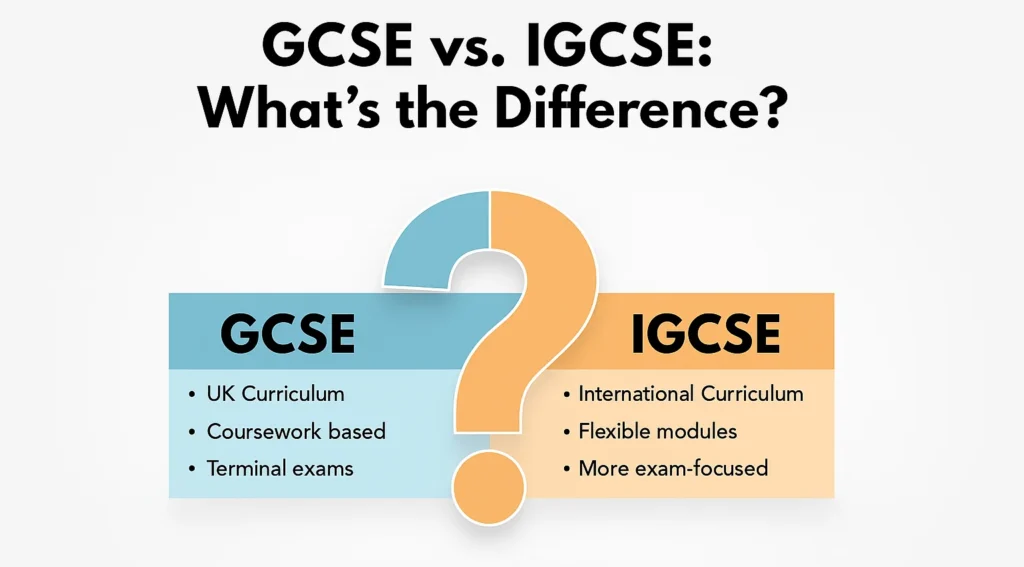
There are several reasons why students choose to take the IGCSE, including its global recognition, broad subject choices, and tough nature, which prepares students for further education at A Level, IB, and beyond.
The IGCSE can be a step toward obtaining further international education, whether it is IB or A-Level. But why should you choose it instead of MYP or other options? The reasons might be the following:
In contrast, the IGCSE programme has its downsides as well:
If your child is enrolling in IGCSEs, the registration process depends on whether they are taking exams through a school or as a private candidate.
As an IGCSE student, you can expect increased independence, greater responsibility for your learning, and a more detailed assessment than at the primary or early secondary level. You may also find that your teachers set more classwork and homework for you to complete.
There are higher expectations regarding time management, independent learning, and exam preparation. It is totally understandable to feel a bit stressed at first by this change, but with good planning and support from IGCSE Maths tutors, you can set yourself on the path to exam success.
Preparing for IGCSE exams requires the right approach, consistent practice, and effective study techniques. Many students and parents ask, “What is an IGCSE, and how can students achieve IGCSE success?” The key lies in structured revision, using the right resources, and managing exam stress effectively.
A strong preparation plan starts with understanding the syllabus for each of the chosen IGCSE subjects. Since different IGCSE exam boards, such as Cambridge, Pearson Pearson Edexcel, Oxford AQA, have slight variations in their exams, students should review the syllabus provided by their school or exam centre. Here are effective study techniques to maximize results:
IGCSE qualifications offer flexibility, global recognition, and a strong academic foundation. This curriculum makes them suitable for students with different learning needs. With a wide range of subjects, varied assessment methods, and international credibility, the IGCSE prepares students for A-Levels, IB, and university admissions worldwide. After completing your IGCSEs, you will need to consider your next educational steps. If a little push can help, Mixt Academy is at your service. As a team of experienced online IGCSE tutors and examiners, we can help you pass your exams with confidence. Whether you want to be fully prepared for your assessment or need specific subject tuition, we are just a call or email away. Get in touch today.
IGCSE stands for International General Certificate of Secondary Education. The IGCSE qualification has global recognition, and it prepares secondary school students for A-Levels, IB, or other advanced studies.
Consider your interests, strengths, and future career goals. It is also helpful to discuss your options with teachers, career advisors, and family members.
Yes, IGCSEs are widely accepted by universities around the world as part of their entry requirements.
Students usually take a minimum of 5 and a maximum of 14 IGCSE subjects, with 3 compulsory subjects: English, Science, and Mathematics.
The IGCSE uses a grading scale of A* to G (Cambridge) and 9 to 1 (Pearson Pearson Edexcel and AQA). A* and 9 are the highest grades, respectively. Grades A* to C and 9 to 6 are generally considered passing grades.
The recommended number of IGCSE subjects to take is typically between 8-10. This allows achieving a complete education while maintaining a manageable workload.
IGCSEs can be more challenging due to their international focus and focus on exam-based assessment. However, both qualifications are tough and respected.

Mixt Academy is a global online tutoring platform that connects students with expert IGCSE, GCSE, and A-Level tutors for one-to-one learning. With flexible scheduling, personalized lesson plans, and experienced teachers from top curricula, Mixt Academy helps students strengthen concepts, improve exam skills, and achieve higher grades with confidence.
IGCSE Physics Formula Sheet: Key Formulas for 0625 & Edexcel…
IGCSE Chemistry Papers: Common Mistakes & Exam Tips This IGCSE…
IGCSE Extended vs Core Tiers: How to Pick the Right…
Understanding GCSE Grade Boundaries and How to Prepare? Grade boundaries…
Differences GCSE English Language vs English Literature GCSE English is…
What is GCSE? A Guide for International Students & Parents…
A Level vs AP: Complete Guide to Choosing the Right…
Top Benefits of Completing AS and A Levels Privately Explore…
Cambridge vs IB Guide to Choosing the Best Curriculum Choosing…
IB vs A Levels: Which Qualification Is Right for You?…
How to Use OCR Past Papers for Effective Revision? Past…
AQA Physics Equation Sheet: Complete GCSE Guide for Combined Science…
AQA vs Edexcel Complete GCSE Comparison and Guide Choosing between…
Complete Guide to the AQA GCSE Chemistry Specification Understanding the…
Hire an Expert Tutor from Just 15$/hr