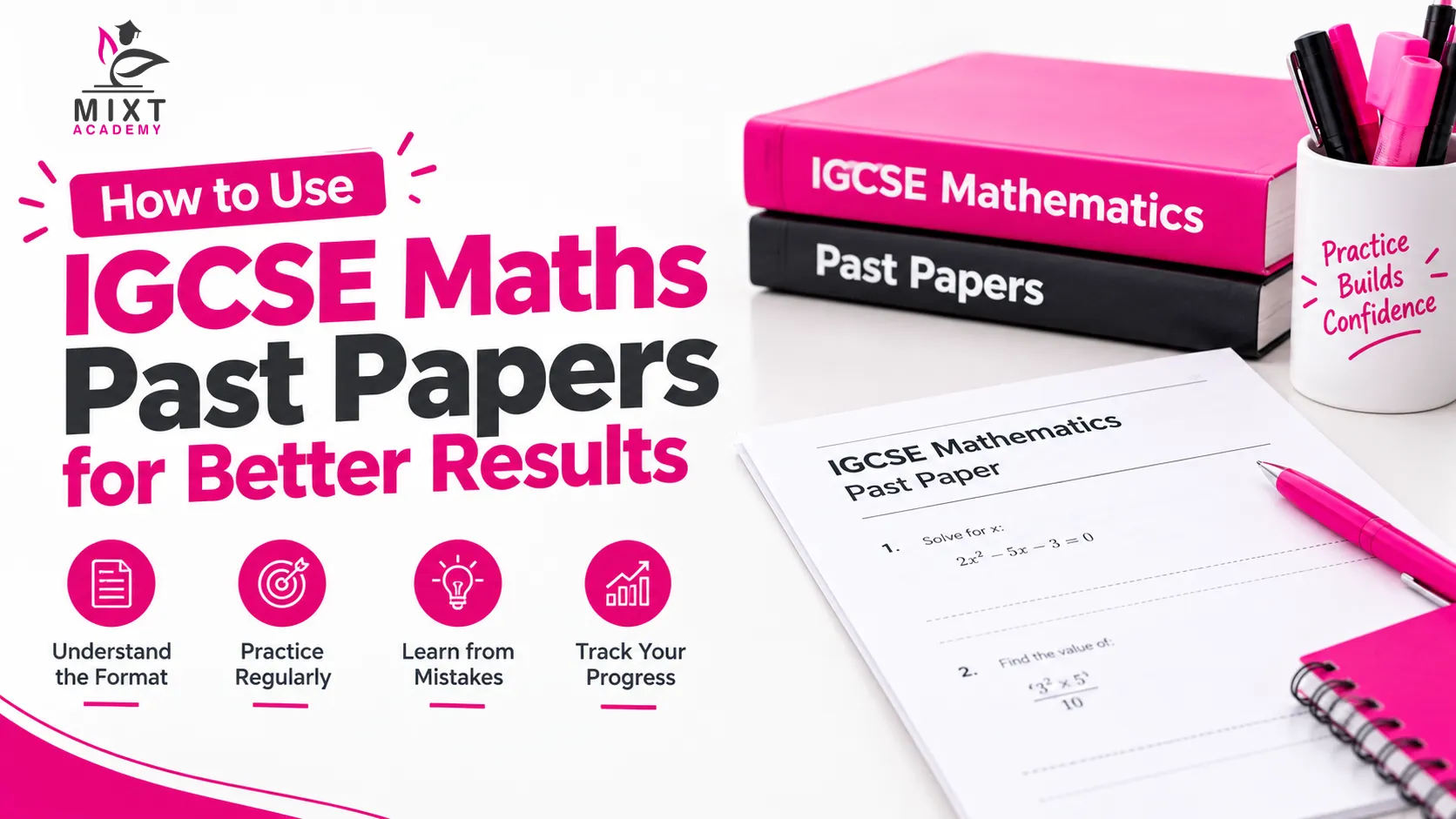
Used properly, IGCSE maths past papers can show you exactly where your knowledge, problem-solving, mathematical reasoning, and exam technique need attention. They can also help you become more comfortable with different question styles and improve your ability to apply mathematical methods under pressure. At Mixt Academy UAE, this kind of targeted practice can form an important part of a structured revision strategy.
This guide shows you how to use past papers effectively, from targeted topic practice to full exam papers. You’ll also learn how to analyse mistakes and turn each practice session into measurable progress.
What Can IGCSE Maths Past Papers Actually Teach You
A past paper is more than a collection of questions. It gives you an opportunity to see how well you can apply what you have learned when questions are presented in an examination format. Regular past paper practice can help you:
- Recognise recurring question patterns across topics
- Improve your accuracy with algebra, geometry, statistics, probability and trigonometry
- Become more confident with unfamiliar mathematical problems
- Practise showing clear working and mathematical reasoning
- Understand how marks are awarded for different parts of a question
- Improve pacing when working through a complete mathematics paper
- Identify topics that need further revision
There is an important difference between knowing a formula and knowing when to use it. Past papers help bridge that gap by making you apply mathematical knowledge to problems rather than simply recalling information.
Start With Your IGCSE Maths Syllabus
Before opening a past paper, look at your current syllabus and create a topic checklist. Your revision should cover the full range of content you are expected to know rather than focusing only on the chapters you find easy. Depending on your specification, your checklist may include areas such as:
- Number and percentages
- Algebra and equations
- Sequences and graphs
- Geometry and mensuration
- Trigonometry
- Statistics and probability
- Vectors
- Functions and transformations
- Ratio and proportion
- Problem-solving and mathematical reasoning
This gives your past paper practice a clear purpose. Instead of simply asking, “How many questions did I get right?” you can ask, “Which topics are costing me marks?” That change in thinking can make your revision considerably more productive.
Choose the Right IGCSE Maths Past Papers
Not every paper is equally useful for every student. Always make sure the past paper matches your exam board, qualification, syllabus version, tier, and paper format.
For students following Pearson Edexcel, searching specifically for Edexcel IGCSE Maths past papers can help narrow your practice materials to the relevant qualification. Students following Cambridge should likewise check that the paper matches their current syllabus.
Cambridge currently provides past papers, examiner reports and specimen exams for IGCSE Mathematics 0580, while also warning that some older past papers may not fully reflect the current syllabus. Pearson also has different International GCSE Mathematics routes, so checking the exact specification before practising is important.
Use Topic Questions Before Full Papers
A common mistake is jumping straight into complete papers before checking whether the underlying knowledge is secure. Suppose you consistently struggle with simultaneous equations, circle theorems, probability or quadratic graphs. Completing another full paper may show the same weakness again, but it will not necessarily fix it. Start with topic-based practice instead. Work through several questions on one area until you understand:
- Which method does the question require?
- How to set up the calculation?
- Where you tend to make mistakes
- How much working do you need to show?
- How should the final answer be presented?
This approach is especially useful when you are still building subject knowledge. You are moving from understanding mathematics in your notes to using maths on paper in unfamiliar situations.
Build a Diagnose and Practise Revision Loop
The most useful past paper routine is not simply: Paper → score → next paper
A better process is: Paper → analyse → identify weakness → revise → practise → retest
After each paper, review every question where you lost marks. Ask yourself what actually went wrong. Was it:
- A knowledge gap?
- A forgotten formula?
- A calculation mistake?
- A misunderstanding of the question?
- Poor mathematical reasoning?
- Incorrect use of a method?
- A timing problem?
- Failure to show sufficient working?
This categorisation tells you what kind of revision you need. For example, repeatedly getting factorisation questions wrong suggests a knowledge or method issue. Leaving several high-mark questions unfinished points towards timing and exam technique. Losing easy marks through arithmetic errors requires a different solution again.
Read the Question Before Choosing a Method
Some students see a familiar mathematical topic and immediately start calculating. That can be risky. The wording of a question often tells you what it expects. Pay attention to words such as:
- Calculate
- Explain
- Show that
- Hence
- Estimate
- Determine
- Prove
- Solve
- Compare
These words can change how you should approach the problem and how much explanation is required. A student may know the correct mathematical method but still lose marks because the response does not fully address the task. Learning to translate question wording into mathematical action is an important part of exam preparation.
Learn From the Mark Scheme
Do not use the mark scheme only to check whether your final answer matches. Study how the marks are awarded. A multi-step question may award marks for the correct equation, substitution, method, intermediate calculation, or final answer. This means a wrong final answer does not always mean that every part of your approach was wrong. When reviewing a mathematics paper, compare your working with the mark scheme carefully. Look for patterns in the places where your method stopped earning marks.
This can help you understand the difference between: Knowing the answer and showing enough mathematical working to earn the available marks
That distinction becomes increasingly important as questions become more complex.
Use Examiner Reports to Understand Common Errors
Examiner reports can provide another layer of insight because they explain common candidate mistakes and misconceptions from particular exam series. They can help you recognise issues such as:
- Incorrect rounding
- Weak algebraic manipulation
- Misreading graphs
- Using an inappropriate formula
- Giving answers without sufficient working
- Confusing mathematical terms
- Failing to interpret a real-world problem correctly
This is valuable because you can start watching for the same problems in your own work. Rather than simply asking whether an answer is correct, ask whether your approach is reliable enough to repeat under exam conditions.
Hire the Best Online Tutors for Your Child
When Should You Introduce Timed Papers
Timing should become stricter as your knowledge improves. Trying to complete every past paper under full exam conditions from the beginning can make revision unnecessarily stressful, especially when you still have major knowledge gaps. A gradual approach works better:
1. Early Revision
Work through individual questions without strict timing. Concentrate on understanding the method and correcting mistakes.
2. Mid-Revision
Complete larger sets of questions with some time awareness. Avoid spending too long on one difficult problem.
3. Final Revision
Complete full papers under conditions that closely reflect your real examination. Use the same calculator rules, timing expectations, and working habits you will use in the actual assessment. The aim is to make the process of working through a full mathematics paper feel familiar rather than intimidating.
Practise Both Accuracy and Speed
Good exam performance requires both. Working quickly is not useful if your answers contain avoidable errors. Likewise, producing perfect solutions is not enough if you cannot complete the paper on time. During practice, track two things:
- Accuracy: How many marks are you earning?
- Pacing: How much time are you spending to earn them?
If you regularly spend too long on difficult questions, practise recognising when to move forward and return later. If you work quickly but make careless errors, slow down enough to check calculations, signs, units and final answers. This is one of the clearest ways past papers can improve exam technique.
How IGCSE Maths Tutors Can Support Past Paper Practice
Some students know the content but cannot identify why their marks remain inconsistent. This is where targeted support can be useful. Experienced IGCSE maths tutors in Dubai can look beyond the overall score and identify whether the underlying issue is mathematical knowledge, application, exam technique, question interpretation, or time management.
For families looking for online tutors in the UAE, one advantage of individual support is that practice can be built around the student’s actual mistakes. Instead of spending equal time on every chapter, the sessions can focus on the topics and question types that are repeatedly affecting performance.
A trusted tutoring platform in the UAE can support this process by connecting focused revision with past paper practice, helping students move from identifying weaknesses to actively addressing them.
How Many IGCSE Maths Past Papers Should You Do?
There is no universal number that guarantees improvement. Five carefully analysed papers can be more useful than fifteen papers completed quickly with little reflection.
- The better question is not “How many papers have I finished?”
- Ask: “What have I improved because of the papers I completed?”
After each paper, record your score, the topics that caused difficulty, the mistakes you made, and the action you will take next. For example:
| Problem | What It Shows | Next Action |
|---|---|---|
| Quadratic equations | Method not secure | Complete topic practice |
| Probability | Question interpretation issue | Practise mixed probability questions. |
| Geometry | Formula recall gap | Review formulae and solve examples. |
| Several Unfinished Questions | Timing problem | Complete timed sections |
| Arithmetic slips | Accuracy issue | Add checking time. |
This turns past paper practice into a measurable revision system.
8 Common Mistakes When Using IGCSE Maths Past Papers for Revision
- Doing Papers Too Early: Attempting full papers before learning the relevant content can create unnecessary frustration.
- Repeating the Same Paper: Remembering familiar answers does not necessarily prove that you understand the mathematics.
- Ignoring Incorrect Working: Looking only at the final answer can hide the point where your method went wrong.
- Skipping Difficult Questions: Avoiding unfamiliar problems limits your exposure to the types of questions that can test deeper understanding.
- Never Revisiting Mistakes: A past paper has limited value if you identify a weakness but never practise it again.
- Focusing Only On Scores: Your percentage is useful, but your error patterns provide much more actionable information.
- Using the Wrong Paper: Practising material from a different specification can make your revision less relevant.
- Ignoring Presentation: Untidy working or missing steps can make it harder to demonstrate your method clearly.
Use IGCSE Maths Mock Results to Improve Past Paper Practice
Your school mock can provide a useful snapshot of how your knowledge and exam technique perform under pressure. Once you receive your results, do not stop at the grade. Look through the marked script and compare your mistakes with your previous past paper practice.
If you repeatedly lose marks in algebra, return to algebra questions. If geometry questions cause trouble, build another focused practice set. If your biggest problem was time, use timed sections before completing another full paper. This creates a continuous revision cycle where every assessment informs what you should do next.
Hire the Best Online Tutors for Your Child
Should You Practise Mathematics on Paper or Digitally
Digital resources can be useful for explanations, worked examples and quick topic checks, but writing mathematical solutions by hand remains an important part of examination preparation. You need to become comfortable with:
- Showing calculations clearly
- Setting out algebraic working
- Drawing diagrams and graphs
- Writing mathematical explanations
- Using appropriate notation
- Checking answers before moving on
The final assessment is completed through written examination work, so your preparation should include enough practice that translating your understanding into paper mathematics feels natural.
Help Your Child Prepare More Effectively for IGCSE Maths | Book Free Trial
Past papers become far more valuable when every attempt leads to a clear next step. Mixt Academy UAE can help students turn repeated mistakes into a structured revision plan built around their syllabus, exam technique and individual learning needs. Get focused support with IGCSE maths tutors with topic practice and past paper analysis so your preparation becomes more targeted and purposeful.
Final Thoughts
IGCSE Maths past papers should not be treated as a race to complete as many questions as possible. Their real value comes from understanding what each paper reveals about your knowledge, accuracy, mathematical reasoning, timing and approach to unfamiliar problems.
Start with the syllabus, practise weak topics, analyse your mistakes, study mark schemes carefully and gradually introduce timed conditions. When you use every paper as feedback for your next revision session, your preparation becomes more focused and much easier to measure.