You read your notes three times, highlight every key definition, and feel fully prepared, only to completely blank out during your exam. This frustrating experience happens because recognising information while reading is not the same as retrieving it from memory under exam conditions.
Active recall is a study method built around bridging that exact gap. Instead of passively reviewing notes, you force your brain to retrieve information independently, check your accuracy against a mark scheme, and instantly correct what you missed.
In this guide, we break down how active recall works, why it outperforms traditional rereading, and how GCSE, IGCSE, and A Level students in the UAE can apply it across different subjects to score higher marks.
What Is Active Recall
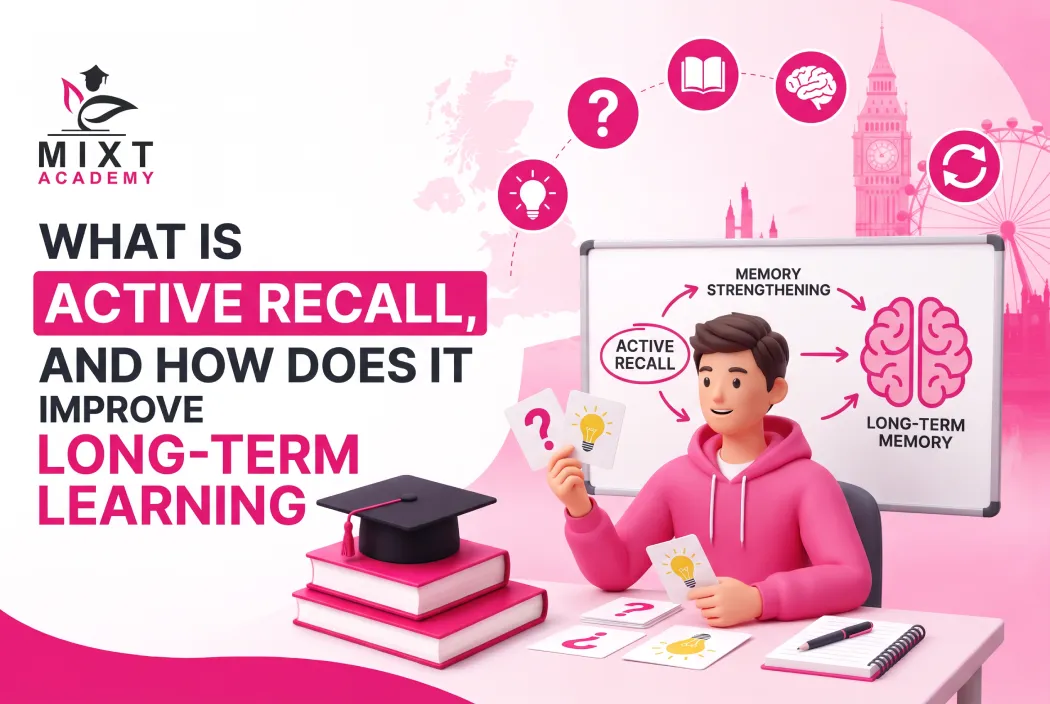
Active recall is a study technique where you try to retrieve information from memory before checking your notes or the answer. Rather than reading a definition of photosynthesis again, you close the book and try to explain the process yourself. If you get stuck, that gap tells you exactly what to revise next. The key distinction is:
- Reading Information → Recognising It (False Confidence)
- Retrieving Information → Recalling It (Long-Term Retention)
Recognising a fact when it is right in front of you requires minimal mental energy. Recalling it without prompts requires cognitive effort, and that exact exertion is what signals your brain to store the information permanently.
How Does Active Recall Improve Long-Term Learning
Active recall relies on what cognitive scientists call retrieval practice. Each time you pull a memory out of your head, you strengthen the neural pathways associated with that concept, making future access faster and more reliable.
- Eliminates the Illusion of Competence
Rereading and highlighting create a false sense of mastery. Self-testing acts as a diagnostic tool that immediately exposes knowledge gaps before the real exam does.
- Builds Flexible Problem-Solving Skills
Active recall is not just about memorising raw facts. When you force yourself to retrieve concepts to explain cause and effect or apply a formula, you move beyond rote memorisation into higher-order analysis (required for Grade 8/9 or A* responses).
Active Recall vs Passive Revision
| Feature | Active Recall | Passive Revision (Rereading & Highlighting) |
| Primary Action | Testing Yourself | Reading notes or watching videos |
| Cognitive Process | Retrieving Information | Recognising printed information |
| Knowledge Gaps | Reveals Knowledge Gaps | Easily hidden behind familiarity |
| Mental Effort | Requires Mental Effort | Low (comfortable) |
| Best Used For | Exam preparation & long-term retention | Initial exposure to new topics |
Important Note! Passive review isn’t useless; it is necessary when learning brand-new material for the first time. However, the switch to active recall must happen immediately after that first exposure.
5 Practical Active Recall Techniques for Students
- Modern Flashcards (Paper or Anki): Write a direct question on the front and the mark scheme answer on the back. The Golden Rule: Always state or write your complete answer before flipping the card over. Never flip early.
- Closed-Book Practice Questions: Work through past paper questions (AQA, Pearson Edexcel, OCR, or Cambridge) without looking at mark schemes or revision guides. This mimics real exam pressure and trains your brain to structure answers under timed conditions.
- The Blurting Method: Read a specific sub-topic (e.g., GCSE Chemistry: Electrolysis) for 10 minutes. Close all books and write down every formula, key term, and process on a blank paper. Use a red pen to mark missing details against your revision guide.
- The Feynman Technique (Teach Someone Else): Explain a concept aloud to a parent, peer, or tutor without referencing notes. If you stumble or rely on vague jargon, you have identified an area that requires immediate review.
- Pre-Session Brain Dumps: Before beginning any revision block, spend 3 minutes writing down everything you remember about the topic from previous lessons. This primes your mind for deeper learning.
Pairing independent self-testing with UAE online tutoring provides expert guidance to refine your answers and target key knowledge gaps. This added layer of interactive feedback helps you stay accountable and master difficult concepts across every subject.

How to Integrate Active Recall into Your Revision Routine
Feedback matters as much as the retrieval itself. Correcting mistakes is what turns a knowledge gap into learning. If you are short on time, even ten minutes of self-testing on one topic is more useful than an hour of rereading.
- Study: Review the core content for 15–20 minutes.
- Close: Put all revision materials out of sight.
- Retrieve: Write, draw, or speak your answers from memory.
- Check: Cross-examine your output against official mark schemes or class notes.
- Correct: Highlight missing points in a distinct colour and record them in an error log.
- Repeat: Re-test the exact same material 3 to 7 days later.
Pairing Active Recall with Spaced Repetition
While active recall dictates how you review, spaced repetition determines when you review. Combining both ensures maximum retention with minimum effort.
- Session 1 (Day 1 Initial Recall)
- Session 2 (Day 3 First Gap)
- Session 3 (Day 7 Second Gap)
- Session 4 (Day 21 Long-Term Lock)
Instead of spending 5 hours cramming biology the night before a test, split that time into 45-minute active testing blocks distributed across three weeks.
How Active Recall Can Help Different Subjects
Different subjects require different cognitive outputs. Tailor your retrieval method accordingly:
- STEM (Maths, Physics, Chemistry): Solve problem sets without looking at worked examples. Focus on retrieving multi-step formula derivations and problem-solving pathways.
- Sciences (Biology, Environmental): Use blurting for biological pathways, labelled diagrams, and exact syllabus definitions.
- Humanities (History, Geography): Write essay outlines from memory. Retrieve key dates, statistical evidence, case studies, and cause-and-effect chains.
- Languages (English, French, Spanish): Practice vocabulary flashcards via spaced repetition apps and write full essay paragraphs without a dictionary.
7 Common Mistakes to Avoid
- Peeking at Notes Too Early: Looking at answers after 5 seconds deprives your brain of the memory effort needed for growth.
- Relying on Flashcards for Simple Facts Only: Use flashcards to test process explanations and “Why?” questions, not just simple definitions.
- Skipping the Correction Step: Failing to cross-check answers leaves misconceptions uncorrected.
- Practising Only Easy Topics: Spending time testing familiar material feels good but yields zero score improvement.
- Cramming Everything Into One Session: Omitting spacing leads to rapid memory decay.
- Confusing Recognition with Recall: Assuming you know a topic just because a worked solution “makes sense”.
- Ignoring Exam Board Mark Schemes: Failing to align retrieval practice with the exact wording required by examiners (e.g., Pearson Edexcel vs. Cambridge IGCSE).
How Mixt Academy Can Help
Mastering study techniques is one thing; applying them consistently across 8 to 10 exam subjects is another. At Mixt Academy, we pair students in the UAE with expert, UK-qualified online tutors specialising in GCSE, IGCSE, and A Level curricula.
Our tutors do not just deliver lectures; they integrate structured active recall, past paper mark scheme analysis, and customised revision roadmaps into every live session. Whether your child needs targeted IGCSE online tutoring or comprehensive GCSE exam preparation support, our 1-to-1 programmes build independent study habits that deliver top grades.
Conclusion
Mastering active recall transforms revision from a passive chore into an efficient, results-driven process. By forcing your brain to retrieve stored information rather than simply rereading familiar text, you actively strengthen key memory pathways. This process allows you to pinpoint critical knowledge gaps early while building true confidence for exam conditions.
The key to long-term success lies in consistency and feedback. Combining self-testing methods like blurting, flashcards, and past papers with spaced review ensures that facts move efficiently from short-term memory into durable, lasting recall. This systematic approach prepares you to tackle even complex, high-mark application questions with confidence and clarity.
Ultimately, shift your mindset from measuring study time by hours spent reading to measuring performance by active answers retrieved. Making retrieval a core, daily habit allows you to study smarter, eliminate pre-exam panic, and achieve the top grades your hard work deserves.