Ground that never moves suddenly moves. That is what an earthquake feels like, and it is one of the first natural hazards students meet in geography class. If you are studying IGCSE geography in Dubai, Abu Dhabi, or anywhere in the UAE, this topic usually falls under the unit on tectonic hazards or natural hazards, and it comes up again and again in exam questions.
At Mixt Academy, students often ask the same three questions: what causes an earthquake, how does the shaking actually start, and what can people do about it? This guide answers all three in plain language, with the exact terms your exam expects you to know.
What Is An Earthquake
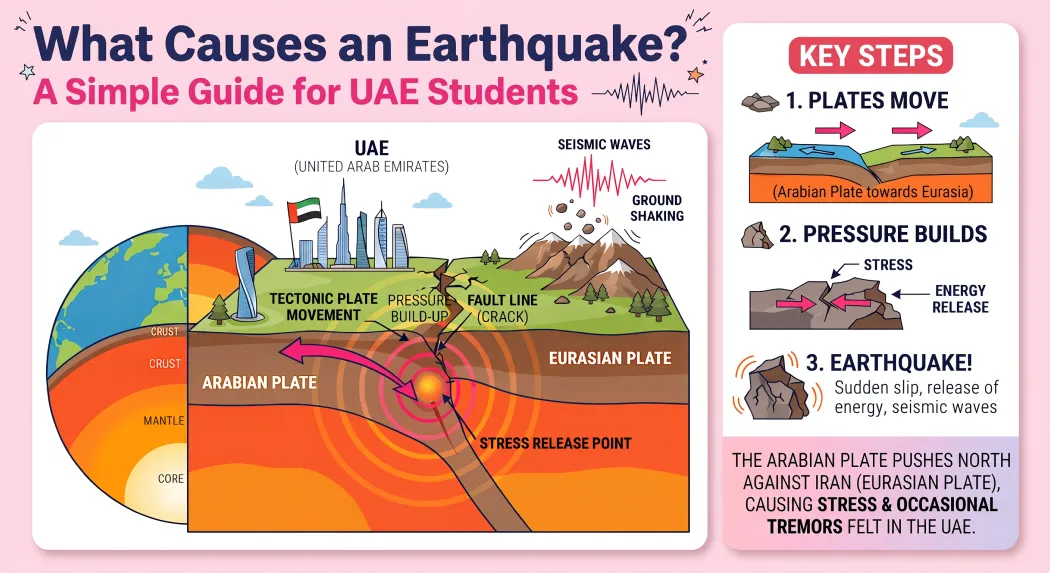
An earthquake is the sudden shaking of the ground. It happens when rocks inside the Earth suddenly move and release energy. Earth’s surface is made of large pieces called tectonic plates. When these plates move, they can cause rocks to break or slide along faults, producing an earthquake.
Simple Example: Imagine pushing two books against each other. When one book suddenly slips, you feel a small movement. In a similar way, sudden movement of rocks can cause the ground to shake.
Key Terms for Quick Revision
- Earthquake: Sudden shaking of the ground.
- Tectonic plates: Large pieces that make up Earth’s outer layer.
- Fault: A crack in the Earth where rocks can move.
- Focus: The point inside Earth where the earthquake starts.
- Epicentre: The point on the surface directly above the focus.
- Magnitude: The amount of energy released by an earthquake.
- Seismic waves: Energy waves that travel through the Earth during an earthquake.
What Causes an Earthquake
So what causes an earthquake in the first place? The short answer is stress. The Earth’s outer layer, called the lithosphere, is broken into around fifteen large sections known as tectonic plates. These plates float on a softer layer beneath them called the asthenosphere, and they move a few centimetres every year. That sounds slow, almost nothing, but over hundreds of years this slow movement builds enormous pressure along the edges where plates meet.
These edges are called fault lines. As two plates try to move past, toward, or away from each other, friction holds them locked in place even while the deeper rock keeps pushing. Energy builds up in the rock the same way energy builds in a bent ruler before it snaps. Eventually the friction cannot hold any longer. The rock breaks or slips, and all that stored energy releases at once. That sudden release is an earthquake.
How Stress Turns into Shaking
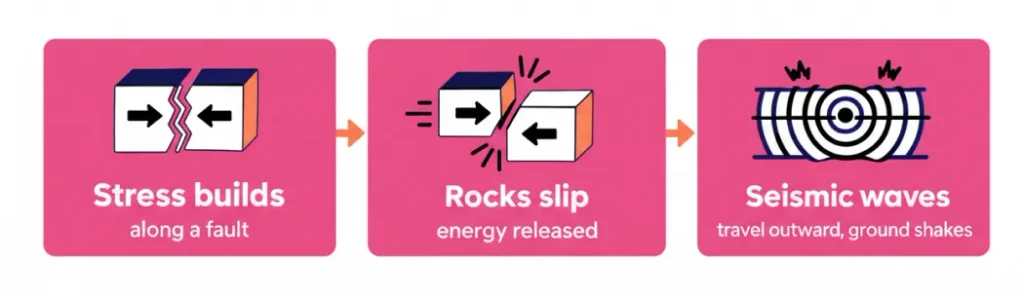
Understanding how an earthquake is caused becomes easier if you picture it in three stages.
- First, stress builds. Tectonic plates push against each other at a boundary, but friction along the fault keeps the rocks stuck together. The rock bends slightly, storing energy the way a spring stores energy when you compress it.
- Second, the rock breaks. Once the built-up stress becomes greater than the friction holding the fault together, the rock cannot bend any further. It fractures or slips suddenly.
- Third, energy is released. The rock snaps back toward its original shape, a process geologists call elastic rebound. This sudden movement sends out seismic waves, which travel through the ground and cause the shaking we feel at the surface.
This whole process is known as elastic rebound theory, first proposed by geologist Henry Fielding Reid after studying the 1906 San Francisco earthquake. It remains the standard explanation used in textbooks and exams today.
Which Subject Covers Earthquakes at School
Earthquakes sit inside geography, specifically the branch called physical geography or tectonic geography. In the IGCSE and A Level syllabus, you will usually find this topic under headings like Natural Hazards, Tectonic Landscapes, or The Restless Earth.
Teachers expect you to explain the causes of earthquakes using specific vocabulary such as tectonic plates, fault lines, focus, epicentre, and seismic waves. Getting these terms right is often the difference between a pass and a strong grade, because examiners look for precise language, not vague descriptions.
What Are the Causes of the Earthquake: The Main Types
When students ask what are the causes of the earthquake, they usually mean the different sources, not just the plate tectonics explanation. There are actually a few distinct categories worth knowing.
Tectonic earthquakes are by far the most common. These happen at plate boundaries, where plates are diverging, converging, or sliding past one another. Nearly every major earthquake in recorded history falls into this group.
Volcanic earthquakes happen when magma moves underground near a volcano. The pressure of moving magma can crack surrounding rock and trigger tremors, sometimes as a warning sign that an eruption is coming.
Induced earthquakes are caused by human activity rather than natural forces. Large dams, deep mining, and underground fluid injection from oil and gas operations can all change stress patterns in nearby rock and trigger tremors. These are usually smaller than tectonic earthquakes, but not always harmless.
Collapse earthquakes are the rarest type. These occur when underground caverns or old mine tunnels collapse, sending a small shockwave through the surrounding rock.
What Is Causing Earthquakes in Specific Regions
If you have ever wondered what is causing earthquakes to cluster in certain parts of the world, the answer connects directly back to plate boundaries. Most of the world’s largest earthquakes occur along the Pacific Ring of Fire, a horseshoe-shaped zone circling the Pacific Ocean where several plates meet. Japan, Indonesia, Chile, and the west coast of the United States all sit on or near this boundary, which is why they experience frequent, often powerful earthquakes.
Some earthquakes occur far from any plate boundary. These are called intraplate earthquakes, and they are harder to predict because they happen inside a plate rather than at its edge. The 2001 Gujarat earthquake in India is a well-known example. It struck an area not typically associated with high seismic risk, yet it measured 7.6 on the moment magnitude scale and killed more than 20,000 people.
Read more: Earthquake in the UAE
Types of Plate Boundaries and Faults
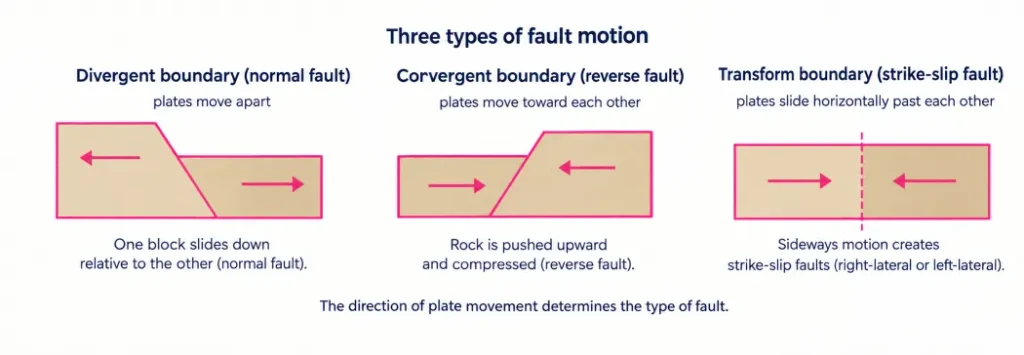
Geography exams often ask you to link earthquake causes to specific boundary types, so this section is worth memorising carefully.
- At divergent boundaries, plates move apart from each other. This stretching creates normal faults, where one block of rock slides down relative to the other.
- At convergent boundaries, plates move toward each other and collide. This pressure creates reverse faults, where rock is pushed upward and compressed.
- At transform boundaries, plates slide horizontally past each other. This sideways motion creates strike-slip faults, which can be right-lateral or left-lateral depending on the direction of movement.
Some faults combine both vertical and horizontal motion. These are called oblique slip faults, and they show up in regions where plate movement is complex rather than purely one direction.
Focus and Epicentre: Two Terms You Must Not Confuse
Two terms trip up almost every student at some point: focus and epicentre.
- The focus, sometimes called the hypocentre, is the exact point underground where the rock first breaks and the earthquake begins. Earthquakes with a focus less than 70 kilometres deep are called shallow, and these cause the most surface damage because the energy has less distance to travel before reaching buildings and people.
- The epicentre is the point on the surface directly above the focus. News reports almost always describe an earthquake’s location using its epicentre, because that is what tells you which towns or cities felt the strongest shaking.
Why Some Earthquakes Cause More Damage Than Others
Magnitude alone does not decide how destructive an earthquake becomes. Several factors combine to determine the actual damage.
- Depth Matters Enormously: A shallow earthquake close to the surface tends to cause far more destruction than a deep one of the same magnitude, simply because the shockwaves have less rock to travel through before reaching buildings.
- Local Geology Plays a Role Too: Soft, loose soil can shake far more violently than solid bedrock, and in the worst cases it can undergo a process called liquefaction, where saturated soil temporarily behaves like a liquid and building foundations sink or tilt.
- Building Design is Often the Biggest Factor of All: In many major disasters, the greatest damage comes not from the shaking itself but from the fires, floods, and structural collapses that follow. Well-constructed buildings with flexible steel frames can survive shaking that would destroy poorly built structures nearby.
How Geography Tutors Help Students Master This Topic
Earthquake topics involve a lot of interconnected vocabulary, from tectonic plates and fault types to focus, epicentre, and elastic rebound theory. Many students understand each term separately but struggle to explain the full process in an exam answer.
This is exactly where working with experienced geography tutors makes a real difference. IGCSE geography tutors can walk through past paper questions and show you exactly how examiners expect answers to be structured. Furthermore, they clear up the small mix-ups, like confusing focus with epicentre, that quietly cost marks.
For families searching for online tutors in the UAE, finding a trusted online tutoring platform matters just as much as finding a knowledgeable tutor. Structured lessons, clear explanations, and consistent feedback tend to produce far better exam results than last-minute revision alone.
Earthquake Solutions and How Engineers Reduce Damage
No one can stop tectonic plates from moving, and predicting the exact timing of an earthquake remains beyond current science. What communities can control is how prepared they are when the ground does shake.
Earthquake-resistant design has advanced significantly. Engineers now use flexible steel frames, base isolators that let a building’s foundation absorb movement, and dampers that reduce swaying during a quake. These systems allow tall buildings to bend slightly rather than crack apart.
Early warning systems detect the faster, less destructive P waves that arrive before the more damaging S waves. Even a few seconds of warning gives enough time to halt trains, shut off gas lines, and alert people to take cover.
Public education saves lives too. The Drop, Cover, and Hold On method, getting beneath sturdy furniture, covering your head, and holding on until shaking stops, remains the safest response almost everywhere in the world.
Land use planning restricts new construction near active fault lines or on soil known to be at risk of liquefaction, reducing exposure before a disaster ever happens.
Study Smarter With the Right Support
Earthquake topics reward students who can explain the full process clearly, from stress building along a fault to the moment energy releases as seismic waves. Practising past paper questions and reviewing diagrams of focus, epicentre, and fault types will strengthen both your understanding and your exam technique.
If you want that guidance from someone who knows exactly what IGCSE examiners look for, Mixt Academy connects students across Dubai, Abu Dhabi, and the wider UAE with experienced geography tutors who make complex topics like this genuinely easy to follow.