Have you ever wondered why you can see your face in a mirror or why a calm lake reflects nearby trees? These everyday observations happen because of light reflection. It occurs when light strikes a surface and bounces back into the same medium.
Understanding reflection helps you explain how mirrors form images, why different surfaces reflect light differently, and how optical devices work. At Mixt Academy, students explore these physics concepts through simple explanations and practical examples.
Let’s understand the definition, laws, types, calculations and real-life applications of reflection of light step by step.
What Is Reflection of Light
Reflection of light is the process in which light rays strike a surface and bounce back into the original medium. The surface that sends the light back is called a reflecting surface. For example, when sunlight falls on a mirror, the mirror reflects the light into the surrounding area. When these reflected rays reach your eyes, you can see the light or an image. Reflection can occur on different surfaces, including:
- Mirrors and polished metals.
- Calm water and glass surfaces.
- Walls, books and wooden objects.
- Shiny jewellery and vehicle surfaces.
A surface does not need to look shiny to reflect light. Even a rough wall reflects some light, although it scatters the reflected rays in different directions. Remember that not every object produces its own light. Objects such as books, trees and furniture are visible because they reflect light from external sources. The sun and electric bulbs are examples of objects that emit their own light.
How Does Reflection of Light Occur
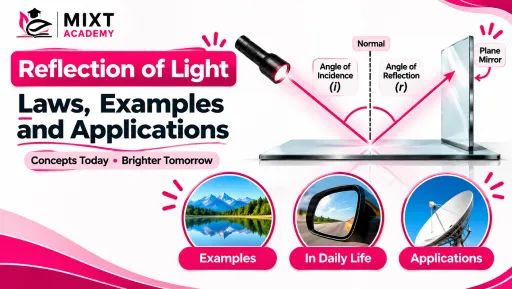
Reflection begins when light from a source travels towards an object and strikes its surface. Depending on the material, some light may be reflected, some absorbed, and some transmitted. Consider what happens when you shine a torch towards a plane mirror:
- The torch produces light that travels towards the mirror.
- The light ray strikes the mirror at a particular point.
- The mirror reflects the ray back into the surrounding medium.
- The reflected light travels towards your eyes.
- Your eyes detect the light, allowing you to see the reflected image.
The direction of the reflected light depends on the angle at which the incident ray strikes the surface. This behaviour is explained by two basic laws of reflection.
Important Terms Used in Reflection
Before studying the laws, you should understand the scientific terms used to describe the path of light. These terms also help you label ray diagrams correctly in physics examinations.
- Incident Ray: The incident ray is the incoming ray of light that strikes a reflecting surface. It travels from a light source or an illuminated object towards the surface.
- Point of Incidence: The point of incidence is the exact position where the incident ray strikes the reflecting surface.
- Normal: The normal is an imaginary line drawn perpendicular to the reflecting surface at the point of incidence. It makes a 90° angle with the surface.
- Reflected Ray: The reflected ray is the light ray that bounces away from the reflecting surface after striking it.
- Angle of Incidence: The angle of incidence is the angle between the incident ray and the normal. It is represented by the symbol θi.
- Angle of Reflection: The angle of reflection is the angle between the reflected ray and the normal. It is represented by θr.
- Plane of Incidence: The plane of incidence is the imaginary plane containing the incident ray and the normal at the point of incidence. The reflected ray also lies in this plane.
Remember: Measure both angles from the normal, not from the reflecting surface. This is one of the most common points tested in numerical and diagram-based questions.
What Are the Two Laws of Reflection?
The laws of reflection describe how light behaves when it strikes a reflecting surface. There are two main laws, and both apply to smooth and rough surfaces.
First Law of Reflection
The first law states, “The incident ray, the reflected ray and the normal at the point of incidence all lie in the same plane.”
This means that all three lines exist on a single flat plane. They do not move into separate planes during reflection. For example, when a light ray strikes a plane mirror, you can draw the incident ray, normal and reflected ray on the same sheet of paper. This arrangement demonstrates the first law of reflection.
Second Law of Reflection
The second law states, “The angle of incidence is always equal to the angle of reflection.”
In simple terms, the angle at which light strikes a surface equals the angle at which it bounces away, provided both angles are measured from the normal. For example, if a light ray strikes a mirror at an angle of 40° to the normal, it reflects at 40° to the normal.
This law remains true for curved mirrors and rough surfaces at each point of reflection. On rough surfaces, different points have different normal directions, which changes the overall directions of the reflected rays.
Why Are the Laws of Reflection Important
These laws help you understand and predict the direction of reflected light. You can use them to:
- Calculate the angle of a reflected ray.
- Understand how mirrors produce images.
- Draw accurate reflection ray diagrams.
- Explain how periscopes and optical instruments work.
- Understand how light behaves on different surfaces.
Formula and Numerical Examples of Reflection
The second law of reflection gives you a simple mathematical relationship between the angle of incidence and the angle of reflection.
Formula of Reflection of Light
The formula is: θi = θr
Where:
- θi = Angle of incidence.
- θr = Angle of reflection.
Both angles are measured from the normal to the reflecting surface. This formula tells you that the incident and reflected rays make equal angles with the normal.
Numerical Example 1: Finding the Angle of Reflection
Question: A ray of light strikes a plane mirror at an angle of 35° to the normal. Calculate the angle of reflection.
Solution:
- Given: Angle of incidence (θi) = 35°
- According to the second law of reflection: θi = θr
- Therefore: θr = 35°
- Answer: The angle of reflection is 35°.
Numerical Example 2: Finding the Angle of Incidence
Question: A light ray strikes a mirror at an angle of 25° with the mirror surface. Calculate the angle of incidence and the angle of reflection.
Solution: Remember that the normal makes a 90° angle with the mirror surface.
Given: The angle between the incident ray and the mirror surface is 25°.
Angle of incidence:
- θi = 90° − 25°
- θi = 65°
According to the second law of reflection:
- θr = θi
- θr = 65°
Answer:
- Angle of incidence = 65°.
- Angle of reflection = 65°.
Numerical Example 3: Finding the Angle Between Two Rays
Question: A light ray strikes a plane mirror at an angle of incidence of 45°. Find the angle between the incident ray and reflected ray.
Solution:
- Given: θi = 45°
- According to the law of reflection, θr = 45°.
- The angle between the incident and reflected rays is 45° + 45° = 90°.
- Answer: The angle between the two rays is 90°.
These examples show why identifying the normal correctly is important before attempting a reflection calculation.
Types of Reflection of Light
The type of reflection depends on the surface and the direction of the reflected rays. There are two main types:
1. Regular Reflection (Specular Reflection)
Regular reflection occurs when parallel light rays strike a smooth, polished surface and reflect in parallel directions. A plane mirror is a common example of regular reflection. Its smooth surface produces an organised reflection, allowing you to see a clear image. Main characteristics of regular reflection:
- It occurs on smooth and polished surfaces.
- Parallel incident rays remain parallel after reflection.
- It produces clear and sharp images.
- The reflected light travels in a predictable direction.
Examples:
- A bathroom mirror.
- A polished metal sheet.
- A calm lake or pond.
- A clean and smooth glass surface.
Imagine standing in front of a mirror. Light from your face strikes the mirror and reflects towards your eyes. The reflected rays allow you to see a clear image of yourself.
2. Irregular Reflection (Diffuse Reflection)
Irregular reflection occurs when parallel light rays strike an uneven or rough surface and reflect in different directions. Unlike a polished mirror, a rough surface has small irregularities. Each part has a different normal, causing the reflected rays to travel in multiple directions. This type of reflection is also called diffuse reflection. Main characteristics of irregular reflection:
- It occurs on rough or uneven surfaces.
- Reflected light travels in different directions.
- It does not normally produce a clear mirror image.
- It allows people to see objects from different viewing positions.
Examples:
- A painted wall.
- A sheet of ordinary paper.
- A wooden table.
- A rough road or stone surface.
For example, when sunlight strikes a wall, the reflected light spreads in different directions. This allows you to see the wall from different positions.
Difference Between Regular and Irregular Reflection
| Property | Regular Reflection | Irregular Reflection |
|---|---|---|
| Surface | Smooth and polished | Rough and uneven |
| Light rays | Reflect in parallel directions. | Scatter in different directions |
| Image | Clear and sharp | No clear mirror image |
| Common Examples | Mirrors and calm water | Walls, paper and wood |
| Reflection | Specular | Diffuse |
An Important Concept: Both regular and irregular reflection follow the laws of reflection. Rough surfaces do not break these laws. The different surface normals simply change the directions of the reflected rays.
Understanding Transparent, Translucent and Opaque Materials
The behaviour of light also depends on the type of material it strikes. Materials can be classified into three categories according to how much light passes through them.
1. Transparent Materials
Transparent materials allow most light to pass through with very little scattering. You can see objects clearly through these materials. Examples include:
- Clear glass.
- Clean water.
- Air.
- Transparent plastic.
For example, you can see objects through a clean glass window because most visible light passes through it.
2. Translucent Materials
Translucent materials allow some light to pass through but scatter it in different directions. As a result, objects behind them appear blurred. Examples include:
- Frosted glass.
- Butter paper.
- Thin curtains.
- Oiled paper.
A frosted bathroom window is a useful example. It allows natural light inside while preventing a clear view of objects on the other side.
3. Opaque Materials
Opaque materials do not allow light to pass through them. When light strikes these objects, it is reflected or absorbed. Examples include:
- Wood.
- Metal sheets.
- Stone.
- Brick walls.
- Cardboard.
An opaque object also creates a shadow when it blocks light from reaching a surface behind it.
Comparison of Transparent, Translucent and Opaque Materials
| Property | Transparent | Translucent | Opaque |
|---|---|---|---|
| Light Transmission | Most light passes | Some light passes | No light passes through |
| Light Scattering | Very little | Significant | Not transmitted |
| Visibility | Clear | Blurred | No visibility through material |
| Examples | Clear glass | Frosted glass | Wood |
To understand this concept in more detail, read Understanding Transparent, Translucent and Opaque Materials.
Image Formation by Different Mirrors
Mirrors are among the most common applications of reflection. Their shape determines how reflected rays travel and what type of image they produce. Three main types of mirrors are used in basic geometrical optics.
1. Plane Mirror
A plane mirror has a flat reflecting surface. It produces an image with the following characteristics:
- The image is virtual and cannot be projected onto a screen.
- The image is upright.
- The image is the same size as the object.
- The image appears as far behind the mirror as the object is in front.
- The image shows lateral inversion.
Lateral inversion means the left and right sides appear reversed in a mirror image. For example, when you raise your right hand in front of a plane mirror, the reflected image appears to raise its left hand.
2. Concave Mirror
A concave mirror has a reflecting surface that curves inward. It is also called a converging mirror because it can bring parallel reflected rays together at a focal point. Its image depends on the distance between the object and the mirror. Main characteristics are mentioned in the following:
- It can produce real or virtual images.
- Real images are inverted.
- Virtual images are upright and magnified.
- The image size changes with the object’s position.
For example, when you hold a concave mirror close to your face, it can produce a larger, upright image. This is why concave mirrors are used in shaving and makeup mirrors. Other uses include:
- Dentist’s examination mirrors.
- Vehicle headlights and searchlights.
- Solar furnaces.
- Reflecting telescopes.
3. Convex Mirror
A convex mirror has a reflecting surface that curves outward. It is also called a diverging mirror because parallel reflected rays spread apart. It always produces an image with these characteristics:
- Virtual image.
- Upright image.
- Smaller image than the object.
- Wider field of view.
A convex mirror is commonly used as a vehicle side-view mirror. It allows drivers to see a wider area behind their vehicles. You can also find convex mirrors in:
- Shopping centres.
- Parking areas.
- Road intersections.
- Security monitoring systems.
Everyday Examples of Reflection of Light
Reflection is not limited to physics laboratories. You can observe it in several everyday situations.
- Looking into a Mirror
When you stand in front of a mirror, light from your body reflects from its smooth surface and reaches your eyes. This creates a clear virtual image.
- Reflection on Calm Water
A still lake reflects nearby trees, buildings and mountains. Its relatively smooth surface allows light to reflect in an organised manner. When the water becomes disturbed, the reflection becomes less clear because its surface changes.
- Seeing Objects Around You
Most objects do not produce their own visible light. They reflect light from the sun or artificial sources. Reflected light enters your eyes, allowing you to recognise colours, shapes, and objects.
- Vehicle Mirrors
Drivers use plane and convex mirrors to observe vehicles and objects around them. Convex mirrors provide a wider field of view, although the reflected images appear smaller.
- Shiny Jewellery
Polished jewellery reflects incident light from its surface. This produces bright highlights that make the jewellery appear shiny.
- Reflectors on Bicycles
Bicycle reflectors redirect light from vehicle headlights towards the driver. This makes cyclists easier to notice in low-light conditions.
Applications of Reflection in Modern Technology
The laws of reflection are used in several devices that help people communicate, observe distant objects and improve safety.
1. Periscopes
A periscope allows you to see objects that are not directly in your line of sight. It commonly uses two plane mirrors positioned at 45° angles. Light strikes the upper mirror, reflects towards the lower mirror and then reaches the observer’s eyes. Periscopes are commonly associated with submarines, where they help people observe objects above the water.
2. Reflecting Telescopes
Reflecting telescopes use concave mirrors to collect light from distant objects, including stars and planets. The curved primary mirror reflects incoming light towards a focal region. Additional optical components direct the light to the viewing or imaging system. This design allows astronomers to observe faint objects in space.
3. Optical Instruments
Mirrors help direct light through different parts of optical instruments. For example, some microscopes use mirrors to direct illumination towards a specimen. Cameras and other optical devices also use reflective surfaces to control light paths.
4. Fibre Optic Communication
Optical fibres transmit information through thin strands of glass or plastic. They work through a phenomenon known as total internal reflection. Light repeatedly reflects inside the fibre, allowing signals to travel along curved paths. This technology supports:
- High-speed internet connections.
- Telecommunications.
- Medical endoscopes.
- Data transmission systems.
5. Solar Cookers
Solar cookers can use concave reflectors to direct sunlight towards a cooking area. The concentrated sunlight increases the amount of solar energy reaching the receiver, producing heat. This is useful in solar heating systems that collect and concentrate sunlight.
6. Road Safety Devices
Road reflectors help drivers identify roads, vehicles and obstacles at night. They reflect light from vehicle headlights back towards approaching drivers. This improves visibility when natural light is limited.
Total Internal Reflection and Its Uses
Total internal reflection is a special phenomenon that occurs when light travels from an optically denser medium to an optically less dense medium. It happens when two conditions are met:
- Light must travel from a medium with a higher refractive index towards one with a lower refractive index.
- The angle of incidence must be greater than the critical angle for the two materials.
When both conditions are satisfied, the light does not pass into the second medium. Instead, it reflects completely back into the original medium.
What Is the Critical Angle
The critical angle is the angle of incidence in the optically denser medium at which the refracted ray travels along the boundary between the two materials. At this point, the angle of refraction is 90°. For angles of incidence greater than the critical angle, total internal reflection occurs.
Applications of Total Internal Reflection
- Optical Fibres
Optical fibres use repeated total internal reflection to transmit light signals over long distances. The light stays inside the fibre as it travels along its length.
- Medical Endoscopes
Endoscopes use optical fibre technology to carry light and images through narrow tubes. Doctors use these instruments to examine internal parts of the human body.
- Binoculars
Some binocular designs use prisms that reflect light internally. These reflections help direct light through the instrument before it reaches your eyes.
- Diamond Sparkle
Diamonds have a high refractive index. Light entering a properly cut diamond can undergo repeated internal reflections before leaving the stone. These internal reflections contribute to diamonds’ bright appearance and sparkle.
6 Common Mistakes Students Should Avoid
Students sometimes understand the basic definition but make mistakes when answering numerical and conceptual questions. Keep these points in mind while preparing for your physics examination:
- Measuring angles from the mirror surface instead of the normal.
- Assuming that only smooth surfaces reflect light.
- Thinking that diffuse reflection does not follow the laws of reflection.
- Confusing regular reflection with total internal reflection.
- Assuming that every mirror produces a virtual image.
- Forgetting that convex mirrors always produce upright, diminished and virtual images.
A useful way to avoid these errors is to draw a labelled ray diagram before attempting a numerical question. Practise identifying the incident ray, normal, reflected ray and both angles. This will help you understand the concept rather than depend on memorised answers.
Students seeking physics tuition in Dubai can also explore Mixt Academy’s physics tutors in Dubai to find support suited to their curriculum and learning requirements.
When Should You Seek Help with Reflection of Light
If you find ray diagrams, mirror calculations, or total internal reflection difficult, discussing the topic with a physics teacher can help you identify where your understanding needs improvement.
Students looking for online physics tutors in the UAE or private tutors in the UAE can explore subject-specific support at Mixt Academy. Its physics lessons include concept explanations, numerical practice and personalised tutoring.
Strengthen Your Understanding of Physics with Mixt Academy
Understanding reflection of light becomes easier when you connect scientific laws with everyday examples. Practise drawing ray diagrams, calculating angles and explaining how different mirrors work.
At Mixt Academy, you can learn challenging physics topics through one-to-one online lessons and guided practice. Work on your weak areas, strengthen your fundamentals and prepare for your upcoming examinations with the right academic support.