Have you ever noticed your shadow changing size as you walk or move closer to a light? Shadows are part of everyday life, but they form because light travels in straight lines and can be blocked by objects.
Understanding how shadows form helps you explore light sources, opaque materials, object positions, and light behaviour. These concepts also connect with reflection and other topics in physics.
At Mixt Academy, students explore these ideas through practical examples and clear scientific explanations. Let’s understand why shadows appear and what causes them to change.
What Is a Shadow
A shadow is a dark area formed when an object blocks light from reaching a surface. It usually appears on the side opposite the light source.
You can observe shadows when sunlight falls on buildings, trees, people, or other objects. A flashlight shining towards a wall can also create a shadow. Three main elements are involved:
- Light Source: An object that produces light, such as the Sun, a bulb, or a flashlight.
- Blocking Object: An object that stops or reduces the amount of light reaching a surface.
- Screen or Surface: The wall, ground, or another surface where the shadow appears.
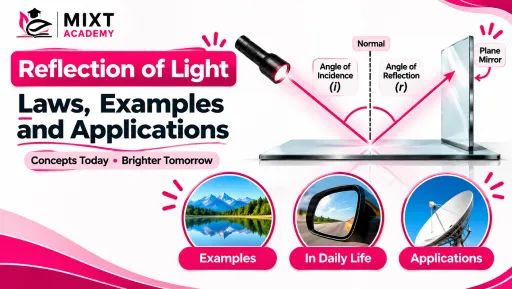
Shadow formation is closely connected to other light concepts, including reflection and the way light travels. To understand these topics together, explore our guide to reflection of light, which explains the laws, types and everyday applications of reflection.
How Are Shadows Formed
Light travels in straight lines through a uniform medium. When an opaque object comes between a light source and a surface, it blocks the light from reaching certain areas. The blocked region appears as a shadow because less light reaches that part of the surface.
For example, when you stand in sunlight, your body blocks some sunlight from reaching the ground. This creates a shadow behind you.
Understanding Umbra and Penumbra
Shadows can have two regions, especially when the light source is large.
- Umbra: The darkest central region where the object blocks light completely.
- Penumbra: The lighter outer region where the object blocks only part of the light source.
These regions explain why some shadows have sharp edges while others look blurred.
What Types of Objects Form Shadows
Different materials interact with light differently. Their ability to transmit light affects how their shadows appear.
- Opaque Objects: Block light completely and usually produce dark, well-defined shadows. Examples include wooden doors, books, and metal sheets.
- Translucent Objects: Allow some light through while scattering it, often producing softer and lighter shadows. Examples include frosted glass and tracing paper.
- Transparent Objects: Allow most light to pass through and usually produce very faint shadows. Examples include clear glass and clean water.
Mixt Academy’s guide to transparent, translucent, and opaque materials explains how different materials affect light transmission.
What Factors Affect the Size of a Shadow
The appearance and size of a shadow depend on the positions of the light source, object, and screen.
- Light Source Distance: When an object moves closer to a light source while the screen remains in the same position, its shadow generally becomes larger. Moving the object closer to the screen usually makes its shadow smaller.
- Object Position: Moving an object closer to the screen generally produces a smaller shadow under the same lighting conditions.
- Light Direction: Changing the angle of a light source changes the shadow’s direction and length.
- Light Source Size: Larger light sources generally produce softer edges because they create wider penumbra regions.
For example, your outdoor shadow is often shorter around midday and longer in the morning or evening as the sun’s position changes.
How Do Multiple Light Sources Affect Shadows?
When an object is illuminated by two or more light sources, it can produce multiple shadows. Each light source creates a shadow in a different direction depending on its position. Where shadows overlap, the area may appear darker because less light reaches that region. This effect can be observed when several lamps shine on the same object.
Examples of Shadows in Everyday Life
You can identify shadow formation in several familiar situations:
- Human Shadows: Your body blocks sunlight and creates a shadow on the ground.
- Tree Shadows: Trees block sunlight, producing changing patterns on roads and nearby surfaces.
- Building Shadows: Buildings prevent sunlight from reaching certain areas, creating shaded spaces.
- Torch Shadows: A flashlight creates shadows when its light encounters objects in its path.
Mixt Academy’s physics tutors in the UAE help students connect concepts like light, reflection, and shadow formation with practical physics questions.
Simple Experiment to Understand Shadow Formation
You can explore shadow formation using a flashlight, a small object, and a plain wall.
- Turn on the flashlight and point it towards the wall.
- Place your hand or another opaque object between the flashlight and the wall.
- Observe the shadow appearing behind the object.
- Move the object closer to the flashlight and notice how the shadow changes size.
- Change the flashlight’s angle and observe how the shadow moves.
This simple activity demonstrates how light direction, object position, and distance affect shadow formation.
Learn Light and Physics with Greater Clarity
Understanding shadows becomes easier when you connect scientific principles with everyday observations. Practise identifying light sources, blocking objects, and changes in shadow size to strengthen your knowledge.
Mixt Academy offers one-on-one online tutoring with personalised lessons to help students understand physics topics. Explore online learning support and develop stronger scientific knowledge through guided explanations and practice.