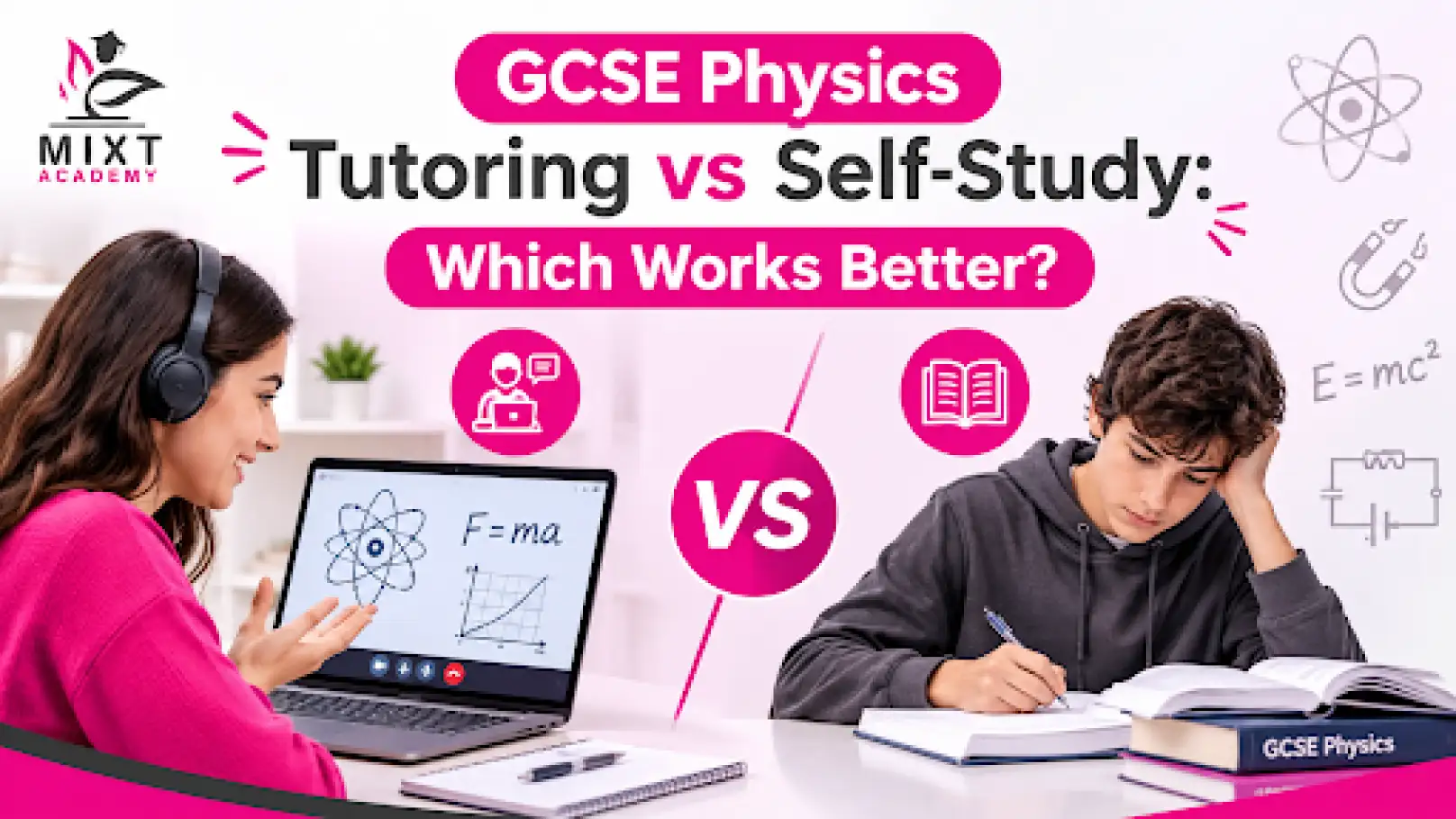
The better option depends on your child’s current understanding, study habits, and exam goals. For families in the UAE, both approaches offer useful ways to support GCSE Physics preparation. Students can develop independent study habits while benefiting from Mixt Academy’s personalised, one-to-one online lessons to strengthen subject knowledge, practise exam questions, and improve their understanding of challenging concepts.
This guide compares the costs, flexibility, feedback, and exam preparation involved, so you can decide whether self-study, tutoring, or a combination suits your child.
What Does GCSE Physics Self-Study Involve
Self-study means preparing for your GCSE Physics examinations independently, without regular guidance from an in-person or GCSE Physics online tutor. You decide which topics to revise, how much time to spend, and which resources to use. Students can use textbooks, revision guides, classroom notes, educational videos, practice questions, and past examination papers.
For example, if you struggle with electricity, you can dedicate a revision session to circuit diagrams, current, potential difference, and resistance. A useful self-study routine includes these 5 steps:
- Review Your Syllabus: Check your exam board’s specification to identify every topic and understand what your examinations may cover.
- Revise One Topic: Study concepts such as energy transfers, forces, or electromagnetic waves before attempting related questions.
- Practise Calculations: Solve numerical problems involving speed, acceleration, work done, power, resistance, and electrical energy.
- Attempt Past Papers: Answer examination questions under timed conditions to improve your ability to apply knowledge independently.
- Check Your Mistakes: Compare answers with official mark schemes and record the concepts or calculation methods you need to revisit.
The key is to study actively rather than repeatedly read the same revision notes.
When Does Self-Study Work Best
Self-study can be a suitable option when students understand most of their Physics syllabus and can identify areas that need improvement. It also works well for students who enjoy independent learning and can follow a consistent revision timetable. Consider self-study when your child:
- Understands the fundamental Physics concepts and can explain them without constantly referring to textbooks.
- Can solve familiar examination questions without needing someone to demonstrate every calculation.
- Understands how to use mark schemes and identify missing keywords or calculation steps.
- Completes revision tasks consistently without depending on reminders from parents or teachers.
- Achieves stable results in mock examinations and wants to improve through additional practice.
What Are the Limitations of Self-Study
Independent learning requires students to recognise their own mistakes. This can become difficult when they misunderstand a concept or repeatedly use an incorrect method. For example, a student might memorise the equation for electrical resistance but struggle to rearrange it when the question provides different values.
Without feedback, they may continue practising the same incorrect approach. Self-study also provides less accountability. Students who delay difficult topics may reach examination season without enough time to address their weaknesses.
How Does GCSE Physics Tutoring Help Students
GCSE Physics tutoring gives students access to individual explanations, structured practice, and feedback from a subject specialist. A tutor can identify whether a student struggles with understanding scientific concepts, mathematical calculations, practical methods, or examination technique. This support is especially useful when classroom explanations and independent revision aren’t improving examination results.
Mixt Academy’s GCSE Physics tutors provide one-to-one lessons covering AQA, Pearson Edexcel and OCR specifications. Their teaching focuses on calculations, graph analysis, required practicals and exam-style questions.
Key Benefits of Private GCSE Physics Tutoring
- Personalised Explanations: Students can ask questions whenever a concept becomes difficult. Tutors can explain forces, energy, electricity and waves through worked examples rather than expecting students to memorise definitions.
- Better Understanding of Calculations: Physics involves applying mathematical knowledge to scientific problems. A tutor can show how to rearrange equations, convert units, and present complete working to earn calculation marks.
- Feedback On Examination Answers: Students sometimes understand a topic but fail to communicate their knowledge in the expected format. Tutors can explain command words, scientific terminology, and mark-scheme requirements.
- Structured Examination Preparation: Regular lessons create opportunities to review completed work, practise past papers and revisit topics that require more attention.
- Accountability and Progress Tracking: Scheduled lessons encourage students to complete revision tasks between sessions. Parents can also monitor their child’s progress and discuss areas requiring further support.
What Are the Limitations of Tutoring
Private tutoring requires a financial commitment and scheduled learning time. Students also need to practise independently between lessons to retain what they learn. A tutor cannot replace personal revision. Without regular practice, students may understand a concept during a lesson but struggle to recall and apply it independently during examinations.
GCSE Physics Tutoring vs Self-Study: Key Differences
Both approaches support examination preparation, but they offer different learning experiences.
| Comparison | GCSE Physics Tutoring | Self-Study |
|---|---|---|
| Cost | Requires payment for individual lessons. | Usually free or low-cost resources |
| Learning Approach | Personalised explanations and guided practise. | Independent revision. |
| Flexibility | Depends on scheduled lesson times. | Students choose their study hours. |
| Error Correction | Tutors identify mistakes and explain corrections. | Students check answers using mark schemes. |
| Accountability | Regular lessons encourage consistency. | Requires personal discipline. |
| Exam Preparation | Includes guided past paper analysis. | Depends on independent paper practise. |
| Learning Pace | Adjusted to individual understanding. | Controlled by the student. |
Which Approach Offers Better Results
There is no single answer for every student. A student who consistently scores well in mock examinations might only need structured revision and more past-paper practice.
Someone struggling with equations, practical questions, or scientific explanations may benefit more from individual teaching. The decision should depend on actual performance rather than assumptions about which method is more effective.
Can You Combine Tutoring with Self-Study
Yes, combining both approaches lets students get expert explanations while building independent problem-solving skills.
Instead of using every tutoring session to cover new content, students can bring their practice questions and completed examination papers for review. Here is an example of a balanced weekly revision routine:
| Day | Activity | Learning Objective |
|---|---|---|
| Monday | Independent revision | Review energy and electricity concepts. |
| Tuesday | Topic-based questions | Practise calculations and scientific explanations. |
| Wednesday | One-to-one tutoring | Address difficult questions and misunderstandings. |
| Thursday | Past paper practice | Apply knowledge to examination-style questions. |
| Friday | Mark scheme review | Identify missing steps and incorrect answers. |
| Saturday | Practical revision | Review experimental methods and data analysis. |
| Sunday | Short recap | Revisit previous mistakes and prepare for the next week. |
You can adjust this schedule based on school commitments, upcoming examinations, and your child’s progress.
Make Every Tutoring Session More Useful
Students should prepare specific questions before meeting their tutors. For example, instead of asking for another explanation of electricity, bring three questions you found difficult. Ask your tutor to explain the method, demonstrate one example, and let you solve a similar question independently.
Mixt Academy also offers Online GCSE Maths tutoring to support students who need extra practice with algebra, graphs, and mathematical problem-solving. This can be useful when calculation difficulties affect performance in Physics.
How Should UAE Parents Choose the Right Support
Parents in the UAE have different options for preparing their children for GCSE examinations. Some prefer independent revision, while others opt for online lessons for additional academic guidance.
When comparing UAE tutors online, focus on the quality of teaching rather than choosing a service based on price alone. Consider these factors before booking lessons:
- Exam board experience: Choose GCSE Physics tutors who understand your child’s AQA, Pearson Edexcel, or OCR specification.
- Subject knowledge: Check whether the tutor can explain mathematical calculations, practical investigations, scientific terminology, and examination techniques.
- Personalised lessons: Look for tutors who assess existing knowledge and focus on specific learning gaps.
- Flexible scheduling: Consider lesson times that fit around school, family commitments, and exam preparation.
- Progress updates: Ask how tutors communicate improvements, remaining weaknesses, and upcoming learning targets.
When Is Online Physics Tuition Worth Considering
For families researching online tuition in the United Arab Emirates, one-to-one lessons can provide subject-specific support without the need to travel to a tutoring center. Students can attend lessons from home, ask questions in real time, and practise difficult topics with a specialist.
If your child needs support in both subjects, physics and maths tutoring in Dubai can help address the connection between mathematical reasoning and Physics calculations. Parents searching for qualified tutors in the UAE should also compare teaching experience, examination board knowledge, and the level of individual attention offered.
Get the Right Support for GCSE Physics
Every student needs a different balance of explanation and independent practice. If your child isn’t sure which topics are holding them back, Mixt Academy can help identify learning gaps through a free trial session with a subject tutor.
Book one-to-one GCSE Physics tuition and build a study plan around your child’s exam board, current level, and target grade. Regular practice between lessons can help turn explanations into independent examination skills.