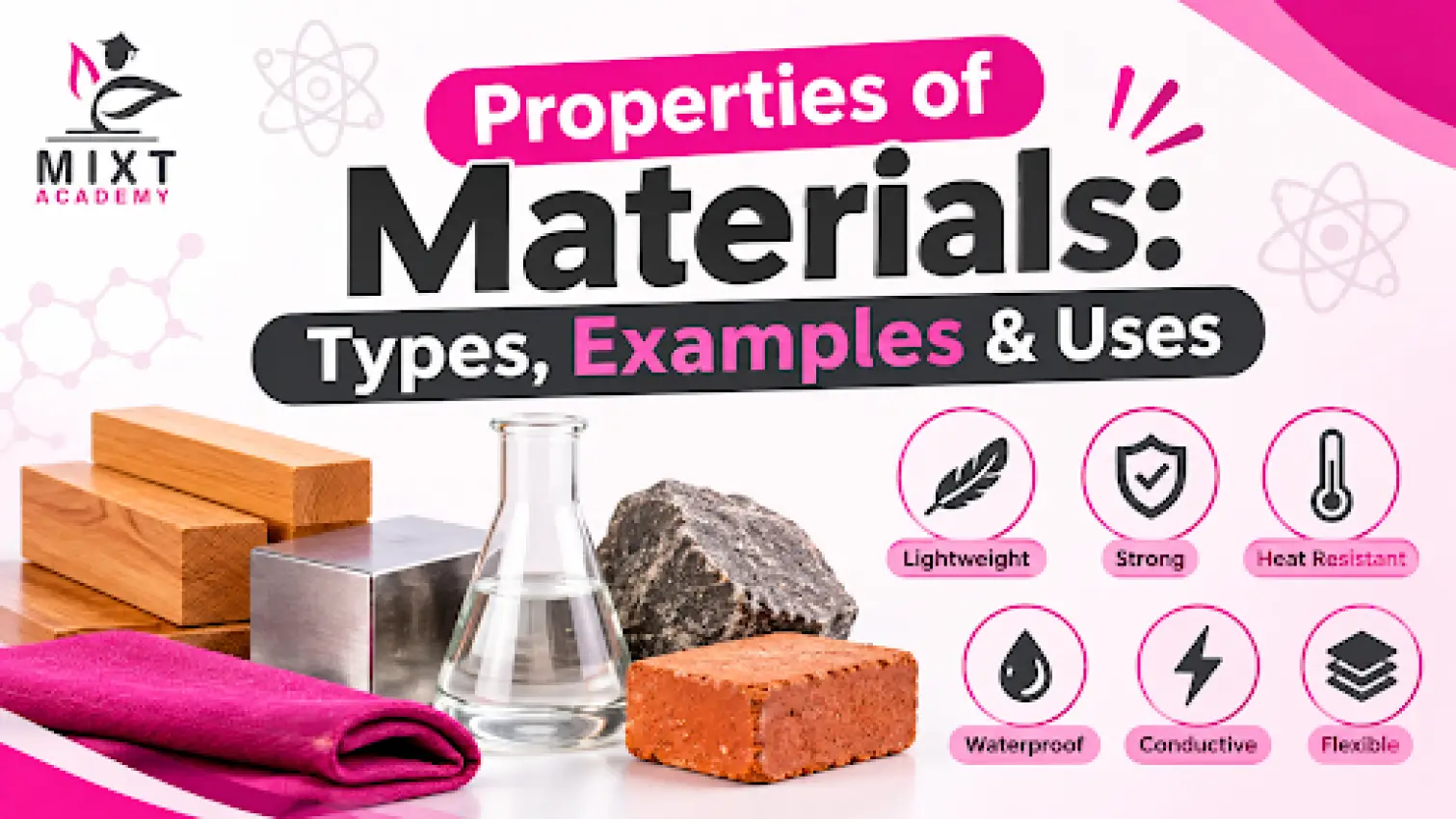
Learning the properties of materials shows why one substance suits a task better than another. Rubber bends and keeps water out, while glass lets light pass through but can break when dropped. These differences connect science concepts with choices you see at home, school, and in product design.
At Mixt Academy, students learn to connect scientific definitions with practical examples. This guide explains common material properties, how to test them, and how engineers use evidence when selecting materials.
What Are the Properties of Materials
Material properties are the characteristics that help you identify a substance and understand how it behaves under different conditions. You can observe these characteristics with your senses or measure them through scientific tests.
Consider a wooden table and a glass window. Both are solid materials, but they differ in hardness, transparency, texture, and strength. These differences explain why manufacturers use wood for furniture and glass for windows.
A material can have several properties at once. For example, aluminium is lightweight, malleable, electrically conductive, and corrosion-resistant. Its combination of properties makes it useful in construction, transport, and electrical applications.
Common Categories of Material Characteristics
You can identify materials through different types of observations and measurements.
- Visual Properties: Colour, shine, transparency, and surface appearance help you recognise and compare different materials.
- Physical Properties: Hardness, flexibility, density, melting point, and conductivity describe how materials behave without changing their chemical composition.
- Mechanical Properties: Strength, stiffness, toughness, and elasticity explain how materials respond when forces act upon them.
- Chemical Properties: Flammability, reactivity, and corrosion resistance describe how substances behave when they interact with other chemicals.
Understanding these categories gives you a starting point for comparing materials and predicting how they will perform in everyday situations.
Physical and Chemical Properties of Materials
Scientists classify material properties into two main groups: physical properties and chemical properties. Both help explain the behaviour and possible uses of different substances.
1. Physical Properties
Physical properties describe characteristics that scientists can observe or measure without changing a material into another substance.
For example, melting ice changes solid water into liquid water, but its chemical identity remains H₂O. The change affects its physical state rather than creating a new substance. Common physical properties include:
- Density
- Hardness
- Colour
- Solubility
- Electrical conductivity
- Thermal conductivity
- Melting point
- Transparency
2. Chemical Properties
Chemical properties describe how a substance reacts with other substances or changes into new materials through chemical reactions. For example, iron reacts with oxygen and moisture to form rust. This process changes the original material’s chemical composition. Other examples include:
- Flammability: Describes how easily a substance catches fire and burns when exposed to suitable conditions.
- Reactivity: Explains how readily a material reacts with substances such as oxygen, water, or acids.
- Corrosion Resistance: Describes how well a material resists chemical deterioration caused by environmental exposure.
Knowing the difference between physical and chemical properties helps you understand why some changes are reversible while others create new substances.
Main Types of Material Properties and Examples
Each material has a combination of properties that determines how it responds to pressure, heat, electricity, water, and other environmental conditions. The following examples explain the most common properties students encounter in science.
Mechanical Properties of Materials
Mechanical properties describe how a material responds to force, pressure, or other physical stress. They help engineers determine whether a material can bend, stretch, withstand loads, or resist damage.
Hardness and Stiffness
- Hardness: Describes a material’s resistance to scratching, cutting, indentation, or surface damage; hardened steel is suitable for cutting tools.
- Stiffness: Measures how strongly a material resists bending or deformation under force, as seen in steel support beams.
Strength and Toughness
- Tensile strength: Measures how much pulling force a material can withstand before breaking, making it suitable for strong ropes used for lifting and supporting loads.
- Compressive strength: Measures how well a material resists crushing forces, which makes concrete useful for supporting buildings and structural foundations.
- Toughness: Describes a material’s ability to absorb energy and resist breaking when struck, making leather and impact-resistant plastics useful in protective products.
- Brittleness: Describes a material that breaks or fractures with little deformation, as glass and ceramics can do under sudden impact.
Flexibility and Deformation
- Flexibility: Describes how easily a material bends without breaking, which makes thin plastic sheets and rubber useful for flexible products.
- Elasticity: Measures a material’s ability to return to its original shape after stretching or compression, as demonstrated by springs and rubber bands.
- Malleability: Describes how easily a material can be hammered or pressed into different shapes without cracking, as seen with gold and aluminium.
- Ductility: Describes a material’s ability to stretch under pulling forces and form thin wires, making copper useful in electrical applications.
These properties are related but have different meanings. A material can be flexible without being elastic, while a brittle material may be hard but have low toughness.
Thermal and Electrical Properties
Some materials transfer heat or allow electric current to pass through them. These properties influence how scientists and engineers select substances for electrical equipment, cooking appliances, and insulation.
- Thermal Conductivity: Measures how readily a material transfers heat, making copper and aluminium useful in cookware and heat exchangers.
- Electrical Conductivity: Describes how easily electric current passes through a substance, which makes copper and aluminium common choices for electrical wiring.
- Thermal Insulation: Describes a material’s ability to slow heat transfer, making wool, foam, and fibreglass useful for insulation.
- Electrical Insulation: Describes materials that resist electric current, making rubber and plastic suitable for covering electrical wires.
Metals generally conduct heat and electricity well, while many plastics and rubber products act as insulators. Their different atomic structures help explain these behaviours.
Optical and Appearance Properties
A material’s appearance can influence its suitability for products that need to transmit, reflect, or block light. These properties are particularly important when choosing materials for windows, lenses, packaging, and decorative objects.
- Transparency: Describes how clearly light passes through a material, allowing you to see objects through clean glass.
- Translucency: Describes materials that allow light through but scatter it, making frosted glass useful for privacy.
- Opacity: Describes materials that do not allow light to pass through, making wood and thick metal suitable for blocking visibility.
- Lustre: Describes how a material reflects light from its surface, giving polished metals their characteristic shine.
- Texture: Describes whether a surface feels rough, smooth, soft, or coarse, influencing its grip and comfort.
These characteristics help you compare materials through observation before conducting more detailed scientific tests.
Other Important Physical and Chemical Properties
Some properties describe how materials interact with water, magnets, air, or temperature changes. These characteristics often determine whether a material performs well in a particular environment.
- Density: Measures how much mass exists within a given volume, helping explain why a small metal object can weigh more than a larger plastic object.
- Solubility: Describes how well a substance dissolves in a particular solvent, such as salt dissolving in water under suitable conditions.
- Absorbency: Describes how readily a material takes in liquids, making cotton towels useful for absorbing spilt water.
- Water Resistance: Describes how well a material prevents water from entering or passing through, making treated fabrics useful for outdoor clothing.
- Magnetism: Describes how a material responds to magnetic fields; iron and some steel alloys show strong magnetic attraction.
- Melting Point: Identifies the temperature at which a solid changes into a liquid under a specified pressure.
- Corrosion Resistance: Describes how well a material withstands chemical deterioration, making stainless steel useful in equipment exposed to moisture.
Not every material has the same combination of these properties. Your choice depends on the conditions and purpose of the finished product.
How Do Mixtures Affect Material Properties
A mixture contains two or more substances combined physically. The substances retain their chemical identities, although the mixture can have different observable properties from its individual components.
For example, adding salt to water produces a salt solution. The salt dissolves and spreads throughout the water, changing properties such as its density and freezing point. You can recover the salt by evaporating the water.
Understanding Changes in Mixtures
Different ingredients can affect a mixture’s appearance, texture, strength, and other measurable characteristics.
- Salt and Water: Salt dissolves in water, creating a solution with different properties than pure water.
- Sand and Water: Sand does not dissolve, so the particles remain separate and can settle or be removed through filtration.
- Flour and Water: Mixing these ingredients creates a thicker mixture with a different consistency from either ingredient alone.
- Cement and Water: Combining cement with water starts chemical reactions that eventually help the mixture harden into a solid material.
Do Material Properties Change with Quantity
The quantity of a substance does not usually change its characteristic intensive properties when its composition and conditions remain the same. For example, a small piece of pure copper and a large piece of the same copper have the same density and electrical conductivity at the same temperature. Their total mass and volume differ because these properties depend on the amount of material.
This distinction helps you understand why scientists separate properties into two groups:
- Intensive Properties: Characteristics such as density, colour, and melting point do not depend on the quantity of material.
- Extensive Properties: Characteristics such as mass and volume change when the quantity of material increases or decreases.
Glue provides another useful example. Its sticky nature remains a characteristic of the adhesive, but the amount used and the surfaces joined influence the final bond strength.
How to Identify and Test Different Material Properties
Scientists use observation, measurement, and controlled experiments to identify materials accurately. A fair test changes one factor at a time while keeping other relevant conditions consistent. You can explore several properties through simple classroom comparisons using familiar objects and suitable measuring equipment.
Simple Tests for Material Identification
- Hardness Test: Compare how easily different materials scratch using an appropriate method and consistent pressure.
- Absorbency Test: Place equal amounts of water on different materials and compare how much liquid each sample absorbs.
- Transparency Test: Hold materials in front of an object and observe whether you can see it clearly.
- Flexibility Test: Apply similar bending forces to different samples and record how easily each material changes shape.
- Magnetism Test: Bring a magnet near different samples and observe whether they are attracted.
- Conductivity Test: Use a suitable low-voltage classroom circuit to compare which materials allow electric current to pass through.
Why Is Scientific Evidence Important
Observations help you describe what happens, while measurements provide data that supports your conclusions. Recording results also makes it easier to compare materials without relying on guesses.
For example, imagine you need to select a material for an umbrella. You could compare several fabrics by measuring water absorption, checking flexibility, and examining how well each sample resists water penetration.
Why Do Engineers Consider Material Properties
Engineers use scientific knowledge to design products, structures, and systems that solve practical problems. They must select materials that meet specific requirements while considering strength, durability, cost, weight, and environmental conditions.
A material suitable for one product may not perform well in another. For example, glass works well in windows because it transmits light, but rubber is better suited for waterproof footwear.
Everyday Examples of Material Selection
Different products demonstrate how material properties influence design decisions.
- Rain boots: Rubber provides flexibility and water resistance, helping footwear protect your feet from wet surfaces and rain.
- Cooking pans: Aluminium and stainless steel transfer heat and withstand cooking temperatures, making them suitable materials for different cookware designs.
- Window Panels: Glass allows natural light into buildings while providing a transparent barrier between indoor and outdoor spaces.
- Electrical Wires: Copper carries electric current effectively, while plastic insulation helps prevent unwanted contact with conducting surfaces.
- Building Foundations: Concrete provides high compressive strength, allowing it to support significant structural loads.
- Sports Equipment: Flexible and impact-resistant materials help manufacturers create products that withstand repeated movement and physical contact.
Understanding the Engineering Design Cycle
Engineers follow a structured design process to identify problems, select materials, and evaluate whether their solutions work. Material properties guide several decisions throughout this cycle.
- Identify the Problem: Understand what the product needs to do and which conditions it must withstand.
- Research Materials: Compare available substances and identify the properties that match the design requirements.
- Plan the Design: Select suitable materials, prepare drawings, and decide how different components will work together.
- Build a Prototype: Create an initial model that allows you to examine the design and material choices.
- Test the Product: Check whether the prototype meets its requirements and record evidence of its performance.
- Improve the Design: Make changes based on test results and repeat the process when necessary.
Mixt Academy encourages students to connect these engineering examples with classroom science. Understanding why rubber bends or why copper conducts electricity makes scientific definitions easier to apply in practical questions.
How Material Properties Connect to What Science Is and Its Branches
Material science connects several areas of scientific study. It helps explain why substances behave differently and how their composition and structure influence their physical and chemical characteristics.
Understanding what science is gives you a foundation for studying materials through observation, experiments, and evidence. You can also explore the branches of science to understand how different disciplines contribute to this subject.
How Different Science Branches Study Materials
- Physics: Examines properties such as density, heat transfer, electrical conductivity, magnetism, and how materials respond to forces.
- Chemistry: Studies the composition, structure, reactions, and chemical properties of substances, including how materials change during chemical processes.
- Materials science: Combines knowledge from physics and chemistry to investigate how a material’s structure influences its properties and performance.
- Engineering: Applies scientific findings to select, develop, and test materials for products, buildings, machines, and other practical applications.
Students often study these ideas through physics and chemistry lessons at different academic levels. For learners who need extra support, online tutors in UAE can explain scientific principles through worked examples and practical applications.
Students exploring online physics tuition in UAE can also study how heat, electricity, forces, and energy affect material behaviour. Parents searching for physics tutors in Dubai can explore subject-specific lessons through Mixt Academy’s online physics tuition in the UAE.
Learn Science Through Practical Examples
Understanding material properties becomes easier when you can connect definitions with real objects, experiments, and scientific explanations. Regular practice also helps you describe observations and support answers with relevant evidence.
Mixt Academy offers personalised online lessons for students who need support with science and physics. Explore subject-specific tutoring, work through challenging concepts, and develop the skills to apply scientific knowledge confidently in your exams.