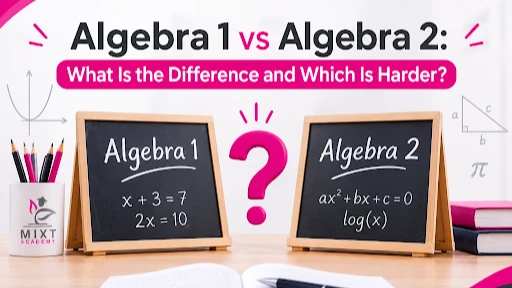
Algebra 1 covers the basics, like solving linear equations, graphing lines, working with systems, using exponent rules, factoring, and starting with quadratics. Algebra 2 builds on these topics and adds polynomials, rational and radical expressions, exponential and logarithmic functions, complex numbers, and more statistics. Most students find Algebra 2 harder because it is more abstract, moves faster, and relies on all the skills learned in Algebra 1.
Many students and parents worry about the differences between Algebra 1 and Algebra 2, especially families in the UAE who might switch between American, British, or IB programmes. This guide explains what each course includes, gives side-by-side examples, compares difficulty using clear criteria, and covers topics like the SAT, typical course order, common mistakes, and preparation tips. If course content changes by state or school, we mention it.
What Is Algebra 1?
Algebra 1 is the first formal algebra course. In this class, students shift from working with numbers to working with variables. Most students in the United States take Algebra 1 in Grade 8 or 9, after finishing pre-algebra. American-curriculum schools in the UAE usually follow the same pattern, with Grades 9 to 12 making up high school.
State standards outline what is taught in the course. For example, Kentucky’s Algebra 1 standards include:
- Creating and solving linear equations and inequalities in one variable.
- Graphing linear inequalities in two variables.
- Solving systems of linear equations by graphing, substitution and elimination.
- Function notation, key features of graphs and average rate of change.
- Linear versus exponential situations, including growth and decay.
- Factoring quadratics to find zeros, and solving quadratics by square roots, factoring and the quadratic formula.
- Extending integer exponent rules to rational exponents.
- Scatter plots, linear models and correlation.
The main goal is for students to become fluent in algebra. They learn to see an equation as a balance, switch between tables, graphs, and formulas, and use these tools to model real-life situations.
Algebra 1 worked examples
Let’s solve a linear equation: 3(2x − 4) = 18. First, expand the brackets to get 6x − 12 = 18. Next, add 12 to both sides, so 6x = 30. Divide by 6 to find x = 5. To check, substitute back: 3(10 − 4) = 18.
Now, let’s factor and solve a quadratic equation: x² − 5x + 6 = 0. Look for two numbers that multiply to 6 and add up to −5. These numbers are −2 and −3. So, we can write (x − 2)(x − 3) = 0, which means x = 2 or x = 3.
Let’s solve a system of equations: y = 2x + 1 and 3x + y = 11. Substitute y from the first equation into the second: 3x + 2x + 1 = 11. This simplifies to 5x = 10, so x = 2. Plug x back in to get y = 5.
What Is Algebra 2?
Algebra 2 builds on what students learn in Algebra 1 and Geometry, introducing more complex functions and equations. Most students take it in Grade 10 or 11, but some take it earlier if they are in advanced classes. Some schools also offer an integrated math pathway instead. For example, Kentucky’s official Algebra 2 course standards include the following topics:
- Quadratics with complex solutions and solving linear-quadratic systems.
- Polynomials: standard form, degree, roots as zeros, graphing and end behaviour.
- Rational equations, radical equations and extraneous solutions, plus graphing square root and cube root functions.
- Exponential and logarithmic functions and their inverse relationship.
- Complex numbers, using the imaginary unit i.
- Function transformations, inverse functions and average rate of change.
- Statistics and probability, including data distributions, conditional probability, independence and counting techniques.
- Matrices.
Course content can vary. Kentucky’s Algebra 2 standards do not seem to include trigonometry or sequences, but many other programmes do. Some schools teach the quadratic formula in Algebra 1, while others cover completing the square in Algebra 2. Be sure to check your own school’s syllabus.
Algebra 2 worked examples
Here’s a quadratic equation with complex solutions: x² + 2x + 5 = 0. The discriminant is 2² − 4(1)(5) = −16, which is negative, so the roots aren’t real numbers. Using the quadratic formula, x = (−2 ± 4i) ÷ 2, so x = −1 ± 2i.
Let’s look at an exponential equation. Suppose AED 10,000 grows at 5% compound interest each year. How long will it take to double? Set up the equation: 10,000 × 1.05^t = 20,000. This means 1.05^t = 2. To solve for t, use logarithms: t = ln 2 ÷ ln 1.05, which is about 14.2 years. Logarithms are a new concept in Algebra 2.
Here’s a tricky radical equation. Solve √(x + 6) = x. First, square both sides to get x + 6 = x². Rearranging gives x² − x − 6 = 0, which factors to (x − 3)(x + 2) = 0. So, x = 3 or x = −2. Check both: √9 = 3 works, but √4 = 2, which isn’t −2, so x = −2 doesn’t work. The only solution is x = 3.
Key Differences Between Algebra 1 and Algebra 2
| Feature | Algebra 1 | Algebra 2 |
|---|---|---|
| Typical grade (US) | Grade 8 or 9 | Grade 10 or 11 (earlier if accelerated) |
| Usual prerequisite | Pre-Algebra | Algebra 1 and usually Geometry |
| Main focus | Foundations: equations, graphs, systems, basic quadratics | Extending those ideas to advanced functions |
| Function families | Linear, introductory quadratic and exponential | Polynomial, rational, radical, exponential, logarithmic |
| Number system | Real numbers | Real numbers plus complex numbers |
| Solving quadratics | Factoring, square roots, and often the quadratic formula | Quadratic formula with complex solutions, plus higher-degree polynomials |
| Typical problem style | One or two steps of reasoning | Several linked steps, with checks for domain restrictions |
| Statistics | Scatter plots, linear models and correlation | Distributions, conditional probability, counting |
| Leads to | Geometry and Algebra 2 | Precalculus, statistics, calculus and university maths |
How Algebra 2 Builds on Algebra 1
Most Algebra 2 topics build on ideas from Algebra 1. If you struggle with the basics, it often becomes clear right away.
| Algebra 1 idea | Algebra 2 extension |
|---|---|
| Solving linear equations | Solving rational, radical and exponential equations |
| Factoring quadratics | Factoring higher-degree polynomials and finding all zeros |
| The quadratic formula | Quadratics with complex solutions |
| Integer and rational exponents | Exponential and logarithmic functions |
| Function notation and graphs | Transformations and inverse functions |
| Linear and exponential models | Modelling with polynomial, logarithmic and other functions |
| Correlation and scatter plots | Probability, distributions and counting |
If a student struggles with the left-hand column, the right-hand column can seem impossible. This reliance is the main reason Algebra 2 often feels more difficult.
Which Is Harder: Algebra 1 or Algebra 2?
Most students find Algebra 2 harder. Since there is no official difficulty scale, the best way to answer is to compare what makes each course challenging.
| Difficulty factor | Algebra 1 | Algebra 2 |
|---|---|---|
| Abstraction | First use of variables and function notation | More abstract objects, such as logarithms and complex numbers |
| Number of topic strands | Fewer | More, and each goes deeper. |
| Steps per problem | Usually one to three | Often four or more, with checks at the end |
| Dependence on earlier skills | Builds on arithmetic and pre-algebra | Builds on all of Algebra 1 and some Geometry |
| Pace | Gentler introduction | Faster, because it assumes fluency |
| Cost of an error | Usually a lost mark | An early error can cascade through a long solution |
Two important things to keep in mind. The first course can be more challenging. Many students see symbolic algebra for the first time in Algebra 1, and switching from numbers to letters is a real jump. If a student struggles with fractions or negative numbers, Algebra 1 might feel harder than Algebra 2 does for a well-prepared friend.
How hard a course feels depends on how prepared you are. The course that feels tougher is usually the one where your basics aren’t strong. If you have a solid year in Algebra 1, Algebra 2 will feel like a step up instead of a big barrier.
The hardest topics in each course
Algebra 1: word problems, factoring, systems of equations, and understanding slope.
Algebra 2: logarithms, rational expressions, complex numbers, function transformations, and checking for extraneous solutions.
Common Mistakes in Algebra 1 and Algebra 2
| Mistake | Example | Fix |
|---|---|---|
| Sign errors when distributing | −2(x − 3) written as −2x − 6 | The correct expansion is −2x + 6. |
| Squaring a sum incorrectly | (x + 4)² is written as x² + 16. | The correct expansion is x² + 8x + 16. |
| Dividing by a variable | Dividing both sides by x and losing x = 0 | Factor instead of dividing |
| Forgetting to check solutions | Accepting x = −2 in √(x + 6) = x | Substitute every answer back in. |
| Misusing log rules | Writing log(a + b) as log a + log b | Learn each rule from its exponent form. |
| Mixing up i² | Treating i² as 1 | Remember i² = −1. |
Why the Difference Matters: SAT and University Plans
The Digital SAT Math section from the College Board has four main areas: Algebra (13 to 15 questions), Advanced Math (13 to 15 questions), Problem-Solving and Data Analysis (5 to 7 questions), and Geometry and Trigonometry (5 to 7 questions). This means that most questions come from the two algebra-focused areas.
Algebra 1 develops many of the foundational skills assessed in the SAT’s Algebra domain, including linear equations, inequalities and systems. Algebra 2 extends these skills into more advanced topics such as quadratic, polynomial, exponential, rational and radical functions, which overlap with the SAT’s Advanced Math domain. However, these SAT domains are not exact equivalents of individual school courses, and students should prepare across all four areas.
The College Board also notes that about 30% of math questions are set in real-world situations. Students need to turn these situations into equations, a skill taught in both Algebra 1 and Algebra 2. Students who need support beyond algebra can also benefit from personalised physics and maths tuition in Dubai. These subjects often overlap in areas such as equations, graphs, formulas and problem-solving. With guidance from experienced tutors, students can strengthen their mathematical foundations, understand challenging physics concepts and prepare more confidently for school assessments and examinations.
University entry requirements depend on the country, course, and institution. Many programs in maths, science, engineering, and economics expect strong results through at least Algebra 2 or its equivalent. Make sure to check the requirements for your chosen courses early.
Typical Course Sequence
In the traditional American sequence, students take Algebra 1, then Geometry, then Algebra 2, followed by Precalculus, statistics, or calculus. Some schools use an integrated pathway with Math 1, Math 2, and Math 3, where algebra, geometry, and statistics are mixed each year. Both pathways cover similar topics in different orders, so if a student changes schools partway through, they should ask for a content map to check for any gaps.
Algebra in the UAE: American, British and IB Students
In the UAE, students encounter algebra in different ways because schools use a variety of curricula.
American-curriculum schools: Over 40 American schools in Dubai offer classes from KG to Grade 12. Students take courses called Algebra 1 and Algebra 2 and usually sit for the SAT in Grade 11.
British and IGCSE schools: Students do not have classes named Algebra 1 or Algebra 2. Instead, algebra topics are included throughout the Cambridge IGCSE Mathematics syllabus. The extended tier covers areas like completing the square, the quadratic formula, functions, surds, and algebraic fractions, which are similar to Algebra 2 topics. However, the content does not match exactly, so the two are not directly equivalent.
IB and mixed pathway schools: Students in these programmes often study similar algebra topics, but the courses have different names.
This is especially important for families who change school systems, such as moving from a British to an American school in Dubai. A quick diagnostic test can reveal which topics have been covered, which were missed, and what needs extra attention. Many families in this situation seek IGCSE maths tutoring to help students adjust to the new syllabus.
Is Your Child Ready for Algebra 2?
Try this ten-minute self-check with no calculator. Each answer should feel routine before starting Algebra 2.
- Solve 4x − 7 = 2x + 9.
- Factor x² + 7x + 12.
- Simplify (2x³)² ÷ x².
- Solve y = 2x + 1 and 3x + y = 11.
- Find the slope of the line through (1, 3) and (5, 11).
- Expand (x − 4)².
Answers: 1) x = 8. 2) (x + 3)(x + 4). 3) 4x⁴. 4) x = 2, y = 5. 5) Slope = 2. 6) x² − 8x + 16.
If more than two of these cause trouble, strengthen Algebra 1 first. Moving ahead with shaky foundations usually costs more time than pausing to repair them.
How to Succeed in Algebra 1 and Algebra 2
Start by learning the basics. Fractions, negatives, order of operations, and exponent rules are the foundation for everything else. Practice a bit each day. Doing problems for twenty to thirty minutes is better than cramming in one long session on the weekend.
Write out every step. Showing your work clearly helps you spot mistakes and makes sure you get credit for your method. Check your answer by plugging it back into the original equation. This also helps you find any extra solutions that don’t actually work.
Keep a log of your mistakes. Write down the question, what went wrong, and how to solve it correctly. Try the problem again a week later. Link graphs to equations. Sketching each function helps you see what the algebra is really showing.
Try mixing practice problems. After each topic, include both old and new questions, so you have to pick the right method instead of just repeating steps. Ask for help early. Small gaps in Algebra 1 can turn into bigger problems in Algebra 2. Reference: https://www.storyofmathematics.com/algebra-2-vs-algebra-1/
Getting Extra Maths Tutoring Support in the UAE
Extra help is worth considering if grades have stalled for a term, the same mistakes keep returning, homework takes far longer than it should, or a move between curricula has left gaps. The most useful support gives personal feedback on written work, which is hard to get from a textbook or a video.
More families are choosing online maths tutors in Dubai because these lessons fit around school hours and save travel time. When you search for UAE online tutors, you’ll find tutors familiar with the American, British, and IB syllabuses. If your child needs ongoing, personalised help, private tuition for maths can begin with a diagnostic and a plan focused on the most important topics. Mixt Academy offers live one-to-one online lessons and a free first session, so you can check whether the tutor’s style suits your child before deciding.