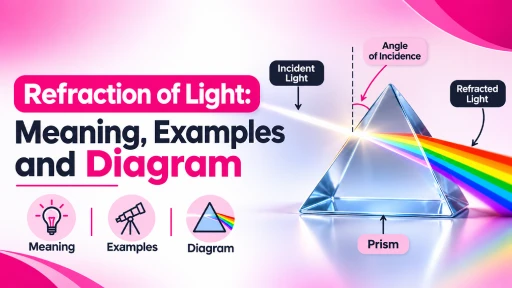
Have you ever placed a straw in a glass of water and noticed that it looks bent? Or wondered why a swimming pool appears shallower than its actual depth? These effects happen because of the refraction of light.
Refraction occurs when light travels from one transparent medium to another and changes speed. This change can also alter the direction of light, making objects appear different from their actual positions. Refraction is one of the important topics within physics and the branches of science, helping students understand how light interacts with different materials.
At Mixt Academy, students learn physics through simple explanations and practical examples. Understanding refraction helps you explore how lenses, prisms, spectacles and other optical devices work.
What Is Refraction of Light?
Refraction of light is the change in direction of light when it passes from one transparent medium into another because its speed changes. A medium is any substance through which light can travel, such as air, water or glass.
For example, when light travels from air into water, it slows down because light travels at different speeds in different materials. If it enters the water at an angle, its direction also changes. You can observe refraction in several situations:
- A pencil appears bent when placed inside a glass of water.
- A swimming pool looks shallower than it actually is.
- A glass lens focuses light to form an image.
- A glass prism separates white light into different colours.
Refraction is an important concept in geometrical optics. It explains how light travels through different materials and how lenses form images.
How Does Refraction of Light Occur?
Refraction takes place when light crosses the boundary between two transparent materials with different refractive indices. Each material allows light to travel at a different speed. When light enters another medium at an angle, this change in speed changes its direction. Let’s understand this through a simple example.
Imagine shining a torch towards a glass of water. When the light ray travels from air into water, it slows down and bends towards the normal. When the light travels from water back into air, it speeds up and bends away from the normal, provided it enters the second medium at an angle. The process involves three main steps:
- Light travels through the first medium towards a boundary.
- It crosses the boundary and enters a material with a different refractive index.
- Its speed changes, and its direction changes when it enters at an angle other than 90° to the boundary.
One important point is that light does not always change direction during refraction. When a ray strikes the boundary perpendicularly, it changes speed but continues along the same straight path.
Does the Speed of Light Change During Refraction?
Yes! The speed of light depends on the refractive index of the material through which it travels. Light travels fastest in a vacuum, at approximately 3 × 10⁸ metres per second. It travels more slowly through materials such as water and glass. During refraction:
- From air to glass: Light slows down.
- From air to water: Light slows down.
- From glass to air: Light speeds up.
- From water to air: Light speeds up.
The frequency of light remains unchanged when it enters another medium. Its wavelength changes because its speed changes. This relationship helps explain why light bends when travelling between different materials.
Why Does Light Change Direction During Refraction?
The change in direction occurs because one part of a light wave changes speed before the other part when the wave reaches a boundary at an angle. You can understand this by imagining a vehicle moving from a smooth road onto a rough surface at an angle. One wheel reaches the rough surface first and slows down, causing the vehicle to turn.
A similar principle applies to light waves. When light enters a medium with a higher refractive index, it slows down and bends towards the normal. When it enters a medium with a lower refractive index, it speeds up and bends away from the normal.
However, remember that the bending depends on the angle of incidence. A ray entering along the normal changes speed without changing direction.
Refraction of Light Diagram and Its Explanation
A ray diagram makes it easier to understand how light changes direction when it travels between two materials. The following diagram shows a light ray travelling from air into glass.
Diagram: Refraction from Air into Glass
Caption: A light ray bends towards the normal when it travels from air into glass at an angle.
How to Read the Refraction Diagram
There are several parts of this diagram that you should understand:
- Incident Ray: The incoming light ray that strikes the boundary between two materials.
- Boundary: The surface separating the two transparent media.
- Normal: An imaginary line drawn at 90° to the boundary at the point where light strikes.
- Angle of Incidence (i): The angle between the incident ray and the normal.
- Refracted Ray: The light ray that enters the second medium.
- Angle of Refraction (r): The angle between the refracted ray and the normal.
In this example, glass has a higher refractive index than air. The light slows down and bends towards the normal. The angle of refraction is smaller than the angle of incidence.
Useful Exam Tip: Always measure the angles from the normal, not from the boundary. This helps you avoid mistakes when drawing diagrams and solving numerical questions.
Important Terms Used in Refraction
Before studying the laws and numerical questions, learn these important terms.
- Incident Ray: The incident ray is the light ray that travels towards the boundary between two different media.
- Refracted Ray: The refracted ray is the light ray that enters the second medium after crossing the boundary.
- Normal: The normal is an imaginary line drawn perpendicular to the boundary at the point of incidence.
- Angle of Incidence: The angle of incidence is the angle between the incident ray and the normal.
- Angle of Refraction: The angle of refraction is the angle between the refracted ray and the normal.
- Refracting Surface: A refracting surface is the boundary between two materials where light changes its speed and may change direction.
- Refractive Index: The refractive index describes how much the speed of light decreases in a material compared with its speed in a vacuum.
- Optical Density: Optical density describes how much a medium slows down light. A material with a higher refractive index is optically denser than a material with a lower refractive index.
Remember that optical density and physical density are different. A material can have a high mass density without having a higher refractive index than another material.
What Are the Two Laws of Refraction?
The behaviour of light when it passes between two transparent media follows two fundamental laws. These laws help you understand the direction of refracted rays and calculate their angles.
First Law of Refraction
The first law states, “The incident ray, the refracted ray and the normal at the point of incidence all lie in the same plane.” This means you can represent the incident ray, refracted ray and normal on the same flat surface. It helps you draw accurate ray diagrams and understand the direction of light after it crosses a boundary.
Second Law of Refraction (Snell’s Law)
The second law of refraction is known as Snell’s law. It states that for a given pair of media, the ratio of the sine of the angle of incidence to the sine of the angle of refraction remains constant.
The mathematical formula is:
n₁ sin i = n₂ sin r
Where:
- n₁ = Refractive index of the first medium.
- n₂ = Refractive index of the second medium.
- i = Angle of incidence.
- r = Angle of refraction.
For example, when light travels from air into glass, you can use Snell’s law to calculate the angle at which it enters the glass. This law applies to different transparent materials, including air, water, glass and plastic.
What Is the Refractive Index?
The refractive index measures how slowly light travels through a material compared with a vacuum. It is represented by the letter n.
The formula for the absolute refractive index is:
n = c/v
Where:
- n = Absolute refractive index.
- c = Speed of light in a vacuum.
- v = Speed of light in the material.
The refractive index has no unit because it is a ratio of two speeds.
Examples of Refractive Indices
Different materials have different refractive indices.
| Material | Approximate Refractive Index |
|---|---|
| Vacuum | 1 |
| Air | 1.0003 |
| Water | 1.33 |
| Ordinary Glass | 1.5 |
| Diamond | 2.42 |
These are approximate values. The refractive index can vary with the wavelength of light and a material’s composition.
How Does Refractive Index Affect Light?
The refractive index helps determine how much light slows down and how it bends when entering another material.
- Higher Refractive Index: Light travels more slowly through the material.
- Lower Refractive Index: Light travels faster through the material.
- Equal Refractive Indices: There is no change in speed at the boundary, so the ray does not bend.
For example, when light travels from air into glass, it bends towards the normal because glass has a higher refractive index. When light travels from glass into air, it bends away from the normal, provided total internal reflection of light doesn’t occur.
Factors Affecting Refraction of Light
The bending of light varies depending on the properties of the materials and the angle at which light enters a new medium. Several factors determine how much light changes direction during refraction.
Refractive Indices of the Two Media
The refractive indices of the materials determine how much the speed of light changes at the boundary. A greater difference between their refractive indices generally produces a greater change in direction for the same incident angle.
Angle of Incidence
The angle at which light strikes the boundary affects the angle of refraction. A ray travelling perpendicular to the boundary does not change direction, even though its speed changes.
Wavelength of Light
Different colours of light have different wavelengths. A material can have slightly different refractive indices for different wavelengths. This explains why a prism bends different colours of white light by different amounts.
Nature of the Material
The material’s optical properties determine how quickly light travels through it. For example, light travels more slowly through glass than through air.
Temperature
Temperature can affect a material’s refractive index. Changes in air temperature can create layers with different refractive indices, leading to effects such as atmospheric refraction and mirages.
Types of Refraction and Bending of Light
The direction in which a light ray bends depends on the refractive indices of the two media. There are two common situations to understand.
Bending Towards the Normal
When light travels from an optically less dense medium to an optically denser medium, it bends towards the normal. For example, when a ray travels from air into water or glass at an angle, its speed decreases, and its angle of refraction becomes smaller than its angle of incidence.
Bending Away from the Normal
When light travels from an optically denser medium to an optically less dense medium, it bends away from the normal, provided the angle of incidence does not exceed the critical angle.
For example, when light travels from water into air, it speeds up and moves away from the normal. If the angle of incidence exceeds the critical angle, total internal reflection occurs instead of ordinary refraction into the second medium. Reference: https://openstax.org/books/physics/pages/16-2-refraction
Difference Between Reflection and Refraction
Reflection and refraction both describe how light behaves when it encounters a surface or boundary. However, they involve different processes.
| Property | Reflection | Refraction |
|---|---|---|
| Meaning | Light bounces back from a surface | Light changes direction when entering another medium |
| Medium | Light returns to the original medium | Light enters a different medium |
| Speed | Remains unchanged in the same medium | Usually changes |
| Direction | Follows the law of reflection | Follows Snell’s law |
| Main Formula | Angle of incidence = Angle of reflection | n₁ sin i = n₂ sin r |
| Examples | Mirror and polished metal | Water, glass and lenses |
For a better understanding of how light behaves at different surfaces, you can also explore the guide to transparent, translucent, and opaque materials.
Real-Life Examples of Refraction of Light
Refraction is not limited to science experiments. You can observe it in nature and everyday activities.
A Pencil Appearing Bent in Water
When you place a pencil inside a glass of water, it may look bent at the water’s surface. This happens because light from the underwater part of the pencil changes direction when it travels from water into air. Your eyes trace the refracted rays backwards, making the pencil appear to have a different position.
Swimming Pools Appearing Shallower
A swimming pool often appears shallower than it actually is. Light from the bottom travels through water and then enters the air. During this transition, the light bends away from the normal. Your brain traces the rays backwards, making the bottom appear closer to the water’s surface.
Formation of Rainbows
Rainbows form when sunlight interacts with water droplets in the atmosphere. Light undergoes refraction as it enters each droplet. Different colours bend by different amounts, separating white sunlight into its component colours. The light also reflects internally inside the droplet before refracting again as it exits. This combination of refraction, dispersion and internal reflection produces the colours of a rainbow.
Twinkling of Stars
Stars appear to twinkle because their light passes through different layers of the Earth’s atmosphere. These layers have changing temperatures and refractive indices. As atmospheric conditions change, the direction and apparent brightness of starlight reaching your eyes also fluctuate. This effect is called atmospheric scintillation and involves changing atmospheric refraction.
Mirage in Hot Weather
Have you ever noticed what looks like water on a hot road? This visual effect is called a mirage. Air close to the hot road has a different temperature and refractive index compared with the cooler air above it. Light bends continuously through these air layers, sometimes producing an image of the sky near the road.
Objects Underwater Appearing Displaced
Fish and other objects inside water may appear closer to the surface than they actually are. Light bends when it travels from water into air. This changes the apparent position of underwater objects. The same effect occurs when you look at a coin at the bottom of a transparent container of water.
Applications of Refraction in Everyday Life and Technology
Refraction has many practical uses in science, medicine, photography and modern optical equipment.
Spectacles and Contact Lenses
Spectacles use lenses to correct common vision problems. A convex lens helps correct long-sightedness, while a concave lens helps correct short-sightedness. These lenses refract light so that it focuses correctly on the retina. Contact lenses work on the same basic optical principle.
Cameras
Camera lenses use refraction to focus light onto an image sensor. The lens system controls the direction of incoming light to produce a focused photograph. Modern cameras use multiple lens elements to improve image quality and reduce unwanted optical effects.
Microscopes
Microscopes use curved lenses to magnify small objects that cannot be seen clearly with the naked eye. The objective lens collects and refracts light from the specimen to form an enlarged image. Additional lenses help produce the final view.
Telescopes
Refracting telescopes use lenses to collect and focus light from distant objects. The objective lens brings incoming light together to form an image, while the eyepiece magnifies that image for observation. Astronomers use these instruments to study planets, stars and other distant objects.
Magnifying Glasses
A magnifying glass uses a convex lens to produce an enlarged virtual image when an object is placed within its focal length. You can use it to read small text, examine details or observe tiny objects more clearly.
Glass Prisms
A glass prism refracts light as it enters and leaves its surfaces. When white light passes through a prism, different wavelengths bend by different amounts. This separates white light into a spectrum of colours. This process is known as dispersion.
Optical Fibres
Optical fibres transmit light signals through thin strands of glass or plastic. They operate through total internal reflection rather than ordinary refraction alone. Light remains confined inside the fibre through repeated internal reflections. This technology supports high-speed internet, telecommunications and medical instruments.
Solved Numerical Problems on Refraction
Numerical questions help you understand how to apply Snell’s law and the refractive index formula. Here are three examples with step-by-step solutions.
Numerical Example 1: Calculate the Refractive Index
Question: Light travels through a material at a speed of 2 × 10⁸ m/s. Calculate its refractive index. Take the speed of light in a vacuum as 3 × 10⁸ m/s.
Solution:
Given:
- Speed of light in a vacuum (c) = 3 × 10⁸ m/s
- Speed of light in the material (v) = 2 × 10⁸ m/s
Formula: n = c / v
Substitute the Values: n = (3 × 10⁸) / (2 × 10⁸)
n = 3 / 2
n = 1.5
Answer: The refractive index of the material is 1.5.
Numerical Example 2: Calculate the Angle of Refraction
Question: A light ray travels from air into glass with a refractive index of 1.5. If the angle of incidence is 30°, calculate the angle of refraction. Take the refractive index of air as 1.
Solution:
Given:
- n₁ = 1.00
- n₂ = 1.50
- i = 30°
According to Snell’s law: n₁ sin i = n₂ sin r
Substitute the values: 1.00 × sin 30° = 1.50 × sin r
0.5 = 1.50 × sin r
sin r = 0.5 / 1.5
sin r = 0.3333
r = sin⁻¹ (0.3333)
r ≈ 19.5°
Answer: The angle of refraction is approximately 19.5°.
Numerical Example 3: Calculate the Angle of Refraction from Glass into Air
Question: A light ray travels from glass (refractive index 1.5) into air (refractive index 1.0). If its angle of incidence is 30°, calculate the angle of refraction.
Solution:
Given:
- n₁ = 1.50
- n₂ = 1.00
- i = 30°
Using Snell’s Law: n₁ sin i = n₂ sin r
Substitute the Values: 1.50 × sin 30° = 1.00 × sin r
1.50 × 0.5 = sin r
sin r = 0.75
r = sin⁻¹ (0.75)
r ≈ 48.6°
Answer: The angle of refraction is approximately 48.6°.
The refracted ray bends away from the normal because light travels from glass into air.
Common Mistakes Students Should Avoid
Students sometimes confuse the direction of light, refractive index and the angles used in refraction calculations. Avoid these common errors when preparing for physics examinations:
- Measuring the angle of incidence from the surface instead of the normal.
- Assuming light always bends when it enters another medium.
- Confusing optical density with physical density.
- Forgetting that light’s frequency remains unchanged during refraction.
- Applying Snell’s law without checking which medium is the first and which is the second.
- Confusing refraction with dispersion or total internal reflection.
- Assuming that a higher refractive index means a higher speed of light.
Practise drawing ray diagrams and writing the known values before solving numerical questions. This approach makes it easier to select the correct formula and explain your final answer.
If you struggle with Snell’s law, refractive index calculations or ray diagrams, a physics teacher can help you understand each step. Students looking for online physics tutors in the UAE can explore subject-specific support through Mixt Academy, including personalised lessons and guided numerical practice.