How to Convert 1 Million Seconds into Days? Step-by-step Calculation
Did You Know?
- 1 minute = 60 seconds
- 1 hour = 60 minutes
- 1 day = 24 hours
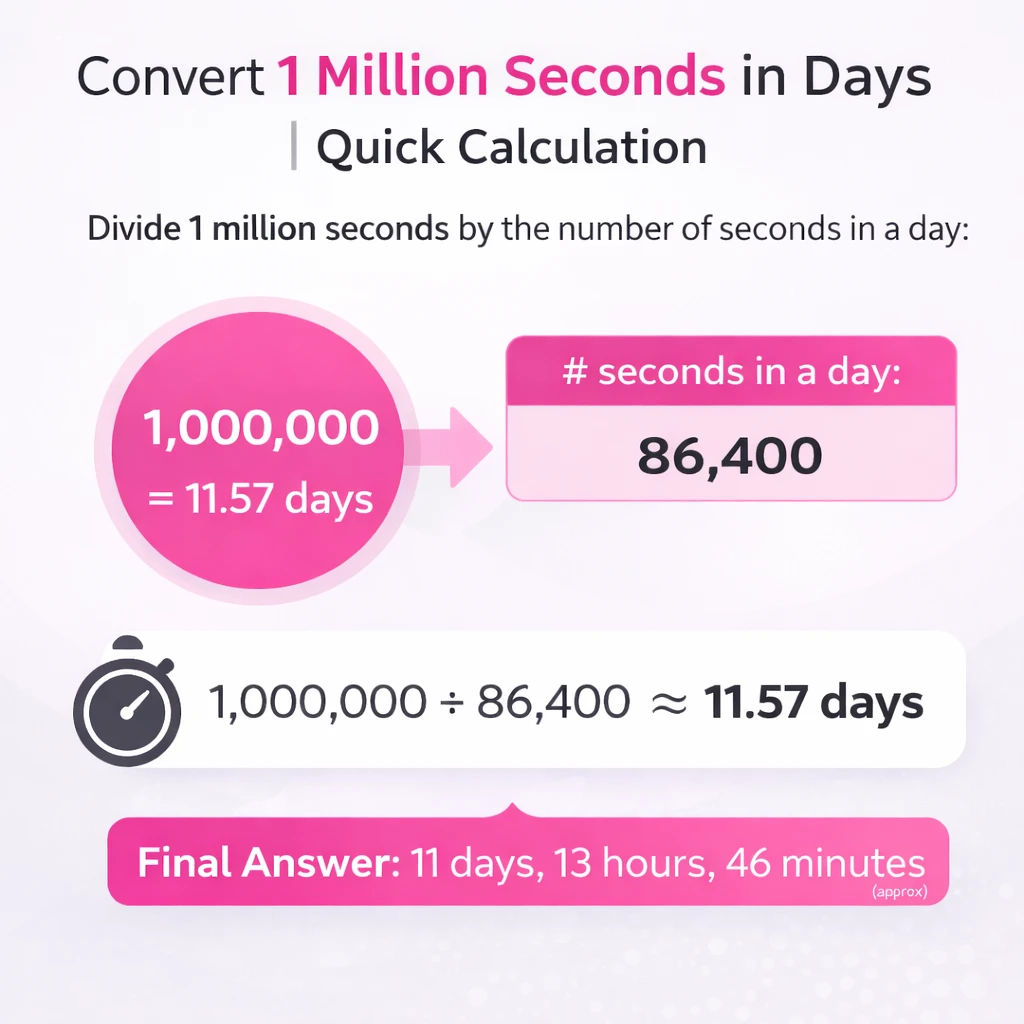
First, find how many seconds are in one day:
60 × 60 × 24 = 86,400 seconds in one day
Now divide one million seconds by the number of seconds in a day:
1,000,000 ÷ 86,400 ≈ 11.57 days
Final Answer: Basically, one million seconds is approximately equal to 11.57 days, which is interpreted as 11 days, 13 hours, and 46 minutes (approximately). This conversion illustrates how the large number of seconds can be turned into days through simple math.
If you want to see this in years, 1 million seconds in years is approximately 0.03 years, giving you a sense of how small it is compared to 1 billion seconds.
Hire the Best Online Tutors for Your Child
How to Convert 1 Billion Seconds in Days and Years?
Step 1: Recall the basic conversions
31 billion seconds may sound like an unimaginably long time, but when converted into years, it gives a fascinating perspective on just how much time that really is.
- 1 minute = 60 seconds
- 1 hour = 60 minutes = 3,600 seconds
- 1 day = 24 hours = 86,400 seconds (since 24×3,600=86,400)
- 1 year ≈ 365.25 days (accounting for leap years), and since 1 day = 86,400 seconds, 1 year ≈ 365.25 × 86,400 ≈ 31,557,600 seconds.
Step 2: Convert seconds into days
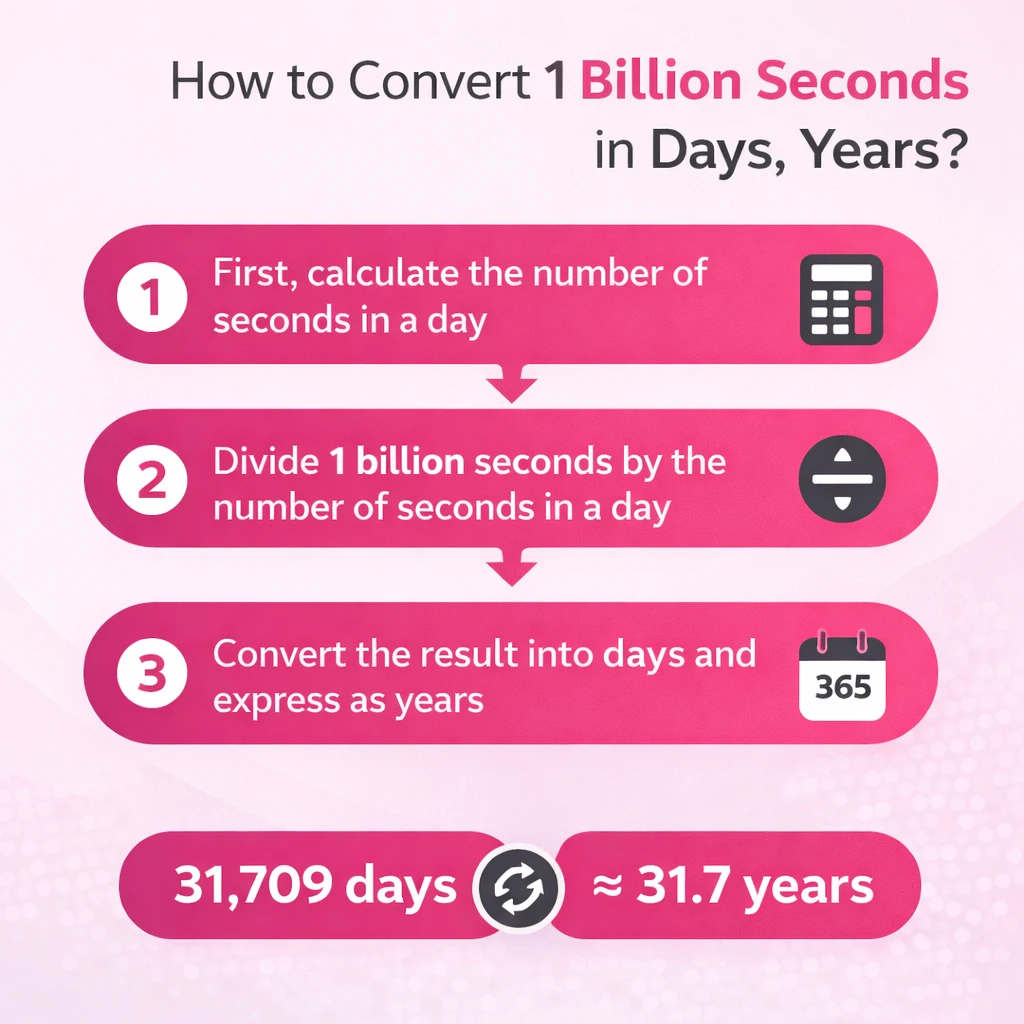
1,000,000,000 ÷ 86,400 = ?
Step by step: Divide 1,000,000,000 ÷ 86,400
Let’s simplify: 1,000,000,000 ÷ 86,400 ≈ 11,574.07 days
So, 1 billion seconds ≈ 11,574 days
Step 3: Convert seconds into years
1,000,000,000 ÷ 31,557,600 ≈ ?
Step by step: Divide 1,000,000,000 ÷ 31,557,600
Calculation: 1,000,000,000 ÷ 31,557,600 ≈ 31.69
So, 1 billion seconds ≈ 31.69 years, which is about 31 years and 8 months.
Do you have Any Idea 1 Million Seconds in Days Calculator?
Yes, numerous online calculators can convert 1 million seconds to days almost immediately. Additionally, you can obtain the answer even faster by simply conducting a direct Google search. Some of the widely used online calculators are:
- Omni Calculator
- Satsig
Although calculators are very handy for obtaining a quick outcome, it is the underlying math that makes the conversion of 1 million seconds into days clearer for the students.
Difference Between 1 Million Seconds in Days vs 1 Billion Seconds
| Time Amount | In Seconds | Approximate Time in Days | Approximate Time in Years | Explanation |
|---|---|---|---|---|
| 1 million Seconds | 1,000,000 seconds | About 11.57 days | About 0.03 years | This is a little less than two weeks, making it easier to imagine in daily life. |
| 1 billion Seconds | 1,000,000,000 seconds | About 11,574 days | About 31.7 years | This equals several decades, showing how much larger a billion is compared to a million. |
The table below clearly explains the difference between 1 million seconds and 1 billion seconds, helping students understand how large numbers change when converted into time.
Why is it Important to Understand 1 Million Seconds in Days?
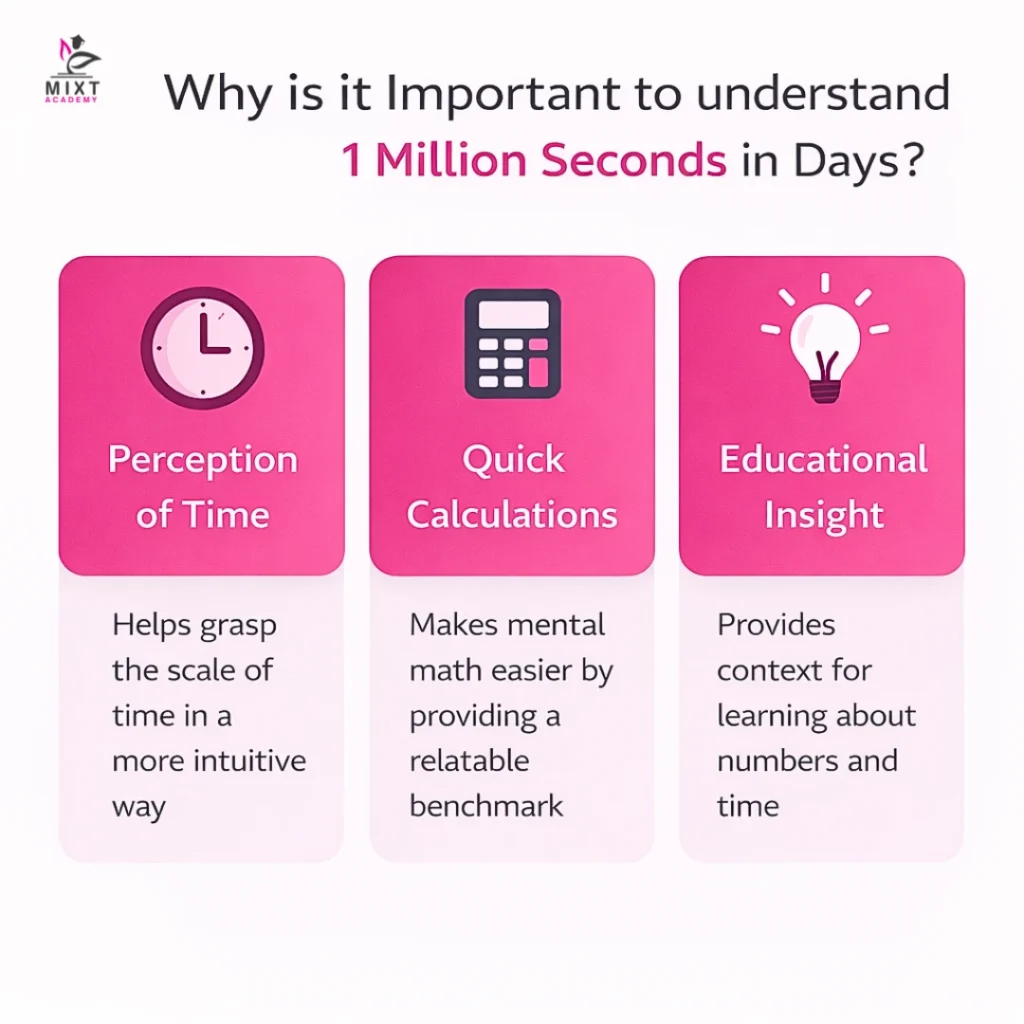
Converting 1 million seconds into days, hours, or years makes it easier to understand and visualise large amounts of time. While online calculators can give quick results, learning the step-by-step process strengthens math skills and problem-solving abilities. Comparing 1 million seconds with 1 billion seconds also helps put numbers into perspective, showing how even small changes in scale can make a huge difference in real-life applications.