
To convert a terminating decimal to a fraction, write the digits without the decimal point as the numerator. Use 10, 100, or 1,000 as the denominator for one, two, or three decimal places, then simplify. For example, 0.65 is 65/100, which simplifies to 13/20.
Decimals and fractions both show the same value, and exams often ask you to switch between them without a calculator. This guide explains how to convert decimals to fractions, with examples for different types, a quick table, and practice questions you can check.
Why This Skill Matters
You’ll use decimals and fractions in algebra, ratios, percentages, probability, and everyday things like measuring, reading prices, or checking discounts. If you can switch between them easily, it’s also simpler to compare numbers, since 0.35 and 7/20 mean the same thing. This small skill helps with lots of later maths.
The Three-Step Method
- Remove the decimal point. Write the digits without the decimal point as the numerator.
- Use a power of ten as the denominator. Use 10 for one decimal place, 100 for two, and 1,000 for three.
- Simplify by dividing the top and bottom numbers by their greatest common factor.
Example: Convert 0.65.
There are two decimal places, so 0.65 = 65/100. The greatest common factor of 65 and 100 is 5. Divide both by 5 to get 13/20. This fraction can’t be reduced any more.
The Place-Value Shortcut
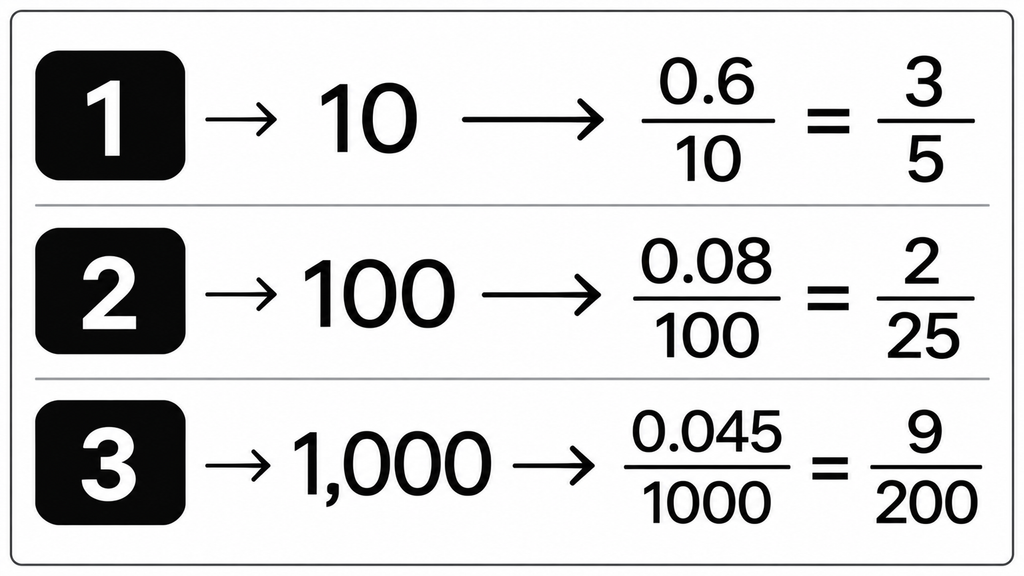
The number of decimal places tells you what the bottom number should be:
| Decimal places | Denominator | Example |
|---|---|---|
| 1 | 10 | 0.6 = 6/10 = 3/5 |
| 2 | 100 | 0.08 = 8/100 = 2/25 |
| 3 | 1,000 | 0.045 = 45/1000 = 9/200 |
It also helps to say the decimal out loud: sixty-five hundredths means 65/100. For a full example with three decimal places, see our guide to 375 as a fraction.
More Worked Examples
Decimals with a zero after the point. For example, to convert 0.08, write 8/100, then divide both numbers by 4 to get 2/25.
Decimals greater than 1. For example, to convert 2.4, set aside the whole number 2. Change 0.4 to 4/10 = 2/5, then put the 2 back to get 2 2/5. As an improper fraction, that’s 12/5.
Three decimal places. For example, to convert 0.045, write 45/1000, then divide by 5 to get 9/200. Since 9 and 200 have no common factor, you’re finished.
Negative decimals. For example, to convert −0.35, ignore the minus sign at first. Change 0.35 to 7/20, then add the minus sign back to get −7/20.
Money. For example, if a snack costs AED 7.25, the 0.25 is 25/100 = 1/4, so the price is 7 1/4 dirhams.
Converting Repeating Decimals
Terminating decimals end, but repeating decimals continue forever. You cannot convert a repeating decimal using a fixed number of decimal places, so use algebra instead.
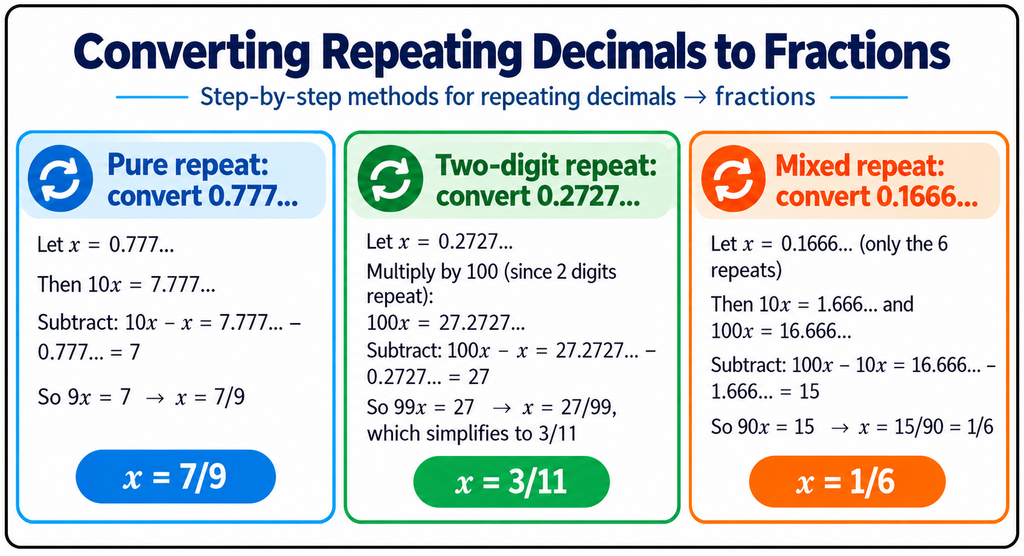
Pure repeat: convert 0.777… Let x = 0.777… Then 10x = 7.777… Subtracting gives 9x = 7, so x = 7/9.
Two-digit repeat: convert 0.2727… Let x = 0.2727… Multiply by 100 to get 100x = 27.2727… Subtracting gives 99x = 27, so x = 27/99, which simplifies to 3/11.
Mixed repeat: convert 0.1666… Here, only the 6 repeats. Let x = 0.1666… Then 10x = 1.666… and 100x = 16.666… Subtracting gives 90x = 15, so x = 15/90 = 1/6.
Use powers of ten to line up the repeating parts before subtracting: 10 for a one-digit repeat, 100 for a two-digit repeat, and so on. For mixed repeats, first account for the non-repeating digits. Notice that 0.333 with no dots is a terminating decimal equal to 333/1000, whereas 0.3 with a dot over the 3 is 1/3.
Going the Other Way
To change a fraction back to a decimal, divide the top number by the bottom number. For example, 13 ÷ 20 = 0.65. This is also the fastest way to check your answer. Also study the fraction to decimal chart to learn easy conversions.
Quick-Reference Table
| Decimal | Fraction |
|---|---|
| 0.1 | 1/10 |
| 0.2 | 1/5 |
| 0.25 | 1/4 |
| 0.4 | 2/5 |
| 0.5 | 1/2 |
| 0.6 | 3/5 |
| 0.75 | 3/4 |
| 0.8 | 4/5 |
| 0.05 | 1/20 |
| 0.125 | 1/8 |
Learning these ten by heart saves time on non-calculator exams.
How to Check Your Answer
Divide the top number by the bottom number to see if you get the original decimal. For 13/20, 13 ÷ 20 = 0.65, which matches. Also, check if the size makes sense: 0.65 is a bit more than half, and 13/20 is a bit more than 10/20.
Common Mistakes to Avoid
- Miscounting decimal places. 0.05 is 5/100, not 5/10.
- Not simplifying. 65/100 is right but not finished. Exam questions usually say “give your answer in its simplest form.”
- Dropping the whole number. 2.4 is not just 4/10, because you need to put the 2 back in.
- Confusing ending and repeating decimals. Always check for a repeating dot or bar.
- Dividing by the wrong number. Always divide the top and bottom by the same number.
Exam Tips for Non-Calculator Papers
Show every step, since method marks reward clear working even if your final answer is wrong. Underline the number of decimal places before writing the denominator. If you can’t spot the greatest common factor, simplify in steps. Always reread the question to check if it asks for a proper fraction, mixed number, or improper fraction. Take ten seconds to check your answer by dividing back.
Practice Questions
Try these questions, then check your answers below.
- Convert 0.35 to a fraction.
- Convert 1.6 to a mixed number.
- Convert 0.004 to a fraction.
- Convert 0.555… to a fraction.
Answers:
1) 7/20.
2) 1 3/5.
3) 1/250.
4) 5/9.
When a Tutor Helps
If fractions are still tricky, getting feedback on your own work is often the quickest way to improve. A tutor can spot where you go wrong, whether it’s counting decimal places, simplifying, or dealing with repeating digits. Families looking for online tutors in UAE can learn from home, and many parents search for Dubai maths tutors who know the local exam styles. No matter which mathematics tutors in UAE you choose, ask how they mark homework, explain mistakes, and track your progress. Mixt Academy offers live one-to-one online lessons with a free first session, so you can try a tutor before you decide.