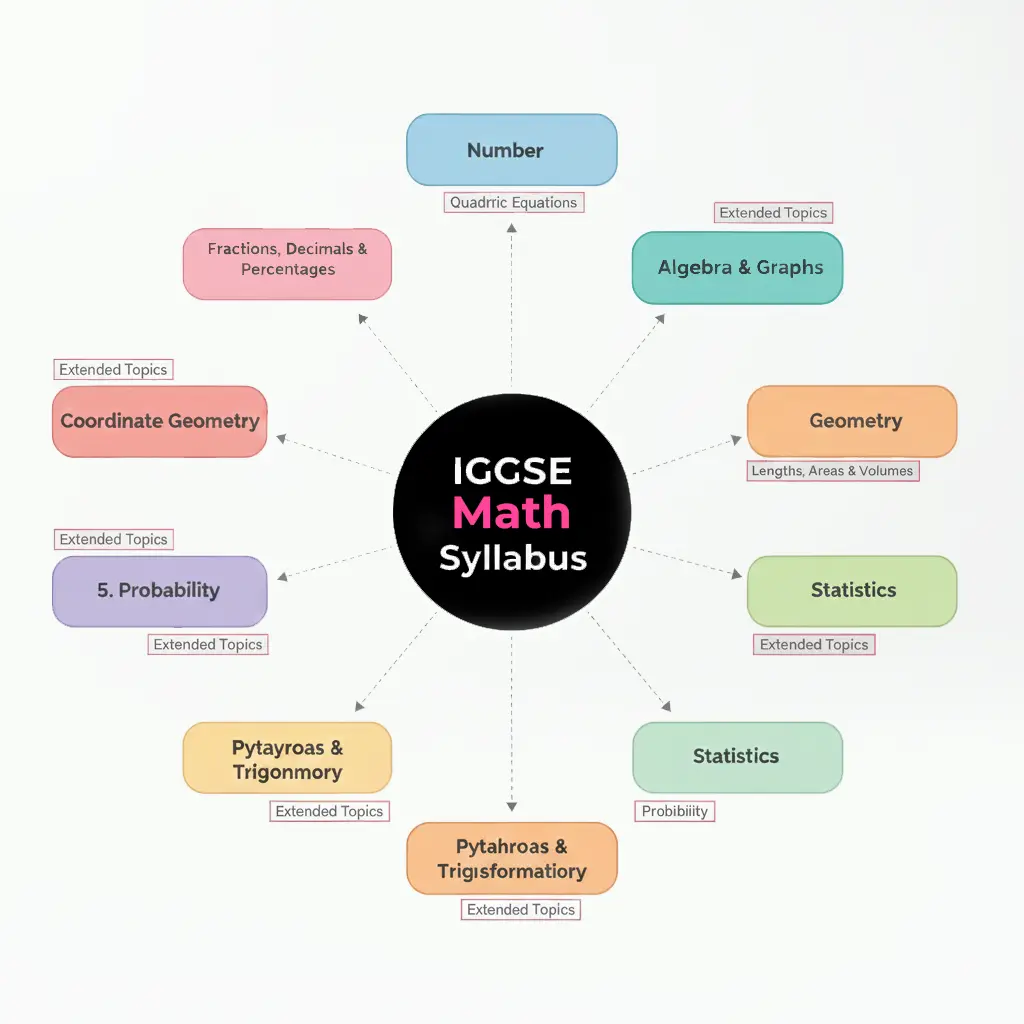
The IGCSE Maths syllabus aims to enable students to develop a positive attitude towards mathematics in a way that encourages enjoyment, establishes confidence and promotes enquiry and further learning. Moreover, students can develop a feel for numbers and understand the significance of the results obtained and apply their mathematical knowledge and skills to their own lives and the world around them. In this syllabus, students study the following topics:
- Number
- Algebra and graphs
- Coordinate geometry
- Geometry
- Trigonometry
- Transformations and vectors
- Probability
- Statistics
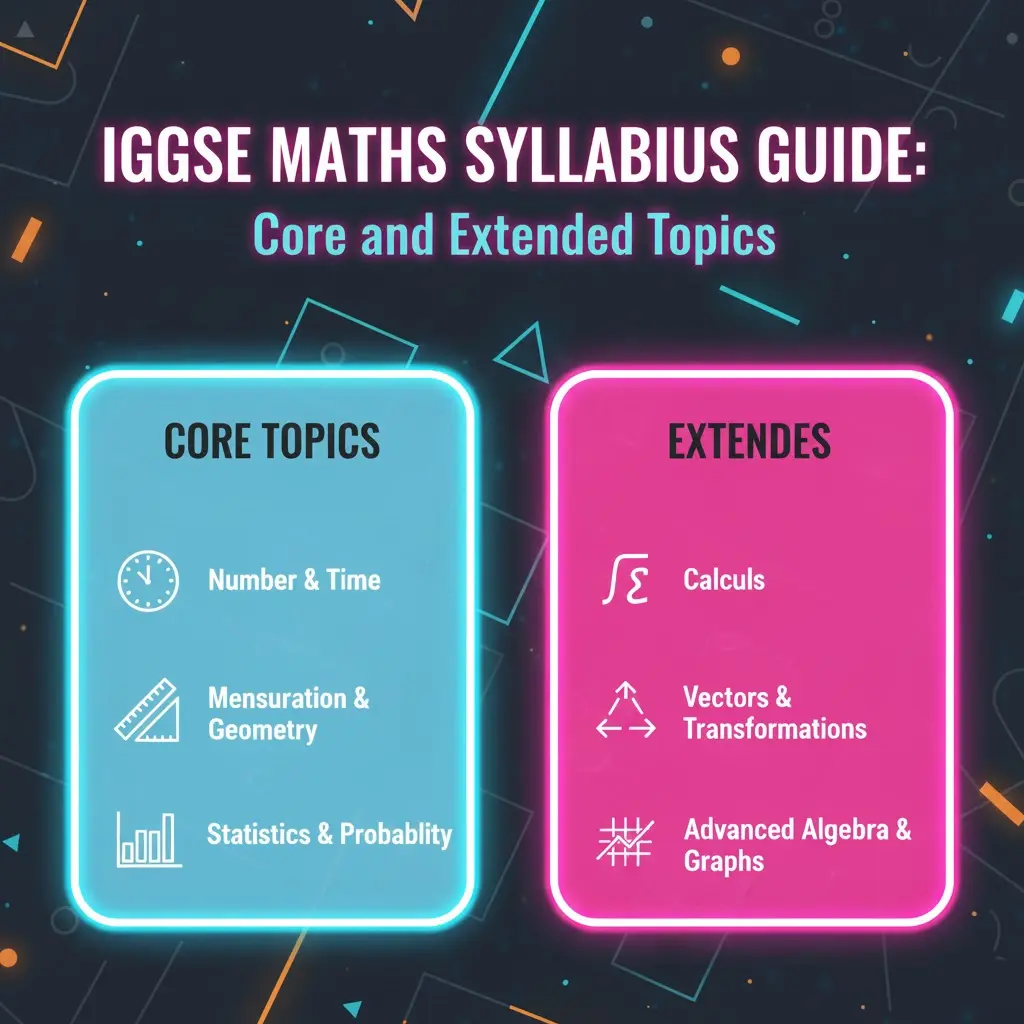
Cambridge IGCSE Mathematics is tiered to enable effective differentiation for students. The Core subject content is intended for learners targeting grades C–G, and the Extended subject content is intended for students targeting grades A*–C. The Extended subject content contains the Core subject content as well as additional content. Qualified maths tutors in Dubai help students master these specific syllabus requirements.
Assessment Style of IGCSE Maths Core and Extended Subjects
The Split-Screen Comparison
All candidates take two components. Students who have studied the Core subject content, or who are expected to achieve a grade D or below, should be entered for Paper 1 and Paper 3. These candidates will be eligible for grades C to G. Candidates who have studied the Extended subject content and who are expected to achieve a grade C or above should be entered for Paper 2 and Paper 4. These candidates will be eligible for grades A* to E. Candidates should have a scientific calculator for Paper 3 and Paper 4. Calculators are not allowed for Paper 1 and Paper 2.
Core Assessment
Core candidates take Paper 1 and Paper 3. The questions are based on the Core subject content only:
| Elements (Core) | Paper 1: Non-calculator | Paper 3: Calculator |
|---|---|---|
| Duration | 1 hour 30 minutes | 1 hour 30 minutes |
| Total marks | 80 marks (50%) | 80 marks (50%) |
| Type of Questions | Structured and unstructured questions | Structured and unstructured questions |
| Calculator | Use of a calculator is not allowed | A scientific calculator is required |
| Assessment Type | Externally assessed | Externally assessed |
Extended Assessment
Extended candidates take Paper 2 and Paper 4. The questions are based on the Extended subject content only:
| Elements (Core) | Paper 1: Non-calculator | Paper 3: Calculator |
|---|---|---|
| Duration | 1 hour 30 minutes | 1 hour 30 minutes |
| Total marks | 80 marks (50%) | 80 marks (50%) |
| Type of Questions | Structured and unstructured questions | Structured and unstructured questions |
| Calculator | Use of a calculator is not allowed | A scientific calculator is required |
| Assessment Type | Externally assessed | Externally assessed |
Assessment objectives of IGCSE Maths
The assessment objectives (AOs) are AO1 and AO2. AO1 analyses students’ knowledge and understanding of mathematical techniques. While AO2 evaluates your analysis, interpret and communicate mathematically.
Assessment objectives of the Core qualification
The approximate weightings allocated to the assessment objectives (AOs) of the core qualification are summarised below:
| Assessment Objective | Weighting in IGCSE (%) |
|---|---|
| AO1 Knowledge and understanding of mathematical techniques | 60–70 |
| AO2 Analyse, interpret and communicate mathematically | 30–40 |
| Total | 100 |
Assessment objectives of the Extended qualification
The weightings allocated to the assessment objectives of the extended qualification are mentioned below:
| Assessment Objective | Weighting in IGCSE (%) |
|---|---|
| AO1 Knowledge and understanding of mathematical techniques | 40–50 |
| AO2 Analyse, interpret and communicate mathematically | 50–60 |
| Total | 100 |
IGCSE Maths Syllabus Content for Core & Extended Qualifications
In this section, the topics for core and extended IGCSE Maths are listed. To help students master these concepts, online offer specialised IGCSE preparation focusing on the major differences between the Core and Extended courses. IGCSE Maths tutoring can be broadly divided into the following topics:
1. Number
Number is a fundamental topic in IGCSE mathematics, as they form the core of numerical literacy. Number topics cover essential skills and include more advanced concepts in other areas of the course. IGCSE Maths Core number topics include:
- Types of Numbers and Basic Number Skills
- Operations with Numbers & Decimals
- Prime Factors, HCF & LCM
- Powers, Roots & Standard Form
- Fractions and Operations with Fractions
- Percentages
- Simple & Compound Interest
- Fractions, Decimals & Percentages
- Ratio & Proportion
- Money Calculations
- Time, Currency & Conversions
- Compound Measures (Speed, Density, Pressure)
- Rounding, Estimation & Bounds
IGCSE Maths Extended number topics include all of the above Core topics, plus:
- Set Notation & Venn Diagrams
- Growth & Decay
- Surds
So, why not take the first step now? Select your subjects, download the appropriate past papers, and begin your revision plan today.
2. Algebra & Sequences
Algebra is a core topic in IGCSE mathematics. It provides the foundation for problem-solving and mathematical reasoning. Algebraic concepts help students to develop essential skills in using expressions, solving equations, and understanding relationships between variables, which are necessary for more advanced topics in the course. IGCSE Maths Core algebra and sequences topics include:
- Basic Algebra (simplifying and substitution)
- Algebraic Roots & Indices
- Expanding & Factorising Brackets
- Linear Equations
- Forming & Solving Equations
- Inequalities
- Rearranging Formulas
- Simultaneous Equations
- Sequences
IGCSE Maths Extended algebra and sequences topics include all of the above Core topics, plus:
- Quadratic Equations
- Algebraic Fractions
- Functions
- Direct & Inverse Proportion
3. Coordinate Geometry & Graphs
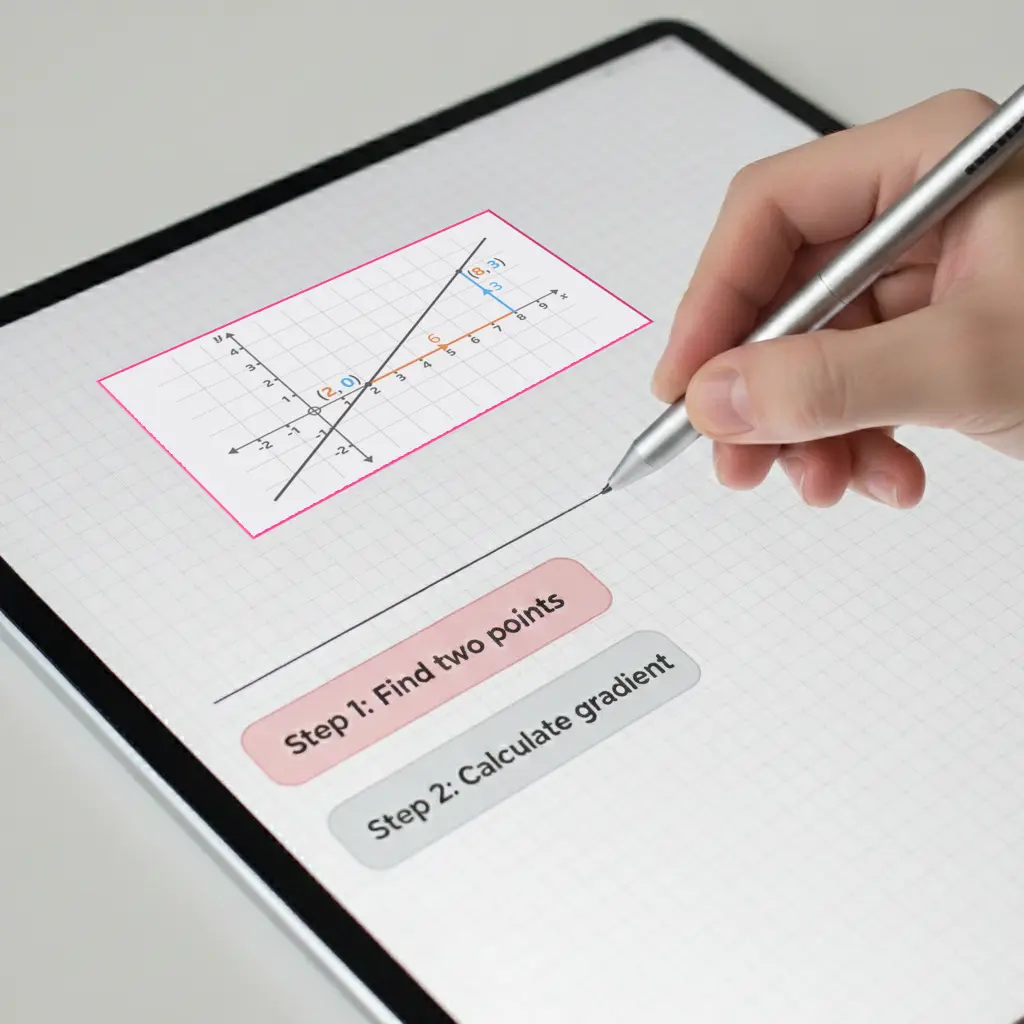
Coordinate geometry and graphs are important topics in the IGCSE mathematics syllabus. Both of these provide a visual representation of mathematical relationships. These topics help students to develop skills in plotting points, interpreting graphs, and understanding the relationships between equations and their graphical representations, which are essential for problem-solving and real-world applications. IGCSE Maths Core coordinate geometry and graphs topics include:
- Gradients and Equations of Lines
- Parallel Lines
- Types of Graphs
- Solving Equations from Graphs
- Conversion Graphs
- Distance-Time and Speed-Time Graphs
IGCSE Maths Extended coordinate geometry and graphs topics include all of the above Core topics, plus:
- Midpoints and Lengths of Lines
- Perpendicular Lines
- Quadratic Graphs
- Gradients of Tangents
- Solving & Graphing Inequalities
- Rates of Change Graphs
- Differentiation
4. Geometry
Geometry is an important topic in IGCSE mathematics. The topic covers shapes, angles, and constructions. It develops spatial reasoning through the study of symmetry, polygons, parallel lines, and circle theorems, with practical applications in scale drawings and directions. IGCSE Maths Core geometry topics include:
- Symmetry & Shapes
- Basic Angle Properties
- Angles in Polygons & Parallel Lines
- Bearings, Constructions & Scale Drawings
- Circle Theorems
IGCSE Maths Extended geometry topics include all of the above Core topics, but some areas are examined in greater depth. For example, there are more circle theorems required. IGCSE International Maths Core geometry topics include:
- Symmetry & Shapes
- Basic Angle Properties
- Angles in Polygons & Parallel Lines
- Bearings
- Circle Theorems
5. Lengths, Areas & Volumes
Lengths, areas, and volumes are the main concepts in the IGCSE maths syllabus. They focus on measurement and spatial reasoning. Topics like perimeter, circles, and volume are crucial for solving real-world geometric problems. IGCSE Maths Core & Extended topics about lengths, areas, and volumes include:
- Area & Perimeter
- Circles, Arcs & Sectors
- Volume & Surface Area
- Congruence & Similarity
6. Pythagoras & Trigonometry
Pythagoras and trigonometry are core topics of IGCSE mathematics for solving problems involving right-angled triangles, 2D shapes, and angles. Fundamental concepts contain the Pythagorean theorem, trigonometric ratios, sine and cosine rules, and their usage in graphs and equations. IGCSE Maths Core Pythagoras and trigonometry topics include:
- Pythagoras’ theorem
- Trigonometric Ratios
IGCSE Maths Extended Pythagoras and trigonometry topics include all of the above Core topics, plus:
- Angles of Elevation & Depression
- Exact Trig Values
- Sine Rule
- Cosine Rule
- Area of Triangles
- 3D Pythagoras & Trigonometry
- Trigonometric Graphs & Equations
- Area & Perimeter
- Circles, Arcs & Sectors
- Volume & Surface Area
- Congruence & Similarity
7. Vectors & Transformations
Vectors and transformations explore the movement and positioning of points and shapes. Key topics include vector operations, translations, rotations, reflections, and enlargements. IGCSE Maths Core vectors & transformations topics include:
- Translations
- Reflections
- Rotations
- Enlargements
IGCSE Maths Extended vectors & transformations topics include all of the above Core topics, plus:
- Vector Basics
- Magnitude of a Vector
- Position & Displacement Vectors
- Finding Vector Paths & Problem Solving
- Pythagoras’ theorem
- Trigonometric Ratios
IGCSE Maths Extended Pythagoras and trigonometry topics include all of the above Core topics, plus:
- Angles of Elevation & Depression
- Exact Trig Values
- Sine Rule
- Cosine Rule
- Area of Triangles
- 3D Pythagoras & Trigonometry
- Trigonometric Graphs & Equations
- Area & Perimeter
- Circles, Arcs & Sectors
- Volume & Surface Area
- Congruence & Similarity
8. Probability
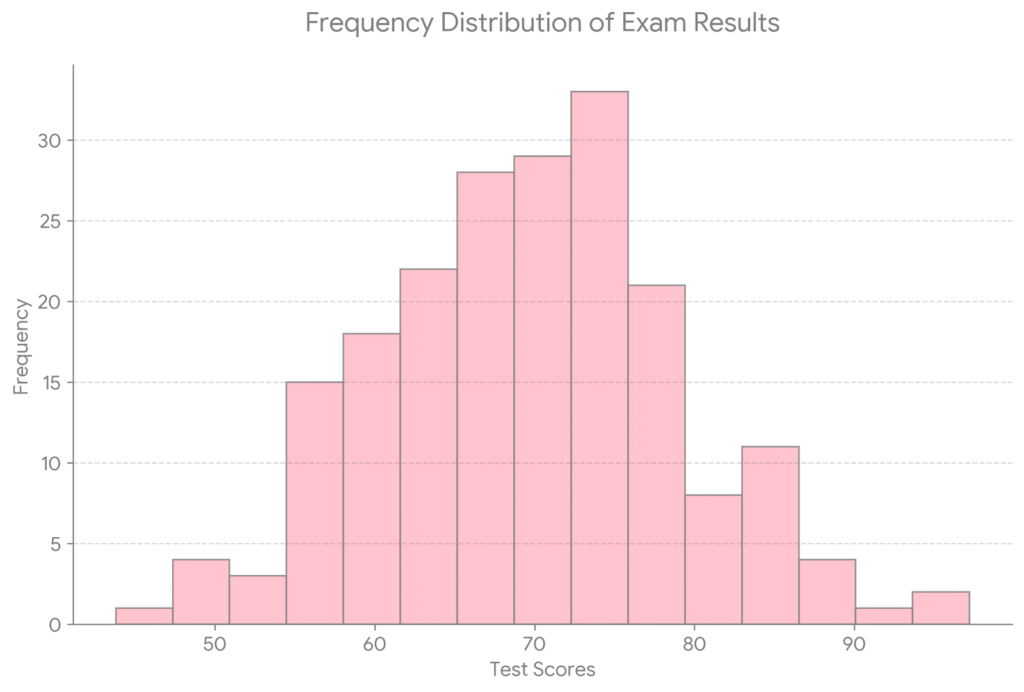
Probability explores the likelihood of events occurring, using concepts like tree diagrams, Venn diagrams, and conditional probability. It helps in making predictions and informed decisions based on data. IGCSE Maths Core probability topics include:
- Basic Probability & Sample Space Diagrams
- Relative & Expected Frequency
- Two-Way Tables
- Set Notation & Venn Diagrams
- Tree Diagrams
- Combined Probability
IGCSE Maths Extended probability topics include all of the above Core topics, plus:
- Conditional Probability
9. Statistics
Statistics involves collecting, analysing, and interpreting data. Key topics include averages, range, statistical diagrams, and scatter graphs, which help in identifying patterns, trends, and correlations in data. IGCSE Maths Core statistics topics include:
- Mean, Median, Mode
- Range
- Averages from Tables
- Comparing Data Sets
- Types of Data
- Tally Charts & Frequency Tables
- Stem & Leaf Diagrams
- Bar Charts & Pictograms
- Pie Charts
- Scatter Graphs & Correlation
- Lines of Best Fit
IGCSE Maths Extended statistics topics include all of the above Core topics, plus:
- Averages from Grouped Data
- Interquartile Range
- Histograms
- Cumulative Frequency Diagrams
Bottom Line:

The IGCSE Maths syllabus encourages students to develop their mathematical ability as a key life skill, and as a strong basis for further study of mathematics or to support skills in other subjects. Mixt Academy is here to help you achieve the best grade possible in IGCSE Mathematics by offering expert-written resources specifically made for your exam board. We have got everything you need, such as detailed revision notes, IGCSE tutors, exam-style questions with student-friendly worked solutions, past papers with mark schemes, and flashcards. Whether you want to improve your understanding of key topics, test your knowledge, or sharpen your exam techniques, Mixt Academy makes it easier and more effective for you to revise.