
Whether you are a student planning ahead or a parent exploring options, understanding the difference between these qualifications is essential. At Mixt Academy, we have helped many students make informed decisions with confidence.
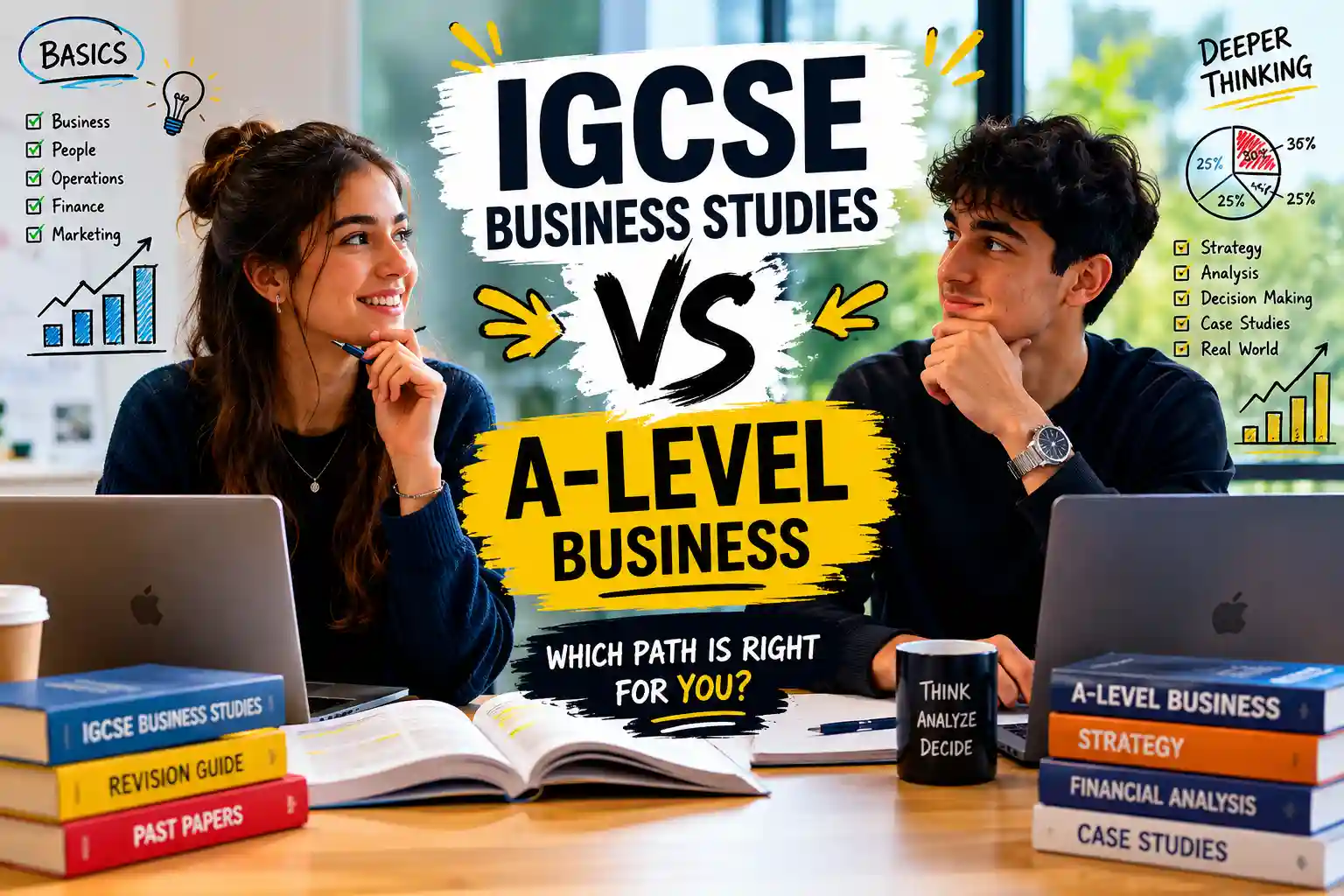
IGCSE vs A-Level Business Studies: Building the Foundations
What the IGCSE Business Studies Course Covers
IGCSE Business Studies (offered by Cambridge and Pearson Edexcel) is typically taken at ages 14–16. It introduces students to the fundamentals of how businesses operate, from sole traders to large multinationals.
Core topics include:
- Business activity and enterprise
- People in business (HR, motivation, leadership)
- Marketing and market research
- Operations and production
- Financial information and performance
- Business and its environment (external factors)
The course encourages students to understand real-world scenarios but stays mainly at the comprehension and application level. You’re expected to identify, describe, and explain, not deeply evaluate or build arguments from scratch.
Assessment Style
IGCSE Business is assessed through written exams, typically two papers. Questions range from short-answer definitions to case-study-based responses. The highest marks require you to “discuss” or “evaluate,” but the depth demanded is far more accessible than at A-level.
Skill demand at IGCSE: Recall → Understanding → Basic Application
IGCSE Business Studies to explore the subject or ready to excel in A-Level Business for university and career success, the right support makes all the difference.
A-Level Business: Where the Real Thinking Begins
A Significant Step Up
A-Level Business (AS and A2, usually ages 16–18) is not simply “more IGCSE.” It’s a fundamentally different intellectual exercise. The same topics, marketing, finance, HR, and return, but now students must integrate them, question them, and argue about them using evidence.
You’re no longer just explaining what a business does. You’re analysing why strategic decisions succeed or fail and evaluating trade-offs with justified conclusions.
A-Level Topics Go Deeper Into
- Strategic business analysis (SWOT, Porter’s Five Forces, Ansoff Matrix)
- Financial decision-making (investment appraisal, ratio analysis)
- Human resource management and organisational change
- Operations management (lean production, capacity utilisation)
- Global business strategy and competitiveness
- Business ethics and corporate social responsibility
Assessment Style
A-Level Business typically includes multiple papers, data response questions, essay-style questions, and, in some boards, a pre-released case study. The marking rewards chains of analysis, justified judgments, and the ability to weigh up both sides of business studies tutoring in Dubai.
Skill demand at A-Level: Analysis → Evaluation → Justified Judgement → Strategic Thinking
Side-by-Side Comparison
| Feature | IGCSE Business Studies | A-Level Business |
|---|---|---|
| Typical Age Group | 14–16 years | 16–18 years |
| Duration | 2 years | 2 years (AS + A2) |
| Depth of Study | Introductory to intermediate | Intermediate to advanced |
| Key Skills Tested | Recall, understanding, application | Analysis, evaluation, judgement |
| Assessment Format | 2 written exam papers | 2–3 papers (essays, case studies) |
| Maths Involvement | Basic calculations | Ratio analysis, investment appraisal |
| University Recognition | Not directly (foundation level) | Widely accepted for business degrees |
| Difficulty Level | Moderate | Demanding |
| Ideal For | Building business awareness | University & career preparation |
| Real-World Application | Conceptual understanding | Strategic decision-making |
Key Differences That Students Often Overlook
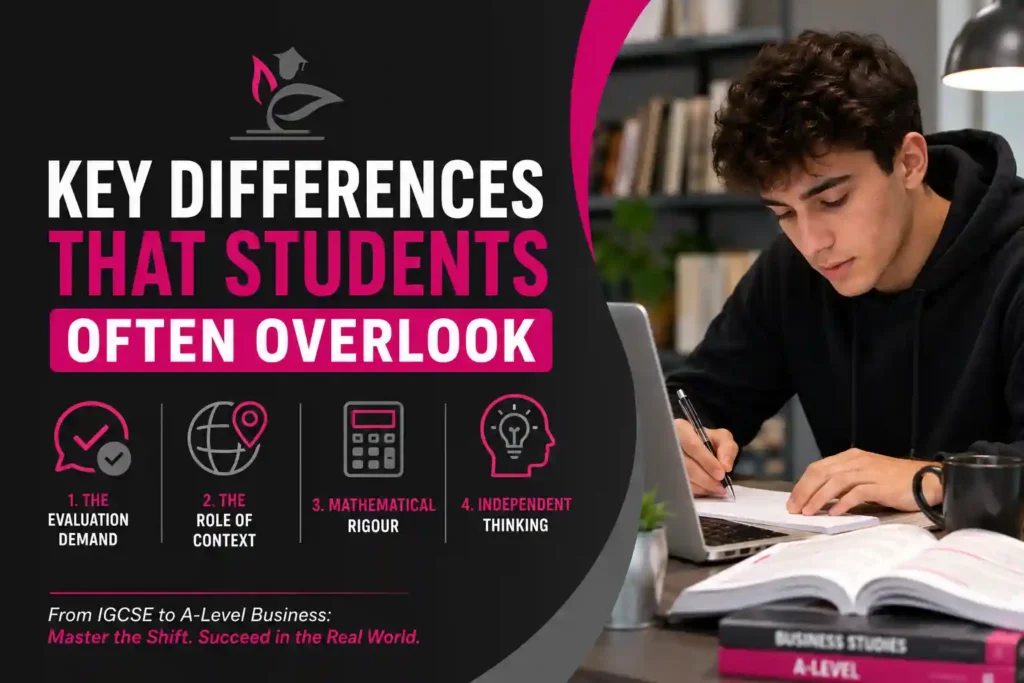
The Evaluation Demand
At IGCSE, a strong answer explains a point clearly. At A-Level, that same point needs to be supported, countered, and then judged, all in the same paragraph. This shift from “describe and explain” to “analyse and evaluate” catches many students off guard in Year 12.
The Role of Context
IGCSE case studies are fairly guided. A-Level case studies are richer, more ambiguous, and often require you to make reasonable assumptions. Students should learn these topics widely through qualified business studies tutors in Sharjah. This will help them to understand such complex topics in a digestible way.
Mathematical Rigour
Financial questions at IGCSE are straightforward. A-Level introduces investment appraisal techniques (payback period, ARR, and NPV), break-even analysis, ratio analysis, and profit forecasting, all of which require both numerical accuracy and written interpretation.
Independent Thinking
A-Level rewards students who read beyond the textbook, who follow business news, who understand why companies make bold decisions, and who can bring real examples into their answers. IGCSE is largely self-contained.
Stop wondering whether IGCSE Business Studies or A-Level Business is the better fit for your future. Our expert tutors specialise in helping students choosing the Right Path.
Which Qualification Is Right for You?
Choose IGCSE Business Studies if you:
- Are in secondary school and exploring your interests
- Want a solid, manageable introduction to business concepts
- Are you building your subject choices for future A-Levels
- Need a structured, exam-friendly overview of business
Choose A-Level Business if you:
- Have completed (or are completing) IGCSE and want to go deeper
- Plan to study Business, Economics, or Management at university
- Are comfortable with extended writing and structured argumentation
- Want a qualification recognised by UK universities and international institutions
Does IGCSE Business Prepare You Well for A-Level?
Yes! IGCSE gives you the vocabulary, the basic models, and an understanding of how businesses function. However, the thinking style required at A-Level is genuinely different.
Students who transition directly from IGCSE to A-level business often find the first few months challenging, not because the content is unfamiliar, but because the exam technique demands a complete reset. This is exactly where structured guidance makes a measurable difference.
At Mixt Academy, we have a team of qualified IGCSE tutors that provides business studies tutoring sessions to help students transition from basic understanding to advanced analytical thinking. These structured lessons build the confidence and exam skills needed to achieve top grades.
Ready to Decide & Actually Succeed in Business Studies?
Don’t just pick a qualification; build a plan around it. Whether you’re navigating IGCSE coursework or pushing for top A-Level grades, Mixt Academy’s expert tutors deliver focused, exam-smart sessions that go beyond the textbook. Your next grade breakthrough starts with one conversation; book your first session today.
Final Thoughts
Choosing between IGCSE Business Studies and A-Level Business tutoring depends on your academic stage, confidence level, and future goals. IGCSE introduces students to the fundamentals of business, while A-Level develops advanced analytical, evaluative, and strategic thinking skills needed for higher education and professional environments.
Although both qualifications cover similar business areas, the depth, workload, and expectations are very different. A-level business demands stronger argument building, independent thinking, and the ability to apply theory to complex real-world situations.
Understanding these differences early helps students prepare more effectively and choose a path that matches their strengths and goals. With the right mindset, study approach, and support, both qualifications can provide valuable preparation for university studies and future business careers.