
Hire the Best Online Tutors for Your Child
What is a Pulley & How Does It Make Lifting Easier?
Definition of Pulley
A pulley consists of a simple machine, which is a wheel rotating about an axle. It employs a rope or cable that goes through the wheel’s groove. The wheel, axle, and rope are the major components of a pulley.
Working Principle of Pulley
Lifting heavy items is made easier through the use of pulleys, as they let you exert force at one end of the rope to pull the load at the opposite end. This working principle is frequently tested in GCSE Physics pulley questions, and our GCSE Physics tutors help students master these topics with real-life examples.
How Many Types of Pulleys with Examples?
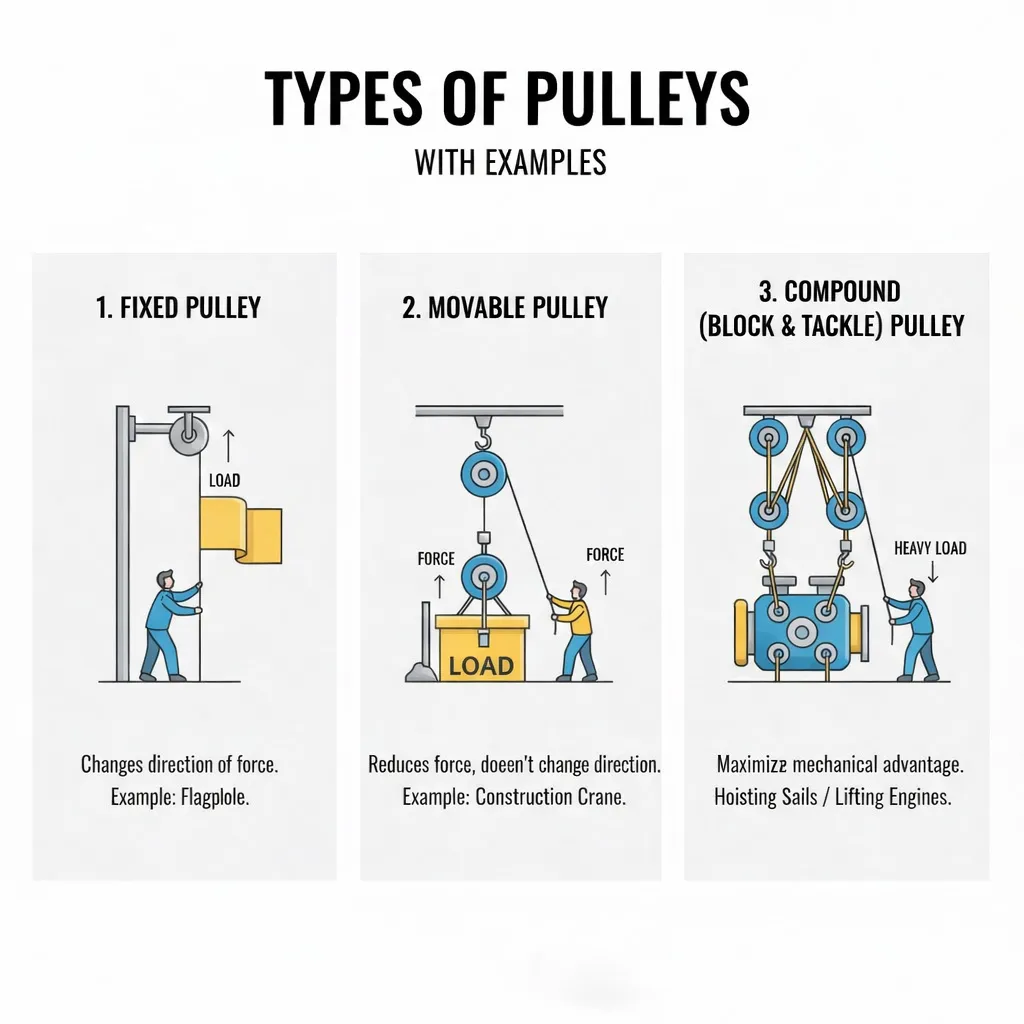
With each kind, the direction of the force is either changed or the need for the force is reduced in the lifting of a load. Pulleys are mainly classified into 3 main categories:
- Fixed (Immovable)
- Movable
- Compound (also known as block and tackle)
Besides these basic types, there are several subject pulleys that are employed in industrial and mechanical applications, meant for operations such as power transmission and belt guiding.
Basic Pulley Types (Physics)
For students in Dubai preparing for school exams, our physics tutors in Dubai cover pulley applications in the local curriculum.
Fixed Pulley: A pulley connected to an immovable support is described below, along with fixed pulley examples, of which many are mentioned.
Movable Pulley: This pulley is linked directly to the load and consequently moves along with the object.
Compound Pulley (Block-and-Tackle): A union of fixed and movable pulleys that are placed together.
Industrial & Specialised Pulleys (Engineering)
Cone (Stepped) Pulley: A collection of pulleys of varying sizes that convert power in belt-driven systems, such as machines or multi-gear bicycles, by changing speed.
Jockey Pulley: This pulley assists the belts in their movements by directing, tensioning, or otherwise altering the path of the belt’s motion.
V-Groove Pulley: This is a pulley that has a V-shaped groove for V-belts to sit in.
Swivel Eye Pulley: It’s a pulley that allows the load to turn around freely, which is very helpful in the case of wire ropes and flexible hoisting scenarios.
Conveyor Pulley: It is a pulley that is used in conveyor belt systems to help in the quick and smooth transportation of materials.
Solid and Split Pulleys: Solid pulleys are made out of one material and are produced as one piece, whereas split pulleys can be disassembled and fitted on existing shafts.
How Do Basic & Industrial Pulleys Work Together?
A fixed pulley alters the force’s direction, while a movable pulley makes the effort needed less. Finally, a compound pulley system takes the advantages of both types of pulleys. The result is that heavy loads can be lifted and moved much more easily and more efficiently. Below are over a hundred pulley system examples mentioned.
Examples of Pulleys in Everyday Life
These pulley types match the IGCSE Physics syllabus requirements for real-life applications.
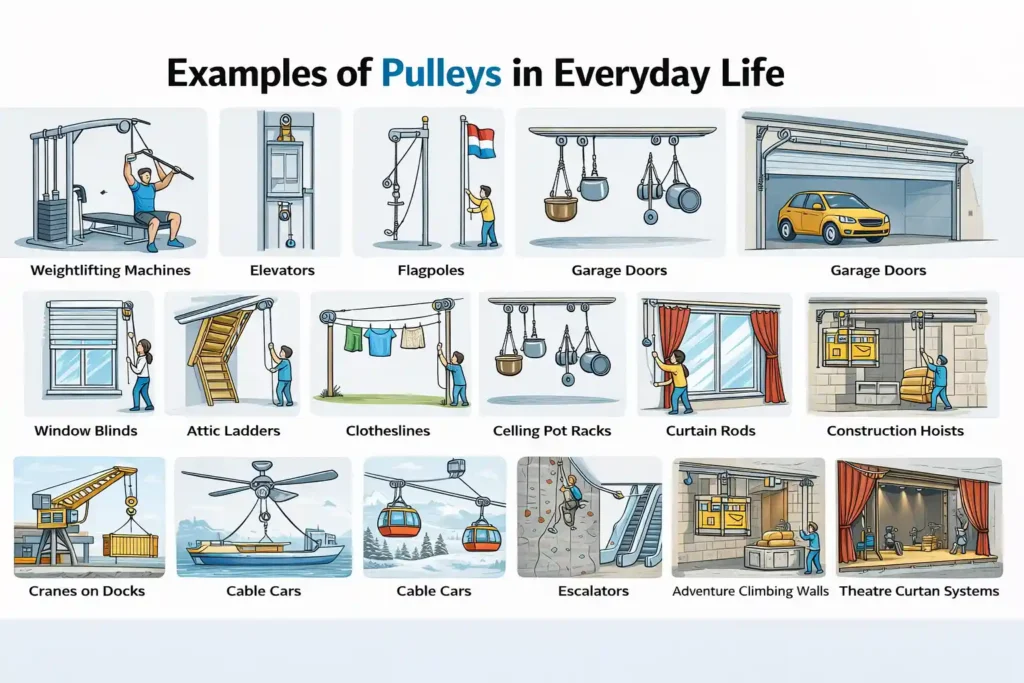
- Weightlifting machines: Machines with cables redirect force, making it easier to lift heavy weights.
- Elevators: Counterweights and ropes allow the cabin to move smoothly up and down.
- Flagpoles: Rope-and-wheel systems let you raise or lower flags effortlessly.
- Garage doors: Wheels and ropes reduce the effort required to lift heavy doors.
- Window blinds: Rope-and-pulley systems allow for smooth and effortless raising and lowering of the blinds.
- Clotheslines: Wheels guide the rope so clothes can move along the line with minimal effort.
- Ceiling pot racks: Wheels and ropes help lift pots safely to higher hooks.
- Curtain rods: Rope-and-wheel setups let you open and close heavy curtains easily.
- Ceiling fan belts: Wheels guide belts that transfer motion from the motor to the fan blades.
- Attic ladders: Rope systems allow ladders to fold and unfold smoothly.
- Tower cranes: Pulleys and cables increase mechanical advantage, making it easier to hoist heavy materials to great heights.
- Construction hoists: Ropes make lifting bricks, cement, and tools easier.
- Cranes on docks: Ropes guided by wheels help lift cargo from ships.
- Cable cars: Ropes guided by wheels carry cabins smoothly along the cable.
- Escalators: Steps move continuously thanks to guided belts and wheels.
- Adventure climbing walls: Ropes and wheels assist in lifting safety equipment.
- Ski resort gondolas: Wheels maintain cable tension for safe passenger transport.
- Rock climbing rescue systems: Ropes guided by wheels help lift injured climbers safely.
- Theatre curtain systems: Wheels guide ropes to open or close heavy curtains smoothly.
- Fly systems: Complex rope-and-wheel setups lift scenery and backgrounds during theatre shows.
A-Level Physics Tutors at Mixt Academy
Struggling with difficult science topics for A-Level Physics across major exam boards like AQA, Edexcel, and OCR? Our A-level physics tutors help students with clear explanations, 100+ real-life pulley examples, and step-by-step guidance to make tricky concepts easy to understand. You can learn how pulleys work, see their everyday applications, get the support you need to excel, and much more.