
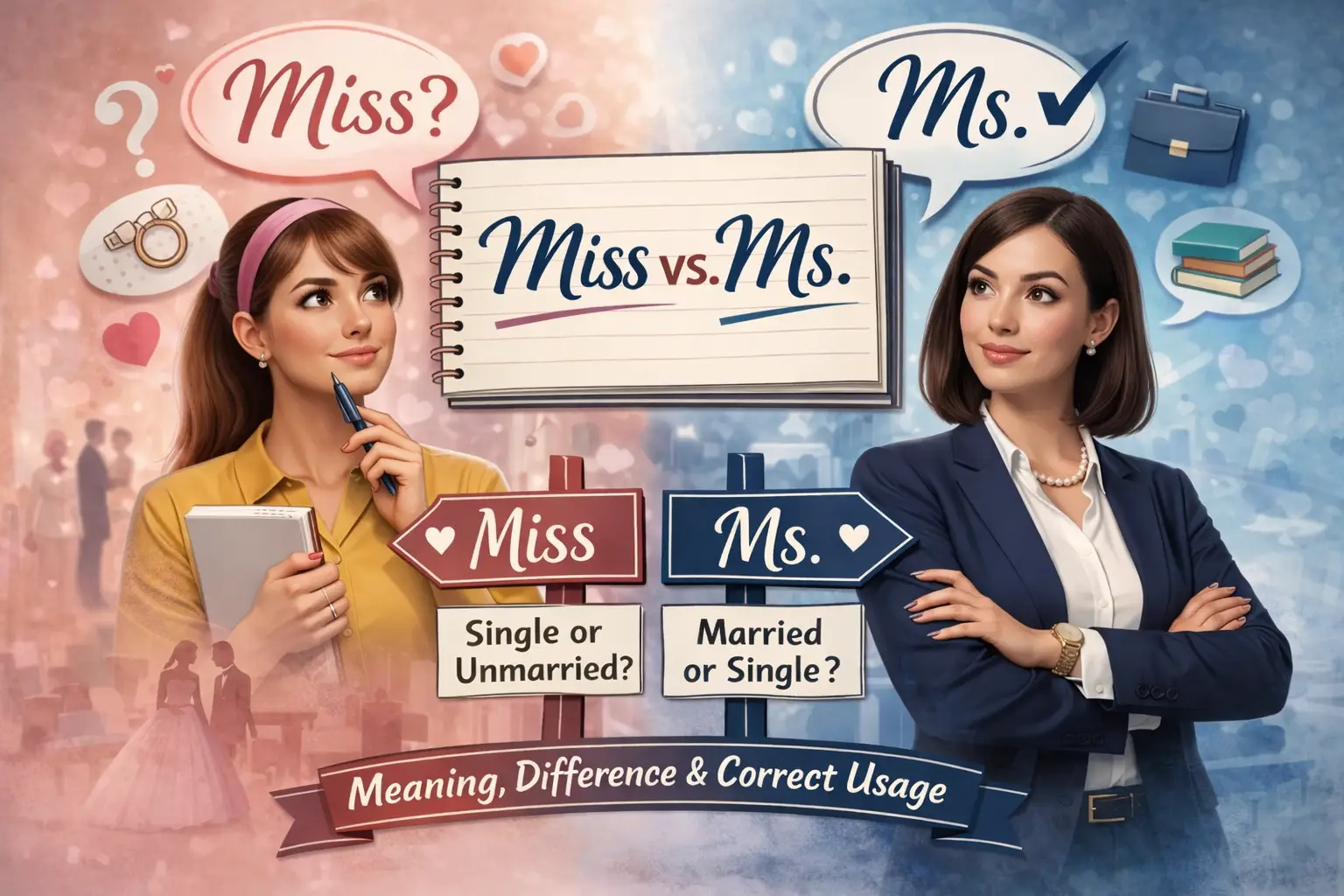
In this guide, you will go through the meanings of Miss and Ms, their differences, the occasions to use each, and the reason why Ms. has become the most secure and widely accepted choice in contemporary English.
Mixt Academy helps you use both confidently and correctly. Start Your Learning Today.
What Does Miss Mean?
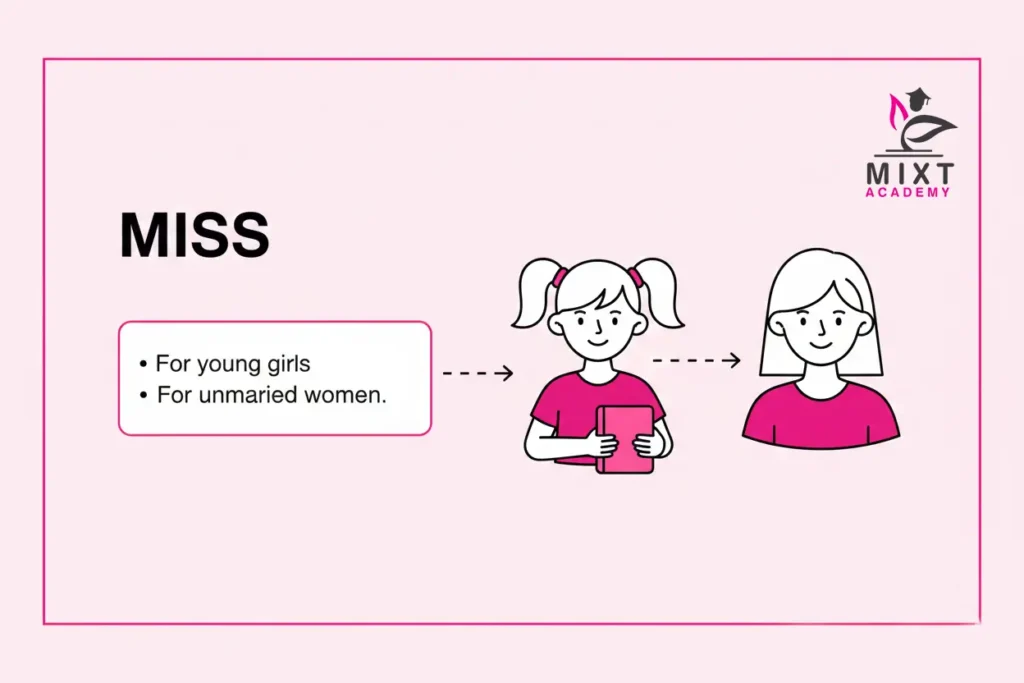
The title Miss has been conventionally associated with single women or girls. Unlike its counterparts, like Ms. or Mrs, Miss is a full-fledged term and hence, does not take a period at the end.
Traditional Use of Miss
Historically, “Miss” was the tag of a woman’s marital status, indicating that she was not a wife. For quite a time, this was the norm and the most socially accepted behaviour in formal places.
Presently, Miss is still used in some contexts, like:
- For young girls
- For teenagers
- For young, unmarried women
- When a woman specifically prefers this title
Connotation of Miss
Even though “Miss” is still understood by the majority, it cannot be separated from its archaic meaning since it was used to mark a woman’s marital status. In today’s world, a lot of people think that rather than being united in one way or the other, a woman’s identity should be recognised, especially in terms of formal and public settings. This is the reason why “Miss” is mostly used for:
- Children and adolescents
- Informal or traditional contexts
- Personal preference
Example of Miss in Use
Miss Taylor is performing in the school play.
The teacher asked Miss Johnson to help organise the event.
What Does Ms. Mean?
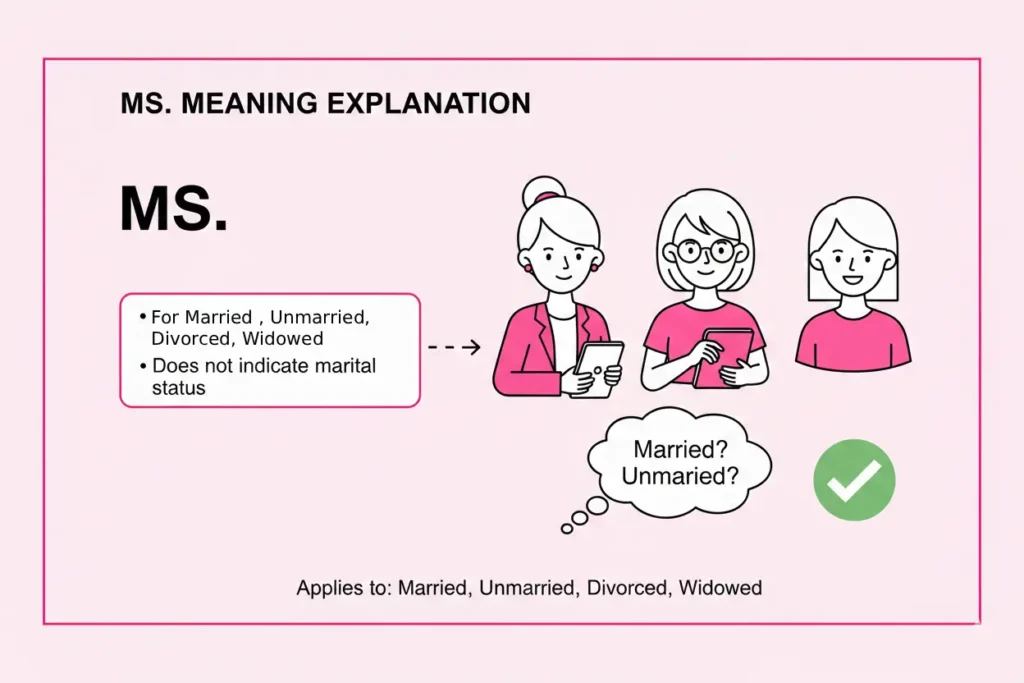
Ms. (which sounds like “miz”) is a title that denotes no marriage status and is thus neutral for women. It applies to any female adult, regardless of her being married, unmarried, divorced, widowed, or if her marital status remains unknown.
The Purpose of Ms.
The title Ms. was introduced to create a female equivalent of Mr., which is used for men regardless of marital status. Unlike Mrs. or Miss, Ms. allows women to be addressed without assumptions about their personal lives.
Connotation of Ms.
- Neutral and respectful
- Professional and modern
- Independent of marital status
- Inclusive and widely accepted
Because of these qualities, Ms. is now the standard choice in business, academic, and formal communication.
Pronunciation of Ms.
Although spelt with two letters, Ms. is pronounced with a “z” sound, like miz. This pronunciation helps distinguish it clearly from “Miss” in spoken English.
Example of Ms. in Use
- Ms. Smith will lead today’s meeting.
- Please contact Ms. Ahmed for further information.
Want to know how to learn English? Read More: How to Learn English Fast: Effective Tips for Beginners
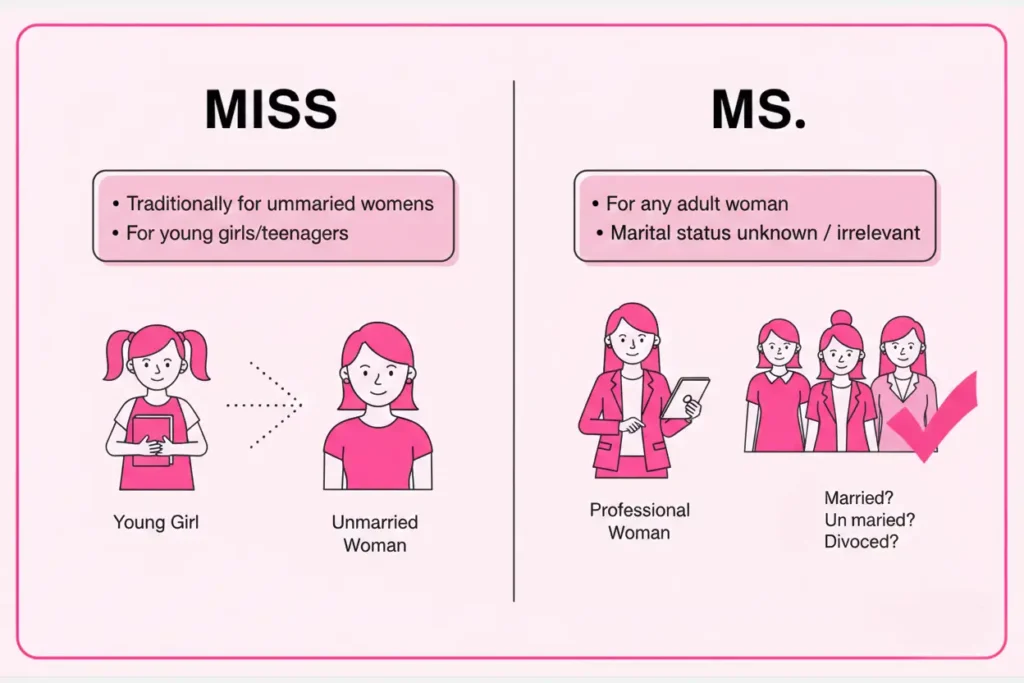
Key Difference Between Miss and Ms.
Understanding the differences between Miss and Ms. helps you choose the correct title with confidence.
Miss
- Traditionally used for unmarried women
- Most common for girls, teenagers, and young women
- Indicates marital status
- Can feel old-fashioned to some people
Ms.
- Used for any adult woman
- Does not indicate marital status
- Pronounced “miz”
- Considered the female equivalent of “Mr.”
- Preferred in professional and formal settings
In short, Miss focuses on marital status, while Ms. focuses on respect and neutrality.
When to Use Miss
Although its usage has declined in formal contexts, Miss still has an appropriate place in modern English tutoring in dubai .
Use Miss When:
- Addressing a girl or young woman under 18
- Referring to a student or child
- A woman has clearly expressed that she prefers to be called “Miss”
- In traditional, cultural, or informal settings
For example, in schools, teachers are often addressed as “Miss” by young children, regardless of their age or marital status. In such cases, the usage is cultural rather than literal.
When to Use Ms.
If you are ever unsure which title to use, Ms. is the safest and most respectful choice.
Use “Ms.” When:
- You do not know the woman’s marital status
- Addressing an adult woman
- Writing in a business, academic, or formal context
- Referring to a woman who is divorced or widowed
- You want to avoid making assumptions
- You want to be polite, professional, and inclusive
In emails, official documents, workplace communication, and public writing, Ms. is now the default and recommended form of address.
Join Mixt Academy and get guidance from qualified English professors online, at your preferred hours.
Why Ms. the Preferred Modern Choice?
Language evolves along with society. As gender equality and personal privacy have become more important, the need for a neutral title has grown. Just as men are not identified by marital status when called Mr., women increasingly prefer the same respect.
Ms. supports:
- Gender equality
- Professional identity
- Personal choice
- Social sensitivity
Using Ms. signals awareness, respect, and professionalism, which is why it has become standard practice in many parts of the world.
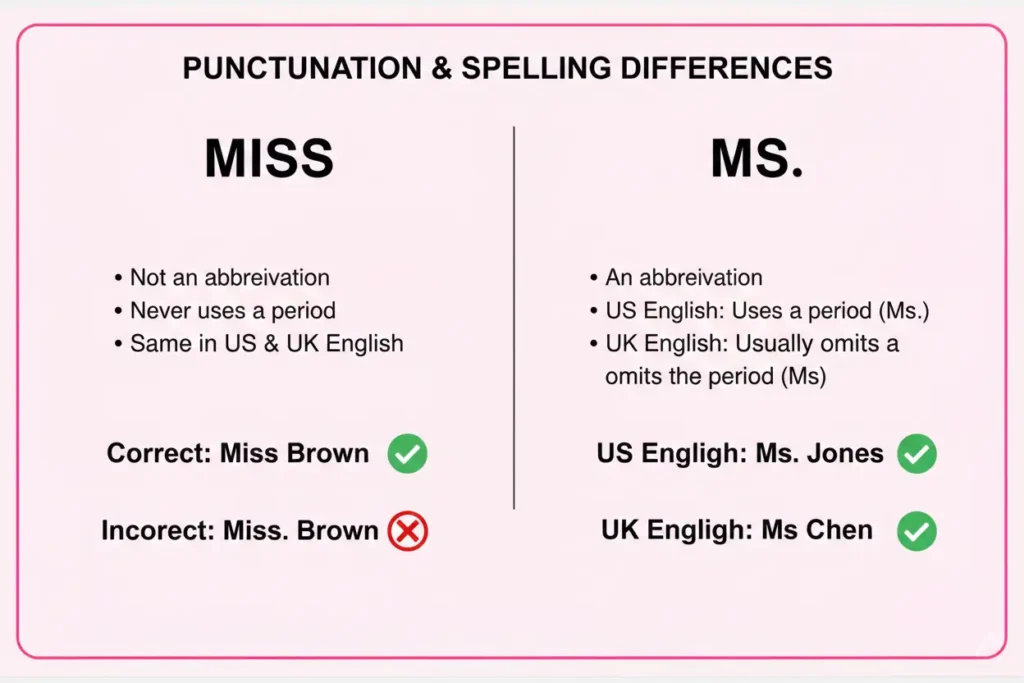
Punctuation and Spelling Differences of Miss & Ms.
Correct punctuation is another important aspect of using these titles properly.
Miss
- Not an abbreviation
- Never uses a period
- Same in both US and UK English
Correct: Miss Brown
Incorrect: Miss. Brown
Ms.
- An abbreviation
- US English: Uses a period (Ms.)
- UK English: Usually omits the period (Ms)
- Both forms are correct depending on the variety of English you are using.
Common Mistakes to Avoid
- Using Miss for adult women in professional settings
- Assuming marital status based on age or appearance
- Pronouncing Ms. as “miss” instead of “miz”
- Adding a period after Miss
- Switching between Miss and Ms. inconsistently
When Should You Use Miss & When Is Ms. the Better Choice?
Knowing when to use Miss or Ms. helps ensure respectful and appropriate communication. Miss is best used for young girls, teenagers, or unmarried women who specifically prefer this title. It traditionally reflects marital status and is now less common in professional or formal settings.
Ms., on the other hand, is a neutral and modern title suitable for any adult woman, regardless of whether she is married, unmarried, divorced, or widowed. It is the safest choice when a woman’s marital status is unknown or irrelevant. When in doubt, Ms. is preferred, as it is polite, professional, and widely accepted in today’s society.
Your English Learning Journey Starts Here!
Book your online classes with Mixt Academy and learn from professional tutors who provide clear explanations, practical examples, and easy-to-follow guidance. Strengthen your grammar, vocabulary, and communication skills, from everyday English to professional writing. Start today and take your English confidence to the next level.