This guide covers what AQA and Edexcel are, key differences between the boards, how they assess core subjects, exam style comparisons, and study and preparation strategies.
Hire the Best Online Tutors for Your Child
Understanding GCSE Exam Boards
Before looking into AQA vs Edexcel, it is crucial to understand what exam boards are. Exam boards are organisations that:
- Design subject syllabuses
- Draft exam papers
- Create marking schemes and set grade boundaries
- Supply past papers, examiner reports, and revision resources
- Ensure exam materials are aligned with the national curriculum
While students across the UK take the same subjects, the exam board a school chooses affects how final papers are structured, how questions are phrased, and how marks are awarded. The two most common boards in England are AQA and Edexcel. They both offer the same GCSE diplomas, but they both approach assessment differently. Some students need the help of GCSE tutors for tough subjects like mathematics and physics.
What Is AQA?
AQA is the Assessment and Qualifications Alliance. It is one of the largest UK exam boards, providing GCSEs and A-levels that are used by many state schools. AQA is recognised for:
- Clear and structured question formats
- Detailed mark schemes that examiners use to grade papers
- Syllabuses that are closely aligned to the curriculum
- Strong support materials and past papers
- A focus on clarity and consistency in question wording
AQA is widely used within the UK and sets exams only for UK GCSEs; it does not offer International GCSE (IGCSE). Because many state schools use AQA, a large number of students and teachers are familiar with it.
What Is Edexcel?
Pearson Edexcel is one of the exam creators in the United Kingdom. This company, along with AQA, creates the exams for the GCSEs and A-levels. Pearson Edexcel is also the creator of the International GCSE (IGCSE). These tests are commonly used in countries that are not part of the United Kingdom. Edexcel is known for:
- Offering both UK GCSE and IGCSE.
- Structured question styles that often include step-by-step parts.
- Contextual and applied questions in mathematics and science.
- Additional guidance and grading for examiners.
- A large base of many past exam questions.
Edexcel offers IGCSE, which many students need to study abroad, through its international schools and private institutions, and many hire IGCSE tutors for private sessions.
Key Differences: AQA vs Edexcel
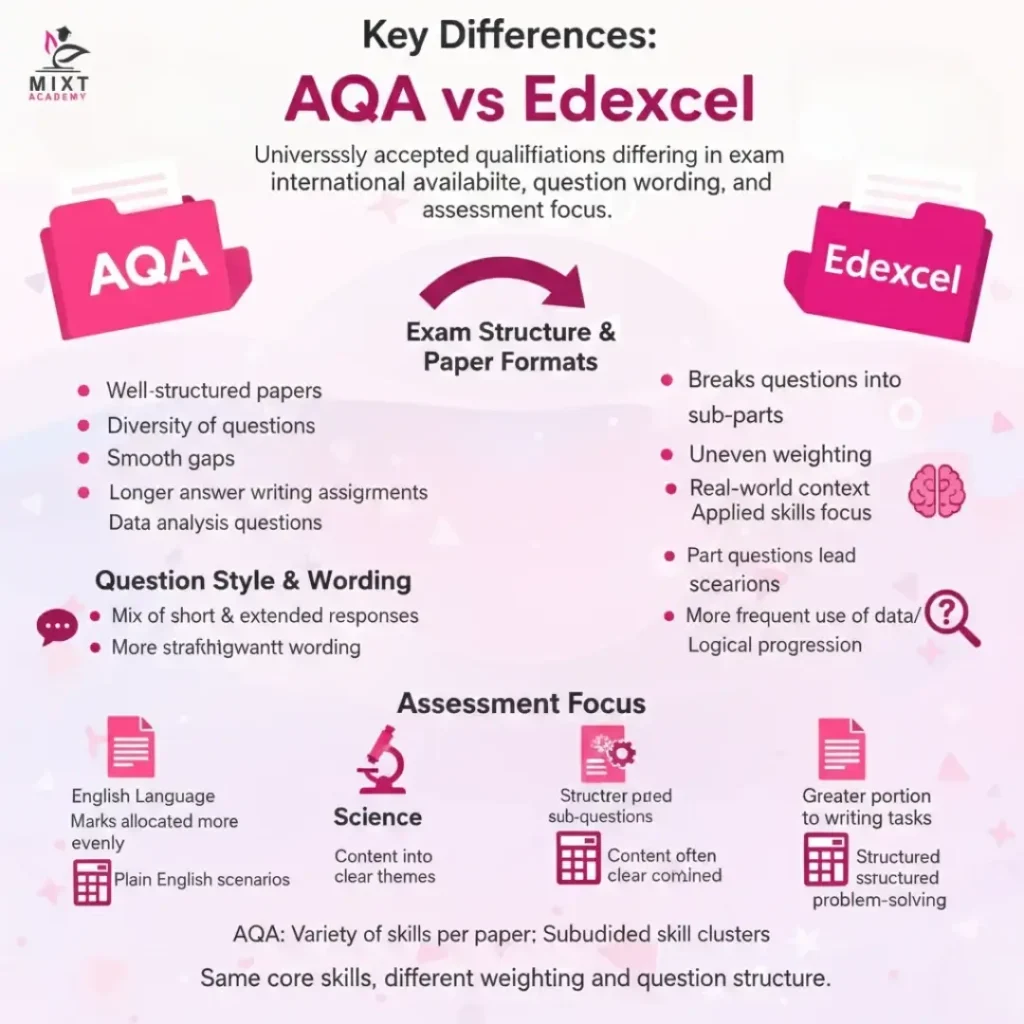
AQA and Edexcel both provide equally valued qualifications that are universally accepted for further education and university applications. The differences include exam structure, international availability, question wording, and assessment focus.
1. Exam Structure & Paper Formats
AQA Structure
- Well-structured papers where marks are allocated equally
- Diversity of questions in the same paper
- Smooth gaps between the brief and long responses
AQA often uses a mix of the following:
- Concise-answer questions
- Longer answer writing assignments
- Data analysis questions (particularly in Science and Humanities)
Most assessment points are found in the same paper structure, so students are developing multiple skills, analysis, evaluation, and explanation, during the same exam.
Edexcel Structure
- Break questions into sub-parts (e.g., 1a, 1b, 1c)
- Can have uneven weighting across sections
- Include stepwise progression from easier to harder questions
- Part questions lead students through a process
- Real-world context occurs more frequently
- Some sections mainly focus on applied skills
Crucial Takeaway
Both boards assess the same thing but in different ways. AQA tends to assess a variety of skills in one paper; Edexcel usually subdivides questions into clusters that assess one skill after another.
2. Question Style & Wording
AQA Question Style
- Uses a range of question types in a single paper
- Can have a mix of short, analytic, and extended responses
- Generally has a more straightforward wording
AQA has questions that require a lot of focus and careful reading, as the key terms can denote different levels of responses.
Edexcel Question Style
- Typically uses structured sub-questions
- More frequent use of data and scenarios from the real world
- Needs more logical progression through each step
Maths tutors in Dubai always help you to solve these questions easily. They provide clarity for students in how to tackle a question.
3. Assessment Focus
English Language
In AQA papers, marks are allocated more evenly in the reading and writing tasks. In some papers, Edexcel may assign a greater portion of the marks to the writing tasks, particularly creative writing.
While both boards assess the same skills, the weighting of these skills differs, in some cases more noticeably than others.
Science (Biology, Chemistry, Physics, Combined)
AQA divides the subject content into clear themes. With Edexcel, content is often combined
This means students preparing for Edexcel Science should be ready for questions that integrate more than one science subject.
Mathematics
AQA’s papers describe scenarios in plain English and are set in everyday contexts. Edexcel papers remove these scenarios and place greater focus on structured problem-solving
While both assess the same core skills, algebra, geometry, statistics and number, the structure of the questions is different on each board.
Mixt Academy tutors provide personalised strategies for AQA and Edexcel students.
4. Grading System for Each Board
GCSE Exam Boards’ Grading for AQA
This board operates a minimum of 1 and a maximum of 9 grading systems. A 9 grade is equivalent to an A* from previous grading systems, while a 1 is equivalent to a G grade. AQA sets its grade boundaries for the GCSE after they have been marked, and that is because they take into consideration the wider performance for those students across AQA.
GCSE Exam Boards’ Grading for Edexcel
The grading system is identical to GCSE. All exams also have a 1 to 9 grading system. However, for Edexcel, they set the grading boundaries before the students sit the exams.
5. International Availability (IGCSE)
A key difference between AQA and Edexcel is that Edexcel has been known to provide students with international IGCSEs, whereas AQA has not. Why this matters:
- IGCSEs are designed for students outside the UK.
- They are also recognised worldwide, both in the corporate world and within higher education.
- They provide learners with a variety of subjects to choose from.
- They sometimes have separate methods of assessment, such as coursework for some subjects.
6. Past Papers & Revision Resources
AQA
- AQA is a popular choice for many past paper revisions and guides.
- Most UK schools use AQA.
- They have a lot of past papers.
- Their mark schemes are detailed, explaining how marks are distributed for each question.
Edexcel
- Edexcel is popular for past papers along with examiner reports.
- They highlight how students performed on each question.
- They have a huge selection of past papers, including IGCSE packs.
- Examiner reports that highlight common mistakes.
- There are some sequences of questions that are structured for targeted practice.
Differences Between AQA vs Edexcel Exam Boards
| Feature | AQA | Edexcel |
|---|---|---|
| Assessment style | Exams with practical components | Structured exams, modular and linear formats, and some coursework |
| Subject range | Broad, including applied subjects | Extensive, with vocational options |
| Global reach | Primarily UK-focused | Global (IGCSEs) |
| Support resources | Extensive, freely accessible, user-friendly materials | Comprehensive, structured resources. Online interactive revision and assessment tools. |
| Ideal for | Students seeking clarity and support | Learners desiring structured paths and modular assessments. Students outside the UK |
Which Board Is Easier?
It is a common question: Is AQA or Edexcel easier? The short answer is that neither is easier nor harder. Both boards:
- Are supervised by the same national educational bodies.
- Award the same-value qualifications.
- Set the same academic level of exams.
Any level of difficulty comes from your personal strengths or preferences. This includes problem-solving or essay writing, the level of familiarity with past paper styles, the phrasing of the questions, and the overall structure. For example, students who are more comfortable and prefer a step-by-step format are likely to feel more comfortable with Edexcel. AQA is likely better for students who prefer many different question types.
Exam Comparisons by Subject
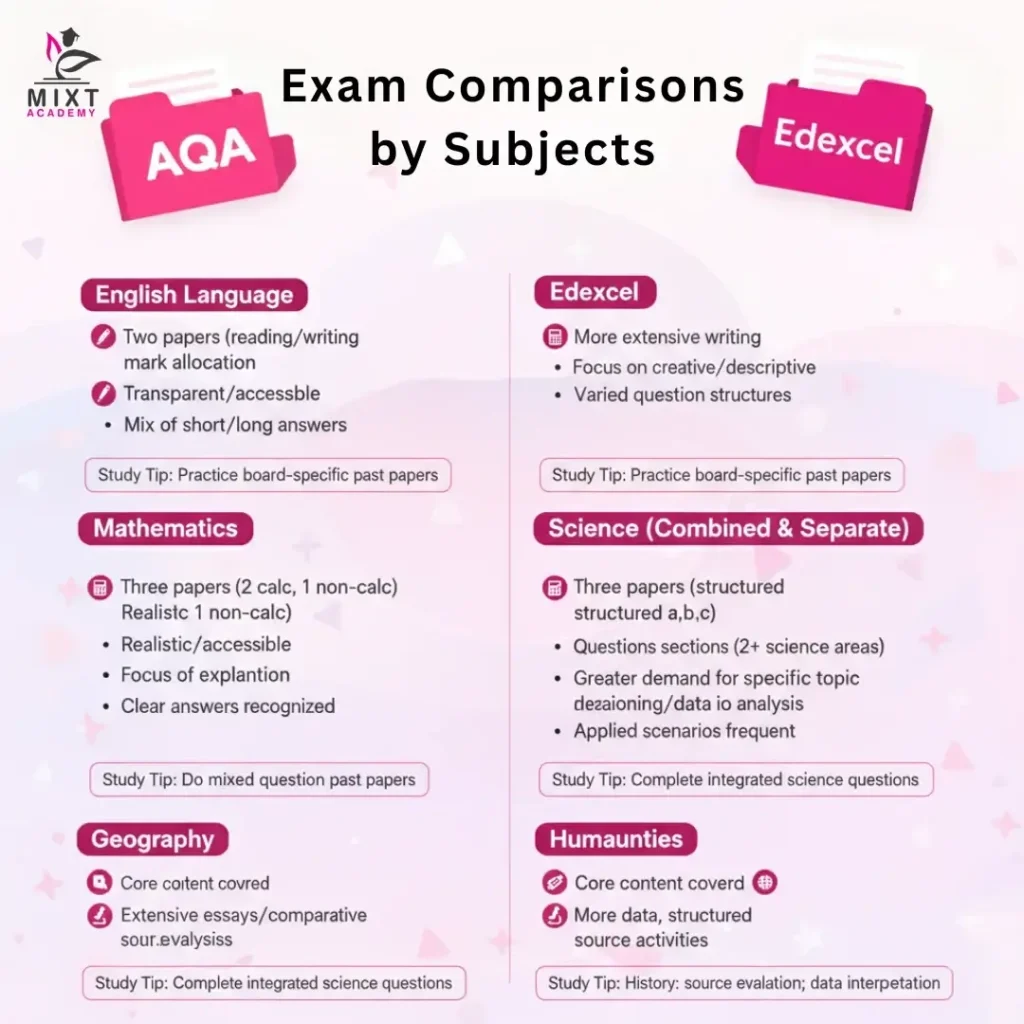
English Language
AQA
- Two papers that cover reading and writing skills.
- Mark allocations are transparent across the various components.
- There is a mix of shorter and longer-answer questions.
Edexcel
- Papers generally include more extensive writing components.
- There is more focus on the creative and descriptive writing styles.
- The structures of the questions can be more varied.
Study Tip: Practice past papers specific to the GCSE boards to become familiar with how mark allocations are divided between essays and comprehension questions.
Mathematics
AQA
- Three papers, two of which are on the calculator and one of which is a non-calculator.
- Papers are written in a more realistic and accessible manner.
- More focus is given to the explanation in addition to the calculation.
Edexcel
- Three papers, each structured with the steps (a, b, c) provided.
- There are many real-world and applied scenarios.
- There is a logical progression through the questions posed.
Study Tip: Do a series of past papers that have a mix of questions to help you gain confidence when working with both calculator and non-calculator questions.
Science (Combined & Separate Sciences)
AQA
- There are defined sections for each of the biology, chemistry, and physics components.
- Many questions centre on a specific component/topic.
- Clearly thought-out answers are recognised in the mark schemes.
Edexcel
- Some questions integrate two or more of the areas of science.
- There is a greater demand for scientific reasoning and data analysis.
- Applied scenarios are more frequent.
Study Tip: For Edexcel, you should complete questions that cover more than one topic and those that integrate two or more areas of science.
Humanities
History
AQA requires more extensive essays containing comparative analyses. On the other hand, Edexcel has more step-by-step, structured source evaluations.
Geography
Both boards have covered the core content. In geography, Edexcel appears to have included more data analysis (interpretation) activities in the papers across different sections.
Study Tip: History requires you to have strong source evaluation skills, geography, and data interpretation.
Hire the Best Online Tutors for Your Child
What You Should Remember!
Choosing between AQA and Edexcel does not determine your success; how prepared you are does. Since AQA and Edexcel are balanced in the recognition and academic standard of the qualifications issued, there is a greater difference in the way they are structured, the type of questions, the focus of the assessment, how available the papers are internationally, and how the exams are set out.
Your choice, whether it is AQA or Edexcel, will not be a limitation to your ultimate success. With sufficient practice aimed at your board, there is a greater chance of success. Focus on differences in exam papers, expectations, and skills you have to work on, and keep a steady pace throughout your board revision. Also, get expert guidance from the private tutors at Mixt Academy to make an informed decision that shapes your future dreams.