
This article is a comprehensive guide to the concept of waves. It aims to provide the scientific definition of waves, the properties of waves, the types of waves in physics, ‘what is wave motion in physics’, important wave formulas like the ‘what is a wave in physics formula’, the behavior of waves with real-life examples and answers to the most asked questions of learners.
Understanding Waves
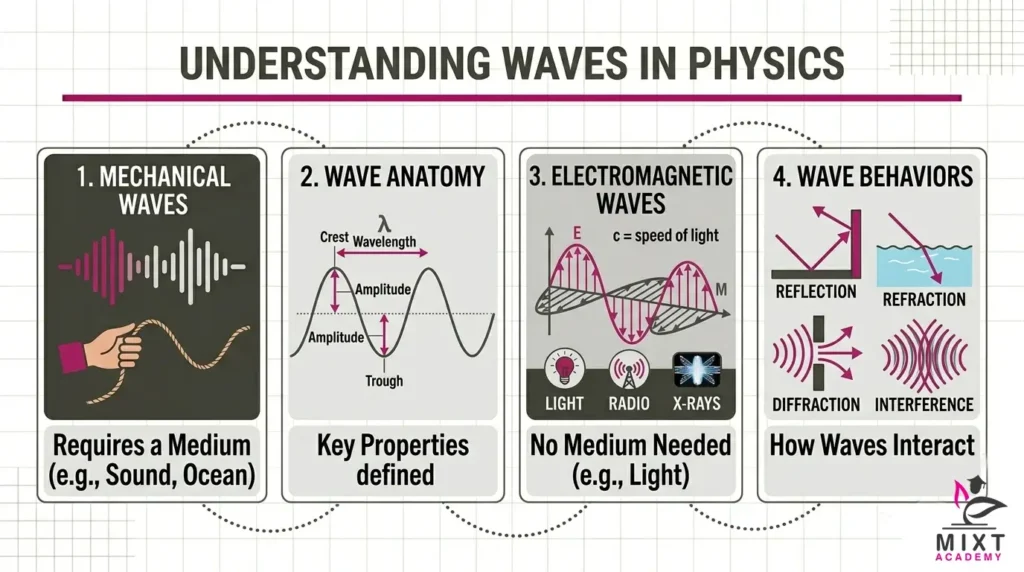
What Does a Wave Do?
The most important aspect of waves is that they move energy, no matter what. In many physical systems, even though energy is in motion, the particles of the medium (air, water or solid materials) do not move to a different location. They stand still and only vibrate or oscillate locally. Consider the following examples:
- If sound transmits through air, the air particles do not move from the sound source to your ear; they only vibrate.
- When light transmits through a vacuum, the energy is moving, but as mentioned, there is no medium.
- The core definition of what is a wave in physics is an energy oscillation through mediums.
What Is Wave Motion in Physics?
When we look at wave motion in physics, we can describe it as how waves propagate, or move, across a medium or even in a vacuum. Wave motion:
- starts with a disturbance.
- causes the particles of a medium to oscillate or vibrate.
- transfers energy from one point to another.
- does not cause permanent displacement of particles.
Take, for instance, water waves. The water particles move in circular or elliptical paths, but the water does not leave its position. It comes back to that position after the wave passes. In sound waves, the air particles vibrate back and forth, but they do not move across the room with the sound.
For water waves, the particles of water move in Circular or Elliptical paths but come to the original position after the wave passes. The particles of air do not travel across the room with the sound; they vibrate and move back and forth; therefore, they do not travel across the room.
For wave motion in physics, it applies the mechanics and the behavior to describe the flow of wave energy in a medium or even in a field, like in electromagnetic waves.
Important Parts of a Wave
When it comes to study wave physics, there are certain key parameters to explain what is a wave in physics. These are:
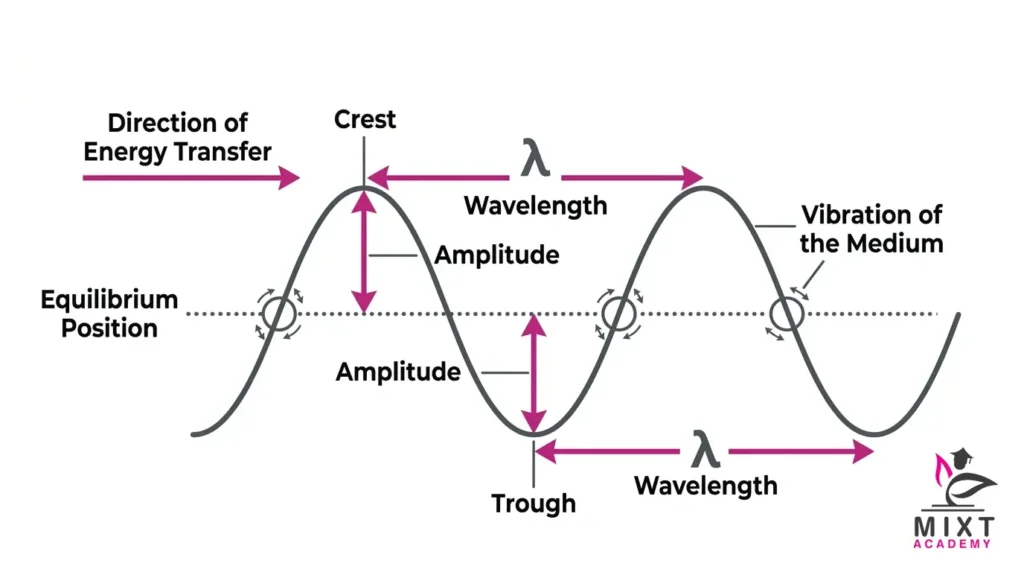
Amplitude
Amplitude is the maximum displacement of a particle or field from its equilibrium (rest) position. A larger amplitude generally means a wave carries more energy.
Wavelength (λ)
Wavelength is the distance between two corresponding points on consecutive cycles of a wave. For example, crest to crest or trough to trough. It is usually represented by the Greek letter lambda (λ).
Frequency (f)
In the field of physics, frequency is the number of complete waves or cycles that pass a particular point in one second. It is measured in hertz (Hz).
Wave Speed (v)
Wave speed means how fast the energy that makes the wave moves through the medium or the space if there is no medium. The speed depends on the type of wave and the characteristics of the medium.
What Is a Wave in Physics Formula?
To understand waves, it is essential to understand the mathematical relationships that define them. The most basic and essential relationship in wave physics is the wave equation.
Wave speed (v) = frequency (f) × wavelength (λ)
This is often written as:
v = f × λ
Where:
- v = wave’s speed
- f = frequency
- λ = wavelength
This formula shows that the speed of a wave is directly proportional to both its frequency and its wavelength. This equation applies to all types of waves. This includes sound waves, light waves, and water waves.
As an example, in sound waves, if the frequency increases, and there is a constant speed of sound, the wavelength has to decrease. This is according to the formula. The wave formula helps us understand and predict the behavior of waves in different situations and conditions.
Types of Waves in Physics
When learning the types of waves in physics, it is crucial to note that waves behave differently. Depending on how waves move and if they need a medium to move, waves can be classified in many ways.
Mechanical Waves
Mechanical waves need a medium through which they can propagate. The medium can be air, water, or solids.
Transverse Waves
In transverse waves, the particles of the medium move up and down (vibrate), and that is how energy is transferred to the wave. Examples of transverse waves are:
- Ripples on water
- Waves on a string
The waves consist of particle movement perpendicular to the direction of the energy flow.
Longitudinal Waves
Longitudinal waves imply that the particles move parallel to the direction of the wave. This type of wave creates compressions and rarefactions, rather than peaks and troughs, like in water waves. An example of a longitudinal wave is:
Sound waves in the air
Longitudinal waves require a medium to propagate. This is because longitudinal waves depend on the movement of particles in compressions and expansions.
Surface Waves
Surface waves are released at the interface of two mediums, like when air and water are together. These waves are a combination of longitudinal and transverse waves. Typical surface waves are ocean waves.
Electromagnetic Waves
Electromagnetic waves can even travel through a vacuum with no medium in between. These are made of oscillating electric and magnetic fields that cross each other. Some examples of such waves are light, radio waves, and X-rays. Electromagnetic waves travel at the speed of light, which is about 299,792 kms per second in a vacuum.
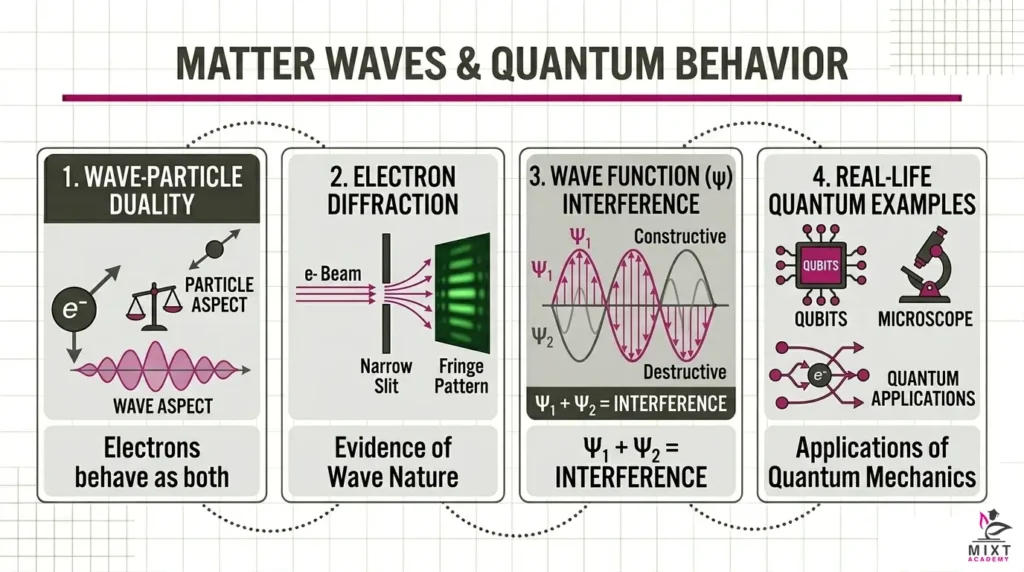
Matter Waves
Moving upwards in the scale, matter waves are in the domain of Quantum Physics. At the Quantum level, instead of the particles being described as wave-like behaviour, particles, such as electrons, are the waves. This type of wave is described as a wave function, used to describe phenomena such as electron diffraction and quantum interference.
How Waves Behave?
Waves are in a constant state of movement and interaction with the world around them.
Reflection
Some key behaviours are waves changing direction due to the interface they are on, which is called Reflection. An example of this is found in echoes, when sound waves reflect off a wall and return to the listener.
Refraction
Refraction is when a wave changes its direction from its original path because there is a new medium that is affecting the speed at which the wave is travelling. A common example is when light is going from air into water, and the light bends.
Diffraction
Diffraction describes the wave that spreads out when it passes through an opening or when the wave goes around an object. This is more noticeable when the wavelength is similar to the size of the opening.
Interference
Interference is when there is more than one wave that overlaps and resultantly produces a new pattern of the wave. Constructive interference is when the result is a bigger wave, and Destructive interference is when the wave is cancelled out. These behaviours apply to all waves, including quantum waves.
Real‑Life Examples of Waves
To understand what is a wave in physics, the following examples of waves in daily life:
Sound Waves
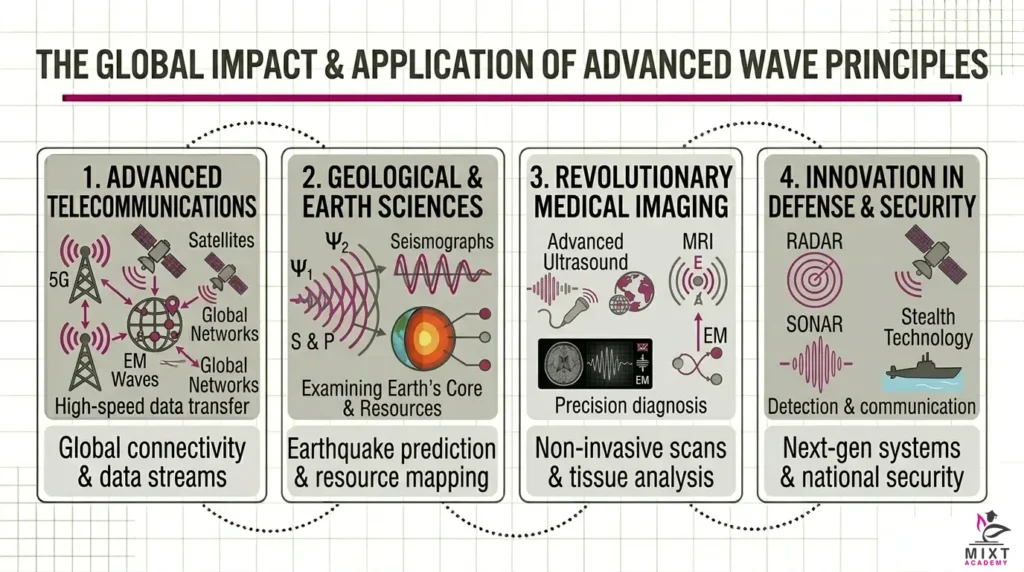
Sound Waves are longitudinal mechanical waves that travel through air, water, or solids. When someone talks, the vocal cords create high-frequency sounds and compress the air. The waves travel to the ear, and that is how people are able to hear.
Water Waves
Water waves are mechanical waves that are created when wind blows and disturbs the water in a pond or an ocean, which includes a wave motion. The water particles rotate in a circular motion, and the majority of energy travels outward to create waves.
Light Waves
Light travels as an electromagnetic wave and can move through a vacuum, without any medium. Light movements transmit energy, which allows us to see and provides energy for life. This energy travels from the Sun to the Earth.
Radio Waves
Radio waves communicate. They are a type of electromagnetic wave. These waves send messages from a radio transmitter to a receiver without a physical link.
Seismic Waves
Seismic waves are made from the power of an earthquake. These waves travel through the Earth’s crust. These types of mechanical waves are used to aid researchers in examining the Earth’s core.
Why Waves Matter in Physics
To fully understand the world around us, waves are essential. They describe the flow of energy, how information is sent, and the physical interactions of forces within a given distance. Some of the reasons why waves are crucial in physics are:
- Waves describe hearing and sound.
- Waves explain light.
- Waves describe radio, TV, and the internet.
- Waves explain ultrasound.
- Waves describe the structure of matter on the atomic and subatomic level.
Without understanding what is a wave in physics, it would be impossible to explain different phenomena. To understand music, engineering, astronomy, and quantum A level physics tutor,you need to understand waves.
Common Misconceptions About Waves
When students are first introduced to waves, there are many commonly held misconceptions. Addressing these right from the start is critical to building the correct understanding.
Misconception 1: Waves Carry Matter
What some people think is that waves move matter from one place to another. Instead, it is the other way. Waves primarily move energy. The particles of the medium only move back and forth around a central position.
Misconception 2: All Waves Need a Medium
It’s a fact that electromagnetic waves don’t need a medium. They can travel through a vacuum, like the one found in the space between Earth and the Sun.
Misconception 3: All Waves Are the Same
Waves do not all act the same. There is a varied assortment of waves in physics, each having its own unique properties. To properly utilise wave principles, one must comprehend the unique attributes of each of the different types.
Conclusion
In physics, waves are really important. Knowing the answer to the question, what is a wave in physics? It is important, just like knowing the answer to the question, What are the types of waves in physics? is important. Both questions help people understand the importance of waves and how energy, sound, and light move, and how all of these are critical to modern technology. Several points and questions are critical to understand.
- Waves move energy but do not move matter.
- Wave motion moves energy through wave patterns.
- The wave equation v = f × λ shows the relationship between the speed of the wave, its frequency, and its wavelength.
There are many different types of waves, like electromagnetic, mechanical, or matter waves. The behaviours of waves, like reflection, diffraction, refraction, and interference, are predictable and measurable. These points show that people have the core understanding to continue in physics tutoring in dubai.