With the detailed guide by Mixt Academy, we will cover what is energy in science, what is energy in physics formula, types of energy in physics, what is energy in physics symbol, and what is energy in physics electricity.
What is Energy in Physics?
What is energy in physics? The answer is straightforward:
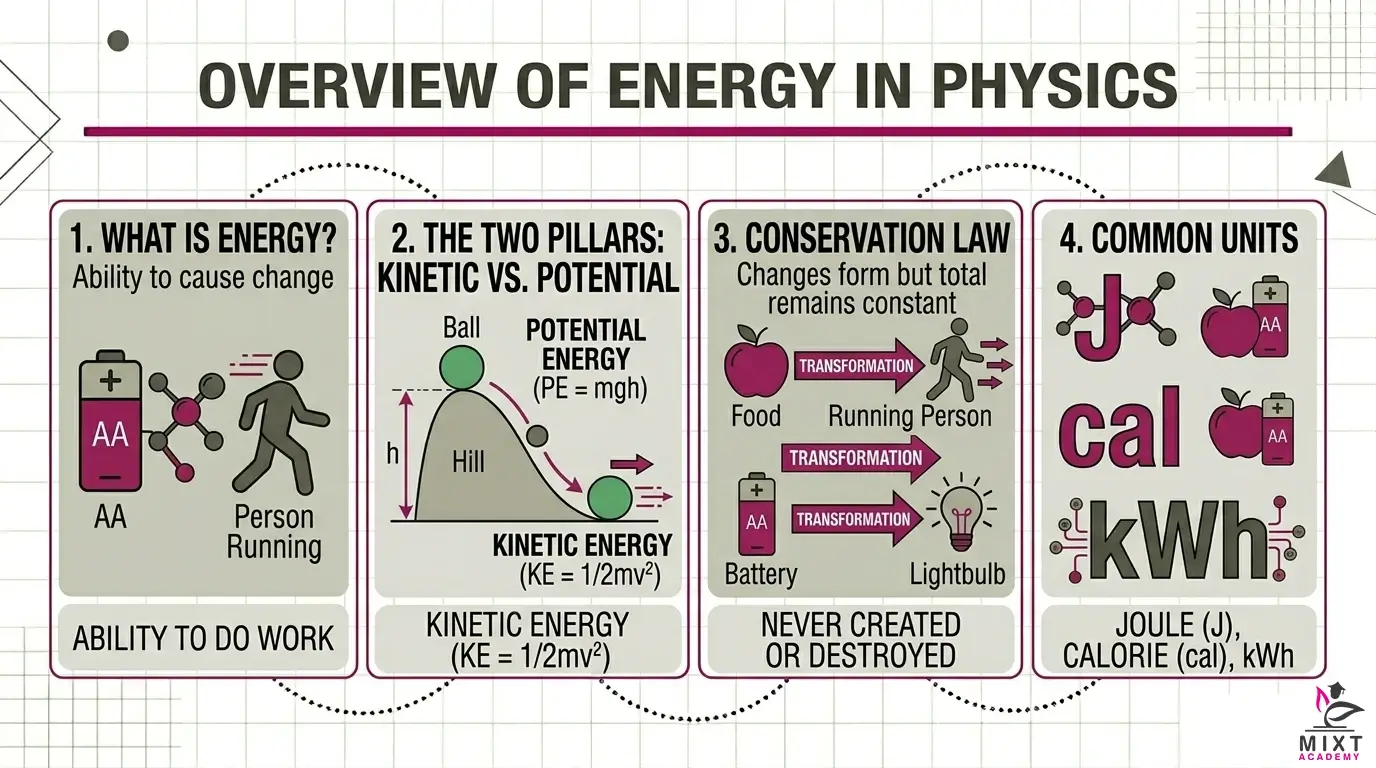
- Energy is the ability to do work or cause changes.
In the case of physics, work is defined as the product of force and the distance of the movement. Energy, on the other hand, is not an object; rather, it is a system in motion that possesses the ability to create movement, heat, and light or any other physical changes.
Consider the following examples:
- Kinetic energy is possessed by a moving car.
- Rubber bands that are stretched possess potential energy since work can be done when it is released.
- A light bulb utilises electrical energy and turns it into light.
Energy is the reason why living things exist, why the temperatures of objects change and why everything around us is in motion.
What is Energy in Science?
When asking what is energy in science, you are looking for something more than just energy in physics:
- Energy is the capacity to do work or cause change in systems, whether they are physical, chemical or biological.
In science, energy can be understood in several ways:
- Biology: Food gives the body chemical energy that the body uses to do work.
- Chemistry: In chemical reactions, energy is either released or absorbed. This energy can be in the form of heat or light.
- Physics: Energy is the reason why objects are in motion or why they can interact.
Because of these reasons, energy is a concept that is found in all the branches of science, not only physics.
What is Energy in Physics Symbol?
In physics, energy is denoted by the symbol:
E
E is what you will see in a lot of equations of energy, be it kinetic energy, potential energy, thermal energy, or electrical energy.
E=KE+PE
For example, in the equation of total mechanical energy, E is the total mechanical energy as the sum of kinetic energy (KE) and potential energy (PE).
SI Unit of Energy
The base unit of energy in SI is Joule (J).
1 joule (J) is the energy expended (or work done) when a force of 1 newton is applied to an object, and it moves in the direction of the force by 1 meter.
Other units that are used to measure energy include:
- Calorie (cal): for measuring food energy.
- Kilowatt-hour (kWh): for billing of electrical energy.
- Erg: this unit is used in some branches of science.
What is Energy in Physics Formula?
When you want to find out what is energy in physics formula, you are looking for a specific answer or definition that will help you answer a lot of physics questions in physics. Different types of energy have different formulas:
1. Kinetic Energy Formula
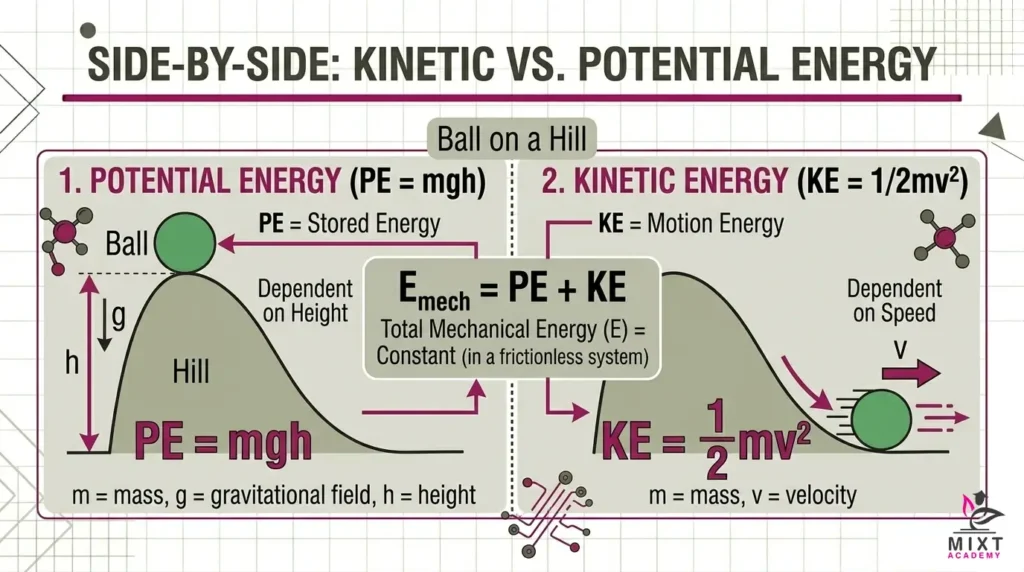
Energy that an object possesses due to its motion is defined as Kinetic Energy. Kinetic Energy is calculated as:
KE = 1/2 mv^2
Where:
- m = mass of the object
- v = velocity of the object
Thus, the faster an object moves and the greater its mass, the more Kinetic Energy it will possess.
Example: Let’s say a 2-kg ball is travelling at a speed of 3 meters per second. Then:
KE = 1/2 × 2 × 3^2 = 9 J
2. Potential Energy Formula
Energy that is held due to the position of an object is termed Potential Energy. Potential Energy can be calculated as:
PE=mgh
Where:
- m = mass of the object
- g = acceleration due to gravity (9.8 m/s²)
- h = height above the ground
Example: If a 5 kg object is at a height of 10 m, then using the above gave relation for Potential Energy:
PE=5×9.8×10=490J
3. Mechanical Energy Formula
For mechanical energy, the relation is
E=KE+PE
Mechanical energy is the sum of potential energy and kinetic energy. This relation is very common in mechanics for energy studies in moving systems.
4. Electrical Energy Formula
The Electrical energy is calculated as a function of current and voltage as:
E=V×I×t
Where:
- V = voltage
- I = current
- t = time
This relation is very important for the calculation of the energy consumption of electric devices.
Types of Energy in Physics
The first thing to understand is the types of energy in Physics, which is essential because energy can take many forms, and there is a range of types, and the types can be transformed from one form to another.
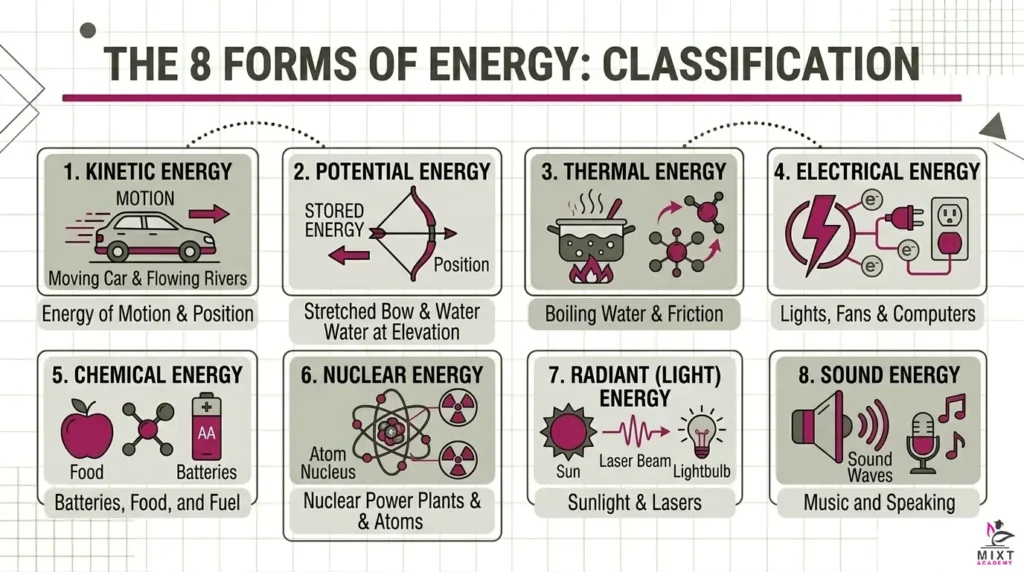
- Kinetic Energy
Energy of motion
Examples are moving cars and flowing rivers. - Potential Energy
Position or configuration stored energy
Examples include a stretched spring and water at an elevated position. - Thermal (Heat) Energy
Energy due to the motion of particles
Examples are boiling water and friction. - Electrical Energy
Electrical energy is energy generated from electrons in motion.
Examples include lights, fans, and computers. - Chemical Energy
Chemical energy is energy that is stored in the bonds of chemicals.
Examples include batteries, food, and fuel. - Nuclear Energy
Nuclear energy is energy that is stored in the nucleus of atoms.
Examples include nuclear power plants and atomic bombs. - Radiant (Light) Energy
Radiant energy is the energy that is carried through electromagnetic waves.
Examples include sunlight and lasers. - Sound Energy
Sound energy is the energy that is carried through waves of sound.
Examples include music and speaking.
All types of energy are interconvertible, which means that one form can change into another form. This usually, but not always, includes some loss as heat.
What is Energy in Physics Electricity?
When we ask what is energy in physics electricity, we refer to:
- It is the energy associated with the movement of electrons through a conductor.
This form of Energy is one of the most versatile because it can be transformed into:
- Light energy (bulbs)
- Mechanical energy (fans)
- Thermal energy (heaters)
Example: A 60 W bulb using electricity for 1 hour consumes:
E=60 W×1 h=60 Wh=0.06kWh
Law of Conservation of Energy
The law of conservation of energy states that:
- Energy can not be created nor destroyed. In other words, it can only change from one form to another.
Example:
- A falling object converts potential energy to kinetic energy.
- A battery converts chemical energy to electrical energy.
This principle is a must in all the calculations of physics and all the applications of physics to everyday life.
Energy Transformation in Daily Life
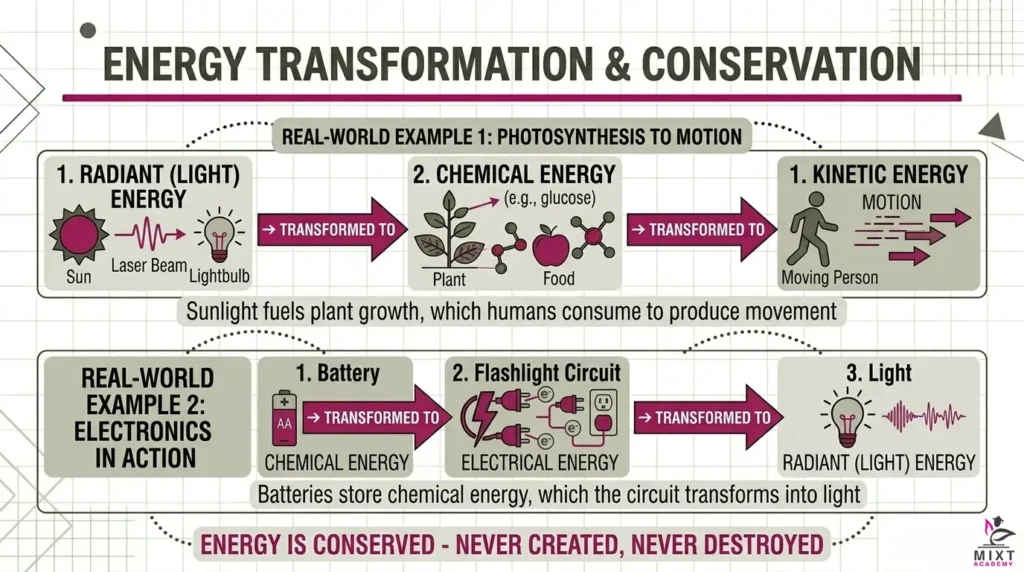
Energy is constantly changing forms in our everyday lives. Examples include:
| Initial Energy | Transformed To | Example |
|---|---|---|
| Chemical | Kinetic | Eating food and running |
| Electrical | Light | Bulb |
| Mechanical | Thermal | Friction in brakes |
| Potential | Kinetic | Water falling from a dam |
The understanding of these transformations is necessary for the design of machines, the conservation of energy, and the understanding of the processes of nature.
Dimensional Formula of Energy
The average dimensional formula of energy is:
[ML^2T^-2]
Where:
- M = Mass
- L = Length
- T = Time
The formula is derived from the work-energy relationship.
Importance of Energy
Energy is important in:
- The study of motion, forces, and the field of thermodynamics in Physics
- The powering of machines and electronics in the field of Engineering
- The heating, moving, and communicating in daily life activities
- The fueling of life processes in the field of Biology
Common Misconceptions About Energy
The following misconceptions should be resolved for any students are learn physics:
- Energy is a substance (Wrong).
- Energy is a property, but not a substance.
- Energy can be created (Wrong).
- Energy can never be created, but is always conserved.
- Only moving objects have energy (Wrong).
- Potential (stored) energy is just as real.
Real-Life Applications of Energy
These examples illustrate the pervasive role of energy in our lives.
- Cars and planes use chemical energy to move. In other terms, they use energy.
- Power plants use mechanical energy to produce electricity. In other terms, they use energy.
- Humans use the chemical energy in food and convert it to mechanical energy and thermal energy. In other terms, they use energy.
- Fans, refrigerators, and heaters use energy to convert it from one form to another.
Hire the Best Online Tutors for Your Child
Core Concepts of Energy in Physics
The study or application of science requires one to understand ‘what is energy in physics’. Energy is everywhere. It can be as small as the tiniest particles and as big as the biggest stars. It gives the ability to do work. Energy is the capability to do work, and it is also called E. Energy’s unit of measurement is Joule (J). The different forms of energy include Kinetic, potential, thermal, chemical, electrical, nuclear, radiant, and sound.
Energy is transformed into power, life, machines, and natural processes. Understanding these concepts helps you in day-to-day applications and also gives you the needed skills in more advanced topics like engineering and physics.