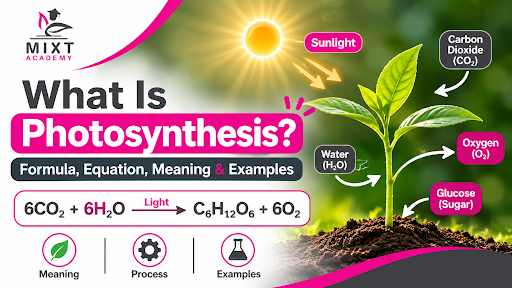
Photosynthesis lets plants turn light energy into chemical energy stored in sugars. It uses carbon dioxide from the air and water absorbed by roots. Oxygen is released as a by-product. The process may look simple in a textbook, but the chemical equation reveals how matter moves through a plant.
Students often need to learn both the word equation and the balanced chemical formula. Understanding what each symbol means makes the equation easier to remember and helps you explain the process in exams.
At Mixt Academy, biology topics are easier to revise when you connect the formula to chlorophyll’s role, the stages of photosynthesis, and the factors that affect its rate. This guide explains those connections step by step.
What Is the Basic Formula for Photosynthesis
The basic chemical formula for photosynthesis is
6CO₂ + 6H₂O + light energy → C₆H₁₂O₆ + 6O₂
This equation summarises how plants use light energy to convert carbon dioxide and water into glucose and oxygen. You can also express the process as a word equation:
Carbon dioxide + Water → Glucose + Oxygen
The process requires light energy and chlorophyll. In the word equation, they are usually written above or below the arrow rather than included as ordinary reactants. The left side of the chemical equation contains the starting substances, known as reactants.
The right side contains the substances produced, known as products. For a school science exam, learn both versions. The word equation helps you explain the process, while the chemical equation shows the number and types of atoms involved.
Understanding Each Part of the Photosynthesis Equation
Every symbol in the photosynthesis formula represents a substance or a quantity. Once you understand these symbols, the equation becomes easier to interpret.
| Symbol | Substance | Role in Photosynthesis |
|---|---|---|
| 6CO₂ | Carbon dioxide | Supplies carbon that plants use to build sugars. |
| 6H₂O | Water | Supplies hydrogen and electrons for the reactions. |
| Light energy | Energy from light | Powers the reactions that convert the starting materials. |
| C₆H₁₂O₆ | Glucose | A sugar that stores chemical energy and provides material for growth. |
| 6O₂ | Oxygen | Released as a by-product of oxygen-producing photosynthesis. |
Let’s examine the main components in more detail.
- Carbon dioxide (CO₂)
Plants obtain carbon dioxide from the air. This gas enters and leaves through microscopic openings called stomata. Carbon dioxide supplies the carbon atoms used to build glucose and other organic compounds. Without sufficient carbon dioxide, the plant’s rate of photosynthesis may decrease.
- Water (H₂O)
Plants absorb water through their roots and transport it to their leaves through specialised vascular tissues. During the light-dependent reactions, water molecules are split. This provides electrons and hydrogen ions for photosynthesis and releases oxygen.
- Light energy
Light supplies the energy needed to drive photosynthesis. Sunlight is the main natural source, although some organisms can use artificial light under suitable conditions. Without adequate light, the light-dependent reactions cannot produce the energy carriers required for the subsequent reactions.
- Glucose (C₆H₁₂O₆)
Glucose is a simple sugar that stores chemical energy. Plants use it in cellular respiration and as a starting material for making other substances. These substances include starch for energy storage, cellulose for cell walls, and compounds needed for growth.
- Oxygen (O₂)
Oxygen is released when water is split during the light-dependent reactions of oxygen-producing photosynthesis. Much of this oxygen passes from leaves into the atmosphere through the stomata.
Why Is the Photosynthesis Equation Balanced
A balanced chemical equation contains the same number of atoms of each element on both sides. Chemical reactions rearrange atoms rather than creating or destroying them. Look at the equation again:
6CO₂ + 6H₂O + light energy → C₆H₁₂O₆ + 6O₂
The numbers in front of the chemical formulas are called coefficients. They indicate how many molecules participate in the overall reaction. Here is how the atoms balance. IGCSE students read this; https://mixtacademy.com/blogs/igcse-biology-vs-human-biology/
| Element | Reactant Side | Product Side |
|---|---|---|
| Carbon (C) | 6 | 6 |
| Hydrogen (H) | 12 | 12 |
| Oxygen (O) | 18 | 18 |
The calculation is straightforward:
- Carbon: Six CO₂ molecules contain six carbon atoms. One glucose molecule contains six carbon atoms.
- Hydrogen: Six H₂O molecules contain twelve hydrogen atoms. Glucose also contains twelve hydrogen atoms.
- Oxygen: The reactants contain twelve oxygen atoms in CO₂ and six in H₂O. The products contain six in glucose and twelve in six O₂ molecules.
Both sides contain six carbon atoms, twelve hydrogen atoms, and eighteen oxygen atoms. The equation is balanced because the number of atoms on each side is equal. At more advanced levels, you may encounter a more detailed form:
6CO₂ + 12H₂O + light energy → C₆H₁₂O₆ + 6O₂ + 6H₂O
This version shows water on both sides of the reaction. For most introductory biology questions, the simpler equation is sufficient unless your syllabus specifies otherwise.
Where Does Photosynthesis Take Place
In plants, photosynthesis mainly takes place in the leaves, inside specialised cell structures called chloroplasts. Chloroplasts contain chlorophyll, a green pigment that absorbs light energy.
The pigment absorbs mainly red and blue light while reflecting more green light, which helps explain why most healthy leaves appear green. Different parts of a plant contribute to the process in different ways.
- Leaves: Provide a broad surface for absorbing light and exchanging gases.
- Stomata: Allow carbon dioxide to enter and oxygen and water vapour to move out.
- Roots: Absorb water and minerals from the soil.
- Xylem: Transports water from the roots to the leaves.
- Chloroplasts: Contain the structures where photosynthesis occurs.
This arrangement helps plants obtain the materials and energy needed for photosynthesis.
What Are the Two Main Stages of Photosynthesis
Photosynthesis involves many chemical reactions. Scientists group these reactions into two main stages: light-dependent reactions and the Calvin cycle.
- Light-dependent Reactions
The light-dependent reactions take place in the thylakoid membranes inside chloroplasts. Chlorophyll absorbs light energy, which drives reactions that split water and transfer energy through a series of chemical steps. These reactions produce three important outputs:
- Oxygen: Released as a by-product when water is split.
- ATP: A molecule that supplies energy for cellular reactions.
- NADPH: A molecule that carries high energy electrons used in the next stage.
ATP and NADPH provide the energy and reducing power needed to help build carbohydrates from carbon dioxide.
2. The Calvin Cycle
The Calvin cycle takes place in the stroma, the fluid-filled space inside chloroplasts. During this stage, enzymes use carbon dioxide, along with ATP and NADPH from the light-dependent reactions, to produce small carbon-containing molecules. These molecules can then be used to build glucose and other carbohydrates.
The Calvin cycle is also called the light-independent stage because its reactions do not directly require light. It still depends on the products of the light-dependent reactions, so it doesn’t happen only at night.
Together, these stages explain how plants capture light energy and store it in chemical compounds. Students studying plant biology can strengthen their understanding of these reactions with online GCSE biology tutors, especially when preparing for questions on photosynthesis, respiration, and plant processes.
What Happens to Glucose After Photosynthesis
Glucose is one of the main products represented in the photosynthesis equation. Plants can use it in several ways, depending on their needs.
- Cellular Respiration: Plants break down glucose through cellular respiration to release usable energy for activities such as growth, transport, and repair. Plants respire day and night.
- Starch Storage: When a plant produces more glucose than it immediately needs, it can convert some into starch. Starch serves as an energy reserve that the plant can use later.
- Cellulose Production: Glucose provides the starting material for making cellulose, which forms an important part of plant cell walls.
- Growth and Development: Plants use glucose as a raw material for producing other organic compounds. With suitable mineral nutrients, these compounds help form proteins, oils, and other substances needed for development.
- Transport: Plants can convert glucose into sucrose, a sugar that travels through the phloem to different parts of the plant.
This explains why glucose is more than a simple end product. It supports energy release, storage, transport, and the construction of new plant tissues.
Why Is Photosynthesis Important
Photosynthesis supports life on Earth in several connected ways.
It Supports Food Webs
Plants, algae, and other photosynthetic organisms are primary producers. They convert light energy into chemical energy stored in organic compounds. Herbivores obtain energy by eating plants or algae. Carnivores obtain that energy by consuming other animals. In this way, photosynthesis provides the energy that supports most food webs.
It Releases Oxygen
Oxygen-producing photosynthesis releases oxygen into the environment. This oxygen supports aerobic respiration in animals, plants, and many microorganisms. Over geological time, photosynthetic microorganisms played a major role in increasing oxygen levels in Earth’s atmosphere.
It Helps Regulate the Carbon Cycle
Plants and algae absorb carbon dioxide during photosynthesis and incorporate its carbon into organic compounds. Some carbon remains stored in living tissues, soils, and other reservoirs.
- Respiration, decomposition, and combustion can return carbon dioxide to the atmosphere.
- Photosynthesis is an important part of the carbon cycle, although the amount of carbon stored depends on the organism, ecosystem, and environmental conditions.
It Provides Resources for People
Crops, fruit trees, vegetables, and other plants depend on photosynthesis to produce the organic matter that supports food production. Photosynthetic organisms also contribute to materials such as timber and natural fibres.
Over millions of years, some ancient organic matter became fossil fuels. Without photosynthesis, the availability of food, oxygen, and many biological resources would change dramatically.
Which Organisms Can Photosynthesise
Plants are the most familiar photosynthetic organisms, but they are not the only ones.
- Plants: Most plants contain chlorophyll and carry out oxygen-producing photosynthesis. They use carbon dioxide, water, and light to produce carbohydrates and release oxygen.
- Algae: These organisms range from microscopic single cells to large seaweeds such as kelp. Microscopic algae and other forms of phytoplankton carry out photosynthesis in aquatic environments.
- Cyanobacteria: These photosynthetic bacteria produce oxygen and played a major role in changing Earth’s early atmosphere.
- Certain Other Bacteria: Some bacteria use light energy to produce organic compounds through photosynthesis. Not all of them release oxygen because some use electron donors other than water.
Animals generally cannot photosynthesise independently. Certain unusual animals can temporarily retain chloroplasts obtained from algae, but this is not the same as having a complete, independent photosynthetic system.
What Factors Affect the Rate of Photosynthesis
The basic equation shows the starting substances and products, but it does not tell you how quickly the reaction occurs. The rate depends on several environmental conditions.
- Light Intensity
Increasing light intensity can increase the rate of photosynthesis when light is limiting. Once another factor limits the process, adding more light may have little effect.
- Carbon Dioxide Concentration
Carbon dioxide supplies the carbon used to build carbohydrates. Raising its concentration can increase the rate under suitable conditions, up to a limit set by other factors.
- Temperature
Photosynthesis involves enzyme-controlled reactions. At temperatures below the optimum, these reactions generally proceed more slowly. Excessive heat can damage the photosynthetic machinery and reduce the rate.
- Water Availability
Water is a reactant in photosynthesis. When a plant lacks water, its stomata may close to reduce water loss. This also restricts carbon dioxide entering the leaves and can lower the rate of photosynthesis.
- Chlorophyll and Leaf Health
Healthy leaves with functioning chloroplasts can absorb light for photosynthesis. Poor plant health, damaged leaves, or conditions that affect chlorophyll production can reduce the amount of light energy captured. These factors help explain why two plants exposed to different conditions may photosynthesise at different rates.
Common Mistakes Students Make When Learning the Photosynthesis Formula
Understanding the formula is only part of preparing for a biology exam. You also need to explain it accurately.
| Common Mistake | Correct Understanding |
|---|---|
| Writing oxygen on the reactant side | Oxygen is a product of oxygen-producing photosynthesis. |
| Forgetting the coefficients | The standard equation includes six molecules of CO₂ and six molecules of H₂O. |
| Saying chlorophyll is a product | Chlorophyll absorbs light energy and is not consumed as an ordinary reactant. |
| Claiming plants obtain all their food from soil | Plants make organic compounds through photosynthesis. Roots absorb water and mineral nutrients. |
| Saying photosynthesis happens only at night or only during the day | Photosynthesis requires light, while plant respiration occurs day and night. |
| Confusing photosynthesis with respiration | Photosynthesis stores light energy in organic compounds, while cellular respiration releases usable energy from those compounds. |
A useful exam habit is to identify the reactants, products, and role of light before writing your explanation. This helps you avoid mixing up the two processes.
How to Remember the Photosynthesis Formula for Exams
Use the following three steps to revise the photosynthesis formula.
Step 1: Learn the word equation.
Carbon dioxide + Water → Glucose + Oxygen
Remember that light energy drives the process, and chlorophyll absorbs it.
Step 2: Connect each word to its chemical formula.
- Carbon dioxide = CO₂
- Water = H₂O
- Glucose = C₆H₁₂O₆
- Oxygen = O₂
Step 3: Practise writing the balanced equation.
6CO₂ + 6H₂O + light energy → C₆H₁₂O₆ + 6O₂
Check the number of carbon, hydrogen, and oxygen atoms on both sides. Then practise explaining the role of each reactant and product in one or two sentences.
Students working through the IGCSE syllabus can also use online IGCSE biology tutoring to practise applying the formula to exam questions, interpreting experiments, and explaining the factors that affect photosynthesis.
Get More Confident with Biology
Understanding photosynthesis becomes easier when you learn the chemical equation alongside the biological processes behind it. Practise explaining how plants absorb light, obtain carbon dioxide and water, and produce glucose and oxygen.
At Mixt Academy, students can receive personalised support with biology concepts, syllabus topics, and exam questions. Explore online A Level biology tuition to build a stronger understanding of photosynthesis and other related topics.