What Is a Physical Change?
A physical change affects how something looks, its shape, size, or state, but does not change what it is made of. The molecules stay the same; only their arrangement or physical form changes.
Here’s one way to think about it: if you can reverse the change and end up with the same substance you started with, it is almost always a physical change.
Key Characteristics of Physical Changes
- No new substance forms. The same chemical stays, just in a different form.
- Usually reversible. For example, melting can be undone by freezing, and dissolving can be undone by evaporation.
- Chemical bonds stay intact. The atoms are not rearranged into new compounds.
- There is only a small energy change. Physical changes usually use much less energy than chemical reactions.
Physical Change Examples
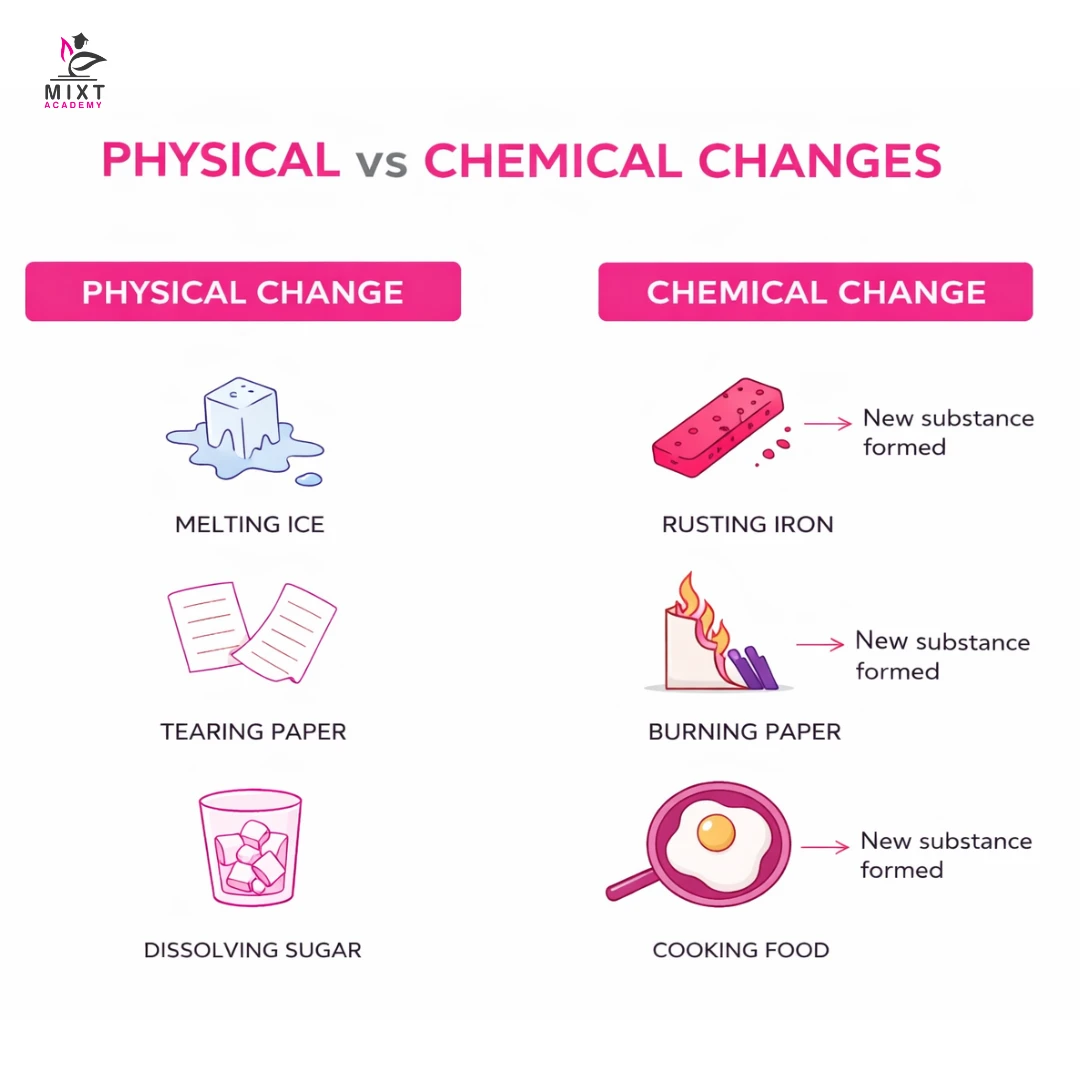
- Melting ice into water
- Boiling water into steam
- Cutting paper into smaller pieces
- Crushing a can
- Dissolving salt in water
- Stretching an elastic band
In each example above, if you checked the substance before and after, you would find the same molecules. They are just arranged or positioned differently.
What Is a Chemical Change?
A chemical change happens when a substance turns into one or more completely new substances with different chemical properties. This is because old chemical bonds break and new ones form, so the atoms are rearranged into new molecules.
Unlike physical changes, chemical changes usually cannot be reversed by simple physical methods. For example, you cannot “unburn” wood or turn rust back into clean iron just by reversing the conditions. These are the slight points where students missed the most marks. That is why online tutoring is important to get a personalised plan to improve your revision techniques.
Key Characteristics of Chemical Changes
- New substances are always formed, with different properties from the original.
- Most chemical changes cannot be reversed unless another chemical reaction takes place.
- Chemical bonds break and reform.
- You can often notice an energy change, such as heat, light, or gas being released.
- Some signs of a chemical change include a colour change, gas being produced, a solid forming, a temperature change, or a new smell.
Chemical Change Examples
- Rusting of iron (iron + oxygen → iron oxide)
- Burning wood or paper
- Cooking an egg
- Milk turning into yoghurt or curd
- Digestion of food in the stomach
- A metal reacting with acid to produce gas
In each example, the new substance is chemically different from what you began with. You cannot just reverse the change to get the original material back.
Physical vs Chemical Change: Side-by-Side Comparison
| Feature | Physical Change | Chemical Change |
| New substance formed? | No | Yes |
| Chemical composition | Unchanged | Changed |
| Reversibility | Usually reversible | Usually irreversible |
| Energy change | Minimal | Often significant |
| Visible signs | Change in shape, state, or size | Colour change, gas, precipitate, heat/light |
| Example | Melting ice | Burning wood |
Examiners often expect students to reproduce tables like this accurately in short-answer and multiple-choice questions.
Why This Topic Matters for GCSE and IGCSE Chemistry
If you are studying Cambridge, Edexcel, AQA, or OCR chemistry, you will learn about physical and chemical changes early on. These ideas come up again in later topics. Understanding the difference helps with:
- Chemical bonding: Understanding why bonds break or form during reactions
- Rates of reaction: Recognising which processes involve real chemical change
- Energetics: Linking chemical changes to exothermic and endothermic energy transfers
- Practical or coursework assessments: Correctly classifying what you observe during experiments
Exam boards frequently test this topic through:
- Direct definition questions
- Classifying a list of examples as physical or chemical
- Explaining *why* a specific change is physical or chemical (reasoning, not just labelling)
- Practical-based questions describing an experiment and asking students to identify the change type</br>
How to Identify Physical vs Chemical Change: A Quick Decision Method
When faced with an unfamiliar example in an exam, ask these four questions in order:
- Has a new substance been formed? → If yes, it’s chemical.
- Can the original substance be recovered by simple physical means (cooling, evaporating, etc.)? → If yes, it’s physical.
- Is heat, light, gas, or a strong odour produced unexpectedly? → Often signals a chemical change.
- Has only the size, shape, or state changed, with nothing new produced? → It’s physical.
This four-step method helps with most exam questions, even those you have not seen before.
Common Misconceptions Students Get Wrong
Even top students often make these mistakes in exams:
Misconception 1: “All irreversible changes are chemical.”
This is not true. Cutting paper is irreversible because you cannot turn shredded paper back into a whole sheet, but it is still a physical change since no new substance is formed.
Misconception 2: “Dissolving is a chemical change.”
This is incorrect. When sugar dissolves in water, the sugar molecules remain the same; they are just spread out among the water molecules. This is a physical change, and you can recover the original sugar by evaporating the water.
Misconception 3: “A colour change always means a chemical reaction.”
A colour change is not always a reliable sign by itself. While it often means a chemical reaction has happened, some physical changes, like mixing coloured substances, can also cause colour changes without making something new. Always look for other signs as well.
Misconception 4: “Melting and freezing are different types of change.”
Both melting and freezing are physical changes. They are just opposite directions of the same process, changing state without changing the chemical structure.
Getting Extra Support With Chemistry Topics
Physical and chemical changes can seem simple when explained well. However, many students still find it hard to use this knowledge on exam questions, especially when the wording is different from what they have practised.
Working with expert chemistry tutors can really help, especially for students who understand the material in class but get stuck when they see new types of exam questions. GCSE chemistry tutors usually focus on helping students build a strong foundation so they can confidently explain and classify changes instead of just memorising examples.
Students studying international curricula often benefit from IGCSE chemistry tutors who know the Cambridge and Edexcel International mark schemes well. These tutors help students understand the difference between textbook explanations and what exam boards expect.
For students moving on to more advanced study, AS/A-level chemistry tutors help link basic topics like physical and chemical changes to more complex ideas such as enthalpy changes, reaction kinetics, and equilibrium. This shows students how early concepts become more important later on.
More students are choosing online chemistry tutors for targeted and flexible support. Online sessions can focus on each student’s weak points instead of following a general classroom pace.
At Mixt Academy, tutoring sessions use a personalised approach. Tutors find out where a student is struggling and help them directly, instead of just repeating what they have already learned in school.
Final Thoughts
Physical and chemical changes are among the first topics you learn in chemistry, and they are also some of the most important. The basic definitions are simple, but doing well on exams means you need to apply what you know to new situations, explain your thinking clearly, and watch out for common mistakes that can confuse even strong students.
If you master this topic by working through clear examples, comparing different types of changes, and practicing with a variety of questions, you will build a strong foundation for almost every other chemistry topic you study later.