
In high school, students must select their academic tracks, a process that will likely shape their prospective universities and future careers. Two qualifications that students can choose from include A Levels and Advanced Placement (AP) courses. Although both qualifications are equally recognised, universities worldwide evaluate students and engage with them differently.
As qualifications, A Levels and AP courses offer different kinds of opportunities, allowing struggling parents and students to choose between them. A Levels offer students fewer subjects to choose from, allowing candidates to develop deep knowledge in their expertise, which prepares them for a career. AP courses, on the other hand, allow students to select from a diverse high school curriculum with the added incentive of obtaining university-level credits.
This becomes even more complicated when students have their goals set on universities abroad. Experts tutors online, and educational consultants at Mixt Academy can help students in A Levels, AP, or both.

After obtaining GCSEs or IGCSEs, students can begin a British qualification called Advanced Levels, or A Levels. These qualifications are recognised by universities in the UK, Commonwealth countries, and many other countries worldwide.
Students usually take A Levels for two years, completing them in year 12 and year 13 of secondary school. A-levels are subject-specific qualifications. Students take three to four subjects, and A Level assessments are mostly exams. Some subjects do offer course assessments as a part of the qualification.
Below are the key features of A Levels that each student must know:
Assessment: A Levels are assessed through exams at the end of the course. Some subjects offer assessments and coursework during the course.
A Level offers in-depth knowledge in the selected subjects. Students who understand their field of study early can benefit from A Levels by obtaining qualifications that are recognised by universities in the UK and Commonwealth countries. A Levels also prepare students for university courses that require a higher level of specialisation, such as engineering, law, or medicine.

Advanced Placement (AP) is a US-centric educational program provided by the College Board. Unlike A Levels, APs are not considered a singular qualification, but instead are a collection of individual college-level courses that high school students can enrol in. Students can decide how many AP courses they want to enrol in, based on their individual interests and capacities.
Every AP course ends in a standardised exam that is scored on a scale of 1 to 5. Colleges and universities may offer students college credit or advanced standing based on their scores. AP courses span a variety of disciplines such as the sciences, math, social studies, the arts, and foreign languages.
Here are the core features of AP that every student should know.
Depth: Students may take a variety of courses in different subjects, resulting in a well-rounded education.
Talk to a Mixt Academy expert tutor to plan your application strategy and get personalised guidance.
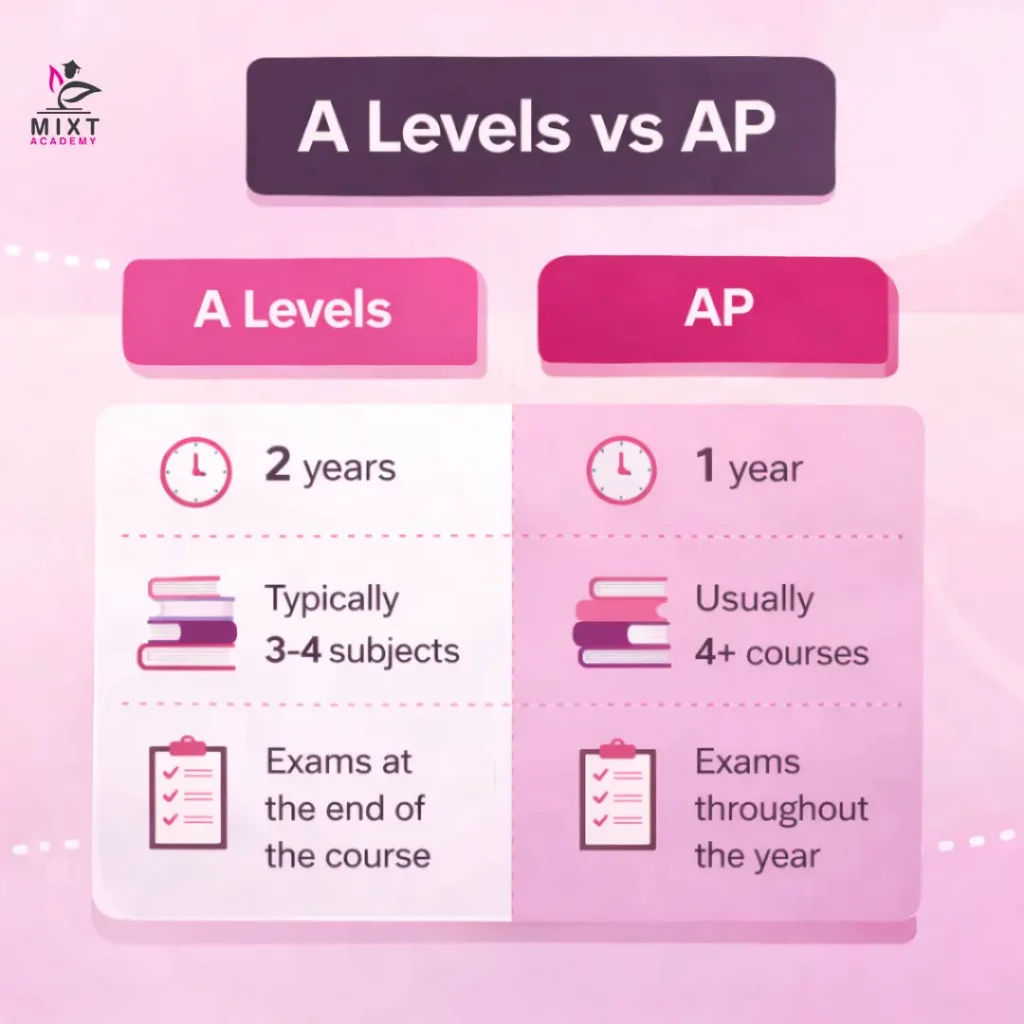
AP and A Level courses are very challenging, but they do differ in structure, assessment, and educational approach. Understanding these differences can help students choose the path that best suits their strengths and goals.
The depth and breadth of the course content of A Levels and AP courses are among the most important differences.
This will also help you in preparing for your university of choice. AP courses are superior to A Levels for students looking to spend their learning on various interests and keep their options open for longer.
Below is a brief overview of the duration and structure of A Levels and AP courses.
| Feature | A Levels | AP Courses |
| Duration | 2 years | 1 year per subject |
| Subjects | 3–4 focused | Flexible, many options |
| Assessment | Exams primarily at the end | Standardized AP exams |
| Flexibility | Limited | High |
Here is the assessment style of A Levels and AP courses that students must know before choosing one. A Levels are more in-depth and provide more of a challenge in their specific subjects. AP allows for more breadth, but requires more consistent effort across various assessments.
A Levels and AP curriculum have strong university recognition and are widely accepted for the admissions in universities and higher education across the world.
In most UK universities, students are required to have A Levels. AP scores are also recognised, but universities often ask for more proof to demonstrate that one is ready for university. A Levels show proof of mastery in a subject and are aligned with the expectations of a university in the UK.
A Levels are also recognised and valued, but AP courses are more accepted and valued. Scoring high in AP courses can also provide one with college credit, the ability to place into a higher level course, or get placed into honors classes. AP courses also provide more freedom in the US university admissions process in comparison to A Levels.
Recognized in most places across the globe, however, A Levels and AP courses also have countries that recognize them in differing ways. Some universities will consider scores from AP exams to fulfill the entry requirements for A Levels, but this varies. Schools should always consider the requirements for university entry that are specific to the universities they wish to attend.

Your academic goals, career plans, and preferred study style will help you choose between A Levels and AP.
Take our free assessment to find the academic path that fits your strengths and goals.
Below are common misconceptions that students and parents have about A Levels and AP.
The difficulty of AP courses depends on the subject. While some AP courses may feel less intensive due to breadth, advanced courses like AP Calculus or AP Physics can be extremely challenging.
Performance matters more than the qualification itself. Universities consider your grades, subject choice, and alignment with your desired field of study.
AP courses are increasingly recognised worldwide. Many international universities accept AP scores for admission or advanced placement. However, students should verify credit policies before relying on AP results.
Some students choose to take both, especially if they are applying internationally. While it can strengthen applications, students must ensure that the workload remains manageable.
Students often share the following insights:
It often comes to the question of pathways regarding students’ strengths, interests and goals and what they see in the future to be fit.
Join Mixt Academy coaching programs for structured preparation and expert guidance.

Deciding between A Levels vs AP is not about which qualification is better universally, but about which aligns best with your strengths, interests, and long-term goals. On an educational level, both options are equally respectable and credible. Both will give you the opportunity to pursue a university degree of your choice, and on a professional level, both will give you access to a successful and fulfilling career.
The more you understand a program’s structure, assessment methods and focus, the more you will be able to confidently choose a path that will lead you to success. Having the ability to access personalised tutoring is not always a possibility. This is where Mixt Academy is able to offer online tutoring, where you will get access to the guidance, coaching and strategies to help you succeed.
With the right preparation and guidance, choosing the right academic path can be a smooth and empowering experience, ensuring that every student maximizes their potential and reaches their university and career goals.
AP courses do emphasize higher-order thinking and writing skills. The A Level curriculum is more limited, and students often take 3 or 4 subjects. It is also a 2-year programme that most pursue after having earned their high school diploma.
AP is more broad in its focus, allowing students to take select courses in their areas of interest. Similarly, A-Levels allow students to explore their interests by studying for exams in their field, though the A-Levels require a more intensive 2-year sequence of study.
Yes. Many universities, especially in the US, grant college credit or advanced placement for high AP exam scores. Credit policies vary by institution.
A Levels are the standard qualification in the UK and are preferred for most courses. AP scores may be accepted, but often with additional requirements.
Both qualifications can benefit students pursuing specialised degrees. However, the IB Diploma offers the added advantage of keeping options open with a broader education, making it an excellent preparation for university and future careers.
Some students do, especially if applying internationally. However, workload management is critical. Focus on performing well in chosen courses rather than overloading.

Mixt Academy is a global online tutoring platform that connects students with expert IGCSE, GCSE, and A-Level tutors for one-to-one learning. With flexible scheduling, personalized lesson plans, and experienced teachers from top curricula, Mixt Academy helps students strengthen concepts, improve exam skills, and achieve higher grades with confidence.



Understanding Units and Dimensions of Physical Quantities A physical measurement…
IGCSE Physics Formula Sheet: Key Formulas for 0625 & Edexcel…
IGCSE Chemistry Papers: Common Mistakes & Exam Tips This IGCSE…
IGCSE Extended vs Core Tiers: How to Pick the Right…
GCSE vs A-Levels Student Friendly Guide Selecting educational credentials is…
Understanding GCSE Grade Boundaries and How to Prepare? Grade boundaries…
Differences GCSE English Language vs English Literature GCSE English is…
A Level vs AP: Complete Guide to Choosing the Right…
Top Benefits of Completing AS and A Levels Privately Explore…
Cambridge vs IB Guide to Choosing the Best Curriculum Choosing…
IB vs A Levels: Which Qualification Is Right for You?…
How to Use OCR Past Papers for Effective Revision? Past…
AQA Physics Equation Sheet: Complete GCSE Guide for Combined Science…
AQA vs Edexcel Complete GCSE Comparison and Guide Choosing between…
Complete Guide to the AQA GCSE Chemistry Specification Understanding the…
Hire an Expert Tutor from Just 15$/hr