Why Numerical Questions Feel Difficult for Students
Numerical questions are examples that require more than just the memorisation of a formula. They require:
- An understanding of the concept
- The appropriate use of units
- Clear, methodical calculations
- Focus and accuracy
Even one small mistake can change the final answer completely. That is why the understanding of common mistakes students make in numerical questions is important for students in order to avoid losing valuable exam marks.
Need Help Fixing Numerical Mistakes?
Strengthen concepts, improve calculation accuracy, and stop repeating the same errors.
Most Common Mistakes Students Make in Numerical Questions
The following are some of the most common mistakes that students repeatedly make in numerical questions over a wide variety of school and college courses.
1. Using the Wrong Unit System
Because of a wrong unit system mistake, the answer to the problem can lose a significant number of marks. It happens when the answer to the problem is provided in a different unit than the one that was used to complete the solution.
- Given values in the MKS system
- Final answer required in the CGS system
If conversion is skipped, the entire solution becomes incorrect, even if all steps are right.
Always check:
- Provided units
- Needed answer units
This mistake by itself accounts for a huge portion of lost marks.
2. Mixing Different Units Together
Unit inconsistency is one of the common mistakes students make in numerical questions. Take the following as an example:
- Length in meters
- Mass in grams
- Time in seconds
Mixed units in one formula will yield a wrong result. Remember to convert to the same unit system before starting calculations.
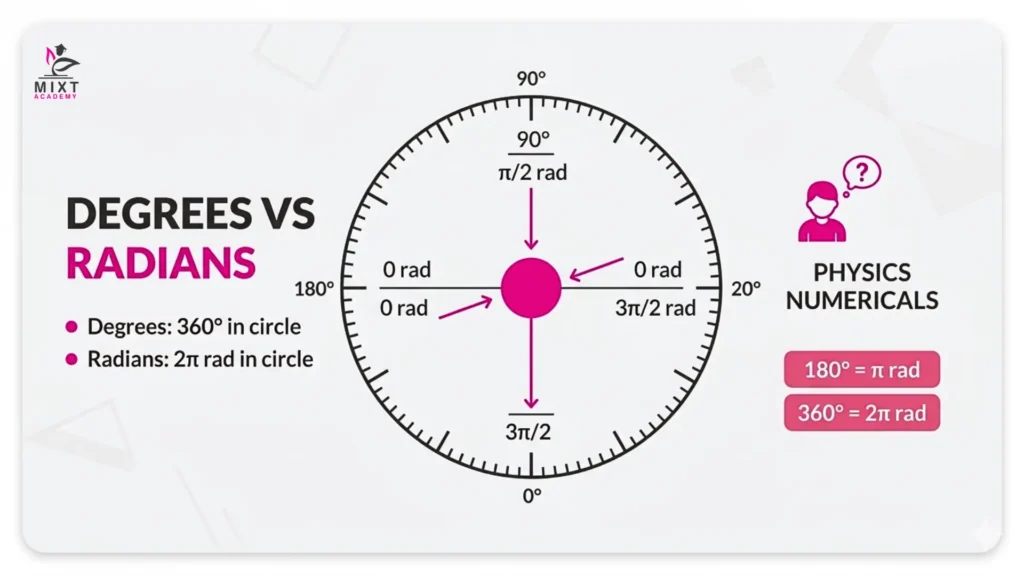
3. Confusing Degrees and Radians
Confusing radians with degrees is one of the mistakes students make that leads to wrong answers. How it applies to:
- Angular velocity
- Angular acceleration
- Rotational motion problems
- Trigonometry may use degrees
- Angular formulas always use radians
4. Forgetting Latent Heat in Thermodynamics
When state changes occur (ice to water, water to steam), latent heat must be added. Most students only use:
Q = mcΔT
and forget:
Q = mL
This leads to wrong answers. Always remember to check if one or more of the following is involved in the question:
5. Wrong Resistor Calculations
Applying the wrong series vs. parallel resistance formulas is one of the most common mistakes students make.
Series:
R = R₁ + R₂
Parallel:
1/R = 1/R₁ + 1/R₂
Using the wrong formula will give the wrong current and voltage.
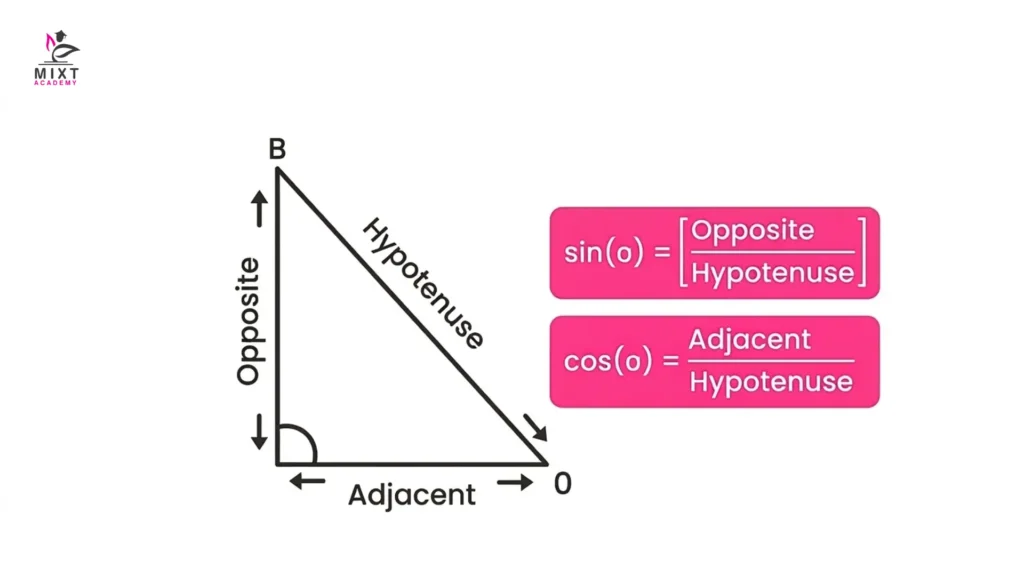
6. Mixing Sine and Cosine Values
In numericals based on Trigonometry, students often confuse:
- sin θ = opposite/hypotenuse
- cos θ = adjacent / hypotenuse
This one mistake will affect the entire solution. Be sure to draw the triangle before adding the values.
Common Math Errors That Affect Numerical Accuracy
Most common mistakes in physics numericals result from poor math abilities, such as:
- Neglecting to carry numbers
- Making mistakes with negative number subtraction
- Miscalculating where to put decimals
- Making rounding mistakes
- Mixing up numbers, like writing 21 instead of 12
Because of these mistakes, the final answers often come out wrong.
Why Do Students Keep Repeating the Same Mistakes?
There is a pattern to the most common mistakes students make in numerical questions, which are:
- Rushing by skipping steps
- Attempting to memorise the formula instead of trying to understand it
- Too much reliance on a calculator
- Failing to double-check the answer
- Poor understanding of basic concepts
These behaviours reduce a student’s confidence and accuracy over time.
Struggling With Repeated Numerical Mistakes?
Get guided support from experienced tutors who identify your weak areas, correct repeating errors, and build strong learning skills.
How Proper Guidance Helps Reduce Numerical Errors?
Targeted academic tutoring support from Mixt Academy helps students with:
- Getting better at the basics
- Encouraging students to record their steps
- Providing better awareness of the measurement units
- Improving estimation and teaching students to do math in their heads
- Helping students understand their mistakes by monitoring their errors
With practice, students learn to improve their precision.
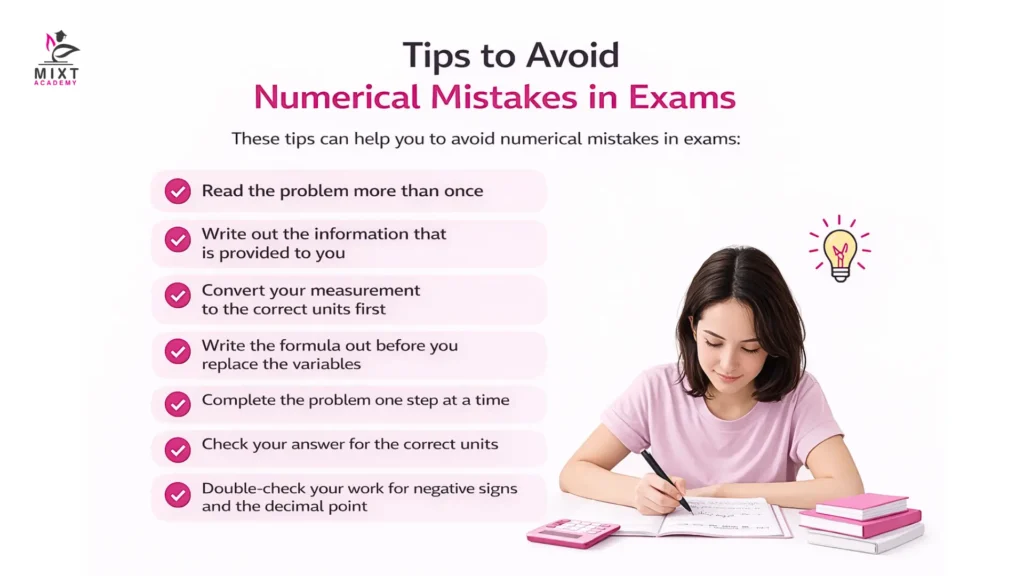
Tips to Avoid Numerical Mistakes in Exams
- Read the problem more than once
- Write out the information that is provided to you
- Convert your measurement to the correct units first
- Write the formula out before you replace the variables
- Complete the problem one step at a time
- Check your answer for the correct units
- Double-check your work for negative signs and decimal points
Using these techniques will decrease the number of common mistakes students make in numerical questions.
What Students Should Remember?
The common mistakes students make in numerical questions are not signs of low intelligence. These mistakes indicate a lack of preparation, a lack of carefulness, and a lack of attention to detail. If these mistakes are found and corrected early on, students are generally happier with their exam results. With enough practice and a clear understanding of the concepts involved, students can do well on numerical questions. Moreover, one-on-one tutoring support from Mixt Academy can help you avoid these common mistakes and boost your academic grades.
FAQs
Find Top Tutors in Your Area