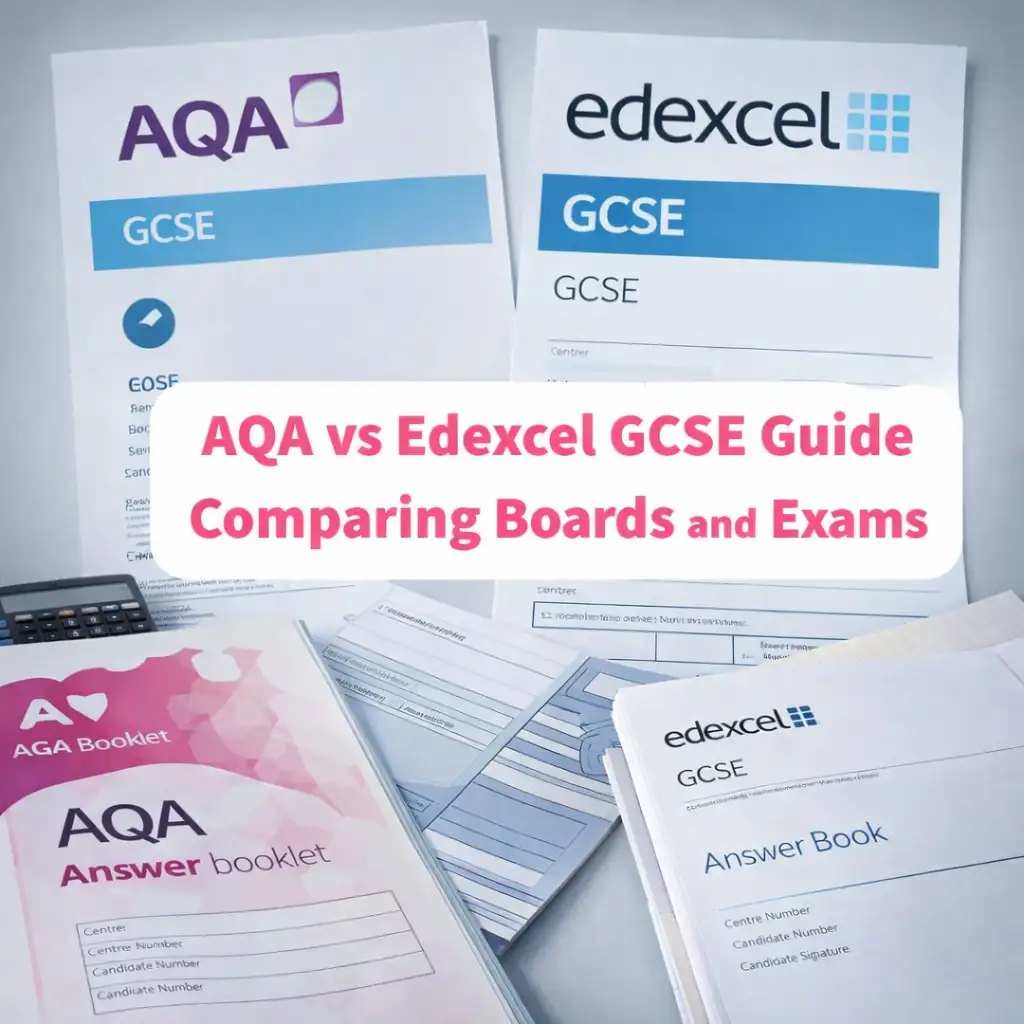
From a student’s perspective, differences between the two boards can affect their academic pathways and learning experiences. Parents and educators also reflect on how each board aligns with a student’s strengths, whether it is the more traditional, exam-based Cambridge or the more modular and versatile Edexcel coursework structure. In this guide, we will discuss the key similarities and differences between the two boards, evaluate the benefits and challenges of each, and answer one of the most common questions: Which board is right for you?
Hire the Best Online Tutors for Your Child
What is the Pearson Edexcel Exam?
Pearson Edexcel offers international IGCSE and A Level examinations with global recognition. It is a part of Pearson Education, the world’s largest education company and a UK-based examination board. Pearson Edexcel examinations are recognised in the UK and in a majority of Commonwealth countries.
These examinations combine academic difficulty with practical assessment methodologies. They also focus on real-world applications, which is why Edexcel is more focused on higher education, vocational training, and employment pathways. These examinations are modular and include written assessments, coursework, and practical assessments.
What is Cambridge International Examinations?
Cambridge International Examinations offers an international assessment curriculum designed for Cambridge International Schools. It is also a UK-based organisation founded in 1858. Cambridge International Examinations is also known as CIE.
Most education programs offered by Cambridge International Schools are based on CIE. It is the world’s largest education provider and operates in more than 160 countries. They are among the universally recognised assessments. They focus on higher-level critical thinking and conceptual understanding.
Key Differences Between Edexcel vs Cambridge Exams
For many subjects, CIE utilises tiered exam systems in which students are offered Foundation and Higher-level exams. In contrast, Edexcel uses a single set of examination papers for most subjects, including math tutoring. Let’s examine this more closely.
| Particulars | Pearson Edexcel | Cambridge (CIE) |
|---|---|---|
| Exam Structure | Modular and linear options. | Primarily linear. |
| Assessment | A combo of coursework, practicals, and exams. | Mostly final exams. |
| Difficulties | It is slightly more accessible in a few subjects. | It is academically more rigorous overall. |
| Resources | Textbooks and guides by Pearson. | Wide range of third-party resources. |
| Flexibility | More modular choices are available. | Fixed syllabus, less modularity. |
| Ideal Student | Learners need a balance of assessment styles. | Academically inclined, exam-focused. |
| Student Experience | Balanced workload. | Intense and exam-centric. |
| Learning Structure | Real-world application, skills-oriented. | Deep conceptual understanding. |
| Curriculum Focus/Breadth | Slightly narrower but practical. | Broad and detailed. |
| Global recognition | Highly recognised globally. | Universally recognised and prestigious. |
Talk to a subject expert and get personalised advice.
1. Exam Structure
The two examination systems, Edexcel and CIE, differ in many aspects, particularly in their exam papers. Although each examination board assesses students through exam papers, practical work, and coursework, the relative weightings of these components differ.
- Students can take CIE exams in June and November.
- Edexcel exams can be taken in June, October, and January.
CIE is known to be a more difficult examination system than Edexcel. CIE, unlike Edexcel, grades practical work and assesses each student’s ability to complete higher-order, application-based assessments.
Another factor that sets CIE apart is its two-tiered exam system. Students may choose to take either the Foundation or the Higher-level exams. The higher-level papers are more difficult and include more advanced questions.
On the other hand, Edexcel uses a two-tiered exam system for mathematics only, allowing students to choose from different levels of difficulty. In every other subject, however, Edexcel provides only one exam paper option containing both challenging and easy questions.
2. Assessment Style
The most significant differences between Cambridge and Edexcel lie in their exam structures.
Edexcel (Pearson): Edexcel is the most flexible. They offer both modular and linear exam options. For the modular option, the syllabus is broken into smaller units. Students can take exams in stages rather than all at once. They can retake modules to improve their grades, which is more student-friendly. Some subjects require both coursework and practical assessments, which distribute the assessment load and reduce pressure on exams.
Cambridge (CAIE): Cambridge uses a linear assessment system for their coursework. Students are required to take their final exams for every subject at the end of the course. They must study consistently throughout the course and prepare for final exams. There are competitions for course and practical assessments in subjects such as the sciences and languages. Overall, Cambridge is known to be exam-heavy across all courses. This style is considered the most rigorous and encourages long-term learning to sustain the endurance required to succeed in exams.
Hire the Best Online Tutors for Your Child
3. Difficulties
Based on the comparison, Edexcel is the least difficult. Cambridge International Examinations is the most difficult and has the most requirements. Edexcel focuses on academically challenging subjects, including business studies tutoring and other well-known subjects.
4. Resources
Since Edexcel works closely with Pearson, one of the largest educational publishers, the study materials available are numerous. Cambridge also provides study materials, but there are multiple publishers to consult. This makes locating the study materials more time-consuming.
5. Academic Approach
How each exam board sets out its teaching and learning philosophy also differentiates them.
Edexcel (Pearson): Edexcel, on the other hand, is often seen as more student-friendly and more accommodating. Their framework is designed to encourage a more progressive approach to learning, allowing students to move through different sections of the syllabus at their own pace. Including coursework and practical assessments in some subjects also allows students to demonstrate their skills. This makes Edexcel suitable for students who benefit from continuous assessment and less exam pressure.
Cambridge (CAIE): Cambridge is renowned for its traditional, academically challenging style. They encourage critical thinking and deep analysis while also building strong subject knowledge. The focus is on developing students’ problem-solving, logical reasoning, and independent research skills. This is why Cambridge is regarded as the best at preparing students for admission to more competitive universities, where students are expected to undertake final exams that require high levels of analytical thinking.
6. Flexibility
Edexcel offers a modular system in which students can schedule exams at any time and retake exams. This reduces the stress students experience and improves their performance. While. Cambridge offers students much less flexibility, as they must do well on a single exam.
7. Ideal Student
Edexcel is perfect for students who want different kinds of assessments and want to see how they improve over time. Cambridge exams are for students who do best when things are a bit tougher.
8. Grading System
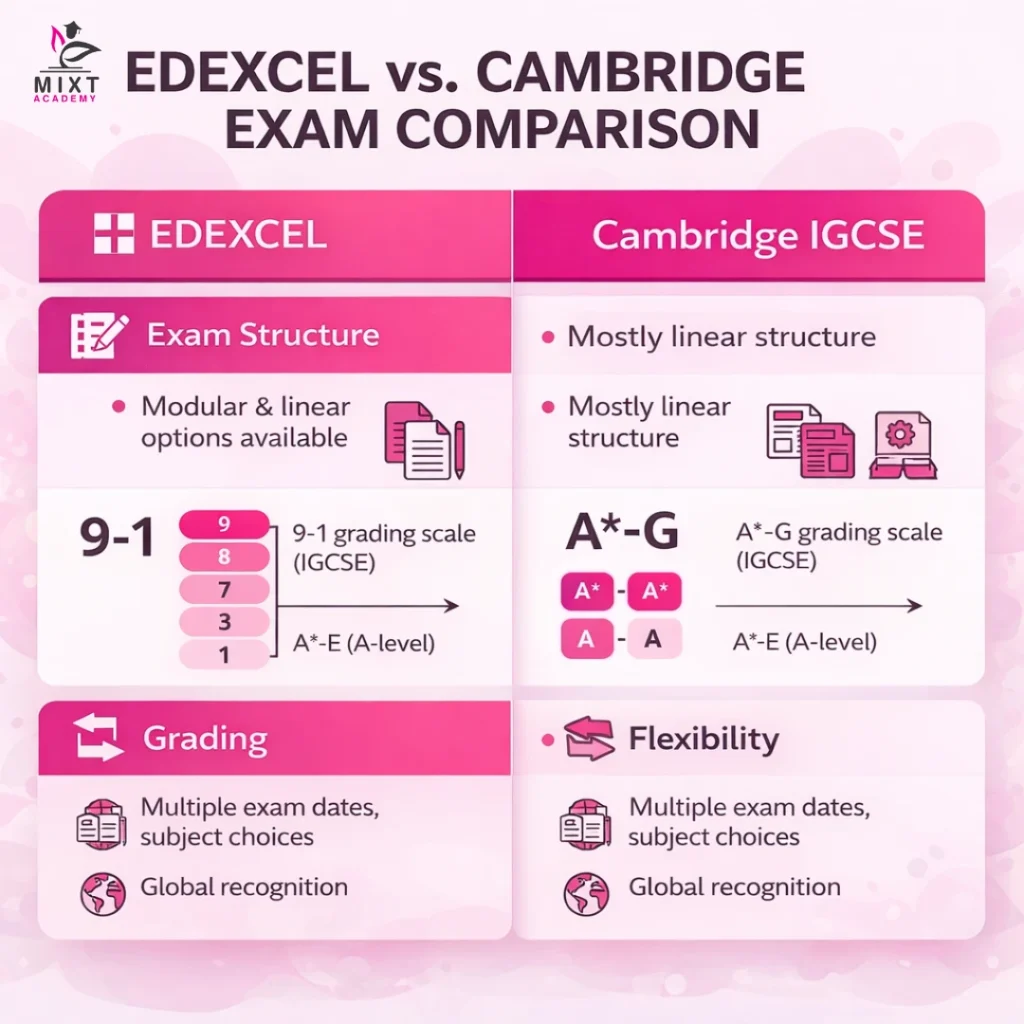
There is also a difference in how students’ achievements are assessed at the IGCSE maths tutoring level across exam boards.
- Cambridge (CAIE): Cambridge uses the standard grading scale for its IGCSEs, with grades ranging from A to G, with A being the highest and G the lowest. At A Level, the grading system is the same, but E is the lowest grade you can pass. This system is simple and easy to understand, but it is less detailed than the new numerical grading system.
- Edexcel (Pearson): At IGCSE tutoring, Edexcel tutoring gives schools an option. They can choose between the A-G system* (like Cambridge) and the newer 9-1 system. 9 is the highest passing grade, and 1 is the lowest. This system aimed to promote greater differentiation among higher-achieving students, so an Edexcel 9 is higher than a Cambridge A*. At A Level, Edexcel has the same A-E grade system.
9. Global Recognition
Both Cambridge and Edexcel qualifications are widely recognised worldwide, but they are viewed slightly differently.
- Cambridge (CAIE): As part of the prestigious University of Cambridge, CAIE has built a reputation over the past few decades. Most universities in the UK, USA, Canada, Australia, Europe, and parts of Asia accept Cambridge IGCSEs and A levels. Cambridge is often regarded as the ‘gold standard’ of international qualifications and is highly regarded for admission to top-tier universities.
- Edexcel (Pearson): Edexcel qualifications are recognised worldwide and are accepted by leading universities. Edexcel is known for the flexibility of its modular system. This is also why Edexcel is a preferred choice for schools seeking to offer more flexible learning. Edexcel International GCSEs and A levels are regarded as equivalent to Cambridge qualifications by top universities. There is a common perception among students and parents that Cambridge Edexcel International A levels and IGCSEs are of equal value.
10. Subject Range
The breadth and variety of subjects offered by each examination board can greatly influence a student’s decision if they have specific interests.
- Cambridge (CAIE): Cambridge offers one of the most extensive ranges of International Examination Boards. In addition to more than 70 IGCSE subjects, students can choose from more than 55 A-level subjects. Subject offerings include all the core academic areas, as well as some specialised options. CAIE allows for optimal customisation of a student’s academic track.
- Edexcel (Pearson): Edexcel offers a narrower range of subjects than Cambridge, but is also considered to have some of the most balanced offerings. Students can select from approximately 40 IGCSEs and more than 20 International A Levels. Edexcel is also considered a pioneer for offering programs at the intersection of Traditional, Modern, and Vocational subjects.
11. Learning Structure
Edexcel learning structures are based on real-world practical scenarios. Learning structures in Cambridge are more theoretical, involving critical analysis. This promotes strong academic insight, research-related skills and overall critical thinking.
Pros and Cons of Cambridge vs Edexcel
Both examination boards are of equal standing, but each has its own advantages and disadvantages. Below is a side-by-side comparison to help you make your decision.
Cambridge (CAIE)
Pros:
- Your certifications can be used all over the world. Cambridge prides itself on being reputable.
- You can take a variety of classes, over 70 IGCSEs and 55 A levels tutoring.
- This prepares students for the best universities.
- Critically prepares students.
- Universities especially love partnerships with Cambridge.
Cons:
- There are many tests and considerable stress over the final exams because of the linear system toward the end.
- Not enough coursework for students.
- Not enough exam sessions during the year. They only really offer them in the Spring and Fall.
- It can be very stressful if you prefer to assess and examine throughout the year.
Pearson Edexcel
Pros:
- Provides numerous options throughout the year for students to take and retake modular exams.
- There are numerous testing sessions, including those in January.
- They break a school year into units and allow students to assess and take tests on each of them.
- They offer a unique blend of new and vocational courses.
Cons:
- The selection of classes is more limited than in Cambridge.
- Universities consider these classes to be of the same difficulty, but some people believe they are less challenging.
- The modular system can lead students to believe only enough to pass the class, rather than to develop a strong understanding.
Choosing the Right Curriculum

Choosing between Cambridge (CAIE) and Edexcel is one of the most important milestones and starting points in a student’s academic journey. Both are world-renowned exam boards that have developed syllabi equally respected by universities, designed to develop essential knowledge and skills. Often, the deciding factors come down to a student’s learning style, academic ambitions, and personal strengths.
In the Cambridge examinations, students are typically awarded points for writing thoughtful, reasoned, analytical and explanatory essays. These challenges are well-suited to those who are driven by the spirit of inquiry, independent research, and study, and who wish to polish their problem-solving skills.
In comparison, Edexcel offers students a more defined and straightforward approach to assessment, with practical, application-based tasks. These tend to be more accessible to students who prefer a more guided, step-by-step approach to learning and provide hands-on, practical knowledge. Ultimately, the determination to learn is most closely associated with a student’s exam success.