

In contrast, Mercury, which is closer to the Sun, has very little atmosphere, and consequently, it cannot retain the heat; hence, it undergoes drastic temperature changes. “In the late 1950s, it was observed that Venus’s thick atmosphere is the reason for the planet’s extreme heat.” This discovery not only provided an explanation for the intense heat on Venus but also settled the long-standing debate on which is the hottest planet in the solar system, even though Venus is not the closest planet to the Sun.
Struggling to Understand Science Concepts Clearly?
Mixt Academy provides specialised 1-on-1 science tutoring, starting to establish solid foundational knowledge.
Why Is Venus So Hot? The Science Behind Its Intense Heat?
The extreme temperature of Venus is mainly caused by the planetary atmosphere, which is very thick. Venus’s atmosphere is more than 90 times denser than Earth’s. Carbon dioxide (CO₂), a greenhouse gas that contributes significantly to the heating effect, is the main constituent of the atmosphere. The mechanism of the greenhouse effect on Venus is explained as follows:
Solar Radiation
Venus takes in sunlight, but rather than allowing it to go back to space, the thick atmosphere absorbs a great deal of the heat and prevents it from escaping.
Greenhouse Effect
The CO₂ present in the atmosphere captures the infrared radiation, thus keeping the heat inside. This translates into a continual rise in temperature as the heat gets more and more concentrated.
Sulfuric Acid Clouds
Venus is also completely enveloped in very dense clouds of sulfuric acid. These clouds reflect sunlight, but at the same time, they help to hold the heat in the atmosphere, further increasing the already very high temperature at the surface of the planet.
Why Venus’s Temperatures Keep Rising
The heat is so intense that it causes the planet to be under a “runaway greenhouse effect”, which implies that the temperatures on Venus can go higher and higher. Consequently, water can never be present in its liquid state. The heat is so severe on Venus that even the surface pressure is comparable to that of being 900 meters (3,000 feet) underwater on Earth!
Exploring Venus: Extreme Conditions & Scientific Challenges
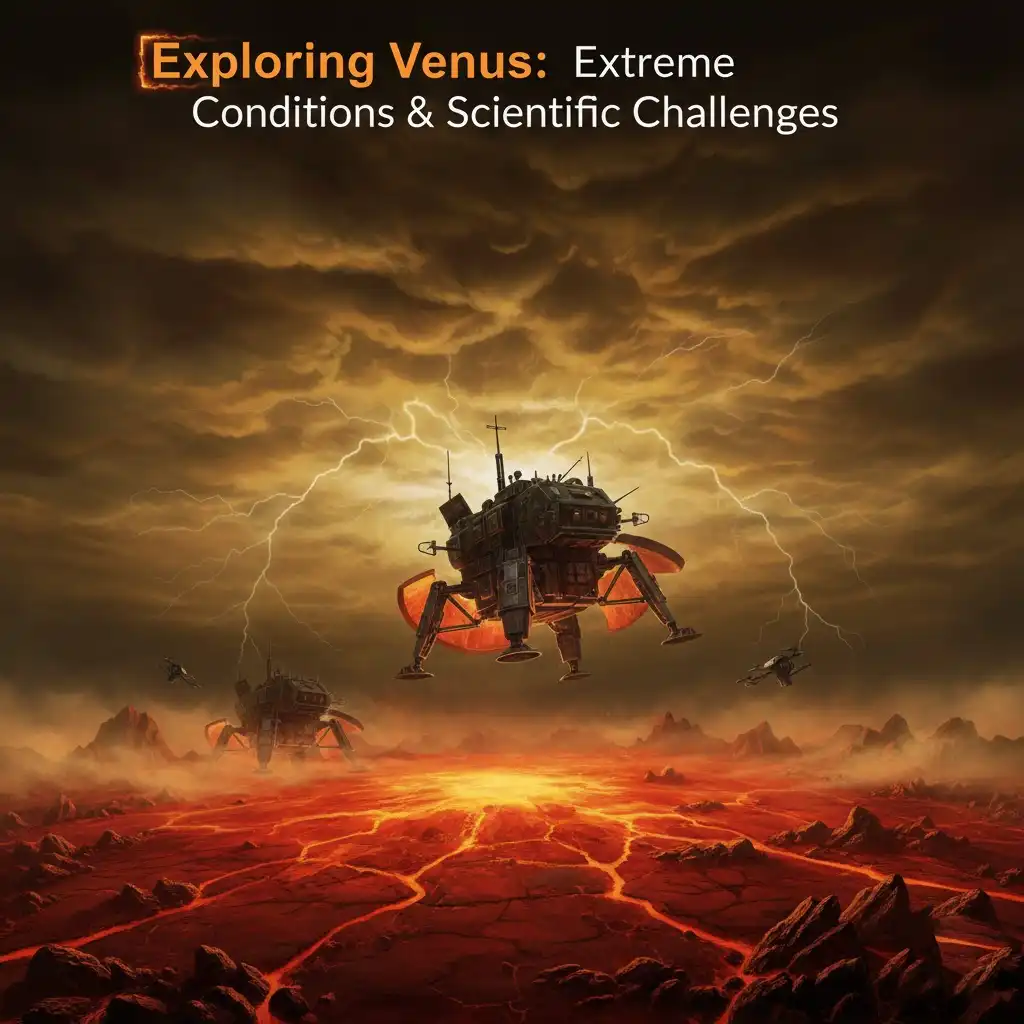
Venus is among the planets in the solar system that exhibit the most extreme conditions. Its intense heat, crushing pressure, and toxic atmosphere make exploration very difficult. Despite these challenges, Venus remains a key target for planetary research.
- Extremely High Surface Temperature: Venus has an average surface temperature of about 464°C, making it the hottest planet in the solar system.
- Crushing Atmospheric Pressure: The surface pressure on Venus is about 92 times higher than Earth’s, similar to deep-ocean conditions.
- Toxic Atmosphere: Venus’s atmosphere is mostly carbon dioxide and contains sulfuric acid clouds that are harmful to life and machines.
- Limited Spacecraft Survival: Most landers sent to Venus survived only a short time due to extreme heat and pressure.
- Unusual Day Length: A single day on Venus is longer than its year because the planet rotates very slowly.
- Scientific Importance: Studying Venus helps scientists understand greenhouse effects and climate evolution on planets.
Science Feels Hard? You’re Not Alone
Mixt Academy’s expert tutors help students simplify complex science topics through 1-to-1 sessions.
The Hottest Planet in Our Solar System is Venus
In conclusion, when people ask which planet is the hottest in the solar system, the correct answer is Venus. Although Mercury is closer to the Sun, it lacks a thick atmosphere to trap heat. Venus, on the other hand, has a dense carbon dioxide atmosphere that creates a strong greenhouse effect, causing extremely high surface temperatures.
This trapped heat keeps Venus consistently hot both day and night. Studying Venus helps scientists better understand planetary atmospheres and climate processes. It also highlights how atmospheric composition plays a more important role than distance from the Sun in determining planetary temperatures. Enjoyed learning which is the hottest planet in the solar system? Read more space, science, and education blogs on Mixt Academy to keep your curiosity growing. Read More.