
Choosing the right post-16 qualification is one of the most important academic decisions a student will make, and for many, the debate comes down to IB vs A Levels. Both pathways are highly respected, academically demanding and widely accepted by leading universities around the world. However, they differ significantly in structure, workload, assessment style and overall learning experience. Also, understanding the differences between the International Baccalaureate Diploma and A Levels is essential before making your choice. At Mixt Academy, we work closely with students and families to help them navigate this decision with clarity and confidence.
In this guide, we break down IB vs A Levels across key areas, including subject choices, difficulty level, grading systems, university recognition and future opportunities, so you can identify the qualification that best aligns with your strengths, interests and long-term goals.
Get expert guidance from Mixt Academy and understand which qualification fits your strengths, goals and university plans.
A Levels are subject-based qualifications typically taken by students aged 16–18. Offered in sixth forms and colleges, A Levels allow you to specialise in 3–4 subjects of your choice, offering deep exploration in specific areas. They are ideal for students with clear academic interests or career goals. A Levels help you:
The IB Diploma Programme is a globally recognised two-year qualification for students aged 16–19. It focuses on developing well-rounded students through a broad curriculum of six subject areas, combined with three unique core components. Instead of narrowing your studies, the IB encourages breadth and depth across disciplines, perfect if you are curious about a range of topics. The IB helps you:
Choosing between the IB vs A Levels means weighing up different learning styles, subject approaches and future goals. Here is how they compare:
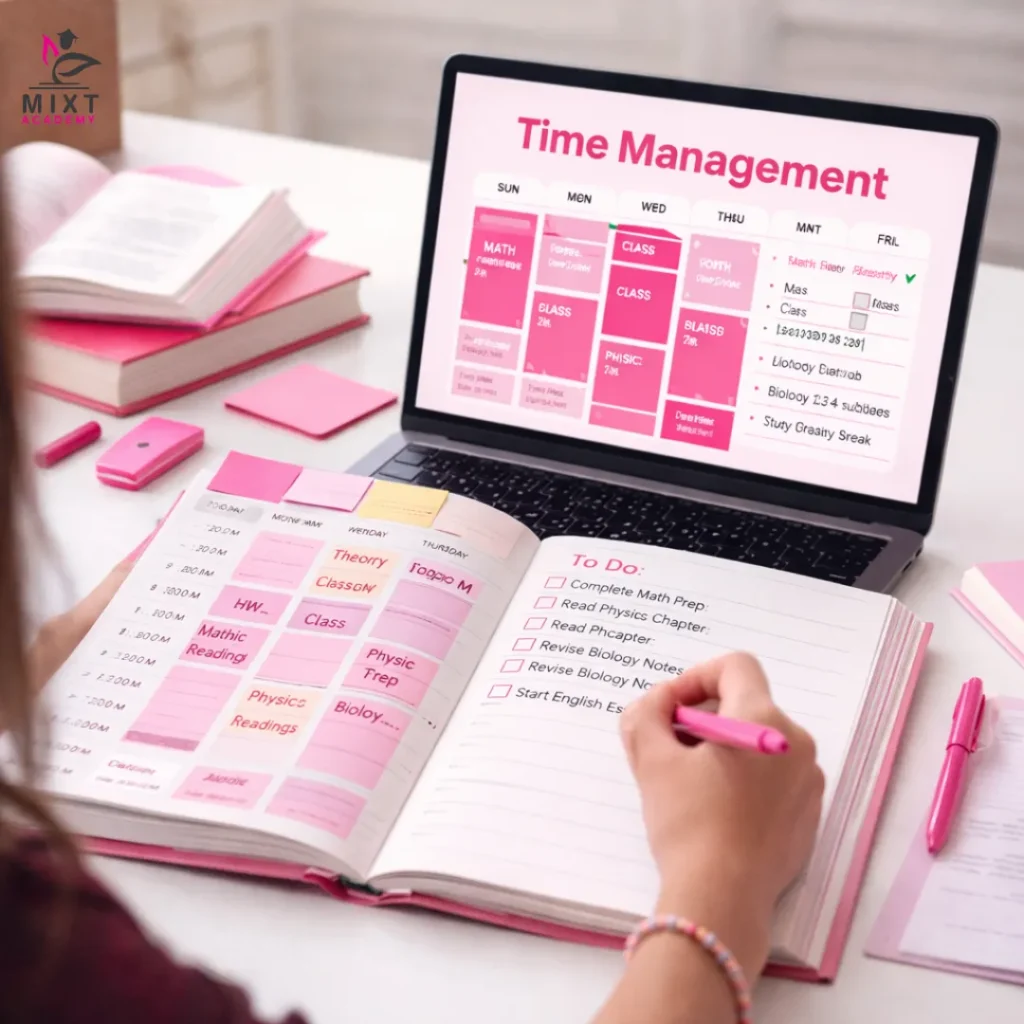
The IB Diploma is widely considered one of the most demanding qualifications at this level. Balancing six subjects, an extended essay, Theory of Knowledge (TOK), and Creativity, Activity, Service (CAS) requires strong organisation and time management. The workload is quite intensive, but with the right approach and support, it is more than manageable.
A Levels are also challenging, but with a more focused scope. You will similarly study your subjects in depth, but you are only studying 3–4 areas. You will need to master complex material and apply analytical skills, but the narrower subject range can allow for more focused revision.
Students benefit from a mix of guided lessons and independent study. There is a lot more flexibility and freedom than with GCSEs, but teachers still provide structured support and frequent check-ins. You will be expected to take accountability for your own learning, so staying motivated is important.
The IB structure is more balanced and requires independence from the outset. However, students often work closely with advisors on core components like the Extended Essay. The collaborative atmosphere means there is support, but you will be expected to manage your time effectively.
One of the key differences between the IB and A Level is how many subjects you will study.
You typically choose four subjects to study at AS Level, with students usually dropping one subject ahead of the second year. This focused approach allows you to specialise early. It is an excellent option for students with clear academic or career plans.
You study six subjects, one from each subject group: Language & Literature, Language Acquisition, Individuals & Societies, Sciences, Maths and the Arts (or a second subject from another group). Three subjects are taken at Higher Level (HL) and three at Standard Level (SL), balancing depth and breadth.
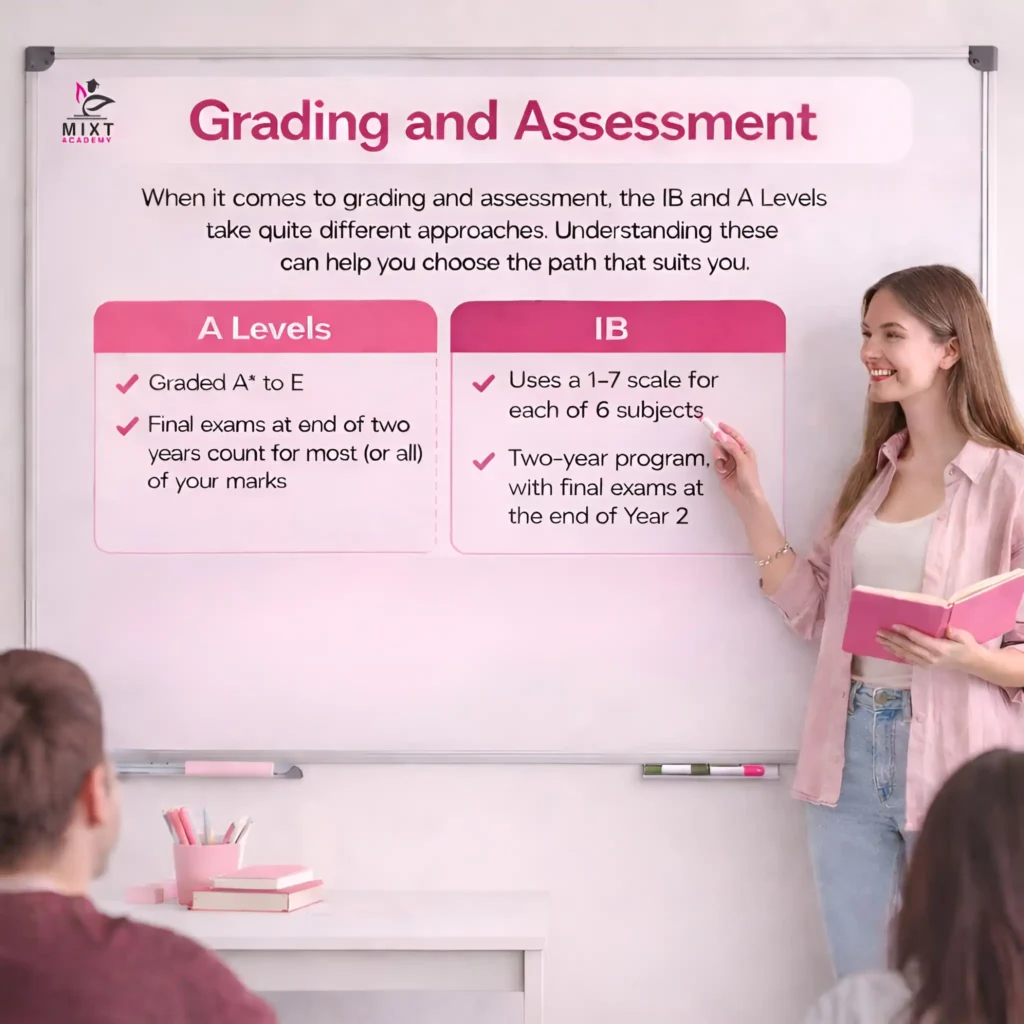
When it comes to grading and assessment, the IB and A Levels take quite different approaches. Understanding these can help you choose the path that suits you best.
A Levels are graded from A* to E, with final exams at the end of two years making up the bulk (or all) of your marks. Some subjects also include coursework or practical assessments.
The IB uses a points system, with each subject graded from 1 to 7 and up to 3 additional points available from the core components: Theory of Knowledge (TOK) and the Extended Essay. That gives a maximum score of 45.
What makes the IB unique is its mix of internal and external assessments, spread throughout the two years, which helps reduce the pressure of one-off exams and rewards consistent effort. Whether you prefer a final exam focus or a more varied assessment style, it is worth considering which structure will play to your strengths.
Again, there are differences in the entry requirements when it comes to enrolling in the IB vs A Levels. Most sixth forms and colleges offering A Levels require:
When it comes to the IB Diploma, the IB itself does not set any entry requirements; this is down to each individual school. Generally, you will need to have achieved decent results in either the Middle Years Programme (MYP) or an equivalent qualification, or you may be required to complete entrance exams.
Both A Levels and the IB Diploma are highly regarded qualifications that can lead to a range of exciting opportunities after sixth form or college. Whether you are aiming to go to university, enter the world of work or apply for an apprenticeship, both qualifications can shape the direction you take.
A-levels are the traditional route to university around the world. Most universities base their offers on three A-level grades. Competitive courses often require specific A Level subjects and top grades.
The IB is recognised by top universities worldwide. The breadth of study, independent research and critical thinking it requires makes it an excellent foundation for higher education. With a strong IB or A Level result, you can:
Get help from expert online mathematics tutors at Mixt Academy today.
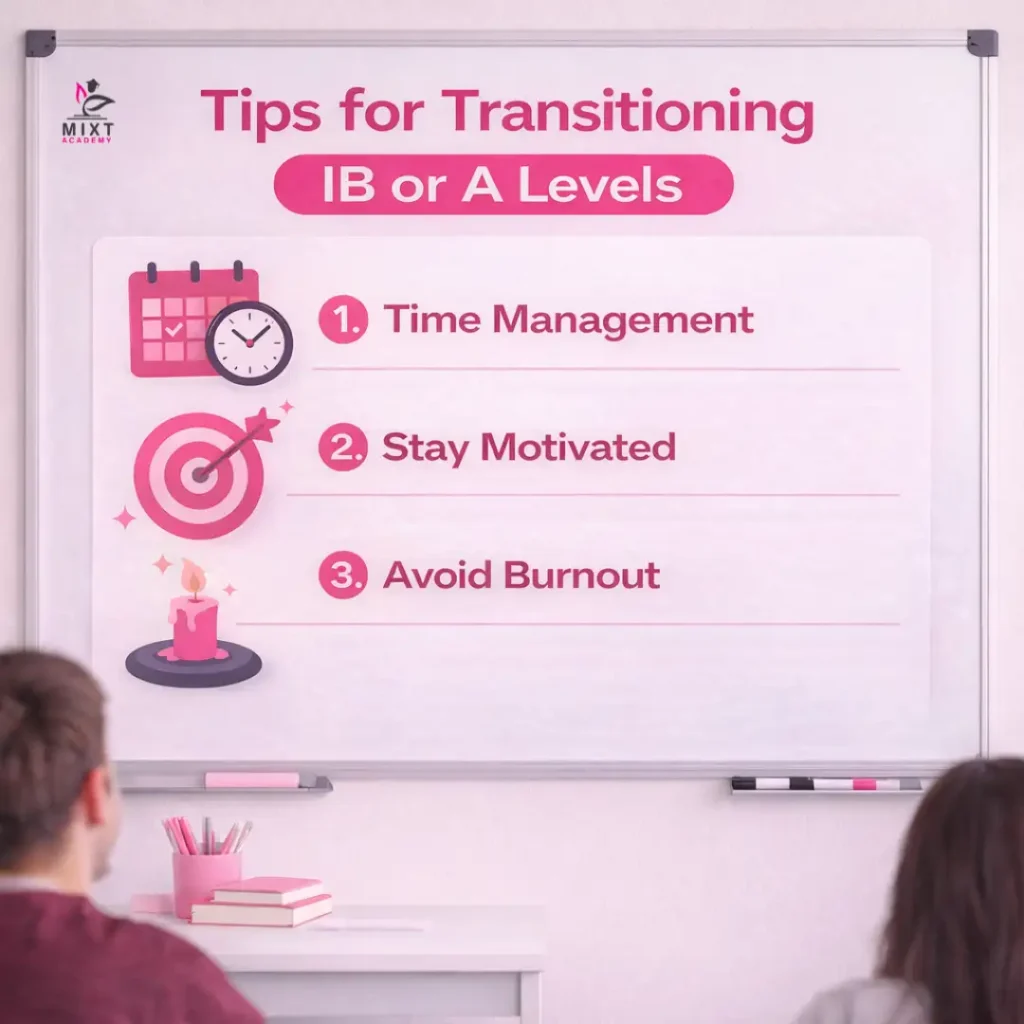
Although both the IB Diploma and A Levels are known for their academic difficulty, they are absolutely manageable, especially with the right mindset and Mixt Academy online support systems that are in place to help you succeed. To help you stay confident and avoid feeling stressed, here are some top tips.
Whether you choose IB or A Levels, time management is essential. Make use of calendars, weekly planners or digital tools to stay on top of deadlines, especially if you are managing coursework or extended projects. Break large tasks into manageable parts, and set specific goals for each study session.
Post-16 education places a greater focus on personal responsibility. If you studied GCSEs or IGCSEs, you are probably used to frequent guidance and reminders from teachers about homework and deadlines.
Without as many structured lessons at IB and A Level, your motivation becomes key. Set meaningful academic and personal goals, like securing a place at your dream university or landing your first job. Track your progress and reflect on wins (big or small) to stay energised.
Burnout can be a risk when it comes to demanding qualifications like the IB and A Levels. Protect your wellbeing with healthy routines, sleep, exercise and downtime. Use the Pomodoro technique or similar methods to build focus and schedule regular breaks. If stress builds up and you begin to feel challenged, remember that your teachers and school counsellors are there to support you.
Thinking about how IB results convert to A Level grades? While exact conversions may vary slightly by institution, this table reflects standard benchmarking used by UCAS and many universities:
IB Score (Per Subject) | A Level Equivalent |
7 | A* |
6 | A |
5 | B |
4 | C |
3 | D/E (below standard offer) |
1–2 | U (ungraded) |
Complete Diploma Comparison (out of 45)
Total IB Points | Typical A Level Equivalent |
43–45 | A*AA (or above) |
38–42 | A*AA to AAA |
34–37 | AAA to AAB |
30–33 | ABB to BBB |
27–29 | BBC to BCC |
24 (minimum pass) | Around CCC |
Join Mixt Academy for personalised IB and A Level support designed to boost results and reduce stress.
When it comes to IB vs A Levels, there is no single better option, only the one that suits you best. Both qualifications are academically challenging, highly respected by universities and capable of opening doors to competitive courses and global opportunities. A Levels offer depth, focus and early specialisation, making them ideal for students with clear academic or career ambitions. The IB Diploma, on the other hand, promotes balance, independence and international-mindedness through its broad subject range and unique core components.
Ultimately, your success will depend less on the qualification itself and more on your learning style, motivation and ability to manage workload effectively. With the right guidance and preparation, both pathways are entirely achievable. At Mixt Academy, we support students throughout their academic journey, from choosing between IB and A Levels to building strong study habits, subject confidence and university readiness. Whichever path you take, making an informed decision today can shape your academic future for years to come.
One-to-one online tutoring to master IB subjects, improve exam confidence, and stay ahead
Neither qualification is better than the other; they suit different learning styles and goals. Both are highly respected by top universities in the world. IB may be more suited to you if you want a balanced, global education across subjects. On the other hand, A Levels are ideal if you want to specialise early on.
Both are academically tough, but they differ significantly in structure, expectations and workload. The IB requires students to study more subjects across a broader range, and includes unique components such as the TOK, CAS and Extended Essay. A Levels can be just as challenging and require the same level of analytical reasoning and critical thinking.
Yes, but usually only early in Year 12. Schools will assess your ability to handle the workload and may require catching up on core IB components.
Universities widely accept the IB Diploma; entry requirements vary depending on the course, so it is important to check individual criteria. Most universities require an IB score of around 34-36 points for undergraduate programmes, while more competitive universities can require a score of around 38-42 points.
IB subjects are graded 1–7. A full IB Diploma score (out of 45) roughly converts to A Level grades, e.g., 38–42 IB points ≈ A*AA to AAA.
A-level entry requirements also vary depending on what you are studying and where you are studying. For a competitive undergraduate course such as Medicine, you will typically need three A Levels with grades A*AA or AAA, including Chemistry and usually Biology.
A Levels are mostly final exams with some coursework. IB uses a mix of internal and external assessments over two years, plus final exams.

Mixt Academy is a global online tutoring platform that connects students with expert IGCSE, GCSE, and A-Level tutors for one-to-one learning. With flexible scheduling, personalized lesson plans, and experienced teachers from top curricula, Mixt Academy helps students strengthen concepts, improve exam skills, and achieve higher grades with confidence.

Understanding Units and Dimensions of Physical Quantities A physical measurement…
IGCSE Physics Formula Sheet: Key Formulas for 0625 & Edexcel…
IGCSE Chemistry Papers: Common Mistakes & Exam Tips This IGCSE…
IGCSE Extended vs Core Tiers: How to Pick the Right…
GCSE vs A-Levels Student Friendly Guide Selecting educational credentials is…
Understanding GCSE Grade Boundaries and How to Prepare? Grade boundaries…
Differences GCSE English Language vs English Literature GCSE English is…
A Level vs AP: Complete Guide to Choosing the Right…
Top Benefits of Completing AS and A Levels Privately Explore…
Cambridge vs IB Guide to Choosing the Best Curriculum Choosing…
IB vs A Levels: Which Qualification Is Right for You?…
How to Use OCR Past Papers for Effective Revision? Past…
AQA Physics Equation Sheet: Complete GCSE Guide for Combined Science…
AQA vs Edexcel Complete GCSE Comparison and Guide Choosing between…
Complete Guide to the AQA GCSE Chemistry Specification Understanding the…
Hire an Expert Tutor from Just 15$/hr