Understanding the power equation is a key step in mastering physics, as it explains how quickly work is done or energy is transferred in a system. This concept plays an essential role in topics ranging from mechanics to electricity and everyday technological applications.
At Mixt Academy, we simplify the power equation by breaking it into clear, easy-to-follow explanations supported by real-world examples. Whether you are a student preparing for exams or someone strengthening foundational physics knowledge, our approach makes learning both effective and engaging.
In this blog, you will learn the power equation in physics, how to apply it correctly, and why it matters, helping you build confidence and accuracy in problem-solving.
Power functions in physics as a measurement system because it shows how fast work advances throughout time, which measures energy transfer. Power functions as a scalar quantity because it possesses size attributes but lacks directional components. The watt (W) serves as the primary power measurement unit because 1 watt equals 1 joule per second (J/s).
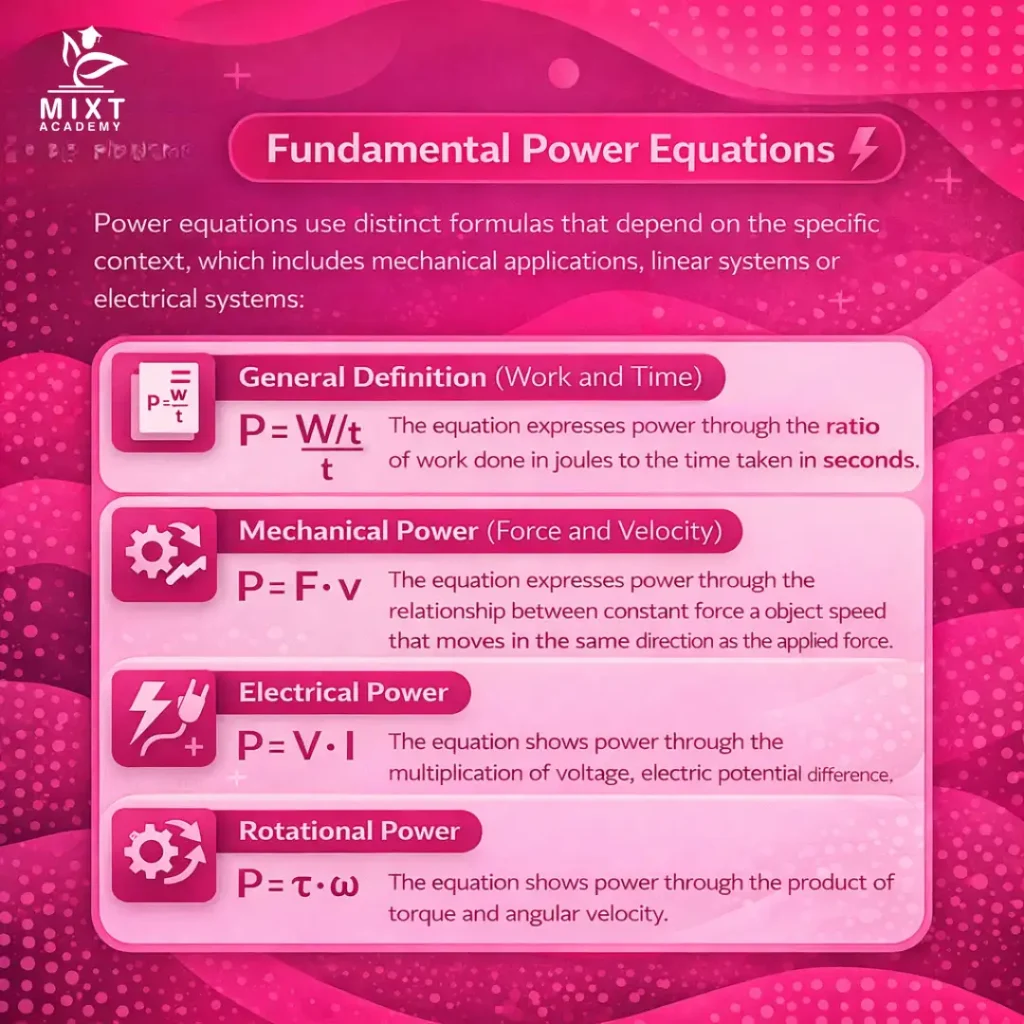
Power equations use distinct formulas that depend on the specific context, which includes mechanical applications, linear systems or electrical systems:
The SI unit for power measurement uses the watt as its standard unit, which people commonly use alongside these standard measurement alternatives:
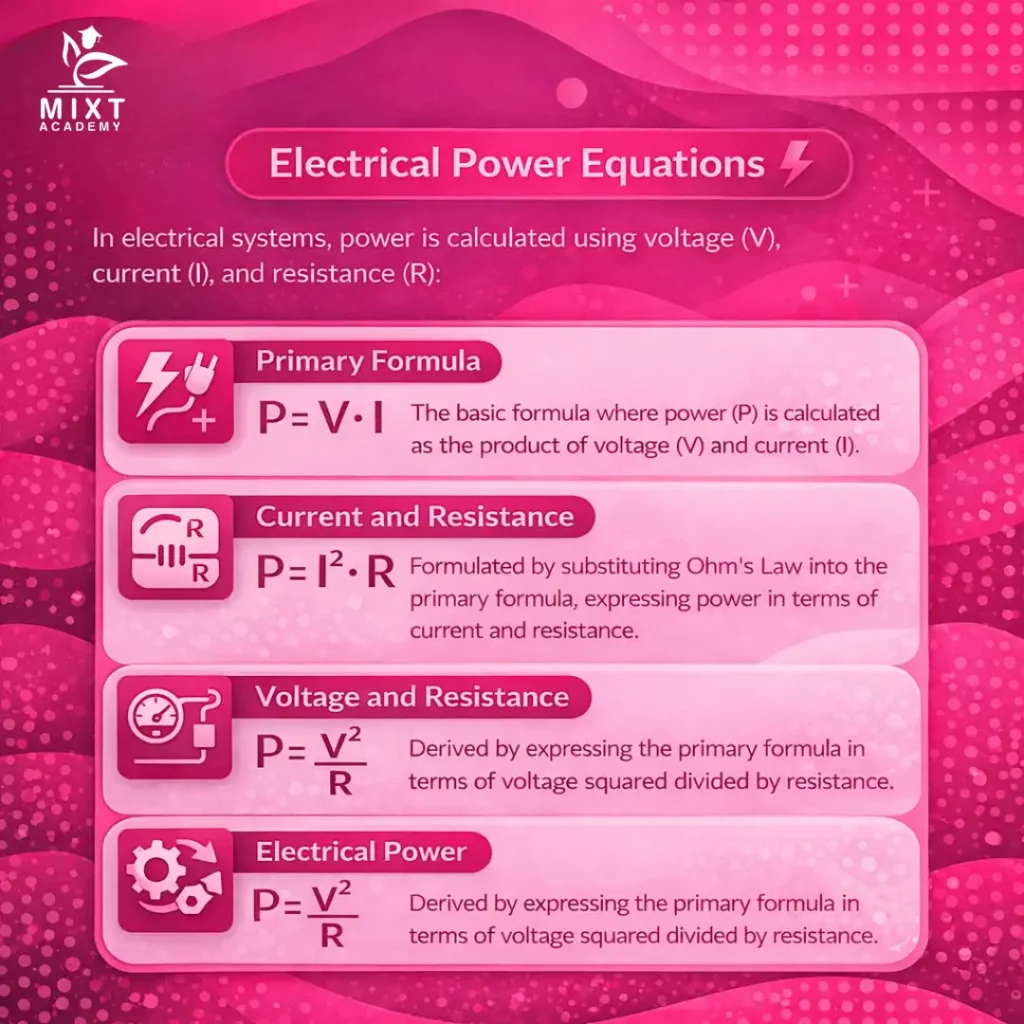
In electrical systems, power is calculated using voltage (𝑉), current (𝐼), and resistance (𝑅):
With Mixt Academy online tutoring, students receive expert guidance and personalised support to master power equations efficiently.
Symbol | Quantity | SI Unit |
P | Power | Watt (W) |
W | Work | Joule (J) |
t | Time | Second (s) |
F | Force | Newton (N) |
v | Velocity | m/s |
V | Voltage | Volt (V) |
I | Current | Ampere (A) |
R | Resistance | Ohm (Ω) |
Power plays an essential role in our everyday lives by measuring how quickly work is done or energy is used. Some common real-life applications of power include:
Students often lose marks in physics due to small but avoidable errors when solving numerical and theoretical questions on power. Some of the most common mistakes include:
Struggling to master the power equation in physics? Mixt Academy online tutors provide step-by-step explanations, real-life examples, and personalised support to help you understand mechanical, electrical, and rotational power formulas. Start practising effectively today, avoid common mistakes, and build confidence to excel in your Class 9–12 physics exams. Book your free demo now!
Power in physics measures how quickly work is done, or energy is transferred. It is a scalar quantity with the SI unit watt (W). Key formulas include:
Power can be average or instantaneous, and common units also include horsepower (hp) and kilowatt-hours (kWh). Real-life applications range from electrical appliances and engines to sports and renewable energy.
Avoiding common mistakes, like confusing power with energy or using the wrong units, ensures accuracy. Mastering these concepts provides a strong foundation for exams and practical physics.
For Class 9 and 10, power is generally calculated using the formula P = W / t, where P is power, W is work done, and t is the time taken. Mechanical power can also be calculated using P = F · v.
Electrical power can be calculated using P = V · I, or with resistance using P = I²R or P = V² / R. These formulas are frequently used in power formula electricity problems for Class 11 and 12.
Power is used in appliances, car engines, industrial machines, sports, and renewable energy systems. For example, a fan rated at 100 W consumes 100 joules of energy per second. With Mixt Academy online physics tutors, students can understand these concepts clearly and apply them in numericals and exams.
Average power is the total work done divided by the total time (P = ΔW / Δt), while instantaneous power is the power at a specific moment (P = dW / dt). Both are important in the power equation in physics examples.

Mixt Academy is a global online tutoring platform that connects students with expert IGCSE, GCSE, and A-Level tutors for one-to-one learning. With flexible scheduling, personalized lesson plans, and experienced teachers from top curricula, Mixt Academy helps students strengthen concepts, improve exam skills, and achieve higher grades with confidence.

IGCSE Physics Formula Sheet: Key Formulas for 0625 & Edexcel…
IGCSE Chemistry Papers: Common Mistakes & Exam Tips This IGCSE…
IGCSE Extended vs Core Tiers: How to Pick the Right…
Understanding GCSE Grade Boundaries and How to Prepare? Grade boundaries…
Differences GCSE English Language vs English Literature GCSE English is…
What is GCSE? A Guide for International Students & Parents…
A Level vs AP: Complete Guide to Choosing the Right…
Top Benefits of Completing AS and A Levels Privately Explore…
Cambridge vs IB Guide to Choosing the Best Curriculum Choosing…

IB vs A Levels: Which Qualification Is Right for You?…
How to Use OCR Past Papers for Effective Revision? Past…
AQA Physics Equation Sheet: Complete GCSE Guide for Combined Science…
AQA vs Edexcel Complete GCSE Comparison and Guide Choosing between…
Complete Guide to the AQA GCSE Chemistry Specification Understanding the…
Hire an Expert Tutor from Just 15$/hr