This article will show you the factors of 30 as pairs and primes using the division method and prime factorisation, all explained very simply.
Looking for a Personal Math Tutor to Boost Your Skills?
Table of Contents
Factors of 30 Explained
The factors of 30 are termed as the whole numbers that do not leave any remainder when divided by 30, and vice versa. Being a whole number that is even and composite, 30 can be divided by more than just the numbers 1 and 30. The factors of 30 are the numbers: 1, 2, 3, 5, 6, 10, 15, and 30, which make up the whole list of factors.
- Factors of 30: 1, 2, 3, 5, 6, 10, 15, 30
- Prime Factorisation of 30: 2 × 3 × 5
Understanding the factors of 30 helps in determining how it can be divided or mixed into smaller numbers.
30 Pair Factors
The pair of factors of 30 indicates two particular numbers such that upon multiplying the two, the result is equal to 30. These factors could also be negative since the multiplication of two negative numbers always results in a positive number.
|
Negative Pair Factors 30
|
| −1 × −30 |
(−1, −30) |
| −2 × −15 |
(−2, −15) |
| −3 × −10 |
(−3, −10) |
| −5 × −6 |
(−5, −6) |
The pairs of positive factors of 30 include (1, 30), (2, 15), (3, 10), and (5, 6), and the pairs of negative factors are (−1, −30), (−2, −15), (−3, −10), and (−5, −6).
Finding the Factors of 30 Using the Division Method
Identifying the factors of 30 is quite easy if we use the division method, which consists of continuously dividing 30 by different integers. A divisor is said to be a factor of 30 if it divides 30 and leaves no remainder, which is the case here.
| Quotient |
Remainder |
| 30 ÷ 1 = 30 |
Remainder 0 |
| 30 ÷ 2 = 15 |
Remainder 0 |
| 30 ÷ 3 = 10 |
Remainder 0 |
| 30 ÷ 5 = 6 |
Remainder 0 |
| 30 ÷ 6 = 5 |
Remainder 0 |
| 30 ÷ 10 = 3 |
Remainder 0 |
| 30 ÷ 15 = 2 |
Remainder 0 |
| 30 ÷ 30 = 1 |
Remainder 0 |
When 30 is divided by any number other than 1, 2, 3, 5, 6, 10, 15, or 30, a remainder is produced. Therefore, these are the only factors of 30.
Factors of 30: 1, 2, 3, 5, 6, 10, 15, 30
Do You Want a Personal Math Tutor Assistant?
Mixt Academy offers a personal math tutor assistant to help students understand concepts, solve problems, and improve their math skills effectively.
Prime Factorisation of 30
Since 30 is a composite number, it can be expressed as a product of prime numbers.
- Start by dividing 30 by the smallest prime number, 2: 30 ÷ 2 = 15
- The result, 15, is not divisible by 2, so move to the next prime number, 3: 15 ÷ 3 = 5
- Finally, divide 5 by 5: 5 ÷ 5 = 1
- Once we reach 1, the process stops.
- Prime Factorisation of 30: 30 = 2 × 3 × 5, where all the factors are prime numbers.
List All the Composite Factors of 30
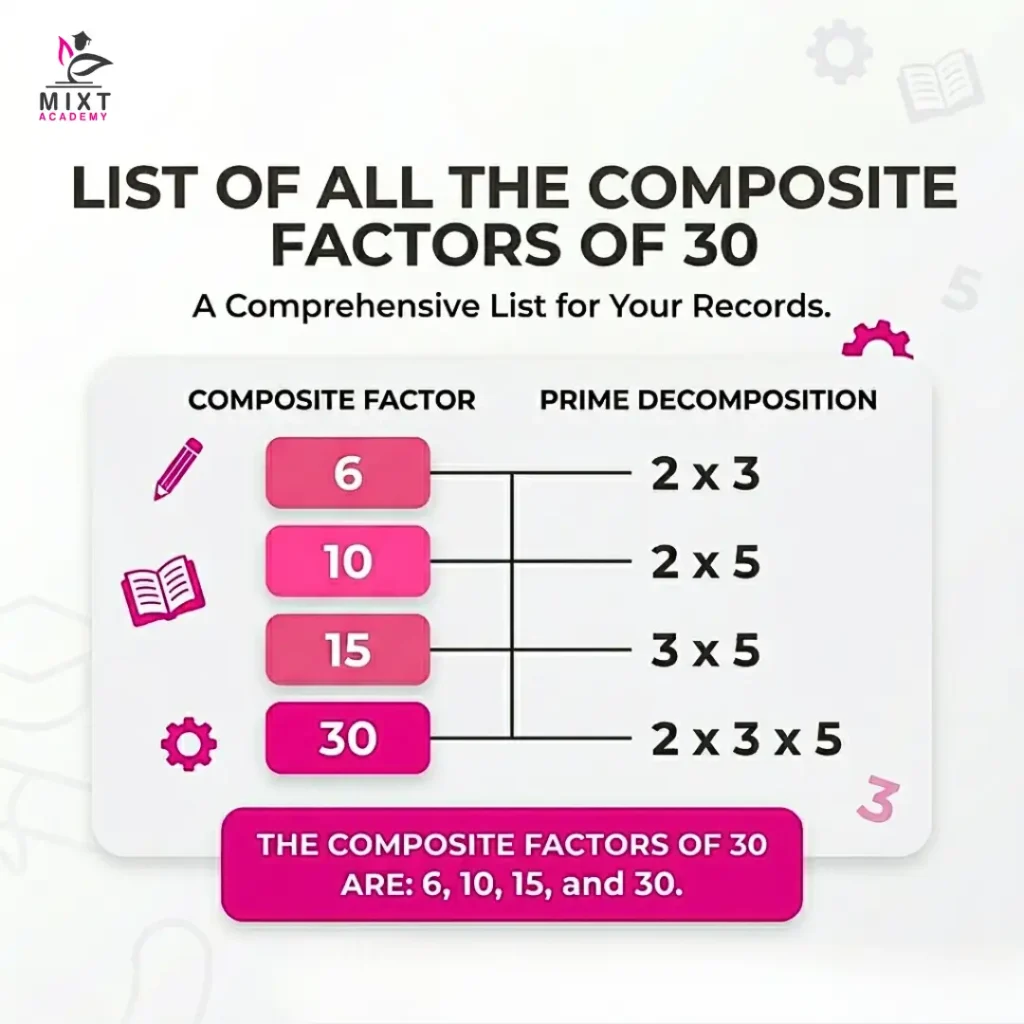
The composite factors of a number are the factors that are not prime and greater than 1. For 30, the factors are: 1, 2, 3, 5, 6, 10, 15, 30. Among these, the prime factors are 2, 3, and 5. So, the composite factors of 30 are: 6, 10, 15, 30. These are all the factors of 30 that are not prime. Clear table showing all factors of 30, indicating which are prime and which are composite, below:
| Factor of 30 | Type |
| 1 | Neither |
| 2 | Prime |
| 3 | Prime |
| 5 | Prime |
| 6 | Composite |
| 10 | Composite |
| 15 | Composite |
| 30 | Composite |
Note: 1 is neither prime nor composite. This table makes it easy to identify prime vs composite factors of 30 at a glance.
Solved Examples on Common Factors of 30
Example 1: Find the common factors of 30 and 20
- Factors of 30 = 1, 2, 3, 5, 6, 10, 15, 30
- Factors of 20 = 1, 2, 4, 5, 10, 20
Common Factors: 1, 2, 5, 10
Example 2: Find the common factors of 30 and 17.
- Factors of 30 = 1, 2, 3, 5, 6, 10, 15, 30
- Factors of 17 = 1, 17
Common Factor: 1 (since 17 is a prime number)
Example 3: Find the common factors of 30 and 6.
- Factors of 30 = 1, 2, 3, 5, 6, 10, 15, 30
- Factors of 6 = 1, 2, 3, 6
Common Factors: 1, 2, 3, 6
What Can We Learn About the Factors of 30?
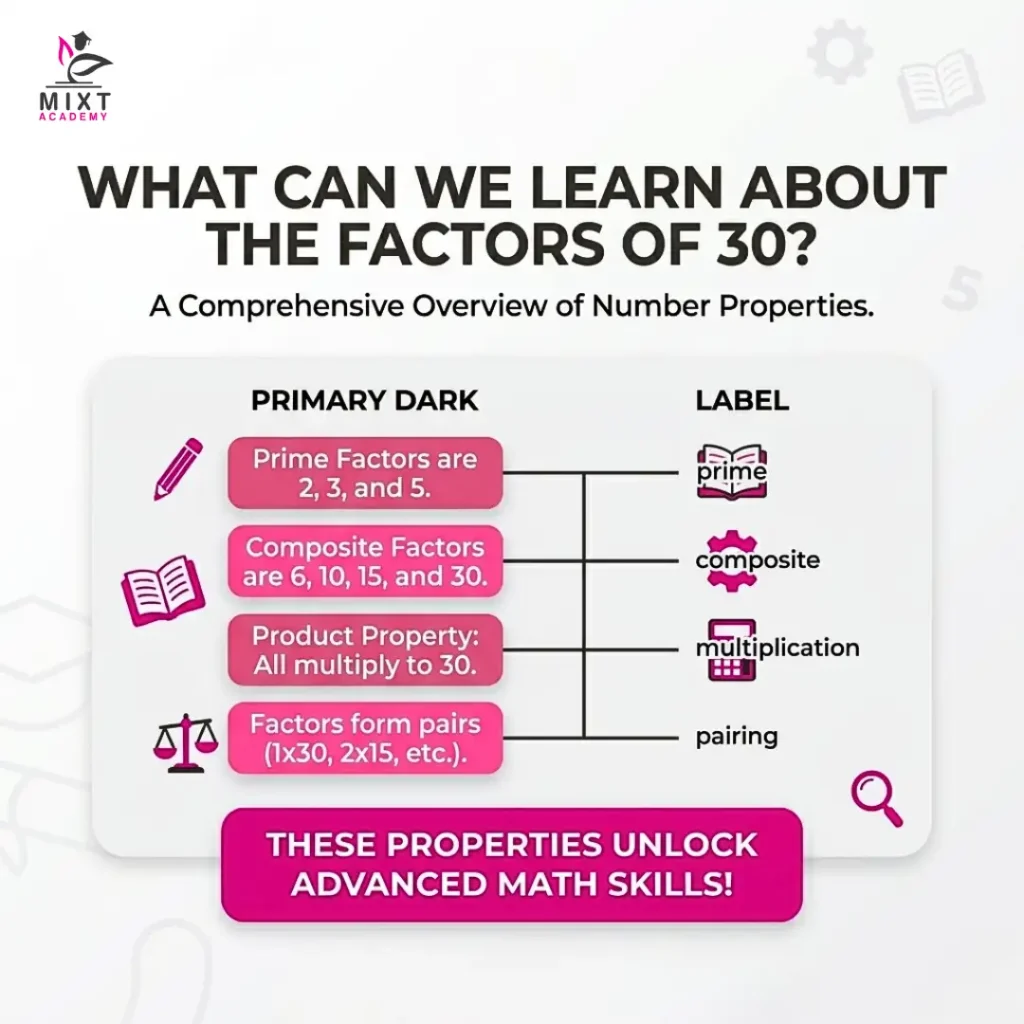
Understanding the factors of 30 helps in breaking the number into smaller, manageable parts. The factors of 30 are 1, 2, 3, 5, 6, 10, 15, and 30, while its prime factorisation is 2 × 3 × 5. We can also identify positive and negative pair factors, such as (1, 30) and (-5, -6).
Using methods like the division method or prime factorisation, we can solve problems involving common factors with other numbers. Learning these concepts makes it easier to handle real-life applications like grouping objects or dividing items evenly.
FAQs?