
Selecting educational credentials is a vital decision that all students must make throughout their education in the United Kingdom. Your selected pathways determine your upcoming studies and your access to college, apprenticeship, and employment opportunities. Understanding the difference between GCSEs and A-Levels is important because both are crucial educational qualifications.
GCSEs and A Levels are two distinct educational qualifications that serve different academic functions. One builds a broad foundation, while the other focuses on depth, independence and preparation for higher education. For students and their parents who are entering the education system for the first time, the transition between these two stages can be challenging.
In this guide, Mixt Academy professionals break down GCSEs vs A Levels in clear, simple terms. You’ll learn how they differ in difficulty, workload, grading, assessment and future opportunities so that you can make informed and confident decisions about the next stage of education.
Personalised online lessons with experienced tutors to help students excel in GCSEs and A-Levels.
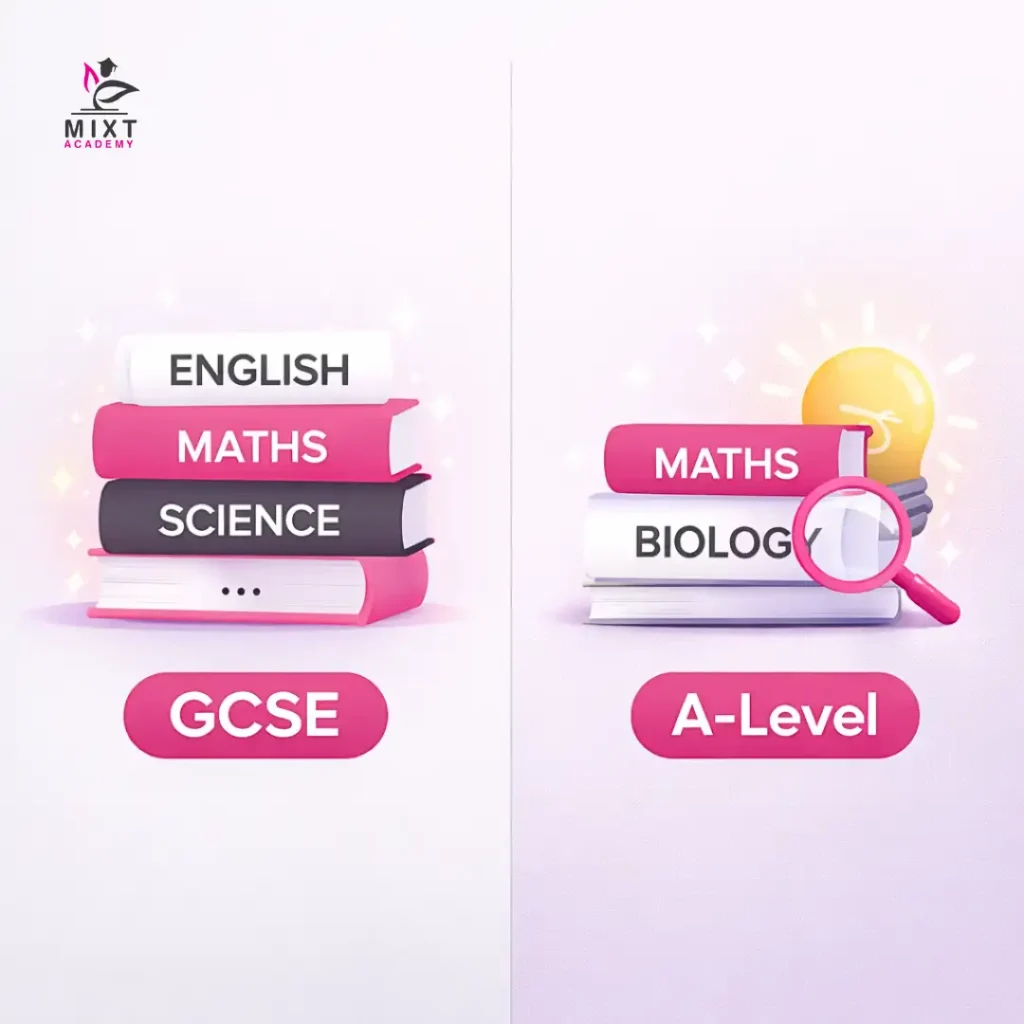
Before we compare GCSEs and A Levels, we must first explain the purpose of each qualification and its place within the UK education system.
Students in England, Wales, and Northern Ireland take GCSEs (General Certificate of Education) during Years 10 and 11, when they are 15 to 16. The exams mark the completion of compulsory secondary education and signal the start of the first major national examination period, which concludes with these exams.
GCSEs are educational assessments that help students acquire broad-based academic knowledge. Students typically complete 8 to 10 subjects, typically including the following:
This broad range of subjects allows students to explore different areas, identify strengths and interests, and develop essential skills such as literacy, numeracy, and problem-solving.
GCSE qualifications play a crucial role because they:
Strong GCSE results keep future options open. Even if a student does not plan to attend university, GCSEs remain valuable academic qualifications in the UK and internationally. If you want a deeper breakdown, see our guide What is GCSE? A Guide for International Students & Parents
A Levels (Advanced Levels) are qualifications taken after GCSEs, usually in sixth form or further education college during Years 12 and 13 (ages 16–18). They are more advanced than GCSEs and are designed to prepare students for higher education and specialised career paths.
Unlike GCSEs, A Levels focus on depth rather than breadth. Most students study:
Each subject is studied in much greater detail, with a stronger emphasis on independent learning, analysis and critical thinking.
A Levels are especially important because they:
For most UK universities, A-level results carry more weight than GCSEs, particularly when making offers for specific courses.
Our tutors guide students through complex topics, revision planning and exam preparation.
Moving from GCSEs to A Levels is a major transition. While both are academic qualifications regulated by bodies such as Ofqual and overseen by the Department for Education (DfE), they differ significantly in structure, difficulty, assessment and expectations.
Feature | GCSEs | A Levels |
Age taken | 15–16 (Years 10–11) | 16–18 (Years 12–13) |
Number of subjects | 8–10 | 3–4 |
Level of study | Broad and foundational | In-depth and advanced |
Teacher support | High and structured | More independent |
Assessment | Exams plus some coursework | Mostly final exams |
Grading system | 9–1 | A*–E |
One of the most common questions students ask is: Are A Levels harder than GCSEs? The simple answer is yes, but for good reason.
GCSEs focus on building core knowledge and essential skills across a wide range of subjects. Lessons are structured, content is clearly defined, and students receive regular guidance from teachers. While GCSEs are challenging, they are designed to help learners develop study habits and exam skills.
A-levels require a much deeper understanding of fewer subjects. Students are expected to:
Tip: Staying organised from the start of Year 12 makes a big difference later on.
GCSEs are highly structured, while A Levels require more independence. At GCSE, teachers closely guide your learning with:
At A-Level, you typically have fewer taught lessons and more free periods. This time is expected to be used for independent study, consolidation and wider reading.
Teachers are still available for help, but success depends much more on self-motivation, time management and responsibility. Learning to manage this independence is one of the most important skills A Levels develop.
Mixt Academy provides quality online lessons with personalised support to help you achieve your academic goals.
GCSEs offer breadth; A Levels focus on depth.
Most students study 8–10 GCSE subjects, including core subjects such as English, maths, and science, as well as optional subjects. This broad approach helps students discover their strengths and interests. At A Level, the number of subjects reduces. Most students:
This allows for much deeper study. For example, A Level History focuses less on memorising facts and more on evaluating sources, building arguments and writing extended essays. The same increase in depth applies across subjects such as maths, sciences and English Literature.
GCSEs and A Levels use different grading systems and assessment methods.
GCSE Grading System
Many sixth forms require at least five GCSE passes at grade 4 or above, including English and maths.
GCSE Assessment Usually Includes
A Level Grading System
A Level Assessment Typically Includes
In most cases, GCSEs are required to take A Levels. Typical entry requirements include:
Requirements vary by sixth form college, further education college and subject, so it’s important to check individual policies.
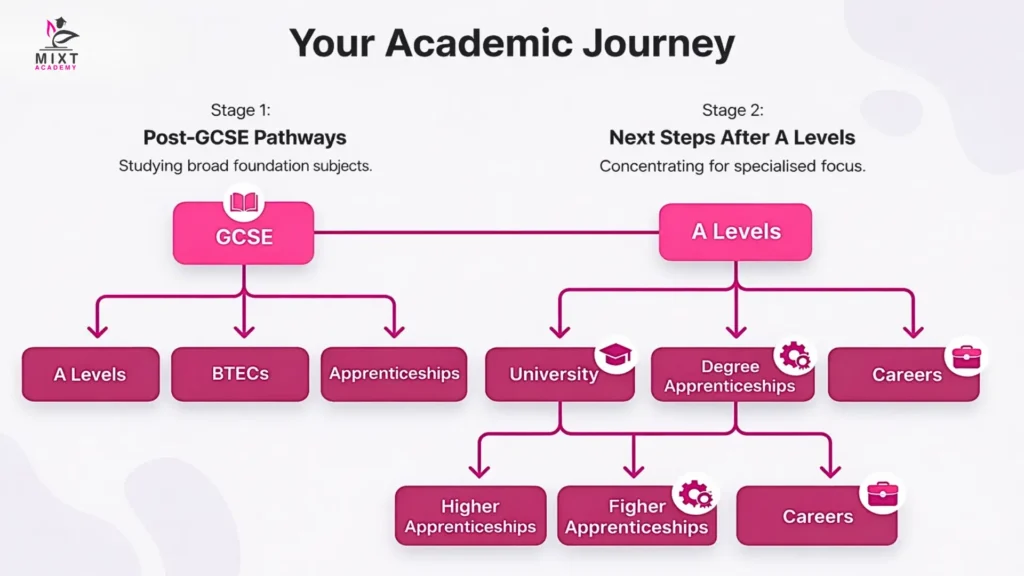
GCSEs open doors; A Levels shape long-term options.
After GCSEs, students may progress to:
GCSE grades, especially in English and maths, are often checked by employers and universities, even years later. A Levels are more specialised and play a major role in:
Many competitive degree courses and professions, including medicine, law, engineering and psychology, require specific A Levels and high grades.
Give your child the support they need to succeed in GCSEs and A Levels. Mixt Academy offers structured online lessons, expert tutors, and guidance on choosing the right subjects for sixth form or further education. With our affordable programs, your child can gain the skills, confidence, and results they need to succeed at top universities and in future careers.
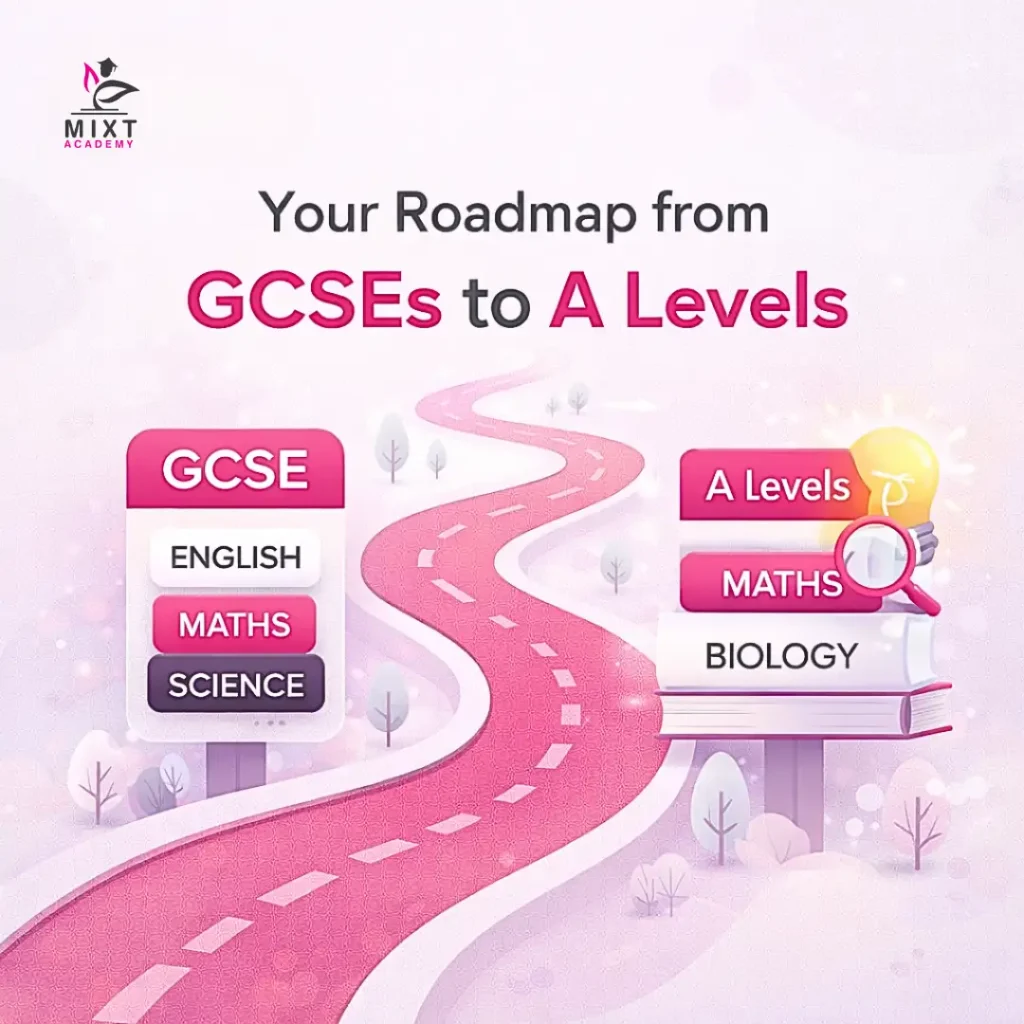
GCSEs and A Levels are both vital qualifications in the UK education system, each serving a distinct purpose at different stages of learning. While GCSEs provide a broad academic foundation and help keep future options open, A Levels focus on depth, independence, and preparation for higher education or specialised careers.
Understanding the differences between the two enables students to choose the right subjects and adjust to increased workloads. In addition, plan confidently for the next stage of their education.
With the right guidance and support, the transition from GCSEs to A Levels can be a smooth, empowering, and rewarding experience. Whether you’re preparing for GCSEs, selecting A Level subjects, or planning your academic path, Mixt Academy is here to provide expert support and guidance every step of the way.
GCSE courses follow a structured curriculum that builds core knowledge across a broad range of subjects. They offer limited scope for personal expression or creative exploration. In contrast, A Levels allow students to go deeper into chosen subjects and develop their own ideas, particularly in creative fields such as the arts, literature, and design. This provides more opportunities to showcase individuality, critical thinking, and advanced skills.
Mixt Academy offers personalised online lessons to guide students from GCSE to A Level, helping them adapt to increased workloads and deeper study. Expert tutors provide structured support in core and optional subjects, help students choose A Level subjects, and prepare them for exams using the latest syllabus.
The GCSE syllabus outlines the content and skills students are expected to learn for the UK's General Certificate of Secondary Education. It covers core subjects such as English, Maths, and Science, along with a wide range of optional subjects across the humanities, arts, languages, and technology.
The A-Level syllabus is designed to provide in-depth study in specific subjects, preparing students for higher education and specialised careers. Students usually focus on three or four subjects, such as Mathematics, Sciences, Humanities, Languages, or Arts, depending on their interests and university goals. Each syllabus is set by exam boards such as Edexcel, AQA, OCR, and Cambridge, and is regularly updated to reflect current academic standards.
GCSEs build a broad foundation with structured lessons and teacher support, while A Levels are more demanding, focusing on fewer subjects, independent study, and deeper analysis. The step-up in workload, complexity, and self-motivation prepares students for higher education and helps them develop critical thinking and organisation skills.

Mixt Academy is a global online tutoring platform that connects students with expert IGCSE, GCSE, and A-Level tutors for one-to-one learning. With flexible scheduling, personalized lesson plans, and experienced teachers from top curricula, Mixt Academy helps students strengthen concepts, improve exam skills, and achieve higher grades with confidence.

Understanding Units and Dimensions of Physical Quantities A physical measurement…
Ultimate Guide to Vocabulary Building Techniques for Effective Language Learning…
IGCSE Physics Formula Sheet: Key Formulas for 0625 & Edexcel…
IGCSE Chemistry Papers: Common Mistakes & Exam Tips This IGCSE…
IGCSE Extended vs Core Tiers: How to Pick the Right…
GCSE vs A-Levels Student Friendly Guide Selecting educational credentials is…
Understanding GCSE Grade Boundaries and How to Prepare? Grade boundaries…
Differences GCSE English Language vs English Literature GCSE English is…
A Level vs AP: Complete Guide to Choosing the Right…
Top Benefits of Completing AS and A Levels Privately Explore…
Cambridge vs IB Guide to Choosing the Best Curriculum Choosing…
IB vs A Levels: Which Qualification Is Right for You?…
How to Use OCR Past Papers for Effective Revision? Past…
AQA Physics Equation Sheet: Complete GCSE Guide for Combined Science…
AQA vs Edexcel Complete GCSE Comparison and Guide Choosing between…
Complete Guide to the AQA GCSE Chemistry Specification Understanding the…
Hire an Expert Tutor from Just 15$/hr