
Studies show that one in three students relies on ineffective revision habits, such as cramming and massed study, while studying notes and highlighting text. The methods provide an illusion of control but do not improve actual memory holding.
Social media trends and unqualified tutors spread misinformation about effective methods, leading to widespread misconceptions. Students need to learn evidence-based revision strategies from professional educators, as these are the most effective way to learn revision techniques. The instructional guide identifies which revision methods to avoid and which to use with caution, based on our experienced tutors’ guidance.
While these methods add value to learning, active recall and spaced practice deliver better results and should be the primary study methods. Let’s explore these poor revision techniques in detail and understand which revision methods truly boost learning and retention.
Join Mixt Academy today and ensure your grades from C to A&A*.
When preparing for exams, some of our habits can be more harmful than helpful. Here’s a checklist of 14 common revision pitfalls that you must avoid to ensure your success!
Simply rereading textbooks or notes is ineffective because it gives a false sense of understanding. Active engagement improves comprehension, retention, and enjoyment of learning. In contrast, passive reading does not enhance recall or problem-solving, so knowledge is quickly forgotten and revision becomes inefficient.
Solution of Passive Reading that Leads to Success
To truly learn, students should actively engage with the material by:
Use self-testing: Quiz yourself on key points instead of just rereading.
Highlighting all the content in textbooks or notes defeats its purpose, because nothing stands out as important. For example, if a student highlights every sentence in a chapter on photosynthesis, they won’t easily distinguish the main steps from minor details. This habit promotes passive rereading rather than active recall, making revision inefficient and causing key details to be easily forgotten during exams.
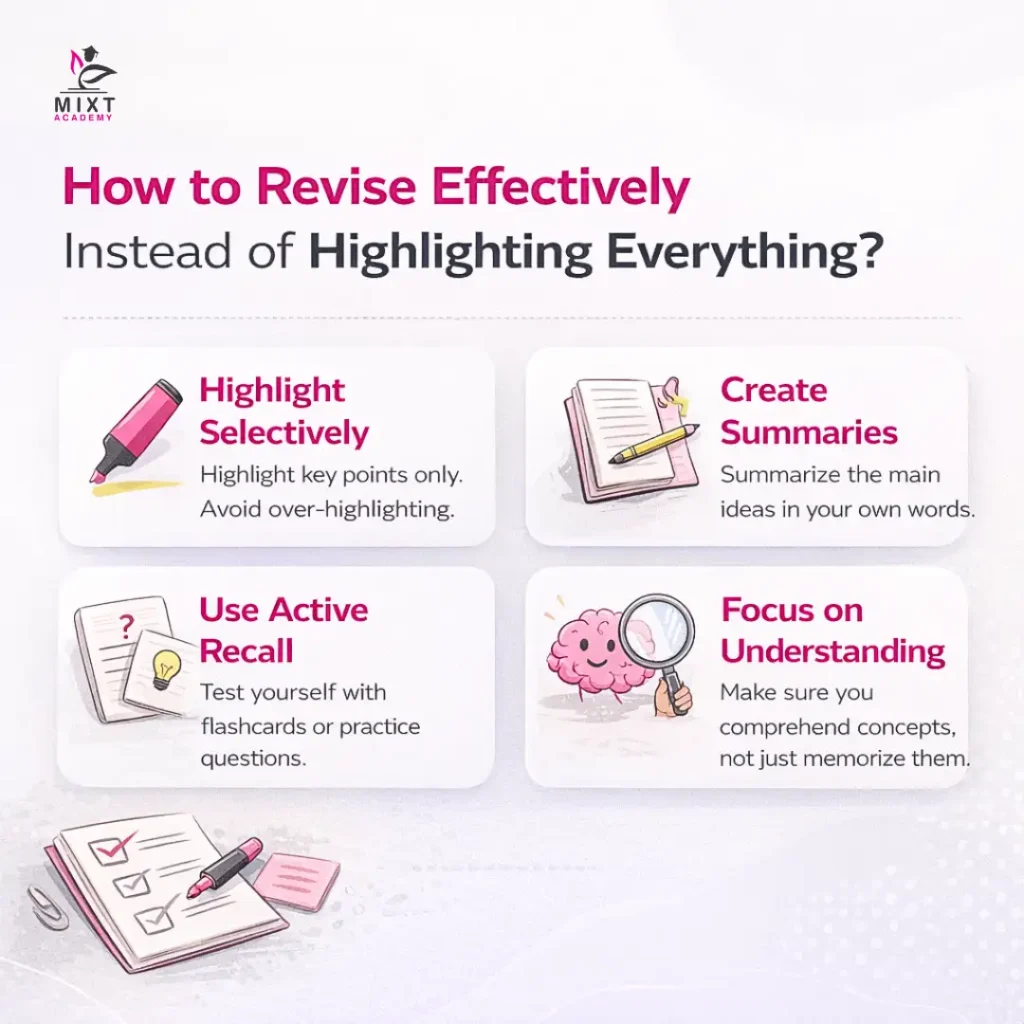
Focus on Understanding: Review highlights to apply concepts, not just recognise them.
Rote memorisation without understanding involves repeating facts or formulas without grasping their meaning or connections. For example, a student may memorise the formula for the area of a triangle but be unable to explain why it works or apply it to a real-world problem.
This method hinders deep learning, weakens problem-solving and critical thinking, and increases exam stress because memorised material is easily forgotten when applied in new contexts.
A better approach is active learning, such as explaining concepts in your own words, solving varied problems, or teaching the material to someone else. These methods strengthen understanding, improve recall, and help apply knowledge flexibly.
Studying for long hours without breaks means spending 3–6+ hours at a stretch, skipping short breaks or meals, and staying glued to notes, books, or screens. This approach overwhelms the brain, reduces concentration, and causes mental fatigue, so even long revision sessions are inefficient. Short, structured breaks are essential to restore focus, unite learning, and make study time more effective.
How to Revise Effectively with Breaks?
Plan Study Sessions: Break large topics into smaller, manageable chunks to maintain concentration.
How to Revise Effectively with Breaks?
Professional recommendations and research suggest that the ideal, highly focused study session should last between 30 and 45 minutes, followed by a short break.
Focusing only on easy topics occurs when students concentrate on material they already know while avoiding challenging or unfamiliar sections. This habit creates gaps in understanding, limits problem-solving skills, and can reduce exam performance, since harder topics often carry more weight or support other concepts.
For example, a student might spend hours revising well-known grammar rules in English but skip complex essay structures or advanced vocabulary, leaving them unprepared for tougher questions.
How to Avoid Revising Only Easy Topics?
Reward Effort: Acknowledge completing tough sections to stay motivated while tackling harder material.
Multitasking during revision may seem efficient, but it actually harms learning. Dividing attention between studying and other activities reduces focus, slows comprehension, and lowers retention.
Lowers Productivity: Overall study efficiency drops, so long hours yield less benefit.
For example, a student trying to revise math formulas while scrolling social media may forget key steps or misapply formulas on practice problems, requiring extra time to relearn what was already “studied.”
How to Avoid Multitasking While Revising?
Set Clear Goals: Know exactly what to study in each session to stay focused and track progress.
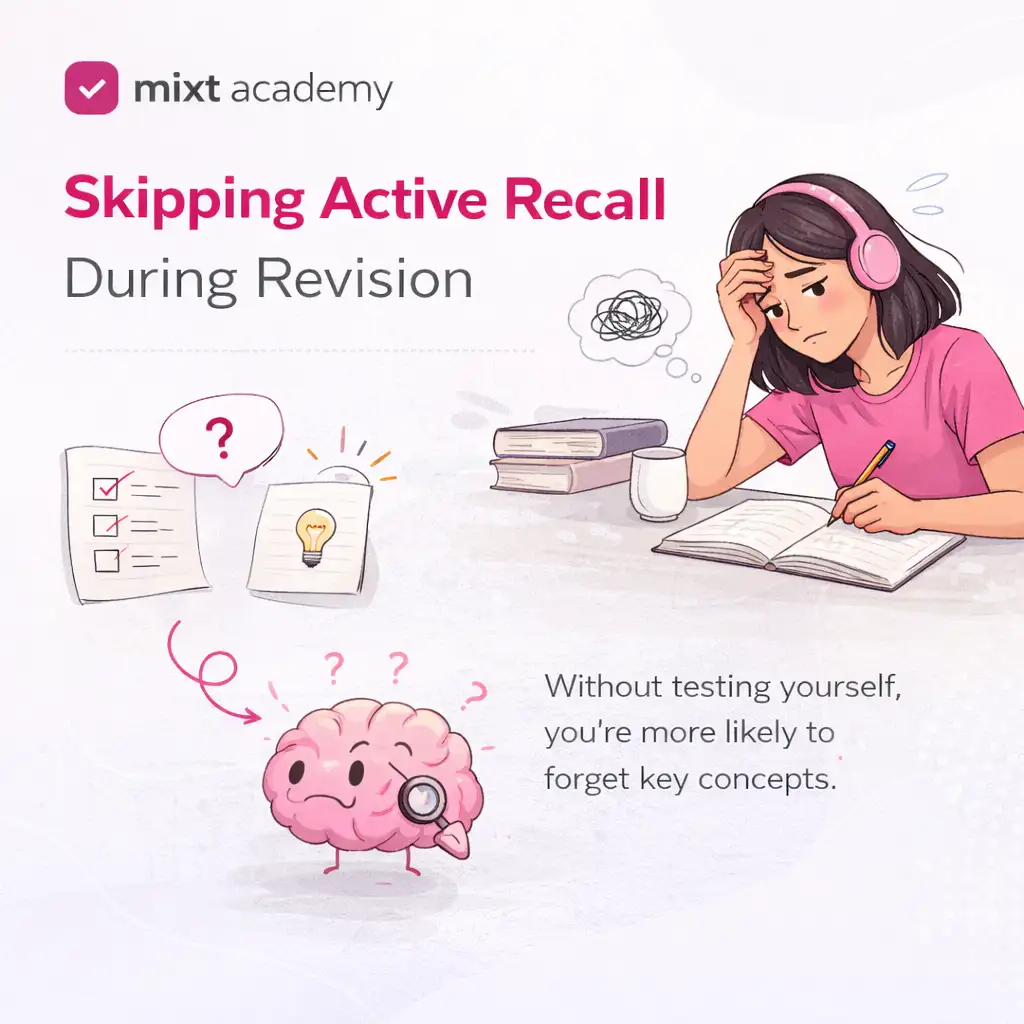
Neglecting active recall during revision happens when students go over notes or textbooks without testing themselves on the content. Passive review alone doesn’t reinforce memory, so even if students feel confident, they often struggle to recall information in exams. Practising active recall, through self-quizzing, flashcards, or practice problems, boosts long-term retention and strengthens problem-solving, making revision far more effective.
For example, a student might reread a chapter on the water cycle several times but be unable to explain the process or answer questions without looking at the text.
How to Avoid Skipping Active Recall During Revision?
Summarise from Memory: Close your books and write down what you remember, then check for gaps.
Cramming, trying to learn a large amount of material in one night, may seem efficient, but it harms learning and exam performance. It stresses the brain, reduces retention, and limits the ability to apply knowledge effectively.
Review Strategically: Focus on understanding and applying key concepts instead of last-minute memorisation.
Studying without a clear plan or schedule leads to inefficient and disorganised revision. Randomly jumping between topics wastes time, leaves gaps in understanding, and makes it difficult to monitor progress or target weak areas.
For example, a student might spend an hour reviewing well-known chapters in history, then switch to a minor topic in biology, leaving core subjects unrevised.
This approach can increase stress, reduce focus, and lower overall exam performance, while structured planning ensures all topics are covered effectively and learning is more productive.
How to Avoid Revising Without a Plan?
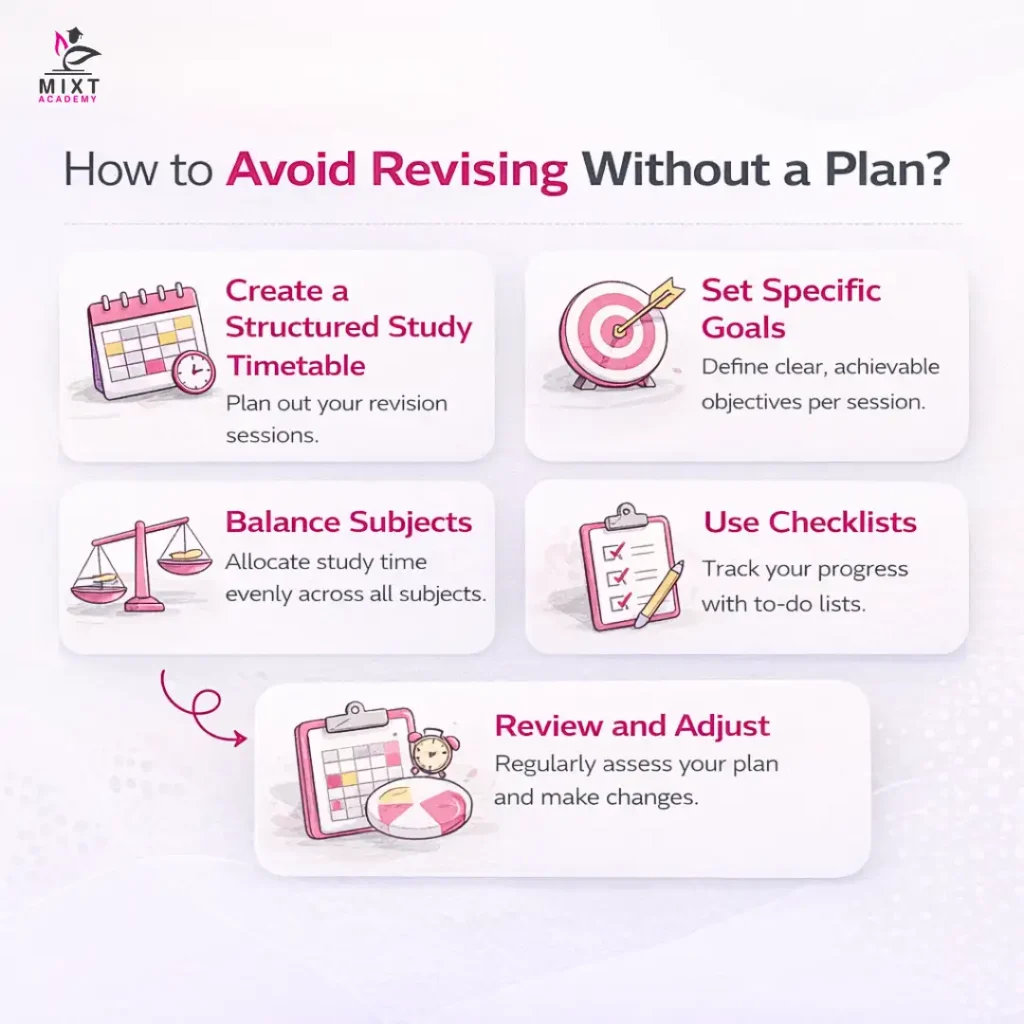
Review and Adjust: Regularly assess your plan and make changes to improve efficiency.
Ignoring weak subjects occurs when students focus only on material they understand and avoid challenging topics. This creates gaps in knowledge, reduces the ability to tackle complex questions, and increases stress despite confidence in familiar areas. Balanced revision that addresses both strong and weak points ensures complete understanding and better exam readiness.
For example, a student might revise only the chapters of chemistry they find easy, like atomic structure, while avoiding chemical bonding. On exam day, they struggle with questions that require understanding both topics together, which could have been prevented with balanced revision.
How to Avoid Weak Areas During Revision?
Track Progress and Mistakes: Monitor improvement by recording common errors and updating confidence ratings as understanding improves.
Relying solely on someone else’s summarised notes or revision guides without engaging with the original material or qualified tutors leads to multiple problem including:
How to Avoid Over-relying on Notes During Revision?
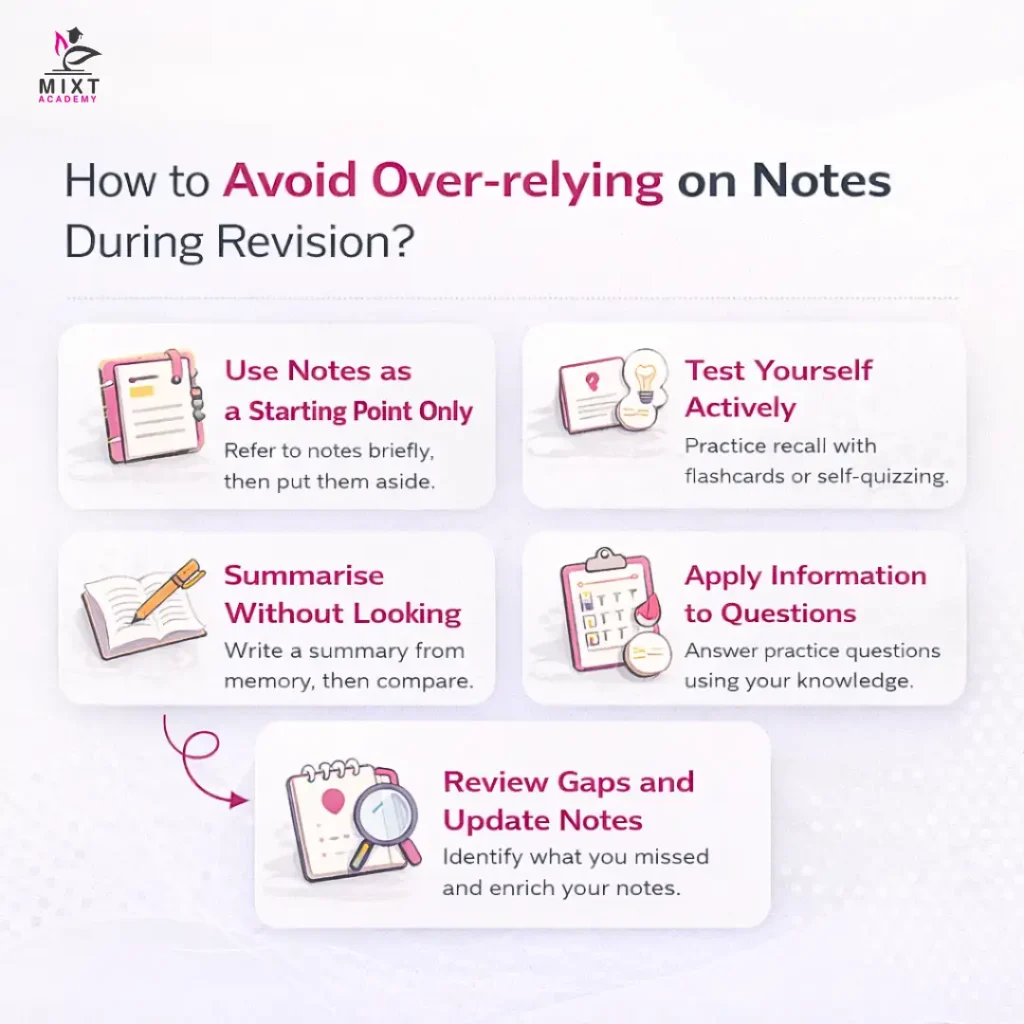
Review Gaps and Update Notes: Return to notes only to fix mistakes or clarify weak points, not as the main revision method.
Don’t Worry! Mixt Academy, a leading online tutoring platform, offers expert guidance and interactive lessons that help you fully grasp concepts, build problem-solving skills, and confidently tackle exams.
Studying in distracting environments occurs when students try to work amid noise, social media, TV, or frequent interruptions. Such surroundings split attention, disrupt thinking, and make it harder to understand and remember material. Even lengthy study sessions are inefficient, since time is lost refocusing. A quiet, organised space improves concentration and makes revision far more effective.
For example, a student revising biology in a noisy living room with TV and friends chatting may repeatedly lose focus and forget key concepts.
How to Avoid Studying in Distracting Environments During Revision?
Review and Adjust Your Environment: Notice what distracts you most and make small changes to improve focus each session.
Not practising past papers during revision is when a student reviews notes or studies content but does not attempt real exam questions or mock tests because of the following issues that may arise:
Reduces Time Management Skills: Without timed practice, students often struggle to complete exams efficiently.
How to Avoid Not Practising Past Papers in Revision?
Track Performance Over Time: Record scores and recurring mistakes to measure progress and refine revision focus.
Hiring tutors who lack proper knowledge, teaching experience, or credibility. Such tutors may provide incorrect guidance and be less confident in exams, including.
How to Avoid Using Unprofessional or Unqualified Tutors?
Tired of wasting hours on ineffective revision methods? Stop passive reading, last-minute cramming, and confusing notes. At Mixt Academy, our expert tutors guide you with proven strategies, active recall, and exam-focused practice, so every study session counts.
Learn smarter, not harder, and strengthen weak areas while building confidence. Transform your approach to learning and achieve better results with structured, professional guidance.
There are multiple common bad revision techniques that students mistakenly adopt and need to avoid, such as:
For the most effective and proven revision techniques, join Mixt Academy, a globally trusted online tutoring platform .
Revision techniques KS4 students find effective include active recall, spaced practice, and timed practice with past papers. These strategies focus on understanding, application, and retention rather than merely rereading or superficially memorising notes.
Start by identifying weak areas, planning structured sessions, and engaging with concepts actively rather than passively. Combining memory-journey revision, interactive exercises, and professional guidance, such as Mixt Academy, helps replace poor habits with effective, exam-focused learning.
Mnemonic (bringing to mind) revision techniques help students remember complex information by turning it into easy-to-remember formats such as acronyms, rhymes, phrases, or visual stories. By creating meaningful unions, they serve as mental shortcuts that improve memory for facts, formulas, and sequences during exams. Examples include BODMAS, acrostics, rhymes, visual mnemonics, and the memory palace technique.

Mixt Academy is a global online tutoring platform that connects students with expert IGCSE, GCSE, and A-Level tutors for one-to-one learning. With flexible scheduling, personalized lesson plans, and experienced teachers from top curricula, Mixt Academy helps students strengthen concepts, improve exam skills, and achieve higher grades with confidence.



Understanding Units and Dimensions of Physical Quantities A physical measurement…

Ultimate Guide to Vocabulary Building Techniques for Effective Language Learning…
IGCSE Physics Formula Sheet: Key Formulas for 0625 & Edexcel…
IGCSE Chemistry Papers: Common Mistakes & Exam Tips This IGCSE…
IGCSE Extended vs Core Tiers: How to Pick the Right…
GCSE vs A-Levels Student Friendly Guide Selecting educational credentials is…
Understanding GCSE Grade Boundaries and How to Prepare? Grade boundaries…
Differences GCSE English Language vs English Literature GCSE English is…
A Level vs AP: Complete Guide to Choosing the Right…
Top Benefits of Completing AS and A Levels Privately Explore…
Cambridge vs IB Guide to Choosing the Best Curriculum Choosing…
IB vs A Levels: Which Qualification Is Right for You?…
How to Use OCR Past Papers for Effective Revision? Past…
AQA Physics Equation Sheet: Complete GCSE Guide for Combined Science…
AQA vs Edexcel Complete GCSE Comparison and Guide Choosing between…
Complete Guide to the AQA GCSE Chemistry Specification Understanding the…
Hire an Expert Tutor from Just 15$/hr