
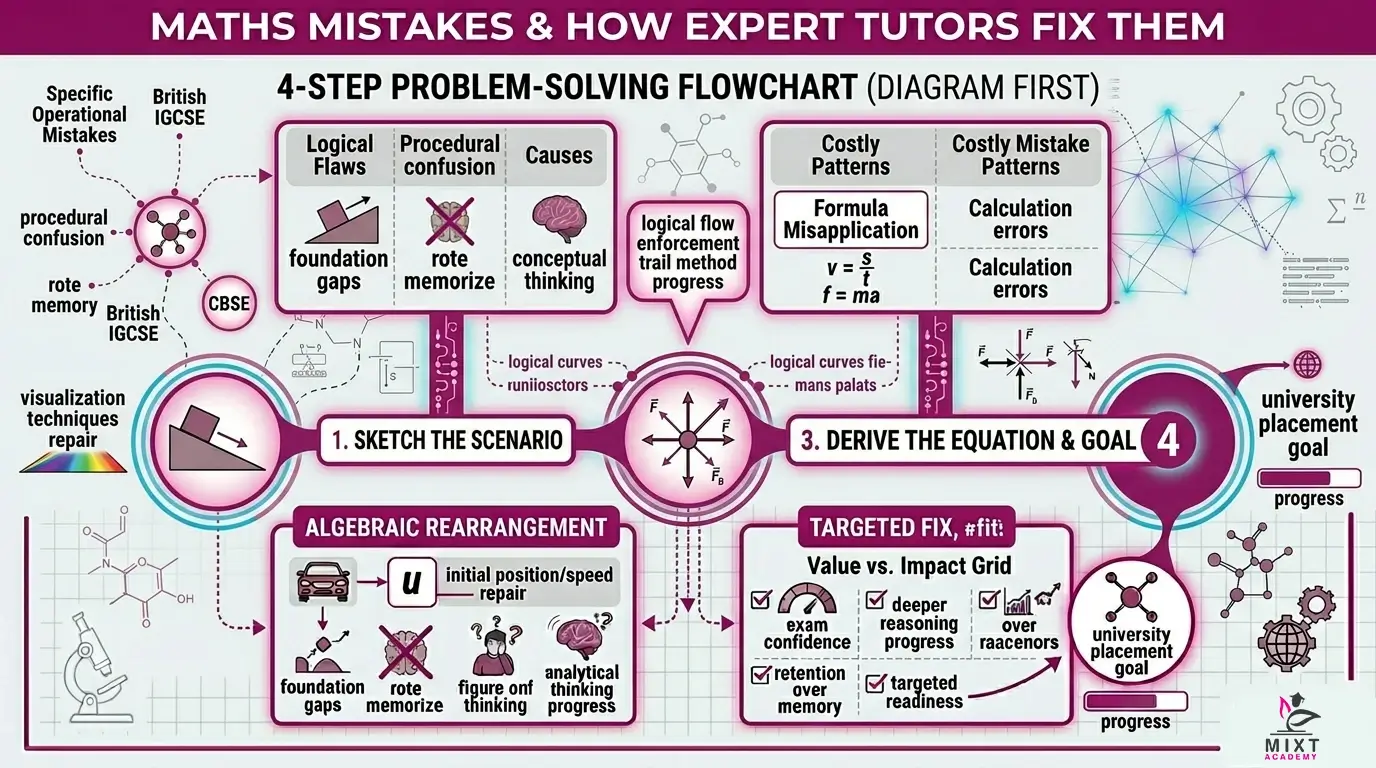
Students spend hours on memorising physics formulas such as F = ma, E = mc², V = IR, λ = h/p, and Δx · Δp ≥ ħ/2 and then forget them in the exam. It’s a more common occurrence than you would think. However, the good news is that physics is not about memorisation alone. Mastering physics formulas learning is much easier, faster and more natural when you learn what each formula means with the help of a Physics tutor in dubai.
This guide will help you walk into your next physics exam with not only a head full of equations but also with real confidence.
Why Memorising Formulas Alone Does Not Work
Formulas are shortcuts. They’re shortened retellings of a longer story. If you know the formula F = ma, but do not really understand it, you have the shortcut but not the map. Once the test question is presented somewhat differently than your practice test, you’re lost.
Physics is built on a small set of core ideas. All other thoughts are on top of those. F = ma, E = constant, W = F·d and v = fλ are not topics. They form the building blocks of the subject. Master the foundation and the formulas become obvious, not mysterious.
Key Insight: Don’t memorise what you don’t know. Knowing the reason why F = ma works, you can re-derive it from the ground up in 30 seconds for any test.
Core Strategies That Actually Work
Start With First Principles
First Principles are the fundamental truths which cannot be resolved further. In Physics study, these are concepts such as “for every force there is an acceleration”, “energy is conserved in a closed system” and “an object in motion will remain in motion unless acted upon by an opposing force.
Learn How Formulas Are Derived
Once you have these in mind, most formulas can be derived from these. For instance, if you are aware of the relationship between work and force applied over a distance, then you don’t need to memorise the equation W = Fd. It’s a thing you just know.
Use Diagrams to Think, Not Just to Illustrate
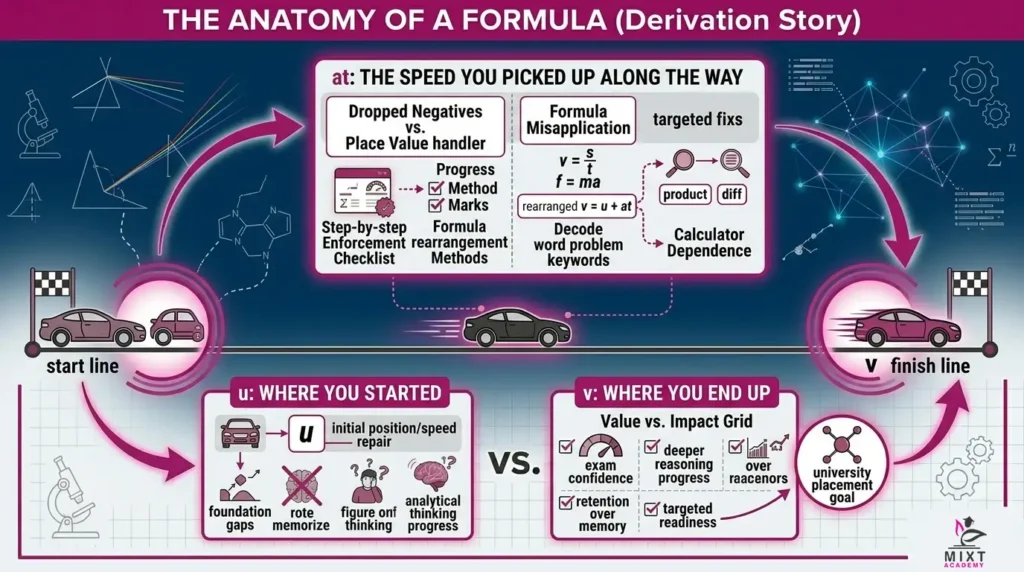
This is the most effective IGCSE physics tutoring habit. Don’t memorise a formula, it will be used 10 times. Take v = u + at. It just means that the final speed is equal to the initial speed plus the speed you acquire during the acceleration. This is not cramming. This is a story that you can remember at the drop of a hat.
If you know where the formula comes from, you will find it remarkably difficult to forget it, as you can just make up your own step-by-step formula.
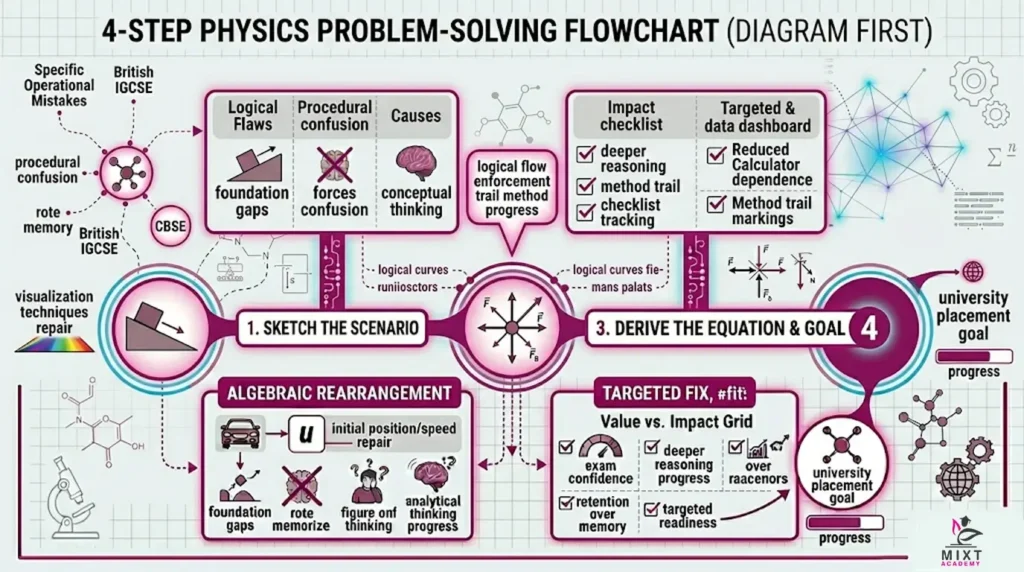
When solving a problem, sketch what is going on before beginning the solution. Draw the object, the forces acting on it and the direction of motion. Diagrams aren’t only for making your answer look better. They explicitly indicate to you which relationships are important in the problem.
If you have a free body diagram for a block on a ramp, you will almost always have a clue as to which force components are involved before you even think of what formula to use. The diagram guides you to the correct equation.
Use Analogies for Abstract Ideas
Physics concepts are often abstract, but they almost always have a real-world twin. Think of electric current as water flowing through a pipe. Voltage is the water pressure pushing it forward. Resistance is the narrowness of the pipe slowing it down. Suddenly, V = IR is not a random collection of letters. It describes something you can actually picture.
Use analogies freely in your mind. They are not cheating. They are your brain doing exactly what it is designed to do: connect new information to things you already know.
Master Dimensional Analysis
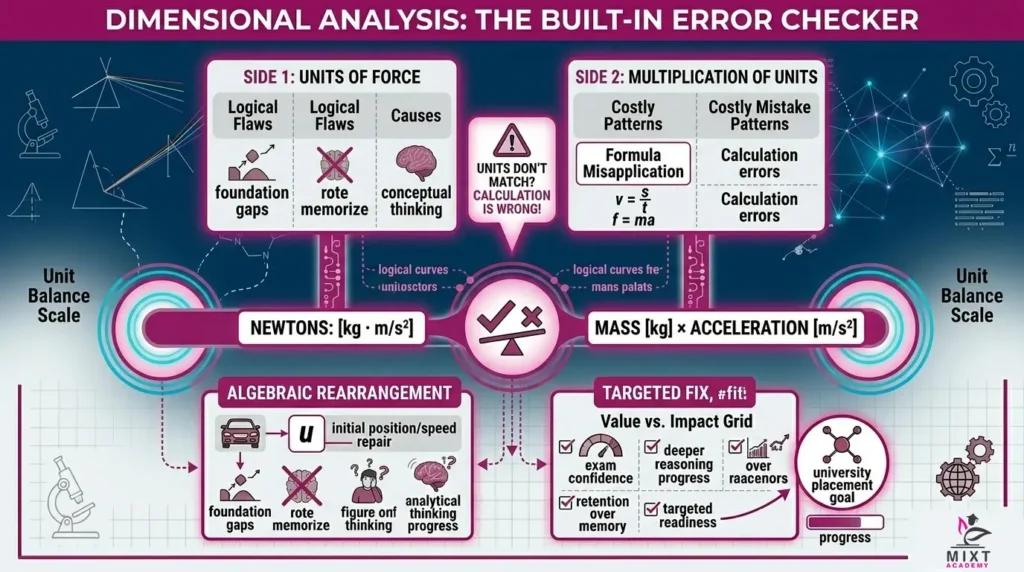
Units are your built-in error checker. A level physics tutor must balance every formula in terms of units. If you know that force is measured in Newtons, and a Newton equals kg · m/s², then you already know that force must involve mass, distance, and time. That logic alone can help you reconstruct or verify a formula during an exam.
Always check your units at the end of a calculation. If they do not match the unit your answer should be in, something went wrong.
Study Tactics That Reinforce Understanding
Solve practice problems daily. Reading your notes feels productive, but solving problems is where real learning physics formula happens. Apply every concept to a numerical question. Speed and accuracy come from repetition, not re-reading.
Study Worked Examples Carefully
Your textbook is full of solved problems. Do not just read the answer. Cover it up, try the problem yourself, then compare. Look at the thinking behind each step, not just the reading.
Reverse Engineer Past Papers
Look at old exam questions and ask, “What concept is this actually testing?” Group similar questions together. You will quickly notice that most exams test the same five or six core ideas in slightly different ways.
Form or Join a Study Group
Explaining a concept to someone else is one of the best ways to test whether you actually understand it. If you can teach it, you know it. If you stumble while explaining, you have found a gap to fix.
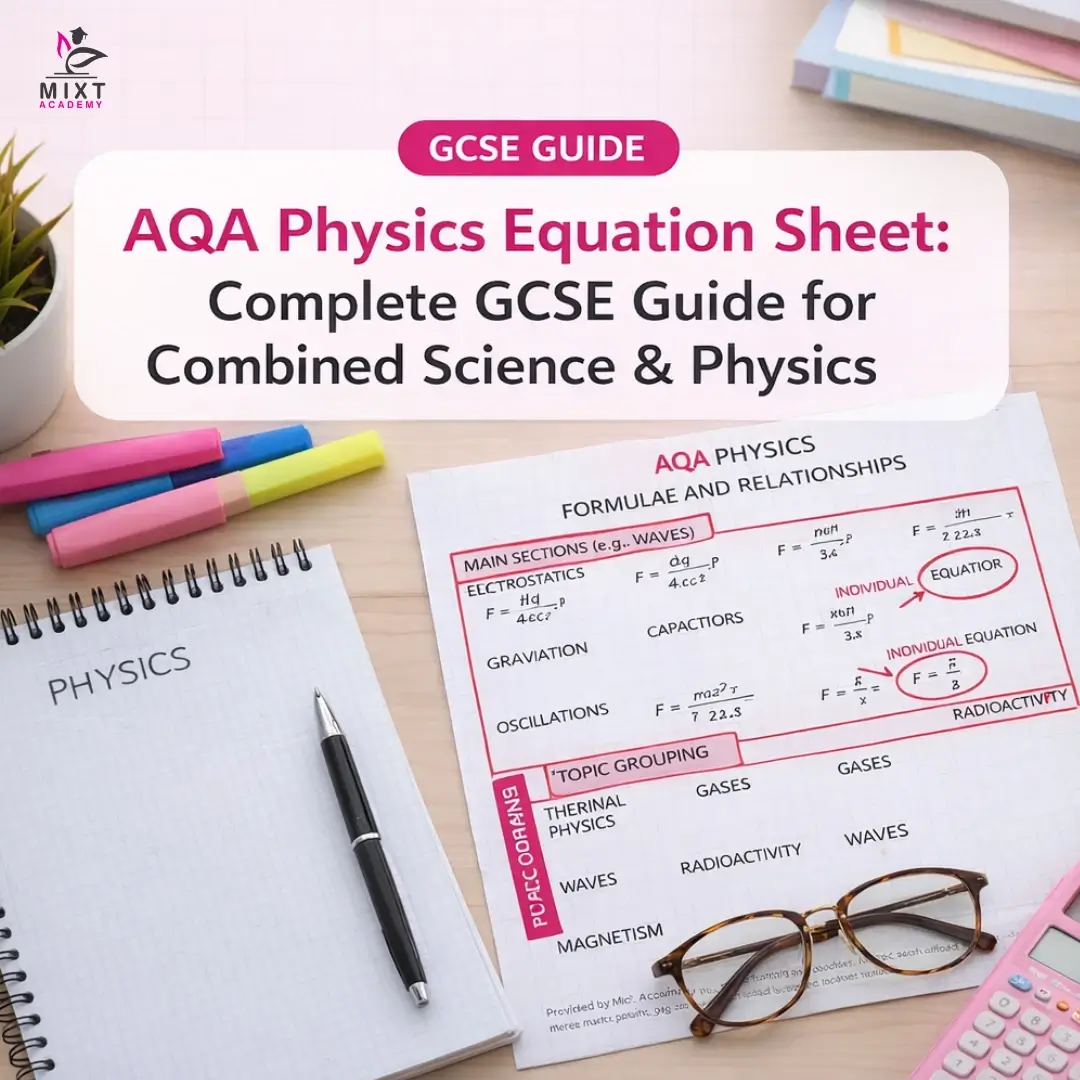
Keep a Personal Formula Sheet (for practice only)
Write down the formulas you work with, but next to each one, write a one-sentence explanation of what it means in plain words. Use this sheet for practice, not for memorising during revision.
What to Do the Week Before the Exam
This is not the time to learn new material. This is the time to reinforce what you have already built. Go through past papers under timed conditions. Focus on any topic where you had to look something up. Revisit those derivations and diagrams once more.
On the night before your exam, do not cram. Go through your one-page summary of core principles. Sleep well. A rested brain retrieves information far better than an exhausted one that spent the night re-reading a textbook.
Pass Quick Tips for Physics Exam
In the exam, if you forget a formula, write down what you know about the situation in words. Often, translating a physical situation into words will lead you directly back to the right equation.
Hire the Best Online Tutors for Your Child
Summary of This Guide
Passing a physics exam without memorising formulas is completely possible when you focus on understanding instead of rote learning. Start with foundational principles like Newton’s laws and conservation of energy. Learn how formulas are derived so you can rebuild them if needed. Use diagrams to visualise every problem before solving it. Apply analogies to make abstract ideas feel real.
Use dimensional analysis to verify your work. Practice problems every day study in dubai, and reverse engineer past papers to spot patterns. The week before your exam, review core principles and rest well. In the exam itself, think in words first, and the right equation will follow. GCSE Physics tutor expert guide for passing exam without formula memorisation.