
Choosing a school curriculum is one of the most important decisions for a student or their parents, and among the most respected international education pathways are the Cambridge and IB curricula. They are both globally recognised, academically difficult, and prepare students for further education; however, their approaches to teaching, assessment, and learning outcomes differ.
This guide examines the differences between IB and Cambridge, explains the meaning of “Cambridge vs. IB,” discusses topics such as “is IB harder than Cambridge,” explores university preparation (Cambridge vs. IB), and compares curricula to help parents and students make an informed decision.
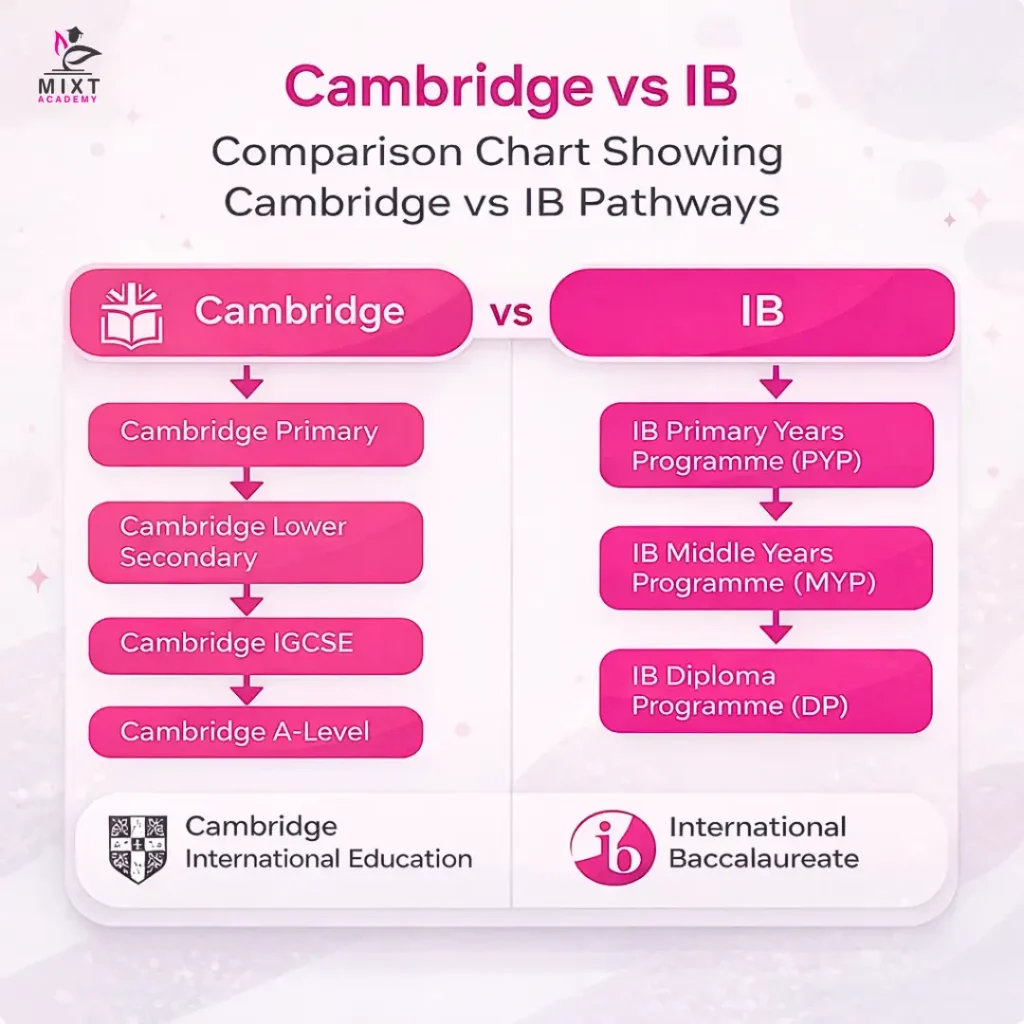
Offered by Cambridge Assessment International Education, the Cambridge Curriculum is quite popular. It has a more traditional structure and is more subject-centred than most other curriculum providers. Focusing more on the mastery and understanding of the core disciplines of English, math, and the sciences, plus a humanities and a language, the major milestones in the Cambridge Pathway are:
The Cambridge system is particularly suitable for students who value structured learning and want to focus on subjects relevant to their careers or university aspirations. It is also great for developing analytical and problem-solving skills, particularly through the assessment of their examinations.
The IB (International Baccalaureate) is a comprehensive, globally oriented curriculum that focuses on inquiry, critical thinking, and conceptual understanding. Within the IB curriculum, there are programmes for different age bands.
The IB curriculum aims to develop students’ ability to inquire and think critically while addressing complex, real-world problems. The combination of the focus on research, reflection, and community service continues to build skills beyond the scholarly areas.
A key point of differentiation, alongside varying curricula, is the contrasting learning philosophies of the two systems, which shape how students learn. In this case, the IB system is more about the process of learning, while the Cambridge system focuses on learning outcomes.
In simple terms, while IB focuses on how students are encouraged to think and develop creative and analytical skills, Cambridge focuses on mastering subject content.
The two systems also employ quite different assessments.
IB awards points out of 45, while Cambridge has grades ranging from A* to E. This demonstrates how the IB focuses on the full picture, while Cambridge has a more pinpoint focus on the subjects.
The difference between IB and Cambridge can also be seen in the breadth vs. depth conversation.
In the breadth versus depth situation, the IB allows students a more balanced development. At the same time, Cambridge focuses on depth, enabling students to achieve mastery in a specific area to support academic or career goals.
The two curricula are quite different in the way they apply their workloads.
The term Cambridge vs IB meaning refers to both equally respected, international educational systems:
Both facilitate entry to tertiary institutions and prepare students for international pathways. However, the two systems differ in how they cater to students, their individual learning needs, and future ambitions.
Discover a clear comparison and find the best fit for your child’s learning style.
| Feature | IB | CIE |
| Full form | The full form of IB is International Baccalaureate | The full form of CIE is Cambridge International Education |
| Approach to Learning | Inquiry-based, focusing on critical thinking and research skills | Exam-oriented, focusing on a strong foundation in core subjects |
| Curriculum Structure | Defined framework with core programs (PYP, MYP, DP, CP) | Greater flexibility with individual subject choices within programs |
| Core Curriculum | Focuses on the core program with Theory of Knowledge, Creativity, Activity, Service (CAS), and the Extended Essay | No core curriculum; focuses solely on subject-specific knowledge and skills |
| Assessment | Internal assessments and external exams | Primarily relies on external, standardised exams |
| Learning Style | Suitable for students who thrive on inquiry-based learning and applying knowledge across disciplines | Ideal for students who excel in standardised exams and prefer a more traditional approach |
| Long-Term Goals | Well-suited for students aiming for universities that value critical thinking and international awareness | Can be beneficial for students seeking a strong foundation in core subjects for specific career paths |
| Availability | Offered by schools worldwide | Offered by schools worldwide |
| School Culture | Choose a school that aligns with your child’s personality and learning style | Consider the school’s approach to education and its overall culture |
| Fees | Generally, higher fees compared to other international curricula | May have higher fees compared to other national and international curricula |
| Language Options | Offers programs in various languages | Offers programs in various languages |
| University Recognition | Widely recognised by universities worldwide | Widely recognised by universities worldwide |
Many parents and students want to know, is IB harder than Cambridge?
IB is seen as offering a heavier load due to the number of subjects paired with the continuous assessments. In Cambridge, students have exams, and that is it. For each system, individual traits and behaviours dictate which educational system is less difficult.
Let Mixt Academy help you identify the curriculum that works best for you.
Both curricula have worldwide acceptance, but have different areas of focus:
Both systems are understood and evaluated by universities. The decision should be based on the students’ priorities, target schools, and aspirations.
Both pathways provide great preparation, but more widely developed skills are fostered by IB as opposed to specific subjects in which Cambridge builds deep knowledge.
In discussions of global education, comparing the International Baccalaureate and the Cambridge AICE is common.
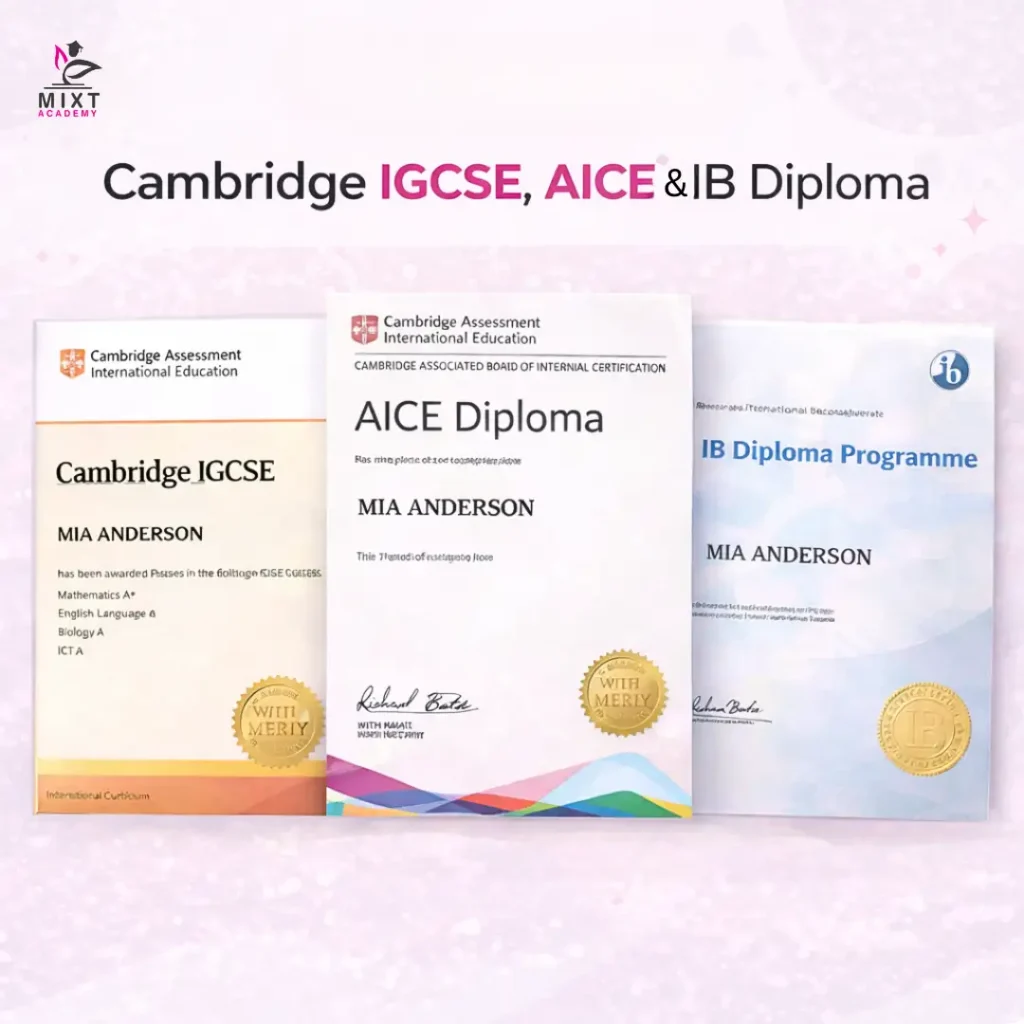
For students aged 14-16, the Cambridge IGCSE curriculum provides a solid foundation. Key components are:
The IGCSE curriculum promotes critical and analytical thinking along with the knowledge necessary to advance and study in depth.
When making the choice between Cambridge vs IB education, the following factors are recommended as primary analysis:
Get personalised guidance to make the best curriculum choice with expert support.
Comparing the two systems of the Cambridge vs IB curriculum is to compare two structured yet flexible world educational systems. The difference between IB and Cambridge systems lies in their philosophy, assessment, breadth vs depth of curriculum, and their preparation for university.
No system is better than the other. The best system is the one that matches the students’ strengths, interests, learning style and career aspirations. Both IB and Cambridge systems are suited to preparing students for further academic study and lifelong learning.
Whether it is the more structured, subject-focused approach of Cambridge with the Cambridge IGCSE curriculum, or the more open, inquiry-based learning styles of IB, it is important to select the system that best meets the students’ goals and abilities. At Mixt Academy, we help students to understand what the Cambridge vs IB systems to ensure proper guidance and academic success.
It depends on the student. Usually, the IB program requires consistent effort throughout the classes, including assessing work, class presentations, and the other core components, while Cambridge puts more pressure on students during exam periods.
The main difference between IB and Cambridge is the educational approach. IB uses more balanced, inquiry-based models while Cambridge prioritises more knowledge-based, teaching-led models. It depends on their own interest and future career goals.
There is no definite answer. The recognition of both IB and Cambridge schools stands. The difference in IB and Cambridge is that IB is more broad and more comprehensive, while Cambridge allows for more subject specialisation. Major universities appreciate both tracks. The students' strengths and goals will determine the path.
The distinction of both curricula being of high repute is that IB focuses more on critical thinking, research, and global citizenship. In contrast, Cambridge focuses more on mastery of the course and success in testing.
Comparative to other programs, yes. While the IB and Cambridge differ in structure, they both require a considerable amount of discipline, commitment, and critical thinking. They help students better prepare for the challenges they will face in university.
Students should note that IB programs require more time; combined with the program's structure, this results in a considerable loss of free time and a heavier overall workload. Cambridge A Levels tend to be better suited to students focused on specific subjects.
One-to-one online tutoring to master IB subjects, improve exam confidence, and stay ahead

Mixt Academy is a global online tutoring platform that connects students with expert IGCSE, GCSE, and A-Level tutors for one-to-one learning. With flexible scheduling, personalized lesson plans, and experienced teachers from top curricula, Mixt Academy helps students strengthen concepts, improve exam skills, and achieve higher grades with confidence.


Understanding Units and Dimensions of Physical Quantities A physical measurement…
IGCSE Physics Formula Sheet: Key Formulas for 0625 & Edexcel…
IGCSE Chemistry Papers: Common Mistakes & Exam Tips This IGCSE…
IGCSE Extended vs Core Tiers: How to Pick the Right…
GCSE vs A-Levels Student Friendly Guide Selecting educational credentials is…
Understanding GCSE Grade Boundaries and How to Prepare? Grade boundaries…
Differences GCSE English Language vs English Literature GCSE English is…
A Level vs AP: Complete Guide to Choosing the Right…
Top Benefits of Completing AS and A Levels Privately Explore…
Cambridge vs IB Guide to Choosing the Best Curriculum Choosing…
IB vs A Levels: Which Qualification Is Right for You?…
How to Use OCR Past Papers for Effective Revision? Past…
AQA Physics Equation Sheet: Complete GCSE Guide for Combined Science…
AQA vs Edexcel Complete GCSE Comparison and Guide Choosing between…
Complete Guide to the AQA GCSE Chemistry Specification Understanding the…
Hire an Expert Tutor from Just 15$/hr