
Which one should I choose? This is a common question we hear from students and parents when entering the international education sector, particularly when considering the Cambridge and Edexcel examination routes. Both international exam boards are highly regarded and widely recognised, and offer IGCSE and A Level qualifications that provide access to top universities and career prospects. In the field of international education, the two most common names are the Cambridge Assessment International Education (CAIE) and the Pearson Edexcel. However, both qualifications share British origins but differ in teaching methods, assessment approaches, grading, and subject flexibility.
From a student’s perspective, differences between the two boards can affect their academic pathways and learning experiences. Parents and educators also reflect on how each board aligns with a student’s strengths, whether it is the more traditional, exam-based Cambridge or the more modular and versatile Edexcel coursework structure. In this guide, we will discuss the key similarities and differences between the two boards, evaluate the benefits and challenges of each, and answer one of the most common questions: Which board is right for you?
Our academic advisors help students choose the right board based on their strengths and university goals.
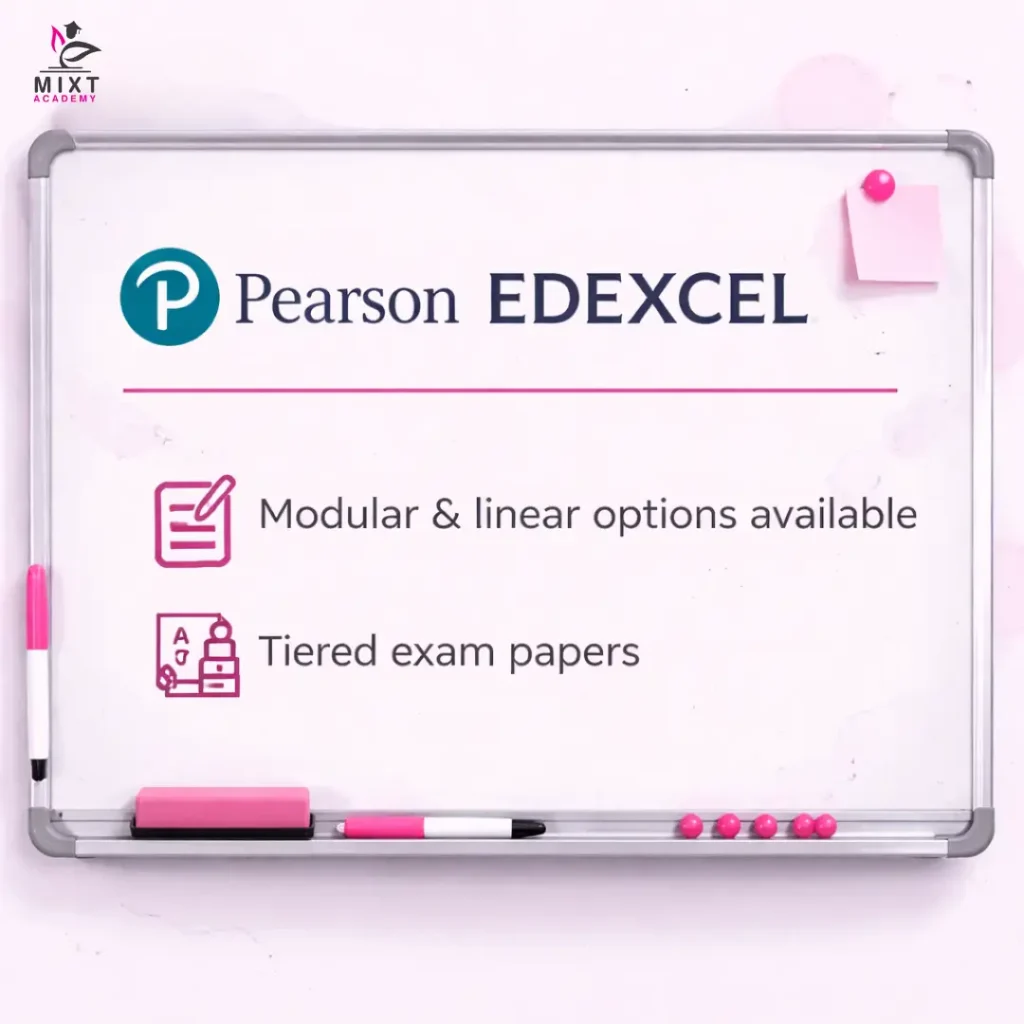
Pearson Edexcel offers international GCSE and A Level examinations with global recognition. It is a part of Pearson Education, the world’s largest education company and a UK-based examination board. Pearson Edexcel examinations are recognised in the UK and in a majority of Commonwealth countries.
These examinations combine academic difficulty with practical assessment methodologies. They also focus on real-world applications, which is why Edexcel is more focused on higher education, vocational training, and employment pathways. These examinations are modular and include written assessments, coursework, and practical assessments.
Cambridge International Examinations offers an international assessment curriculum designed for Cambridge International Schools. It is also a UK-based organisation founded in 1858. Cambridge International Examinations is also known as CIE.
Most education programs offered by Cambridge International Schools are based on CIE. It is the world’s largest education provider and operates in more than 160 countries. They are among the universally recognised assessments. They focus on higher-level critical thinking and conceptual understanding.
For many subjects, CIE utilises tiered exam systems in which students are offered Foundation and Higher-level exams. In contrast, Edexcel uses a single set of examination papers for most subjects, including math. Let’s examine this more closely.
| Particulars | Pearson Edexcel | Cambridge (CIE) |
| Exam Structure | Modular and linear options. | Primarily linear. |
| Assessment | A combo of coursework, practicals, and exams. | Mostly final exams. |
| Difficulties | It is slightly more accessible in a few subjects. | It is academically more rigorous overall. |
| Resources | Textbooks and guides by Pearson. | Wide range of third-party resources. |
| Flexibility | More modular choices are available. | Fixed syllabus, less modularity. |
| Ideal Student | Learners need a balance of assessment styles. | Academically inclined, exam-focused. |
| Student Experience | Balanced workload. | Intense and exam-centric. |
| Learning Structure | Real-world application, skills-oriented. | Deep conceptual understanding. |
| Curriculum Focus/Breadth | Slightly narrower but practical. | Broad and detailed. |
| Global recognition | Highly recognised globally. | Universally recognised and prestigious. |
Talk to a subject expert and get personalised advice.
The two examination systems, Edexcel and CIE, differ in many aspects, particularly in their exam papers. Although each examination board assesses students through exam papers, practical work, and coursework, the relative weightings of these components differ.
CIE is known to be a more difficult examination system than Edexcel. CIE, unlike Edexcel, grades practical work and assesses each student’s ability to complete higher-order, application-based assessments.
Another factor that sets CIE apart is its two-tiered exam system. Students may choose to take either the Foundation or the Higher-level exams. The higher-level papers are more difficult and include more advanced questions.
On the other hand, Edexcel uses a two-tiered exam system for mathematics only, allowing students to choose from different levels of difficulty. In every other subject, however, Edexcel provides only one exam paper option containing both challenging and easy questions.
The most significant differences between Cambridge and Edexcel lie in their exam structures.
Our expert tutors at Mixt Academy specialise in both Cambridge and Edexcel curricula and can guide you step by step.
Based on the comparison, Edexcel is the least difficult. Cambridge International Examinations is the most difficult and has the most requirements. Edexcel focuses on academically challenging subjects, including business studies and other well-known subjects.
Since Edexcel works closely with Pearson, one of the largest educational publishers, the study materials available are numerous. Cambridge also provides study materials, but there are multiple publishers to consult. This makes locating the study materials more time-consuming.
How each exam board sets out its teaching and learning philosophy also differentiates them.
Edexcel offers a modular system in which students can schedule exams at any time and retake exams. This reduces the stress students experience and improves their performance. While. Cambridge offers students much less flexibility, as they must do well on a single exam.
Edexcel is perfect for students who want different kinds of assessments and want to see how they improve over time. Cambridge exams are for students who do best when things are a bit tougher.

There is also a difference in how students’ achievements are assessed at the IGCSE level across exam boards.
Both Cambridge and Edexcel qualifications are widely recognised worldwide, but they are viewed slightly differently.
Edexcel (Pearson): Edexcel qualifications are recognised worldwide and are accepted by leading universities. Edexcel is known for the flexibility of its modular system. This is also why Edexcel is a preferred choice for schools seeking to offer more flexible learning. Edexcel International GCSEs and A levels are regarded as equivalent to Cambridge qualifications by top universities. There is a common perception among students and parents that Cambridge Edexcel International A levels and IGCSEs are of equal value.
The breadth and variety of subjects offered by each examination board can greatly influence a student’s decision if they have specific interests.
Edexcel learning structures are based on real-world practical scenarios. Learning structures in Cambridge are more theoretical, involving critical analysis. This promotes strong academic insight, research-related skills and overall critical thinking.

Both examination boards are of equal standing, but each has its own advantages and disadvantages. Below is a side-by-side comparison to help you make your decision.
Choosing between Cambridge (CAIE) and Edexcel is one of the most important milestones and starting points in a student’s academic journey. Both are world-renowned exam boards that have developed syllabi equally respected by universities, designed to develop essential knowledge and skills. Often, the deciding factors come down to a student’s learning style, academic ambitions, and personal strengths.
In the Cambridge examinations, students are typically awarded points for writing thoughtful, reasoned, analytical and explanatory essays. These challenges are well-suited to those who are driven by the spirit of inquiry, independent research, and study, and who wish to polish their problem-solving skills.
In comparison, Edexcel offers students a more defined and straightforward approach to assessment, with practical, application-based tasks. These tend to be more accessible to students who prefer a more guided, step-by-step approach to learning and provide hands-on, practical knowledge. Ultimately, the determination to learn is most closely associated with a student’s exam success.
Join a trusted platform that prepares students for both boards.
Both Edexcel and Cambridge are primary examination boards in the UK. Post-secondary institutions and employers worldwide recognise them for the quality of their diplomas, certifications, and skills qualifications, including GCSEs, A-levels, and vocational qualifications.
The main difference between Edexcel and Cambridge lies in the ownership. Cambridge Assessment, comprising the Cambridge University Testing Service, is a constituent of the University of Cambridge. Edexcel boards operate under Pearson, the American publishing corporation that primarily specialises in educational and instructional materials, standardised tests, and tutoring services. Aside from the structure of content and assessment methods, the qualifications offered by Cambridge and Edexcel are largely the same.
No, Edexcel and Cambridge are different examination boards, so their syllabuses are not the same. While both offer internationally recognised qualifications in subjects such as Mathematics, Science, and English, each board has its own curriculum, assessment style, and exam format.
Yes, Cambridge University considers Edexcel International AS and A Levels competitive qualifications for entry to the university. Edexcel IGCSEs and A-levels are also accepted in meeting the University’s entry requirements.
There is no clear answer to this question as it depends on students’ preferences and needs. Regardless of which one they choose, both will receive a standard of qualifications that will be recognised around the world for the quality of the services they provide. Resources will be available for a wide range of both Edexcel and Cambridge qualifications, enabling selection that best aligns with individuals’ personal profiles.
It is possible to switch from one board to another, but it can be challenging because the content and assessment methods may differ. It is important to discuss any potential changes with your teachers or academic advisors to ensure that you are making a well-informed decision.
Universities do not generally have a preference for Edexcel or Cambridge qualifications. They recognise both qualifications as equivalent in terms of academic difficulty and course content.

Mixt Academy is a global online tutoring platform that connects students with expert IGCSE, GCSE, and A-Level tutors for one-to-one learning. With flexible scheduling, personalized lesson plans, and experienced teachers from top curricula, Mixt Academy helps students strengthen concepts, improve exam skills, and achieve higher grades with confidence.


IGCSE Physics Formula Sheet: Key Formulas for 0625 & Edexcel…
IGCSE Chemistry Papers: Common Mistakes & Exam Tips This IGCSE…
IGCSE Extended vs Core Tiers: How to Pick the Right…
Understanding GCSE Grade Boundaries and How to Prepare? Grade boundaries…
Differences GCSE English Language vs English Literature GCSE English is…
What is GCSE? A Guide for International Students & Parents…
A Level vs AP: Complete Guide to Choosing the Right…
Top Benefits of Completing AS and A Levels Privately Explore…
Cambridge vs IB Guide to Choosing the Best Curriculum Choosing…
IB vs A Levels: Which Qualification Is Right for You?…
How to Use OCR Past Papers for Effective Revision? Past…
AQA Physics Equation Sheet: Complete GCSE Guide for Combined Science…
AQA vs Edexcel Complete GCSE Comparison and Guide Choosing between…
Complete Guide to the AQA GCSE Chemistry Specification Understanding the…
Hire an Expert Tutor from Just 15$/hr